
The Rise of the 'Library of Things': How Community Sharing is Replacing the Need to Buy
A rapidly growing network of community lending hubs and hyperlocal gifting groups is transforming how neighborhoods access tools, appliances, and everyday goods.
By Factlen Editorial Team
- Circular Economy Advocates
- Focus on reducing waste, lowering emissions, and transitioning away from disposable consumption.
- Community Organizers
- Emphasize mutual aid, financial relief for households, and the rebuilding of local social connections.
- Retail & Manufacturing Industry
- Navigating shifting consumer habits, declining seasonal sales, and new demands for product repairability.
What's not represented
- · Low-income households lacking access to formal library networks
- · Local hardware store owners facing reduced sales
Why this matters
By shifting from individual ownership to community borrowing, households are saving thousands of dollars, reducing high-interest debt, and cutting down on the massive environmental waste generated by rarely used products.
Key points
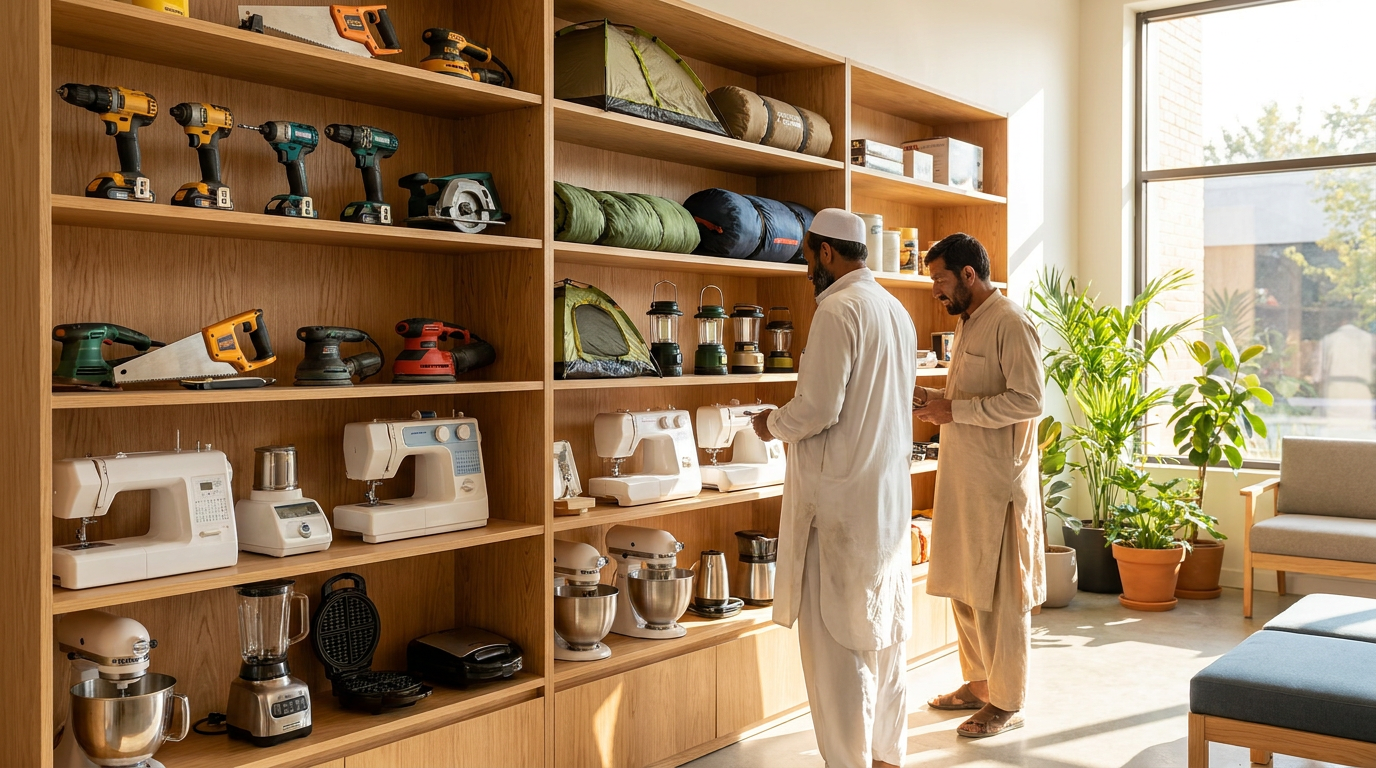
- The 'Library of Things' model allows residents to borrow tools, appliances, and gear instead of buying them.
- Over 2,000 formal sharing libraries currently operate worldwide, alongside massive informal networks like the Buy Nothing Project.
- The movement provides significant financial relief, with single library branches saving communities tens of thousands of dollars annually.
- By keeping manufactured goods in circulation longer, sharing networks drastically reduce carbon emissions and landfill waste.
- The rise of community borrowing is accompanied by a surge in 'Repair Cafes' and right-to-repair advocacy.
- Retailers are beginning to feel the impact, as movements like 'Buy Nothing December' contribute to a decline in seasonal impulse buying.
The modern household is packed with dormant potential. In garages, closets, and under beds, expensive equipment sits unused for months or years at a time. The classic example is the power drill: the average household drill is used for roughly 15 minutes over its entire lifespan.[2]
For decades, the dominant economic model has relied on this inefficiency. The linear economy—extract, make, use, and throw away—assumes that every household needs its own drill, its own carpet cleaner, and its own camping tent. But a rapidly expanding community movement is challenging that assumption by asking a simple question: what if we shared?[2][9]
Enter the "Library of Things" (LoT). Operating on the same fundamental mechanics as a traditional public library, these community hubs allow residents to borrow physical items instead of buying them.[1][2]
The concept is straightforward but transformative. A user browses an online catalog, reserves an item, and picks it up from a local branch or self-service locker. After a week of use, the item is returned, ready for the next neighbor.[1][3]

While the idea of communal resource sharing is as old as human civilization, the formalized Library of Things is experiencing unprecedented global growth. As of early 2026, there are roughly 2,000 formal LoTs operating worldwide, alongside countless informal lending networks.[1]
The movement is driven by a convergence of economic pressure and environmental awareness. With inflation stretching household budgets, the upfront cost of buying specialized tools or event supplies has become prohibitive for many.[1][9]
By turning underused goods into community assets, these libraries provide immediate financial relief. In the UK, a single two-year pilot program at the Charlton Kings library reported that its 482 borrowed items saved local residents over £53,000 compared to buying the same items new.[7]
Beyond the direct financial savings, the environmental impact is profound. The European Union estimates that half of all greenhouse gas emissions and over 90% of biodiversity loss stem from resource extraction and processing.[2]
Sharing infrastructure directly mitigates this by keeping manufactured goods in circulation longer. The same Charlton Kings pilot avoided an estimated 16.74 tonnes of carbon dioxide equivalent simply by reducing the demand for newly manufactured products.[7]

Sharing infrastructure directly mitigates this by keeping manufactured goods in circulation longer.
This shift toward a circular economy extends beyond formalized libraries. The "Buy Nothing Project," a hyperlocal gifting network founded in 2013, has exploded into a global phenomenon.[4][5]
By 2026, the Buy Nothing Project reported a staggering 14 million members across more than 50 countries. Through local social media groups and a dedicated app, neighbors give away roughly 2.6 million items every single month, completely free of charge.[5]
The cultural impact of this sharing economy is beginning to ripple into traditional retail. During the 2025 holiday season, a movement dubbed "Buy Nothing December" saw record participation, contributing to a noticeable decline in seasonal impulse buying.[4]
Retail analysts noted a sharp pullback in spending, particularly among Generation Z shoppers, who increasingly view traditional holiday consumption as financially draining and environmentally unsustainable.[4]
But organizers stress that the movement is about more than just saving money or reducing waste; it is fundamentally about rebuilding social fabric. In an era of increasing digital isolation, borrowing a tool or picking up a gifted item forces a physical, local connection.[5][9]

Researchers studying these networks have found that even brief interactions—a wave from a porch, a quick chat about how to use a sewing machine—foster a measurable sense of neighborhood belonging.[5]
To sustain this ecosystem, communities are also reviving lost maintenance skills. The rise of the Library of Things has coincided with a surge in "Repair Cafes," where volunteers with technical know-how help neighbors fix broken electronics, mend clothes, and sharpen tools.[6]
These repair initiatives are closely linked to the broader "right to repair" legislative movement, which seeks to force manufacturers to make their products easier to fix rather than designing them for planned obsolescence.[6]

Recognizing the profound impact of these systems, traditional institutions are taking note. In March 2026, the International Federation of Library Associations (IFLA) highlighted the Library of Things as a critical component for building resilient, sustainable communities.[8]
As the movement matures, the vision is expanding. Advocates envision a future where shared resource infrastructure is as ubiquitous and well-funded as public parks or traditional book libraries.[1][9]
For now, the success of the Library of Things proves that communities already possess immense wealth. It just happens to be sitting in each other's garages, waiting to be shared.[9]
How we got here
1943
The first known tool library opens in Grosse Pointe Farms, Michigan, to offer training to young people.
1979
The longest-running modern tool library opens as part of the Berkeley Public Library system in California.
2013
The Buy Nothing Project is founded in Washington state, launching a global hyperlocal gifting movement.
2014
Library of Things UK is founded in South London, eventually expanding to dozens of self-service locker locations.
March 2026
The International Federation of Library Associations highlights the Library of Things as a critical component for sustainable community resilience.
Viewpoints in depth
Circular Economy Advocates
Focus on reducing waste, lowering emissions, and transitioning away from disposable consumption.
This perspective argues that the current linear model of consumption is environmentally catastrophic. Advocates cite the massive carbon footprint of manufacturing rarely used goods, pointing out that half of all greenhouse gas emissions stem from resource extraction. They view sharing libraries not just as a convenience, but as a primary tool to reduce waste, keep materials in use longer, and fundamentally alter how society interacts with physical goods.
Community Organizers
Emphasize mutual aid, financial relief for households, and the rebuilding of local social connections.
For organizers on the ground, the environmental benefits are often secondary to the immediate social and economic impacts. They emphasize that sharing infrastructure reduces household financial strain by eliminating the need to finance expensive, infrequent purchases. Furthermore, they argue that the physical act of borrowing and returning items fosters genuine neighborhood connections, combating the digital isolation that plagues modern communities.
Retail & Manufacturing Industry
Navigating shifting consumer habits, declining seasonal sales, and new demands for product repairability.
Facing a measurable shift in consumer behavior, this camp is navigating the decline of impulse buying and the rise of the 'right to repair' movement. While some traditional manufacturers resist changes that threaten sales volume or proprietary repair monopolies, others are adapting. Forward-thinking brands are beginning to design more durable, repairable products or are actively partnering with sharing networks to serve as the preferred equipment provider for community hubs.
What we don't know
- Whether large-scale manufacturers will actively oppose the growth of community sharing networks to protect sales volumes.
- How the Library of Things model will scale in rural areas with lower population densities and fewer public resources.
- The long-term impact of the 'right to repair' movement on the availability of spare parts for community libraries.
Key terms
- Library of Things (LoT)
- A community-based lending system that allows people to borrow physical items—like tools or camping gear—instead of buying them.
- Circular Economy
- An economic model focused on minimizing waste and maximizing resource use through sharing, repairing, and reusing products.
- Mutual Aid
- A voluntary exchange of resources and services within a community, built on the idea that everyone has something to contribute.
- Right to Repair
- A movement advocating for legislation that allows consumers to fix their own electronics and appliances rather than relying solely on manufacturers.
Frequently asked
How much does it cost to use a Library of Things?
Many are completely free and integrated into public library systems. Independent sharing hubs typically charge a small annual membership fee or a few dollars per rental.
What are the most commonly borrowed items?
Power drills, carpet cleaners, sewing machines, gardening equipment, and camping gear are among the most popular items, as they are often expensive and rarely used.
How do these libraries maintain broken items?
Many Libraries of Things partner with local 'Repair Cafes' or host skill-sharing workshops where volunteers fix broken goods and teach community members how to maintain equipment.
Sources
Source coverage
9 outlets
3 viewpoints surfaced







[1]ShareableCommunity Organizers
Library of Things Toolkit (2.0)
Read on Shareable →[2]Active SustainabilityCircular Economy Advocates
What is the Library of Things and how does it work?
Read on Active Sustainability →[3]Cooperative CityCommunity Organizers
Inside the Library of Things UK: The UK's Fast-Growing Sharing Network
Read on Cooperative City →[4]KNKX Public RadioRetail & Manufacturing Industry
Millions skip holiday shopping as Buy Nothing December grows
Read on KNKX Public Radio →[5]Los Angeles TimesCommunity Organizers
What are Angelenos giving away in one Buy Nothing group? All this treasured stuff
Read on Los Angeles Times →[6]Tribune ChronicleRetail & Manufacturing Industry
Broken speaker? Repair Cafes urge you to fix it instead of pitch it
Read on Tribune Chronicle →[7]Charlton Kings Parish CouncilCircular Economy Advocates
Library of Things Impact Report 2025
Read on Charlton Kings Parish Council →[8]IFLACircular Economy Advocates
Library of Things – A Critical Component of Libraries as Access Points to a Local, Resilient, and Sustainable Future
Read on IFLA →[9]Factlen Editorial TeamCommunity Organizers
Synthesis by Factlen editorial team
Read on Factlen Editorial Team →
Every angle. Every day.
Get community stories with full source coverage and perspective breakdowns delivered to your inbox.