
Which Came First, the Galaxy or the Black Hole? JWST Finally Has an Answer
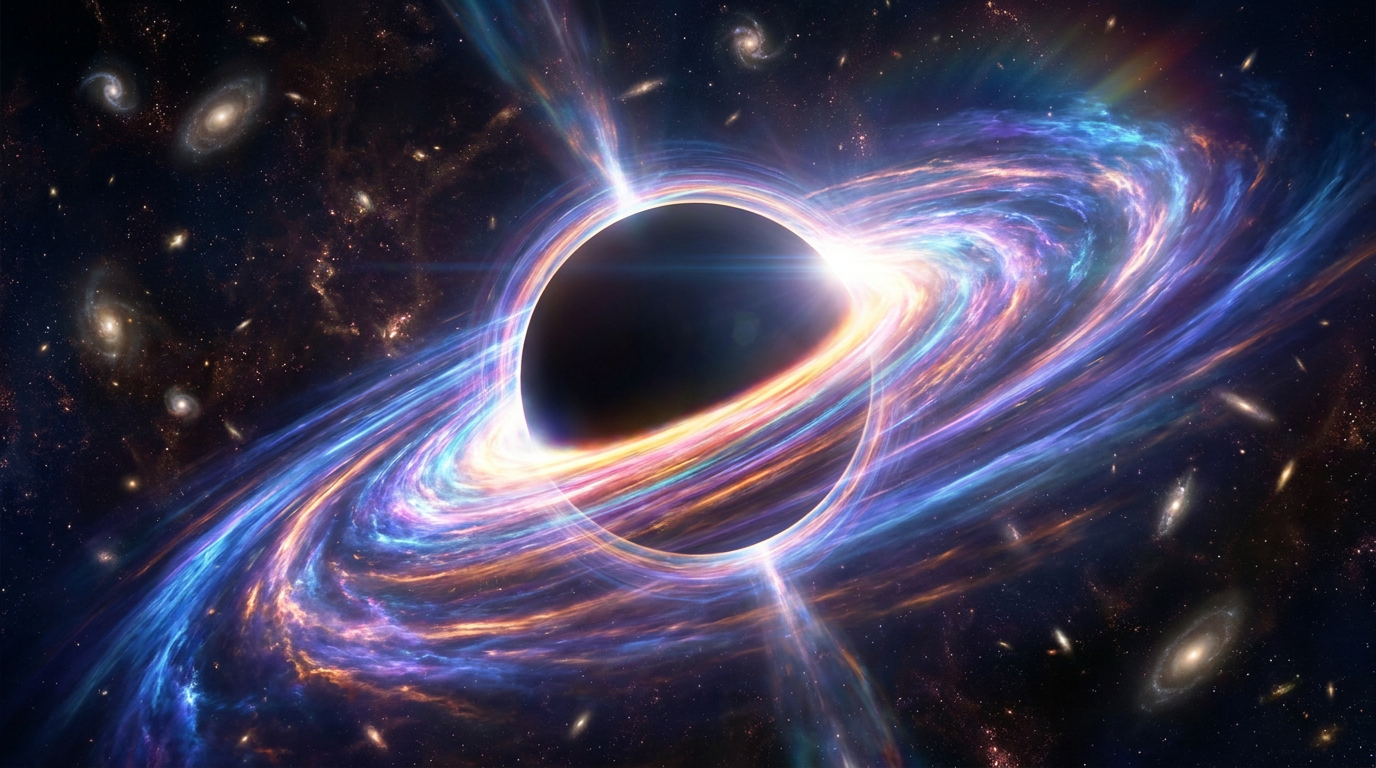
For decades, astronomers debated whether supermassive black holes or their host galaxies formed first. New data from the James Webb Space Telescope reveals they likely co-evolved, with giant black holes acting as the cosmic seeds that built the first galaxies.
By Factlen Editorial Team
- Co-Evolution Theorists
- Focus on black holes and galaxies growing together as deeply intertwined systems.
- Direct Collapse Proponents
- Focus on the mechanism of pristine gas clouds collapsing directly into massive black hole seeds.
- Observational Astronomers
- Focus on the raw JWST data and the challenge of measuring distant quasars and dormant black holes.
What's not represented
- · Theoretical physicists studying alternative dark matter models that might influence early black hole formation.
- · Cosmologists focused on the role of dark energy in the expansion rate during these early epochs.
Why this matters
Understanding how the first galaxies formed rewrites our fundamental knowledge of the universe's origins. It proves that black holes aren't just cosmic destroyers, but the vital engines that helped build the starry galaxies we live in today.
Key points
- For decades, astronomers debated whether galaxies or their central black holes formed first.
- Traditional models assumed stars formed first, died, and slowly merged into black holes over billions of years.
- JWST observations reveal supermassive black holes existed just a few hundred million years after the Big Bang.
- Evidence suggests massive clouds of gas collapsed directly into giant black hole 'seeds' without forming stars first.
- These early black holes acted as cosmic engines, their powerful jets triggering the star formation that built the first galaxies.
The universe is filled with galaxies, and at the heart of nearly every single one—including our own Milky Way—lies a supermassive black hole. For decades, astrophysicists have wrestled with a cosmic chicken-or-the-egg problem: which came first? Did a sprawling galaxy of stars slowly give birth to a central black hole, or did a colossal black hole act as the gravitational anchor that pulled a galaxy together?[1][8]
Until recently, the timeline of the early universe was shrouded in a dense fog of hydrogen gas, making it impossible to see the first cosmic structures taking shape. Astronomers had to rely on theoretical models and observations of mature, local galaxies to guess how the process began.[8]
The traditional assumption favored the "stars first" model. In this scenario, the pristine gas left over from the Big Bang coalesced into the very first generation of massive stars. When these short-lived stellar giants exhausted their nuclear fuel, they collapsed into stellar-mass black holes. Over billions of years, these small black holes merged and gorged on surrounding gas, eventually growing into the supermassive behemoths we see today.[3][6]
But there was a glaring mathematical problem with this slow-and-steady theory. As telescopes began spotting extremely bright, active black holes—known as quasars—further back in time, the timeline simply did not add up.[4]

If a black hole started from a single dead star and grew at the maximum physical limit, it would take billions of years to reach supermassive status. Yet, astronomers were finding black holes billions of times the mass of our sun existing just a few hundred million years after the Big Bang.[5]
Enter the James Webb Space Telescope (JWST). Launched to peer through the cosmic dark ages using its powerful infrared sensors, JWST has spent the last few years systematically dismantling the old models of galaxy formation.[8]
By utilizing a technique called gravitational lensing—where the gravity of a massive foreground galaxy cluster magnifies the light of a distant background object—astronomers have been able to spot "Little Red Dots" in the early universe. These compact, highly reddened objects are the infant stages of quasars.[6]
In one landmark observation behind the galaxy cluster Abell 2744, JWST detected a black hole with a mass of 50 million suns. Crucially, the light from this object originated just 700 million years after the Big Bang.[6]

What stunned researchers was not just the black hole's size, but its surroundings. The central mass was surrounded by a relatively small amount of gas and virtually no mature stellar population. The black hole was already massive, but the galaxy around it was barely formed.[6]
What stunned researchers was not just the black hole's size, but its surroundings.
Similar discoveries have piled up. The European Space Agency reported an actively growing supermassive black hole in a galaxy just 570 million years after the Big Bang, defying the usual relation between galaxy size and black hole mass.[5]
In the local universe, a supermassive black hole typically accounts for about 0.1 percent of its host galaxy's total stellar mass. But in these early JWST observations, the black holes are vastly disproportionate. In some cases, the black hole is 10 to 100 times more massive than expected, and in one extreme case, the black hole's mass appeared roughly equal to the entire stellar mass of its baby galaxy.[3][4]
These skewed ratios provide the strongest evidence yet that black holes did not wait for galaxies to form. Instead, they likely formed first, or at the very least, got a massive head start.[1][3]

To explain how a black hole could get so big so fast without waiting for stars to die, astrophysicists have turned to the "direct collapse" model.[6]
In the chaotic environment of the early universe, converging streams of cold, pristine gas could collide and accumulate into incredibly dense clouds. Rather than fragmenting into thousands of individual stars, these massive clouds—weighing tens of thousands of solar masses—could collapse directly under their own gravity.[6][8]
This direct collapse would instantly create a "seed" black hole of around 40,000 solar masses. Starting with a seed that large, a black hole could easily gorge itself on the abundant surrounding gas and reach supermassive status within a few hundred million years, perfectly matching the JWST observations.[6]
But the story does not end with black holes simply winning the race. The latest synthesis of JWST data suggests a profound co-evolution between the two cosmic structures.[1][8]
As these early, massive black holes fed on gas, they generated immense friction and heat, unleashing powerful winds and jets of radiation. Rather than just destroying their surroundings, these violent outflows acted as gigantic cosmic amplifiers.[3]

The jets compressed the surrounding gas, triggering massive waves of star formation. The black hole was not just sitting in the center of a galaxy; it was actively forging the galaxy around it.[3][8]
Even dormant black holes from the early universe are now being weighed to confirm this relationship. Astronomers recently measured a sleeping giant weighing 6 billion solar masses in a galaxy seen 3 billion years after the Big Bang, proving that these behemoths were ubiquitous and played a critical role in cutting off or stimulating star formation.[2][7]
The cosmic chicken-or-the-egg problem has finally found its resolution. It is not strictly one or the other. The black hole "seeds" likely formed first through direct collapse, but from that moment on, the black hole and the galaxy grew together, locked in a violent, symbiotic dance that shaped the universe we see today.[1][3][8]
How we got here
13.8 Billion Years Ago
The Big Bang occurs, filling the universe with a hot, dense soup of pristine hydrogen and helium.
100–150 Million Years Later
Massive clouds of cold gas converge and directly collapse into the first heavy black hole seeds.
400–700 Million Years Later
JWST observes these early black holes already grown to millions of solar masses, actively shaping their young host galaxies.
3 Billion Years Later
Some of these early giants become dormant, their masses locked in at billions of times the size of our sun.
2021–2026
The James Webb Space Telescope launches and captures the infrared data needed to finally resolve the timeline.
Viewpoints in depth
Co-Evolution Theorists
Argue that black holes and galaxies grew together as deeply intertwined systems.
This camp focuses on the symbiotic relationship between a growing black hole and its host galaxy. They point to evidence that as early black holes consumed gas, they emitted powerful jets and winds. Rather than simply blowing gas away and halting growth, these outflows compressed surrounding material, triggering massive waves of star formation. In this view, the black hole is the engine that actively builds the galaxy around it.
Direct Collapse Proponents
Focus on the physics of how pristine gas clouds bypassed star formation to create massive black hole seeds.
For these astrophysicists, the key to the timeline lies in the very first moments of structure formation. They argue that the traditional model of stars dying to form black holes is mathematically too slow. Instead, they study how converging streams of cold, pristine hydrogen in the early universe could become so dense that they collapsed directly into 40,000-solar-mass black holes, providing the necessary head start to explain JWST's observations.
Observational Astronomers
Emphasize the raw data and the technological leaps required to measure distant cosmic structures.
This perspective is grounded strictly in what can be measured. Observational teams highlight the incredible difficulty of separating the blinding light of an early quasar from the faint starlight of its host galaxy. They rely on techniques like gravitational lensing and deep-field infrared spectroscopy to 'weigh' these distant objects, noting that while the direct collapse theory fits the data, further observations of dormant black holes are needed to map the exact mass ratios across cosmic history.
What we don't know
- Exactly what conditions allowed pristine gas clouds to collapse directly into black holes without fragmenting into stars.
- Whether there is a maximum size limit for these early 'direct collapse' black hole seeds.
- How the transition from gas-dominated early galaxies to the structured spiral galaxies we see today fully played out.
Key terms
- Supermassive Black Hole
- A black hole containing millions to billions of times the mass of our sun, typically found at the center of a galaxy.
- Gravitational Lensing
- A phenomenon where the gravity of a massive foreground object bends and magnifies the light from a more distant object behind it.
- Direct Collapse
- A theoretical model where a massive cloud of gas collapses under its own gravity straight into a black hole, bypassing the star-formation phase.
- Quasar
- An extremely luminous active galactic nucleus, powered by a supermassive black hole aggressively feeding on surrounding gas.
- Redshift
- The stretching of light to longer, redder wavelengths as it travels across the expanding universe, used to measure cosmic distances and age.
Frequently asked
Did the black hole or the galaxy come first?
Current evidence suggests the black hole 'seeds' formed first or simultaneously, acting as gravitational anchors that helped trigger the formation of the galaxy's stars.
How did early black holes get so big so fast?
Instead of starting from a single dead star, they likely formed from the direct collapse of massive gas clouds, giving them a 40,000-solar-mass head start.
Why couldn't we see this before JWST?
The light from the early universe is stretched into infrared wavelengths and hidden behind thick clouds of dust, which older optical telescopes like Hubble could not penetrate.
Sources
Source coverage
8 outlets
3 viewpoints surfaced








[1]New ScientistCo-Evolution Theorists
We may have finally solved cosmology's chicken-or-the-egg problem
Read on New Scientist →[2]Space.comObservational Astronomers
James Webb Space Telescope 'weighs' most distant dormant supermassive black hole ever seen
Read on Space.com →[3]ScienceAlertCo-Evolution Theorists
We Finally Know Which Came First: The Black Hole or The Galaxy
Read on ScienceAlert →[4]NatureDirect Collapse Proponents
Starlight from two massive galaxies hosting actively growing black holes
Read on Nature →[5]European Space AgencyObservational Astronomers
Webb discovers actively growing supermassive black hole in the early Universe
Read on European Space Agency →[6]Big ThinkDirect Collapse Proponents
JWST proves that black holes really do come before galaxies
Read on Big Think →[7]Swinburne University of TechnologyObservational Astronomers
JWST measures mass of a dormant black hole from the early universe for the first time
Read on Swinburne University of Technology →[8]Factlen Editorial TeamCo-Evolution Theorists
Synthesis by Factlen editorial team
Read on Factlen Editorial Team →
More in science
See all 5 stories →

Every angle. Every day.
Get science stories with full source coverage and perspective breakdowns delivered to your inbox.