
How Abandoned Oil Wells Are Being Transformed Into Geothermal Energy Assets
Energy researchers and start-ups are retrofitting depleted oil and gas wells to harvest geothermal heat, turning costly environmental liabilities into zero-emission power sources.
By Factlen Editorial Team
- Geothermal Innovators
- Start-ups and clean energy advocates view abandoned wells as a massive, untapped baseload resource.
- Research & Synthesis
- Academic engineers and analysts focus on the thermodynamic viability and economic modeling of retrofitting.
- Oil & Gas Industry
- Petroleum companies see retrofitting as a strategy to offset decommissioning liabilities and transition their workforce.
What's not represented
- · Local landowners hosting abandoned wells
- · Taxpayer advocacy groups funding well-plugging programs
Why this matters
By bypassing the massive drilling costs that typically hinder geothermal projects, this technology unlocks a vast, weather-independent clean energy source while simultaneously solving the multi-billion-dollar crisis of uncapped, methane-leaking oil wells.
Key points
- The US has over 2 million abandoned oil and gas wells, representing a massive environmental and financial liability.
- Geothermal start-ups are retrofitting these deep wells to extract heat, bypassing the massive drilling costs that typically hinder geothermal projects.
- Pilot projects in Colorado and Oklahoma demonstrate that repurposed wells can successfully generate electricity and provide direct climate control.
- Utilizing the estimated 500,000 suitable US wells could yield 13 gigawatts of clean energy and prevent 16.5 million tonnes of CO2 emissions.
- Engineering challenges remain, particularly ensuring the structural integrity of decades-old well casings under thermal stress.
Across the United States, between two and three million oil and gas wells sit idle, their productive lives seemingly over. For decades, these abandoned sites have represented a mounting environmental and financial liability for local communities and governments. Unplugged wells can leak methane—a potent greenhouse gas—into the atmosphere and risk contaminating local groundwater supplies. Meanwhile, the cost to properly decommission and plug a single well ranges from $20,000 to $76,000, an exorbitant expense that frequently falls on taxpayers when petroleum operators go bankrupt or abandon their leases.[2][3][7]
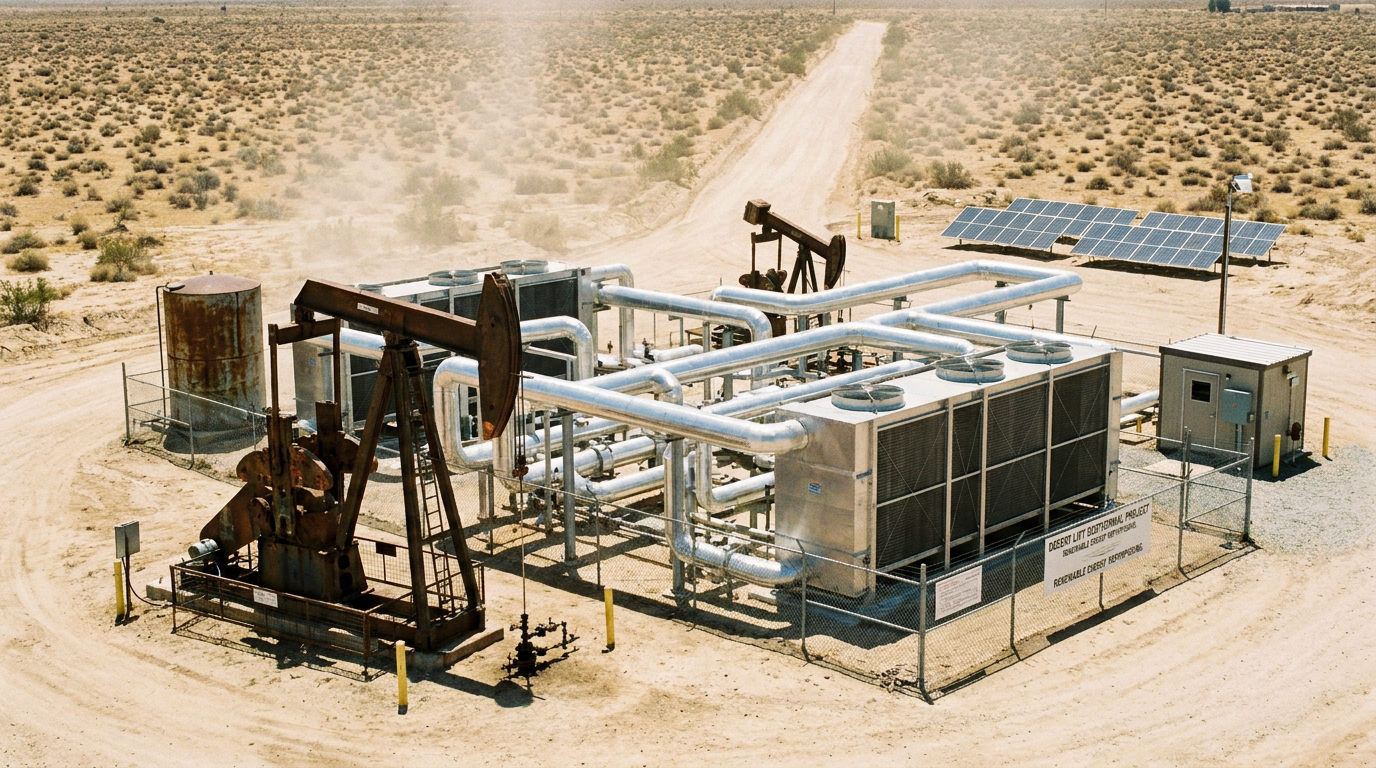
But a growing coalition of energy researchers, clean-tech start-ups, and petroleum engineers is advancing a radical, highly pragmatic alternative: instead of burying these liabilities in cement, they are transforming them into clean energy assets. By retrofitting depleted wells to harvest geothermal energy, the industry is tapping into the immense, constant heat trapped deep within the Earth's crust. This approach effectively recycles existing industrial infrastructure to power the next generation of the grid. The Factlen Editorial Team has synthesized recent engineering breakthroughs and pilot project data to explain how this transition works, highlighting a rare scenario where fossil fuel legacy infrastructure directly accelerates renewable energy deployment.[1][2]
The concept elegantly solves one of the biggest economic hurdles facing the broader geothermal sector. While geothermal energy provides a highly desirable, weather-independent baseload power—unlike the intermittent generation of wind and solar—the upfront capital required to build a new plant is staggering. Drilling deep into solid bedrock to reach adequate subsurface temperatures typically accounts for 40% to 60% of a geothermal project's total capital expenditure. This massive financial barrier has historically kept geothermal energy as the fourth least-utilized renewable resource globally.[5][7]
Abandoned oil and gas wells, however, have already done the hardest and most expensive work. Many of these legacy boreholes plunge more than two kilometers into the earth, reaching geological zones where temperatures are naturally elevated by the Earth's core. By sidestepping the exploratory and drilling phases entirely, energy companies can drastically reduce the initial investment required to bring a geothermal site online. This turns a sunk cost from the petroleum era into a subsidized head start for clean energy generation.[3][5]

The mechanics of this subsurface transformation generally fall into two distinct engineering categories: open-loop co-production and closed-loop systems. In an open-loop setup, operators utilize the fluids that are already naturally present in the geological reservoir. Toward the end of an oil well's commercial lifespan, it often produces a highly diluted mixture that is up to 98% naturally heated water and only 2% residual hydrocarbons. Historically, this water was viewed as a costly nuisance. Now, it is the primary resource being mined.[2][3]
Instead of treating this hot water as a waste byproduct requiring disposal, retrofitted facilities route the fluid through advanced surface-level heat exchangers. The thermal energy is efficiently extracted to generate electricity or provide direct residential heating, while the cooled water is safely reinjected back into the earth to maintain the reservoir's pressure. The small fraction of residual oil is separated during the process and sold, creating a secondary revenue stream that further improves the project's underlying economics. This co-production model maximizes the utility of every drop of fluid brought to the surface.[2][6]
For wells that do not produce sufficient natural fluids, or where fluid extraction poses environmental risks, engineers are deploying sophisticated closed-loop systems. In this configuration, a proprietary working fluid is circulated down a sealed, U-shaped pipe inserted within the existing wellbore. The fluid absorbs the ambient heat from the surrounding subterranean rock as it descends, then returns to the surface at a much higher temperature. Because the working fluid never physically touches the geological formation, the risk of subsurface groundwater contamination is virtually eliminated.[2][6]
To convert this low-grade geothermal heat into usable electricity, facilities frequently rely on an Organic Rankine Cycle (ORC) engine. Unlike traditional steam turbines that require water to reach 100 degrees Celsius to vaporize, an ORC uses an organic fluid—such as specialized refrigerants—with a much lower boiling point. When the geothermal heat transfers to this organic fluid in the heat exchanger, it rapidly vaporizes and spins a turbine, generating reliable, zero-emission power from ambient fluid temperatures as low as 70 degrees Celsius.[2][4]
To convert this low-grade geothermal heat into usable electricity, facilities frequently rely on an Organic Rankine Cycle (ORC) engine.
Pilot projects across the United States are already proving the commercial viability of this retrofitting approach. In Pierce, Colorado, a clean-energy start-up named Gradient Geothermal has successfully repurposed a cluster of wells that had been abandoned and sitting idle for six years. Plunging 2.7 kilometers deep into the earth, the wells now harness naturally heated waters to supply zero-emission electricity to the local municipal grid, demonstrating that co-production can effectively support rural communities while generating new local tax revenues.[3]

Beyond large-scale electricity generation, retrofitted wells are proving highly effective for direct-use heating and cooling applications. A recent comprehensive feasibility study conducted by researchers at the University of Oklahoma evaluated the potential of utilizing depleted wells in the city of Moore. The engineers found that producing just 2,000 barrels of hot water per day from nearby abandoned wells could provide sufficient, cost-effective climate control for three local public schools, entirely replacing their reliance on natural gas boilers. This localized approach proves that geothermal energy doesn't just belong to massive utility companies.[7]
The economic modeling for the Oklahoma direct-use project projected a highly favorable payback period of just 11 years, alongside a deeply competitive Levelized Cost of Heat (LCOH) of $12.80 per MMBTU. By utilizing the existing well infrastructure, the project minimizes the heavy carbon footprint typically associated with new construction materials and heavy machinery. Furthermore, it provides a sustainable, year-round baseload heating solution that intermittent renewables like solar and wind simply cannot match during the cold winter months. Schools and municipalities can lock in predictable energy costs for decades.[7]
The sheer scale of the national opportunity is vast. Industry experts estimate that of the two to three million disused wells scattered across the United States, over 500,000 possess the necessary depth, bottom-hole temperature, and structural integrity for geothermal conversion. Fully maximizing this existing inventory could generate up to 13 gigawatts of clean, dispatchable energy capacity—enough to power millions of American homes—while simultaneously preventing an estimated 16.5 million tonnes of carbon dioxide emissions annually. This represents a monumental shift in how the nation views its industrial legacy.[3]

The technology is also rapidly evolving to encompass long-duration energy storage, solving another critical bottleneck in the renewable transition. In Kern County, California, the US Department of Energy recently awarded $6 million to the innovative GeoTES (Geologic Thermal Energy Storage) project. This initiative will use concentrated solar power arrays to superheat water during the peak sunshine hours of the day, then inject that thermal energy deep into depleted oil reservoirs for long-term storage. This effectively turns the earth itself into a massive, natural battery.[4]
The porous sandstone reservoirs act as a massive, naturally insulated underground thermos, capable of storing thermal energy for up to 1,000 hours with minimal heat loss. When grid demand peaks—such as during evening hours or extended cloudy periods—the pressurized hot water is brought back to the surface and flashed into steam to drive a turbine. This hybrid approach beautifully marries the cheap, abundant generation of solar power with the dispatchable, on-demand reliability of traditional geothermal systems. It solves the intermittency problem that has long plagued renewable grids.[4]
Despite the immense environmental and economic promise, the transition from petroleum extraction to geothermal generation is not without significant engineering challenges. The primary technical concern among researchers is long-term well integrity. Wells drilled decades ago for oil extraction were simply not designed to withstand the continuous thermal cycling, pressure fluctuations, and highly corrosive environments associated with modern geothermal fluid extraction and reinjection. If these structures fail, the consequences could be severe. Engineers must account for the physical realities of aging infrastructure.[2][5]

Before a legacy well can be safely repurposed, engineers must conduct rigorous, expensive inspections of the subterranean steel casing and the surrounding cement sheathing. Any degradation or micro-fractures could lead to the leakage of chemical working fluids into local aquifers, or allow trapped pockets of methane to escape to the surface, entirely negating the environmental benefits of the project. Upgrading these aging structures requires specialized, heat-resistant materials and careful, ongoing regulatory oversight from state environmental agencies. Safety remains the paramount concern for both operators and local residents.[2][5]
Subsurface reservoir dynamics also pose a long-term operational risk known to engineers as thermal breakthrough. If cooled water is reinjected too close to the production well, it can prematurely lower the temperature of the entire geological formation, permanently crippling the system's energy output. To mitigate this, advanced reservoir simulation software and artificial intelligence models are now being deployed to optimize well placement, calculate precise flow rates, and predict heat transfer dynamics over a 30-year project lifespan. These digital twins ensure that the thermal battery is never fully depleted.[6][7]
Ultimately, repurposing abandoned oil wells offers much more than just a clever technical solution to a looming environmental liability; it provides a vital socioeconomic bridge. The retrofitting process relies heavily on the exact same skills possessed by the existing oil and gas workforce—from drilling engineers and roughnecks to pipefitters and geologists. By transforming the rusting relics of the fossil fuel era into the engines of the clean energy transition, communities historically dependent on petroleum can secure a sustainable, highly skilled economic future. It proves that the path to a green grid doesn't require leaving energy workers behind.[1][4]
How we got here
Pre-2010s
Abandoned oil wells are strictly viewed as environmental liabilities requiring expensive plugging and decommissioning.
2015–2020
Academic researchers begin publishing feasibility studies on the thermodynamic potential of co-producing hot water from depleted oil fields.
2022
Comprehensive reviews confirm the viability of open-loop and closed-loop retrofits, highlighting the massive savings in drilling costs.
2024
The US Department of Energy awards $6 million to the GeoTES project to test 1,000-hour thermal energy storage in California oil wells.
2025
Start-ups like Gradient Geothermal successfully bring pilot projects online, powering rural communities with zero-emission electricity.
Viewpoints in depth
Geothermal Innovators
Start-ups and clean energy advocates view abandoned wells as a massive, untapped baseload resource.
For geothermal developers, the primary barrier to entry has always been the exorbitant cost and geological risk of drilling deep exploratory wells. By utilizing existing oil and gas infrastructure, innovators argue they can bypass up to 60% of capital expenditures. They point to successful pilot projects in Colorado and California as proof that co-production and closed-loop systems can rapidly scale, providing a reliable, weather-independent complement to wind and solar power.
Oil & Gas Operators
Petroleum companies see retrofitting as a strategy to offset decommissioning liabilities and transition their workforce.
Faced with billions of dollars in mandated plugging and abandonment costs, the fossil fuel industry is increasingly motivated to find secondary uses for depleted assets. Industry engineers emphasize that retrofitting not only eliminates the $20,000 to $76,000 cost of sealing a well but also creates a new revenue stream from the residual heat. Furthermore, operators highlight that this transition utilizes the exact same subsurface engineering skills and workforce already present in oil-producing regions.
Environmental & Regulatory Analysts
Researchers and watchdogs stress the need for rigorous well integrity standards to prevent subsurface contamination.
While supportive of the clean energy potential, environmental scientists caution that decades-old oil wells were not designed for the thermal stress of geothermal cycling. They argue that without strict regulatory oversight and advanced casing inspections, retrofitted wells could leak working fluids into groundwater or allow trapped methane to escape to the surface. This camp advocates for comprehensive reservoir modeling to ensure that projects do not inadvertently trade one environmental hazard for another.
What we don't know
- How decades-old steel casings and cement sheathing will hold up to decades of continuous thermal cycling.
- The exact percentage of the 2-3 million abandoned US wells that possess the specific geological conditions required for commercial viability.
- Whether state and federal regulatory frameworks will adapt quickly enough to permit rapid, large-scale retrofitting of petroleum sites.
Key terms
- Organic Rankine Cycle (ORC)
- A thermodynamic process that uses an organic fluid with a lower boiling point than water to generate power from low-temperature heat sources.
- Co-production
- The simultaneous extraction of hot water alongside oil and gas, which can be harnessed for geothermal energy.
- Thermal Breakthrough
- A phenomenon where reinjected cold water reaches the production well too quickly, prematurely cooling the geothermal reservoir.
- Levelized Cost of Heat (LCOH)
- A metric used to evaluate the economic feasibility of a heating system over its entire lifespan.
- Closed-loop System
- A geothermal setup where a sealed pipe circulates a working fluid underground to absorb heat without ever touching the geological formation.
Frequently asked
Do all abandoned oil wells work for geothermal energy?
No. Wells must have sufficient depth, high enough bottom-hole temperatures, and intact casing to be viable candidates for retrofitting.
How much energy can one retrofitted well produce?
It varies by temperature and flow rate, but a cluster of retrofitted wells can generate enough megawatt-hours to power local communities or industrial facilities.
Does this process involve hydraulic fracturing (fracking)?
No. Repurposing existing wells typically relies on the natural flow of hot water or closed-loop heat exchangers, avoiding the need for new fracturing.
What happens to the remaining oil in the well?
In co-production systems, the small percentage of remaining hydrocarbons is separated at the surface and sold, while the hot water is routed to a heat exchanger.
Sources
Source coverage
7 outlets
3 viewpoints surfaced





[1]Factlen Editorial TeamResearch & Synthesis
Synthesis by Factlen editorial team
Read on Factlen Editorial Team →[2]Renewable EnergyResearch & Synthesis
Repurposing abandoned wells for geothermal energy: Current status and future prospects
Read on Renewable Energy →[3]Gradient GeothermalGeothermal Innovators
Tapping Old Oil Wells to Power the Future with Geothermal Energy
Read on Gradient Geothermal →[4]US Department of EnergyGeothermal Innovators
1000-hour thermal energy storage to get test in California's abandoned oil wells
Read on US Department of Energy →[5]Society of Petroleum EngineersOil & Gas Industry
Repurposing Oil and Gas Wells to Geothermal Wells
Read on Society of Petroleum Engineers →[6]ASCE LibraryResearch & Synthesis
Abandoned Oil and Gas Wells as an Alternative Geothermal Energy Source: Current Practices and Way Forward
Read on ASCE Library →[7]University of OklahomaResearch & Synthesis
Repurposing Abandoned Oil and Gas Wells for Geothermal Direct Use in Oklahoma: A Case Study
Read on University of Oklahoma →
Every angle. Every day.
Get energy stories with full source coverage and perspective breakdowns delivered to your inbox.