
OLED vs. QD-OLED vs. Mini-LED: Ranking the Best Premium TV Panel Technologies in 2026
As 2026 introduces Tandem OLEDs and RGB Mini-LEDs, the premium TV landscape has fractured into three distinct technologies. Here is the definitive guide to choosing the right panel for your room, lighting, and viewing habits.
By Factlen Editorial Team
- Home Theater Purists
- Advocates for absolute contrast and pixel-level light control, favoring OLED.
- Bright-Room & Sports Viewers
- Prioritizes sustained fullscreen brightness and glare reduction, favoring Mini-LED.
- PC & Console Gamers
- Focuses on color volume, motion clarity, and burn-in immunity, favoring QD-OLED.
What's not represented
- · Budget Consumers
- · Commercial Display Installers
Why this matters
Dropping thousands of dollars on a flagship television in 2026 requires more than just picking a brand; matching the underlying panel technology to your specific room lighting and viewing habits is the difference between a cinematic revelation and a frustrating, glare-filled mistake.
Key points
- Tandem OLEDs now stack light-emitting layers to push peak brightness past 2,500 nits.
- QD-OLED panels offer the widest color volume and advanced matte coatings for mixed-use rooms.
- RGB Mini-LEDs replace blue LEDs with separate color diodes, closing the color gap with OLED.
- Mini-LED remains the undisputed champion for sustained fullscreen brightness in sunlit rooms.
- OLED technology still provides the best absolute black levels for dedicated, dark home theaters.
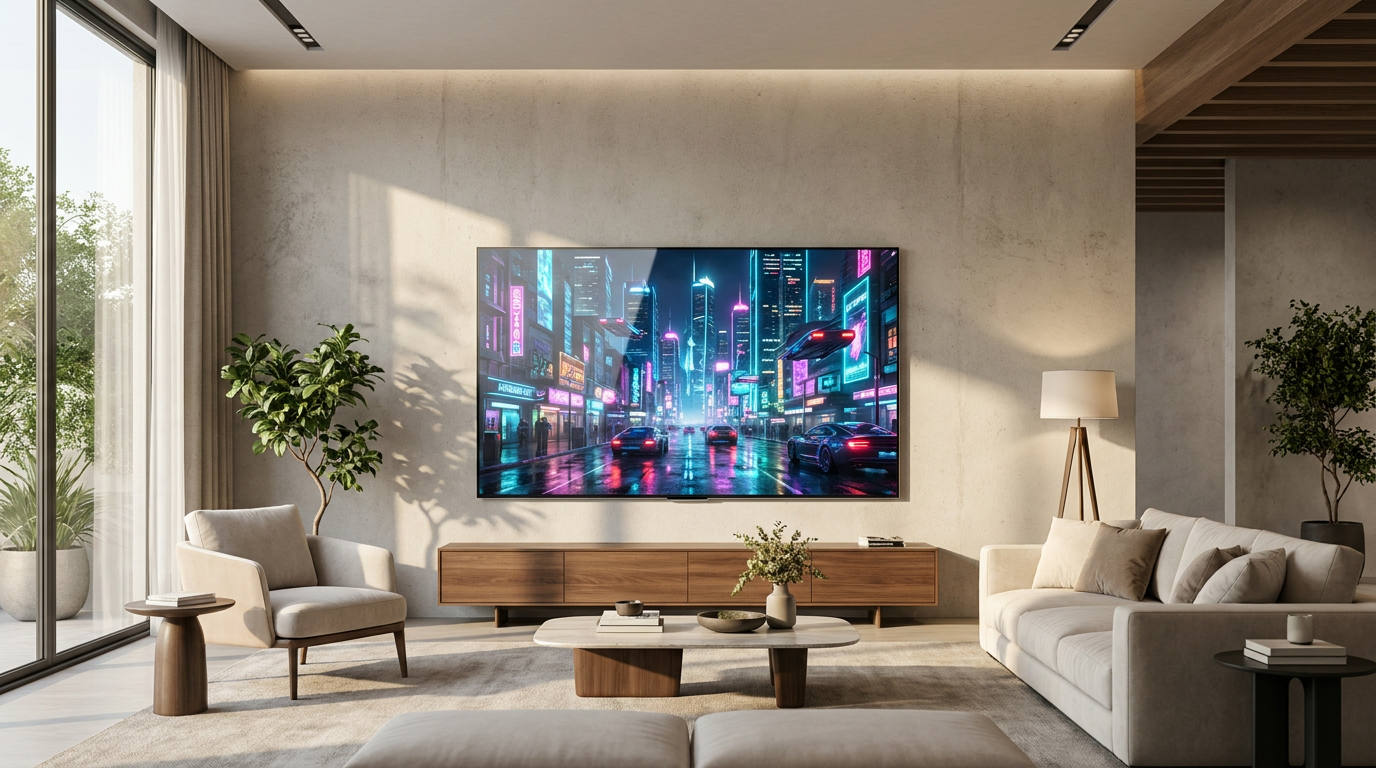
The era of a single dominant television technology is officially over. For years, standard OLED panels held the undisputed crown for premium home theaters, while traditional LED screens served the budget and mid-tier markets. But in 2026, the high-end market has fractured into three fiercely competitive architectures: Tandem OLED, QD-OLED, and RGB Mini-LED. Each technology has achieved massive leaps in brightness and color volume, making the buying decision less about finding an objective "best" screen and entirely about matching the panel's specific thermal and optical properties to the lighting conditions of your living room.[1][3]
The argument for traditional and Tandem OLED, championed by flagship models like the LG G6, centers on absolute contrast and pixel-level precision. Because OLED panels lack a traditional backlight, each individual pixel can turn completely off, creating true, infinite blacks. The evidence for this superiority is most visible in dark, cinematic scenes—think of a starfield in a science fiction film, where bright pinpricks of light sit directly adjacent to pitch black without any glowing halos. For 2026, manufacturers have introduced Tandem OLED, which stacks multiple red, green, and blue light-emitting layers to push peak HDR brightness to roughly 2,524 nits, finally addressing the technology's historical dimness.[1][5]
However, the case against standard OLED remains its fullscreen brightness limitations and the persistent, albeit reduced, risk of permanent image retention. While peak highlights are blindingly bright, the Automatic Brightness Limiter (ABL) aggressively dims the entire panel when displaying a bright, full-screen image like a hockey rink or a snow-covered landscape. Measurements show that even flagship OLEDs throttle down to around 387 nits of fullscreen brightness to protect the organic compounds from overheating. This technology fits perfectly when placed in a dedicated, light-controlled home theater or a bedroom used primarily for evening movie viewing. It does not fit well in sun-drenched living rooms where daytime sports viewing is the priority.[2]

The argument for QD-OLED (Quantum Dot OLED), utilized by the Samsung S95F and Sony Bravia 8 II, focuses on unparalleled color saturation at high brightness levels. By passing a blue OLED light source through a quantum dot color filter, these panels eliminate the white subpixel used in traditional OLEDs. The evidence is striking: QD-OLEDs cover roughly 80 percent of the Rec. 2020 color space, delivering pure, vibrant reds and greens even in the brightest HDR explosions or animated sequences. Furthermore, 2026 models have introduced advanced "Glare Free" matte screen coatings that drastically reduce the mirror-like reflections that plague glossy screens.[4][5]
The argument for QD-OLED (Quantum Dot OLED), utilized by the Samsung S95F and Sony Bravia 8 II, focuses on unparalleled color saturation at high brightness levels.
The case against QD-OLED involves its unconventional subpixel layout and slight compromises in absolute black levels when exposed to ambient light. Because the quantum dot layer can be excited by sunlight hitting the front of the screen, the deepest blacks can occasionally take on a faint purplish-grey tint in a brightly lit room. Additionally, the triangular subpixel structure can cause minor color fringing around sharp text, though second-generation panels have largely mitigated this for all but the most demanding PC monitor users. QD-OLED fits exceptionally well when you want the ultimate gaming display or a vibrant mixed-use living room screen that handles both daytime streaming and nighttime cinema. It does not fit well if you exclusively watch content in pitch-black rooms, where traditional OLED still holds a microscopic edge in black uniformity.[4][6]

The argument for Mini-LED—and specifically the new 2026 RGB Mini-LED architecture—is built entirely on brute-force brightness and sheer scale. Models like the Sony Bravia 9 and Hisense UR9S replace standard backlights with thousands of microscopic, individually controlled dimming zones. The evidence for this approach is found in the raw output: mid-range Mini-LEDs easily push past 3,300 nits of peak brightness and sustain a massive 887 nits of fullscreen brightness. Furthermore, the 2026 shift to RGB Mini-LED replaces blue LEDs with separate red, green, and blue diodes, drastically improving color purity and closing the color-volume gap with QD-OLED.[1][2]
The case against Mini-LED remains the physical limitation of local dimming zones. Even with thousands of zones, a single backlight cluster still illuminates hundreds of pixels simultaneously. When a bright object moves across a dark background, a faint glow or "halo" can sometimes be seen around the edges, particularly when viewed from an off-center angle. Additionally, the complex backlight arrays make these televisions significantly thicker and heavier than their wafer-thin OLED counterparts. Mini-LED fits best when placed in a bright, window-heavy family room, when hosting daytime sports watch parties, or when purchasing massive 100-inch-plus screens where OLED pricing becomes astronomical. It does not fit well for viewers who are highly sensitive to blooming artifacts in dark, letterboxed movie scenes.[1][3]

Ultimately, the 2026 television market requires buyers to audit their own viewing habits before auditing the spec sheets. If your primary use case involves watching prestige television and 4K Blu-rays in a dark room, Tandem OLED provides the most flawless, artifact-free image available. If your viewing is split evenly between daytime gaming, casual streaming, and evening movies, the color volume and matte finishes of QD-OLED offer the best all-around compromise. But if your television lives in a sunlit open-concept space, or if you demand the visceral punch of maximum HDR brightness for weekend sports, the sheer horsepower of a modern RGB Mini-LED remains entirely unmatched.[5][6]
How we got here
2013
LG introduces the first mass-market OLED televisions, establishing a new benchmark for black levels.
2021
Mini-LED technology enters the mainstream, using thousands of tiny diodes to vastly improve LCD local dimming.
2022
Samsung debuts QD-OLED, merging quantum dot color filters with OLED panels for unprecedented color volume.
Early 2026
Manufacturers unveil Tandem OLED and RGB Mini-LED at CES, pushing peak brightness well past 2,500 nits.
Viewpoints in depth
Home Theater Purists
Advocates for absolute contrast and pixel-level light control.
For dedicated cinephiles, the conversation begins and ends with OLED technology. This camp argues that infinite contrast—the ability to place a blindingly bright pixel directly next to a completely deactivated, pitch-black pixel—is the single most important metric for perceived image quality. They point to the fact that Hollywood colorists master films on professional OLED reference monitors, making consumer OLEDs the closest representation of the director's original intent. While they acknowledge the brightness gains of Mini-LED, they argue that the inevitable 'blooming' or haloing around bright objects on LED screens breaks immersion during dark, moody films.
Bright-Room & Sports Viewers
Prioritizes sustained fullscreen brightness and glare reduction.
This perspective, often championed by sports fans and those with open-concept, sunlit living rooms, argues that OLED's perfect black levels are entirely wasted if the screen cannot overcome daytime glare. They point to the aggressive Automatic Brightness Limiter (ABL) in OLEDs, which dims the entire screen during bright scenes like a sunlit football field or a hockey rink. For this camp, the sheer horsepower of a Mini-LED panel—capable of sustaining nearly 900 nits across the entire screen—provides a vastly superior, punchier image for daytime viewing, completely eliminating the need to draw the curtains just to watch a weekend match.
PC & Console Gamers
Focuses on color volume, motion clarity, and burn-in immunity.
The gaming community sits squarely in the middle, weighing the instantaneous response times of OLED against the static-image burn-in risks associated with heads-up displays (HUDs). Many gamers have gravitated toward QD-OLED panels, citing the technology's ability to deliver massive color volume and 144Hz-to-165Hz refresh rates without the smearing sometimes seen on LCD panels. However, a vocal subset of PC users still advocates for Mini-LED monitors and TVs, arguing that the peace of mind of zero burn-in risk is worth the slight trade-off in absolute contrast, especially for users who leave static desktop taskbars on screen for hours at a time.
What we don't know
- Whether RGB Mini-LED technology can fully eliminate the color haloing artifacts seen in early 2026 demonstrations.
- How the long-term lifespan of Tandem OLED panels compares to traditional W-OLEDs after thousands of hours of use.
Key terms
- Tandem OLED
- A new panel architecture that stacks multiple light-emitting layers to increase overall brightness and lifespan.
- QD-OLED
- A hybrid display technology that uses a blue OLED light source passed through a quantum dot layer to produce highly saturated colors.
- Mini-LED
- An LCD backlight system that uses thousands of microscopic LEDs grouped into dimming zones to improve contrast and reduce blooming.
- Automatic Brightness Limiter (ABL)
- A protective feature in OLED TVs that automatically dims the screen when a large portion of the image becomes brightly lit, preventing overheating.
- Color Volume
- A measurement of how well a television can maintain accurate, saturated colors at varying levels of brightness.
Frequently asked
Do OLED TVs still suffer from burn-in in 2026?
While the risk of permanent image retention still exists, 2026 technologies like Tandem OLED and advanced pixel-shifting algorithms have drastically reduced the likelihood of burn-in under normal viewing conditions.
Is Mini-LED better than OLED for a bright living room?
Yes. Mini-LED panels can sustain significantly higher fullscreen brightness than OLEDs, making them much better equipped to overcome glare from windows and sunlight.
What is the difference between OLED and QD-OLED?
Traditional OLED uses white subpixels to boost brightness, which can slightly wash out colors at peak luminance. QD-OLED uses a quantum dot layer to produce pure red, green, and blue light, resulting in richer colors during bright scenes.
Sources
Source coverage
6 outlets
3 viewpoints surfaced






[1]RtingsHome Theater Purists
2026 TV Lineup Announcements: RGB Mini LED and Tandem OLED
Read on Rtings →[2]TechRadarBright-Room & Sports Viewers
Why I recommend mini-LED over OLED for big-screen sports
Read on TechRadar →[3]What Hi-Fi?Home Theater Purists
Best TVs 2026: OLED and Mini-LED Picks
Read on What Hi-Fi? →[4]DisplayNinjaPC & Console Gamers
W-OLED vs QD-OLED vs Mini LED: HDR Image Quality Compared
Read on DisplayNinja →[5]Data Wire SolutionsBright-Room & Sports Viewers
Best TVs for 2026: 10 OLED and Mini-LED Picks by Room
Read on Data Wire Solutions →[6]Factlen Editorial TeamPC & Console Gamers
Synthesis by Factlen editorial team
Read on Factlen Editorial Team →


Every angle. Every day.
Get guides stories with full source coverage and perspective breakdowns delivered to your inbox.