
OLED vs. Mini-LED in 2026: How the New Generation of TVs Compares
The 2026 television market brings massive architectural leaps to both OLED and Mini-LED panels, rapidly closing the historical gaps in brightness and contrast. Here is how the two dominant display technologies stack up for buyers upgrading their living rooms.
By Factlen Editorial Team
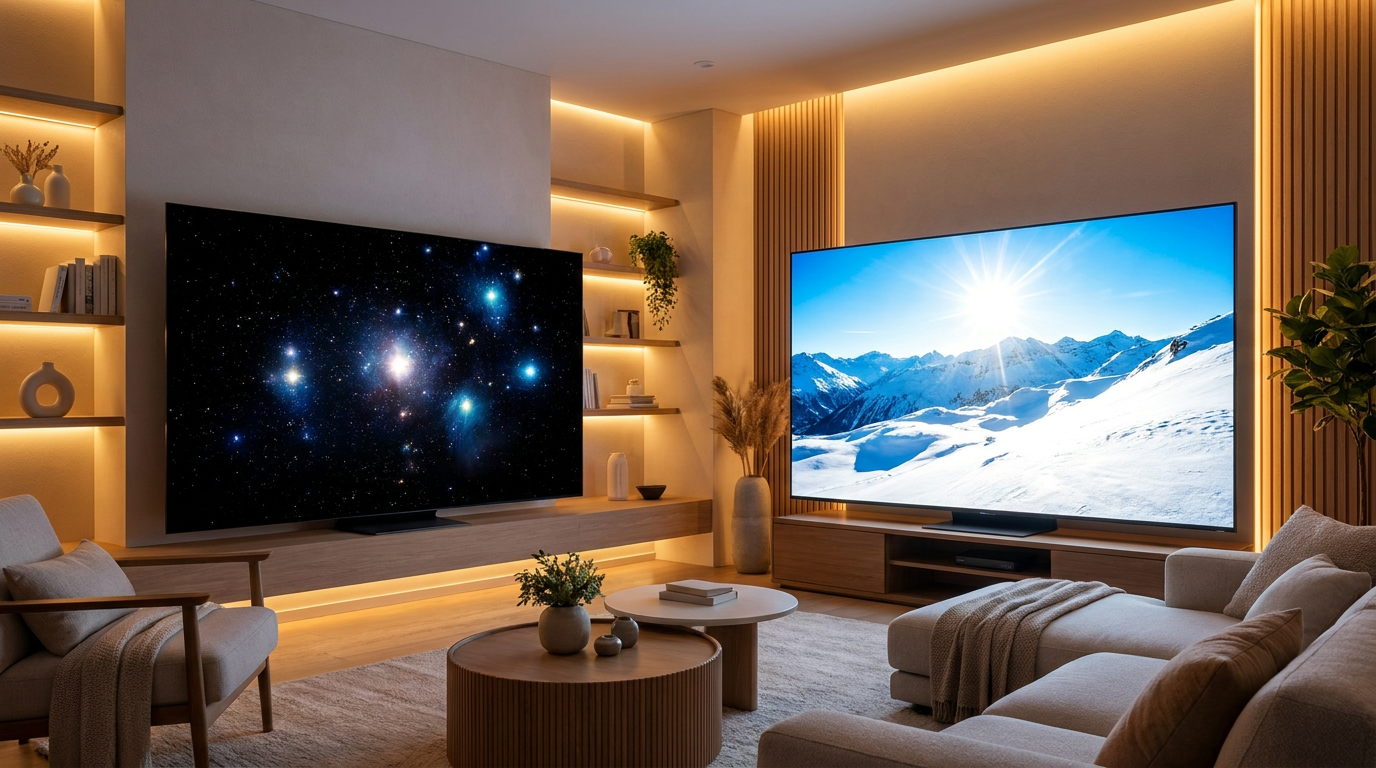
- OLED Purists
- Prioritize perfect black levels, infinite contrast, and exact cinematic accuracy above all else.
- Mini-LED Advocates
- Value sheer peak brightness, bright-room versatility, and immunity to permanent burn-in.
- Value & Large-Format Buyers
- Focus on the price-to-performance ratio, particularly for massive 75-inch and 85-inch screens.
What's not represented
- · Budget-constrained buyers looking under $500
- · Projector enthusiasts who prioritize 100+ inch screens
Why this matters
Choosing the wrong television technology can lead to thousands of dollars wasted on a screen that washes out in a bright room or risks permanent burn-in from heavy gaming. Understanding the 2026 advancements in OLED and Mini-LED ensures buyers match the right panel to their specific lighting environment and viewing habits.
Key points
- Tandem OLED and QD-OLED panels have pushed peak highlights to 2,000 nits, narrowing the brightness gap.
- RGB Mini-LED technology replaces traditional blue backlights, allowing for 2,500+ nits and massive color volume.
- OLED remains the undisputed champion for dark rooms, offering perfect black levels and infinite contrast.
- Mini-LED is the superior choice for bright, sunlit rooms and carries zero risk of permanent burn-in.
- At sizes of 85 inches and above, Mini-LED offers drastically better value than equivalently sized OLEDs.
The 2026 television market has reached a fascinating inflection point. After years of incremental updates, the two dominant display technologies—OLED and Mini-LED—have both received massive architectural leaps. Buyers looking to upgrade their living rooms are no longer just choosing between perfect blacks and blinding brightness. With the introduction of Tandem OLED and RGB Mini-LED, the historical compromises of both panel types are rapidly vanishing, making the choice more complex but ultimately more rewarding for consumers.[1][4][5]
To understand the current landscape, it helps to look at how the underlying technology has evolved. OLED, or organic light-emitting diode, has long been the gold standard for home theaters because each pixel generates its own light and can turn off completely. Mini-LED, conversely, uses a traditional LCD panel illuminated by thousands of microscopic LED backlights divided into dimming zones. In 2026, manufacturers have pushed both approaches to their physical limits, creating a fierce battle for the center of the modern living room.[1][3][5]
The case for OLED in 2026 rests entirely on its unmatched micro-contrast and pixel-level precision. Because there is no backlight, a pure black pixel can sit directly next to a blindingly white star in a sci-fi movie without any light bleeding over. This year, the introduction of Tandem OLED—which stacks multiple emissive layers—and refined QD-OLED panels has given these sets a massive brightness jump. Models like the LG G5 and Samsung S95H can now hit up to 2,000 nits in small highlights, delivering a cinematic punch that older OLEDs simply could not muster.[2][4][6]

The argument against OLED, however, remains tied to its organic nature and full-screen brightness limitations. While peak highlights are dazzling, OLED panels still employ an Automatic Brightness Limiter (ABL) that aggressively dims the screen when displaying large, bright elements like a hockey rink or a snow-covered landscape. Furthermore, while Tandem architecture significantly reduces the risk of permanent image retention, the threat of burn-in from static elements like news tickers or video game HUDs is not entirely zero.[4][5][6]
The evidence from independent testing laboratories confirms these trade-offs. Calibrators measuring 2026 OLED panels note that while color accuracy and viewing angles remain flawless, full-screen sustained brightness still hovers around 250 to 400 nits. This means that in a sun-drenched living room with open blinds, an OLED panel can still look slightly washed out compared to its LED rivals, forcing viewers to rely on heavy anti-reflective coatings that can sometimes mute the image.[1][2][4]
The evidence from independent testing laboratories confirms these trade-offs.
Turning to the LCD side of the aisle, the case for Mini-LED is built on sheer, unadulterated power and environmental versatility. The 2026 generation has moved toward RGB Mini-LED, replacing traditional blue diodes with separate red, green, and blue emitters. This allows flagship models like the Sony Bravia 9 and TCL QM8K to push past 2,500 nits of peak brightness while maintaining massive color volume. These televisions can overpower direct sunlight, making them the undisputed champions of bright, open-concept living spaces.[1][4][6]

The argument against Mini-LED centers on the physical limitations of backlighting. Even with thousands of independent dimming zones, a Mini-LED TV cannot control light at the individual pixel level. When a bright object moves across a dark background—such as white subtitles on a black letterbox bar—a faint halo of light, known as blooming, is often visible. Additionally, Mini-LED panels typically use VA (Vertical Alignment) LCD technology, which means the picture degrades and loses color saturation when viewed from a wide angle.[1][5]
The evidence regarding Mini-LED performance shows a rapidly closing gap with OLED, though purists will still spot the difference. Reviewers note that while 2026 local dimming algorithms are incredibly sophisticated, blooming is still detectable in pitch-black rooms. However, the sheer impact of a 2,500-nit explosion in an HDR movie often distracts from these minor black-level imperfections, offering a different but equally compelling type of visual immersion.[1][4][6]
When it comes to gaming, both technologies offer spectacular performance, but they cater to slightly different setups. OLED panels deliver near-instantaneous pixel response times, making motion blur practically non-existent for fast-paced competitive shooters. Mini-LEDs, meanwhile, offer a worry-free experience for gamers who play the same title for eight hours a day, completely eliminating the anxiety of burning a static health bar into a premium display. Both panel types now routinely support 144Hz refresh rates, variable refresh rates (VRR), and multiple HDMI 2.1 ports.[2][3][4]

Pricing and sizing dynamics also play a crucial role in the 2026 market. While 55-inch and 65-inch OLEDs have become relatively affordable, the cost of manufacturing organic panels skyrockets at larger sizes. For buyers looking to fill a massive wall with an 85-inch or 98-inch display, Mini-LED offers drastically better value, delivering a premium home theater experience for thousands of dollars less than an equivalently sized OLED.[2][4][6]
Ultimately, synthesizing these trade-offs leads to clear purchasing guidelines. OLED fits well when the television is placed in a light-controlled room, when the primary viewing happens at night, and when the buyer prioritizes cinematic accuracy, perfect blacks, and wide viewing angles for group movie nights. It does not fit well when the television will be used as a constant background display for news channels, or when it sits opposite a wall of unshaded, south-facing windows.[3][4][5]

Conversely, Mini-LED fits well when the television lives in a bright, multi-use family room, when the household watches a lot of daytime sports, or when the buyer wants a massive 85-inch screen without taking out a second mortgage. It does not fit well when the viewer is highly sensitive to backlight blooming, or when the seating arrangement forces guests to watch the television from extreme off-center angles.[1][5][6]
How we got here
2013
The first consumer OLED TVs launch, establishing a new benchmark for perfect black levels.
2019
Mini-LED technology enters the consumer market, offering an LCD alternative with vastly improved local dimming.
2022
QD-OLED panels are introduced, combining quantum dots with OLED for better color brightness.
2026
Tandem OLED and RGB Mini-LED architectures become the flagship standards, drastically closing the performance gap between the two technologies.
Viewpoints in depth
The OLED Purist View
Advocates for perfect black levels and cinematic accuracy.
For home theater enthusiasts, the conversation begins and ends with pixel-level light control. OLED purists argue that no amount of peak brightness can compensate for the subtle blooming artifacts inherent to LCD backlights. They point to the introduction of Tandem OLED and QD-OLED as the final nail in the coffin for the brightness debate, arguing that 2,000-nit highlights are more than enough for any properly calibrated viewing environment. For this camp, preserving the director's exact intent in shadow details is the ultimate metric of a premium television.
The Mini-LED Advocate View
Champions raw brightness, color volume, and environmental versatility.
Proponents of Mini-LED argue that real-world viewing rarely happens in a pitch-black home theater. They emphasize that modern living rooms are filled with ambient light, where the sustained full-screen brightness of an RGB Mini-LED panel easily outshines an OLED constrained by its Automatic Brightness Limiter. Furthermore, this camp values the peace of mind that comes with zero burn-in risk, making Mini-LED the superior choice for heavy gamers, sports fans, and households that leave the television running as a background display all day.
What we don't know
- How the long-term lifespan of the new Tandem OLED architecture compares to traditional single-layer OLEDs in real-world usage.
- Whether manufacturing costs for 83-inch and larger OLED panels will drop enough to compete with Mini-LED pricing in the near future.
Key terms
- Tandem OLED
- A new display architecture that stacks multiple organic light-emitting layers to increase brightness and lifespan.
- RGB Mini-LED
- A backlight system that uses separate red, green, and blue diodes instead of traditional blue LEDs, improving color volume.
- Automatic Brightness Limiter (ABL)
- A safety feature in OLED TVs that automatically dims the screen when displaying large, bright images to prevent overheating.
- Local Dimming Zones
- Specific areas of a Mini-LED backlight that can independently dim or turn off to improve contrast and black levels.
- Blooming
- A visual artifact where light bleeds from a bright object into surrounding dark areas on an LCD screen.
Frequently asked
Does OLED still suffer from burn-in in 2026?
While Tandem OLED architecture and software mitigations have significantly reduced the risk, burn-in is still possible if static elements are displayed for thousands of hours.
What is blooming on a Mini-LED TV?
Blooming is a faint halo of light that appears around bright objects on dark backgrounds, caused by the backlight zones being larger than individual pixels.
Which TV is better for a bright living room?
Mini-LED is generally better for bright rooms because it can sustain much higher full-screen brightness to overpower glare and direct sunlight.
Are OLED TVs good for gaming?
Yes, OLEDs are excellent for gaming due to their near-instantaneous response times and infinite contrast, though heavy gamers should vary their content to prevent UI burn-in.
Sources
Source coverage
6 outlets
3 viewpoints surfaced






[1]RTINGSOLED Purists
The Best Mini LED TVs - Spring 2026
Read on RTINGS →[2]CNETValue & Large-Format Buyers
Best TVs for 2026: OLED, Mini-LED and More
Read on CNET →[3]PCMagOLED Purists
The Best TVs for 2026
Read on PCMag →[4]Data Wire SolutionsMini-LED Advocates
Best TVs for 2026: 10 OLED and Mini-LED Picks
Read on Data Wire Solutions →[5]EcoPicksGoMini-LED Advocates
OLED vs Mini LED TVs: 2026 Buyer's Guide
Read on EcoPicksGo →[6]NextGen PicksValue & Large-Format Buyers
Best New TVs 2026: OLED vs Mini LED
Read on NextGen Picks →
Every angle. Every day.
Get shopping stories with full source coverage and perspective breakdowns delivered to your inbox.