
The Rise of the Modern Pilgrimage: Why Secular Walkers Are Flocking to Ancient Sacred Routes
A record-breaking 530,000 people officially completed the Camino de Santiago in 2025, driven by a global surge in secular travelers seeking digital detoxes and mental health resets. The boom highlights a broader cultural shift away from high-tech wellness toward slow, analog immersion in nature.
By Austin Blake

In 2025, the ancient trails leading to northwestern Spain witnessed a modern phenomenon. According to the Pilgrim's Reception Office in Santiago de Compostela, a record-breaking 530,987 people received the official Compostela certificate for completing the Camino de Santiago.
When accounting for those who walked sections of the trail without registering for the certificate, estimates suggest over 1.5 million people traversed the routes. This milestone marks the highest annual figure in the recorded modern era, cementing a sustained, structural growth trend that has transformed a historic Catholic pilgrimage into a global cultural movement.
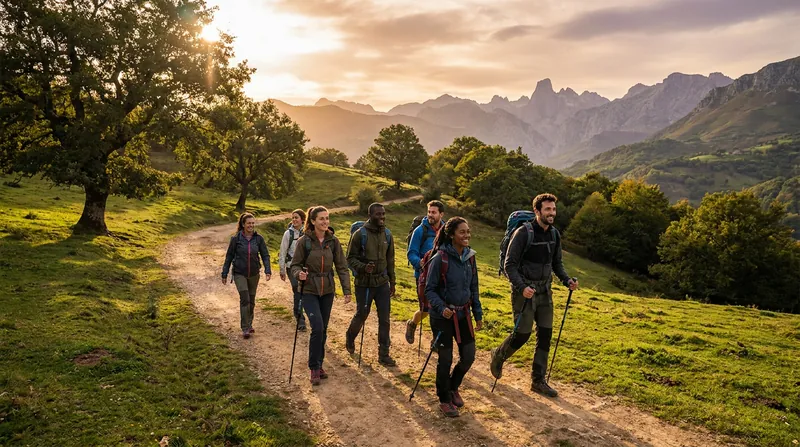
Yet, the driving force behind this explosion in numbers is not necessarily a traditional religious revival. Instead, a massive wave of secular walkers is flocking to these ancient routes seeking a different kind of salvation: relief from digital saturation, chronic burnout, and the relentless pace of modern life. The modern pilgrim is often less concerned with securing a place in the afterlife and more focused on reclaiming their mental health in the present.
The broader travel industry has tracked this behavioral shift closely. After years of the wellness sector emphasizing high-tech "biohacking" and relentless physical optimization, 2026 trends indicate a sharp pivot toward "restorative travel." Discerning travelers are increasingly rejecting rigid schedules and technological overload in favor of cognitive wellness and slow, purposeful movement. The appeal of a pilgrimage lies in its profound simplicity: the only daily requirement is to put one foot in front of the other.[2]
The physiological benefits of this analog immersion are striking. Without the constant glare of artificial light and screen-based stimuli, walkers report a rapid return to their natural circadian rhythms. Within just a few days on the trail, individuals frequently find themselves waking naturally at dawn and experiencing deeper, more restorative sleep cycles as their bodies realign with solar patterns.
The psychological reset is equally measurable. A 2023 study published in the Journal of Environmental Psychology found that participants who engaged in a week-long digital walking detox demonstrated a 62 percent reduction in cortisol—the body's primary stress hormone—alongside a 47 percent improvement in creative problem-solving skills. By removing the cognitive load of constant connectivity, the brain is given the rare opportunity to regulate its nervous system.
This desire for slow, intentional movement has also fueled the rise of a unique cross-cultural phenomenon: the "Dual Pilgrim." In 2014, Spain's Camino de Santiago and Japan's Kumano Kodo—the world's only two pilgrimage routes designated as UNESCO World Heritage sites—formed a formal partnership to promote sustainable tourism and shared spiritual history.[1]
While the two routes seem worlds apart geographically and culturally, they share a profound spiritual DNA. The Camino winds through medieval European villages, rolling vineyards, and coastal cities, while the Kumano Kodo climbs through misty cedar forests and moss-covered stone steps to sacred Shinto-Buddhist shrines deep in Japan's Kii Peninsula. Both paths, however, demand humility, physical endurance, and a deep immersion in the natural landscape.
The connection between the two trails has proven immensely popular. In April 2025, a Mexican walker named Carlos Alberto Garcia Villarreal became the 10,000th person to officially complete both routes, receiving a purification ceremony at the Kumano Hongu Taisha shrine to mark the milestone. Local tourism bureaus in both Tanabe City and Santiago de Compostela view the initiative as a triumph of sustainable, experiential travel that bridges a thousand years of history.[1]
However, the modern secular pilgrimage is not without its internal tensions. As millions take to the trails, researchers and traditionalists are increasingly debating the impact of the "Camino in the Cloud." The widespread use of smartphones has fundamentally altered the psychological landscape of the journey, introducing digital noise into historically quiet spaces.[2]
Historically, a pilgrimage was defined by its "liminality"—a psychological state of transition where an individual is entirely separated from their everyday life and social status. This liminal space is where the transformative power of the journey resides, allowing the walker to shed their daily anxieties and adopt a simplified, anonymous identity on the trail.[2]
Today, however, constant digital interaction with family, friends, and work threatens to short-circuit this separation. When walkers spend their evenings checking emails, scrolling social media, or hyper-planning their next day's accommodation via apps, they symbolically step right back into the world they are trying to escape. Academic studies on slow tourism note that digital media acts as a vehicle of cultural acceleration, directly conflicting with the philosophical values of traditional multi-day walking.[2]
In response to this digital intrusion, a new etiquette is emerging among modern pilgrims. Guides and veteran walkers are increasingly advocating for a deliberate technological detox. Recommendations include establishing strict "offline hours," utilizing airplane mode as the default setting, and returning to analog tools like paper maps and handwritten journals.[2]
By intentionally limiting technology, walkers find that their senses sharpen—they hear the crunch of gravel and the wind in the trees rather than a podcast—and their opportunities for genuine, face-to-face socialization increase. The reliance on physical waymarking, such as the Camino's iconic yellow arrows, forces a level of presence that GPS navigation bypasses.[2]
For the local municipalities that host these routes, the boom in secular pilgrims presents both an economic windfall and an infrastructural challenge. Towns like Sarria in Spain—the most popular starting point for the final 100 kilometers of the Camino Francés—have had to rapidly adapt to the influx of international walkers. Balancing the economic benefits of tourism with the preservation of the trail's sacred and historical character remains an ongoing task for heritage managers.
Ultimately, the explosion of pilgrimage walking in 2025 and 2026 reveals a profound cultural paradox. In an era increasingly defined by artificial intelligence, virtual realities, and frictionless convenience, millions of people are actively choosing to endure physical hardship, carry their own belongings, and walk for weeks on end. It is a powerful testament to the enduring human need for ancient wisdom, physical grounding, and analog connection.
Key points
- The Camino de Santiago issued a record 530,987 official completion certificates in 2025.
- The surge is driven by secular travelers seeking mental health benefits and a break from digital saturation.
- Studies show a week-long digital detox on the trail reduces cortisol by 62 percent.
- Japan's Kumano Kodo celebrated its 10,000th 'Dual Pilgrim'—walkers who have completed both UNESCO routes.
Open questions
- Whether the surge in numbers will eventually degrade the quiet, reflective nature of the trails.
- How local municipalities will fund the long-term infrastructure needed to support over 1.5 million annual walkers.
Timeline
9th Century
The Camino de Santiago is established as a major Christian pilgrimage route across Europe.
10th Century
Japanese emperors and aristocrats begin walking the Kumano Kodo to worship at the three Grand Shrines.
May 2014
Tanabe City (Japan) and Santiago de Compostela (Spain) sign a partnership, linking the two UNESCO World Heritage routes.
February 2015
The official 'Dual Pilgrim' initiative is launched to celebrate walkers who complete both paths.
April 2025
The Kumano Kodo officially registers its 10,000th Dual Pilgrim.
December 2025
The Camino de Santiago records an all-time high of 530,987 official Compostela certificates issued in a single year.
- Secular Wellness Seekers
- Argues that the physical act of walking in nature is a necessary antidote to modern digital burnout, prioritizing mental health over religious doctrine.
- Traditional Pilgrims & Purists
- Argues that treating ancient pilgrimage routes merely as fitness retreats or allowing constant smartphone use strips the journey of its transformative, liminal power.
- Cultural Heritage & Tourism Boards
- Focuses on the logistical triumph and challenge of the boom, celebrating cross-cultural exchange while managing trail sustainability.
Perspectives this story doesn't cover
- Local residents in trail towns
- Non-digital native elderly pilgrims
Sources
Source coverage
2 outlets
3 viewpoints surfaced


- [1]Tanabe City Kumano Tourism BureauCultural Heritage & Tourism Boards
10,000th Dual Pilgrim Celebrated at Kumano Hongu Taisha
Read on Tanabe City Kumano Tourism Bureau → - [2]Times of MaltaTraditional Pilgrims & Purists
Technology during your pilgrimage: The loss of the liminal experience
Read on Times of Malta →

More in Culture
See all →Shi'a Succession
The Mechanics of Succession: How Iran Will Choose Its Next Supreme Leader
4 sources

Canon Law
The Mechanics of Schism: How Canon Law Explains the SSPX Bishop Consecrations
3 sources

Sacred Texts
How AI is Rescuing and Translating the World's Oldest Sacred Texts
3 sources

Modern Pilgrimage
The Modern Pilgrimage Boom: Why Millions Are Walking Ancient Sacred Trails
6 sources
Comments
Every angle. Every day.
Get Culture stories with full source coverage and perspective breakdowns, free every day.