
How Millions of Abandoned Oil Wells Are Being Transformed Into Clean Geothermal Power
Startups and energy companies are repurposing idle oil and gas wells to harvest geothermal heat, turning environmental liabilities into 24/7 renewable energy sources.
By Factlen Editorial Team
- Geothermal Innovators
- Startups and clean-energy developers view abandoned wells as a massive shortcut to scaling baseload renewable power.
- The Oil & Gas Industry
- Fossil fuel operators see well repurposing as a way to erase environmental liabilities while creating new revenue streams.
- State Policymakers
- State governments view the transition as a dual solution to grid instability and taxpayer-funded environmental cleanups.
- Energy Researchers
- Academics focus on secondary applications for the wells, such as direct heating and compressed-air energy storage.
What's not represented
- · Local landowners and farmers who host the well sites on their property
- · Environmental watchdog groups monitoring the methane capping process
Why this matters
The U.S. has millions of abandoned oil and gas wells that leak methane and cost taxpayers billions to plug. Repurposing them into geothermal plants solves an environmental crisis while providing the grid with reliable, 24/7 clean energy without the massive upfront costs of drilling new holes.
Key points
- There are an estimated 3.9 million abandoned or idle oil and gas wells in the U.S., representing a massive environmental and financial liability.
- Geothermal startups are retrofitting these deep boreholes to extract subterranean heat, bypassing the massive drilling costs that usually hinder geothermal projects.
- The retrofits can save developers 30 to 50 percent in upfront capital costs while providing the grid with 24/7 baseload renewable energy.
- The transition utilizes the existing skills of the oil and gas workforce, offering a seamless pivot for petroleum engineers and rig operators.
- State and federal governments are actively funding pilot projects and passing legislation to accelerate the conversion of these legacy assets.
Across the United States, the legacy of a century of fossil fuel extraction is hidden in plain sight. An estimated 3.9 million abandoned or idle oil and gas wells dot the landscape, stretching from the plains of Texas to the valleys of California. For decades, these dormant boreholes have been viewed strictly as environmental and financial liabilities. Many of them leak methane—a potent greenhouse gas—into the atmosphere, while others pose risks of groundwater contamination. State and federal regulators face a monumental cleanup task, with the cost of safely plugging and abandoning a single well often ranging from $75,000 to more than $150,000. Left unchecked, the total bill to remediate these sites could stretch into the hundreds of billions of dollars, a burden that frequently falls on taxpayers when the original operators go bankrupt.[2][6][7]
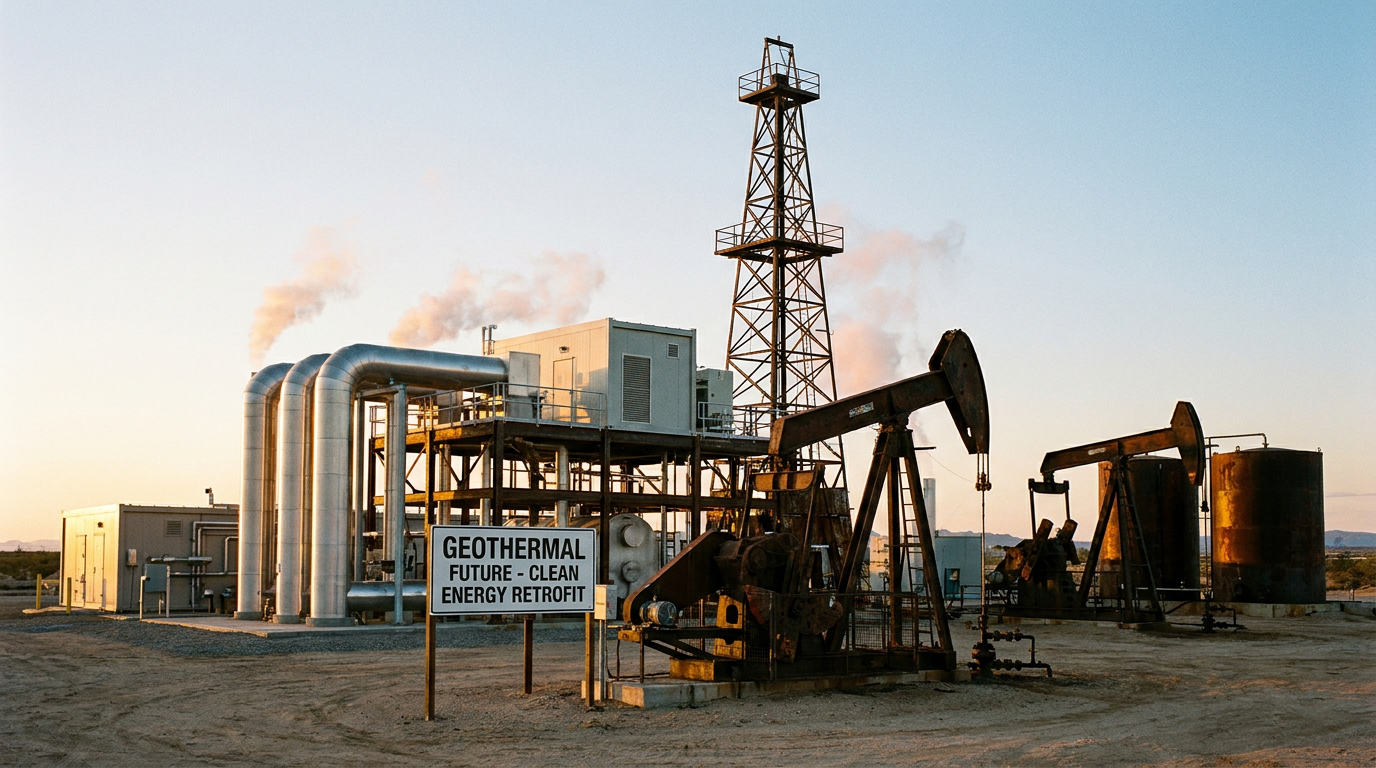
But a growing coalition of energy startups, academic researchers, and policymakers is beginning to view these holes in the ground not as toxic liabilities, but as untapped assets. The Earth's crust naturally grows hotter the deeper you drill, a phenomenon known as the geothermal gradient. Because many of these legacy oil and gas wells were drilled thousands of feet deep, they have already penetrated the hot rock layers necessary for geothermal energy production. By retrofitting the existing infrastructure, engineers are finding ways to harvest the subterranean heat and bring it to the surface, effectively transforming exhausted fossil fuel sites into zero-carbon power plants.[5][7]
Geothermal energy has long been considered the holy grail of renewable power because of its reliability. Unlike solar panels, which only generate electricity when the sun shines, or wind turbines, which rely on favorable weather, a geothermal plant operates 24 hours a day, seven days a week. This baseload power is crucial for stabilizing the electrical grid as more intermittent renewables come online. However, traditional geothermal development has been severely constrained by geography and economics. Historically, plants could only be built in regions with natural hot springs or volcanic activity, and the sheer cost of drilling deep exploratory wells often made projects financially unviable.[4][7]

This is where abandoned oil and gas wells dramatically alter the economic equation. In a conventional geothermal project, the initial drilling phase can account for 30 to 50 percent of the total capital budget. By utilizing boreholes that have already been drilled, cased, and mapped, geothermal developers can bypass the most expensive and risky phase of construction. The subsurface data—including rock permeability, temperature gradients, and fluid dynamics—has already been collected by the original oil operators. This wealth of existing infrastructure and data allows clean energy companies to deploy their technology faster and at a fraction of the traditional cost.[5][7]
Engineers are utilizing two primary mechanisms to extract heat from these legacy wells. The first method is known as co-production, which takes advantage of wells that are still producing small amounts of hydrocarbons alongside massive volumes of hot water. In many mature oilfields, a well might pump up 98 percent boiling water and only 2 percent oil. Instead of treating this hot water as a nuisance waste product, co-production systems run the scalding fluid through a surface heat engine to generate electricity before reinjecting the water back into the earth. This allows operators to generate clean power to run their own onsite equipment, significantly reducing the carbon footprint of their remaining oil operations.[1][3]
The second, more transformative method involves closed-loop geothermal systems, which are ideal for wells that are completely dry or fully abandoned. In a closed-loop setup, engineers insert a sealed pipe deep into the existing wellbore. A specialized working fluid—often water mixed with conductive additives, or supercritical carbon dioxide—is pumped down the pipe. As the fluid travels miles underground, it absorbs the intense heat radiating from the surrounding rock. The superheated fluid then travels back up a parallel inner pipe to the surface, where it flashes into steam to spin a turbine and generate electricity. Because the system is entirely sealed, no fluids are exchanged with the surrounding rock, eliminating the risk of groundwater contamination or induced seismicity.[4][5]

A vanguard of innovative startups is already proving that this technology works in the field. Companies like Gradient Geothermal and Sage Geosystems have successfully launched pilot projects that demonstrate the commercial viability of well retrofits. By combining cutting-edge thermodynamics with the heavy-duty engineering expertise of the oil patch, these firms are bridging the gap between the fossil fuel era and the clean energy transition. They are actively scouting the millions of idle wells across North America, identifying the prime candidates that offer the perfect combination of depth, temperature, and proximity to electrical grid connections.[3][4]
A vanguard of innovative startups is already proving that this technology works in the field.
The results from early pilot programs have been highly encouraging. At the Blackburn oilfield in Nevada, Gradient Geothermal successfully installed American-made heat engines on an existing oil well, generating enough renewable electricity to power onsite operations and even construct new rural electric vehicle charging infrastructure. The project marked a historic milestone as the first privately funded initiative to successfully produce geothermal baseload power at an active oil site. The success in Nevada has provided a blueprint for how operators can incrementally decarbonize their portfolios while generating new revenue streams from aging assets.[1][3]
The transition is also creating a vital bridge for the energy workforce. In states like Texas and Oklahoma, the push to retrofit wells is being led by former oil and gas professionals. The skills required to design, deploy, and maintain a closed-loop geothermal well are nearly identical to those used in hydraulic fracturing and deep-water drilling. Petroleum engineers, rig operators, and geoscientists are finding that their decades of experience in extracting hydrocarbons are perfectly suited for extracting heat. This dynamic offers a compelling economic narrative: a clean energy transition that doesn't displace the traditional energy workforce, but rather relies on it to build the next generation of power infrastructure.[4][7]
The federal government has recognized the massive potential of this synergy and is actively accelerating its development. Through the Department of Energy's Wells of Opportunity initiative, millions of dollars in grants are being distributed to help existing well owners and operators tap into their idle infrastructure. The program is designed to reduce the technical risks associated with early-stage retrofits and to prove that these hybrid systems can operate reliably over the long term. By partnering directly with the private sector, the Department of Energy hopes to unlock gigawatts of untapped geothermal potential, supporting broader national goals for a carbon-free electrical grid.[1][7]

State legislatures are also moving aggressively to remove regulatory hurdles and incentivize the repurposing of orphaned wells. In Oklahoma, lawmakers recently advanced the Well Repurposing Act, a landmark piece of legislation designed to create a streamlined legal framework for companies to purchase abandoned wells and convert them into geothermal assets. Modeled after similar efforts in New Mexico, the bill acknowledges that these wells are currently a massive liability for the state. By transferring ownership to geothermal developers, states can simultaneously erase millions of dollars in cleanup obligations while boosting local tax revenues and grid resilience.[6][7]
Beyond generating electricity, the heat extracted from these wells is being utilized for direct-use applications, which require lower temperatures and simpler engineering. In Tuttle, Oklahoma, a pioneering project funded by the Department of Energy is tapping into four nearby hydrocarbon wells to provide direct heating for the local elementary and middle schools. By circulating the low-grade geothermal heat through the schools' HVAC systems, the district is drastically reducing its winter heating bills and carbon emissions. Similar direct-use projects are being explored to heat massive commercial greenhouses, industrial drying facilities, and municipal district heating networks.[1][7]
Academic researchers are even exploring ways to use these deep boreholes as massive subterranean batteries. A recent study from Penn State University demonstrated that depleted oil and gas wells could be integrated with compressed-air energy storage systems. When the grid has excess power from wind or solar, compressors pump air deep into the heated wells. Because gases increase in pressure as they heat up, the natural geothermal warmth of the well amplifies the stored energy. When the grid needs power, the highly pressurized, heated air is released to spin a turbine. The researchers found that utilizing the natural heat of the well improved the overall efficiency of the storage system by nearly 10 percent.[2][7]
Despite the immense promise, the industry still faces significant engineering and economic hurdles. The most pressing challenge is well integrity. Many of the prime candidates for retrofitting were drilled decades ago, and their steel casings and cement seals have been subjected to years of corrosive fluids and immense pressure. Before a well can be safely repurposed for closed-loop geothermal or compressed air storage, engineers must conduct rigorous diagnostic tests to ensure the casing won't rupture under the new thermal stresses. In some cases, the cost of repairing a degraded wellbore can exceed the savings of skipping the initial drilling phase.[5][7]

Ultimately, the success of this emerging industry will depend on achieving economies of scale. If developers can standardize the retrofitting process and secure predictable regulatory approvals, the millions of idle wells across the globe could become the foundation of a new, decentralized geothermal grid. By turning the environmental liabilities of the fossil fuel era into the clean energy engines of the future, the energy sector has a rare opportunity to solve two massive problems at once: permanently capping the methane leaks of the past, while securing the firm, reliable baseload power needed for the future.[5][7]
How we got here
2020
The U.S. Department of Energy launches the Wells of Opportunity initiative to fund research into repurposing hydrocarbon infrastructure for geothermal use.
May 2022
Transitional Energy (now Gradient Geothermal) successfully generates electricity from an active oil well in Nevada, marking the first privately funded pilot of its kind.
March 2024
Sage Geosystems successfully tests a new closed-loop heat extraction method in an abandoned Shell oil well in Texas.
March 2026
The Oklahoma House of Representatives passes the Well Repurposing Act, creating a legal framework to transfer orphaned wells to geothermal developers.
June 2026
Ongoing pilot projects across the American West continue to prove the commercial viability of both co-production and closed-loop geothermal retrofits.
Viewpoints in depth
Geothermal Innovators
Startups and clean-energy developers view abandoned wells as a massive shortcut to scaling baseload renewable power.
For geothermal startups, the primary barrier to entry has always been the exorbitant cost and risk of exploratory drilling. By taking over existing wellbores, these companies can bypass up to 50 percent of their capital expenditures. They argue that this approach not only makes geothermal energy financially competitive with wind and solar but also provides the crucial 24/7 reliability that intermittent renewables lack. Their focus is on rapidly standardizing the retrofit technology so it can be deployed across thousands of sites simultaneously.
The Oil & Gas Industry
Fossil fuel operators see well repurposing as a way to erase environmental liabilities while creating new revenue streams.
The oil and gas sector is facing mounting pressure from regulators and investors to clean up millions of orphaned wells, a liability that could cost hundreds of billions of dollars. Industry leaders view geothermal retrofitting as a financial lifeline. Instead of paying $100,000 to plug a dry hole, operators can lease or sell the asset to a geothermal developer. Furthermore, the industry emphasizes that its existing workforce—drilling engineers, geophysicists, and rig operators—possesses the exact skill set needed to build this new clean-energy infrastructure, ensuring a just transition for fossil fuel workers.
State Policymakers
State governments view the transition as a dual solution to grid instability and taxpayer-funded environmental cleanups.
Lawmakers in energy-heavy states like Texas, Oklahoma, and New Mexico are acutely aware of the orphaned well crisis, which leaks methane and threatens groundwater. Because the cost of plugging these wells often falls on the state when operators go bankrupt, policymakers are eager to transfer the liability to the private sector. By passing legislation that streamlines the transfer of well ownership to geothermal companies, states hope to simultaneously clean up their environment, generate new property tax revenues, and secure reliable local power for their electrical grids.
What we don't know
- It remains unclear what percentage of the 3.9 million idle wells have the structural integrity required to withstand the thermal stresses of a geothermal retrofit.
- The long-term degradation rate of the specialized working fluids used in closed-loop systems over decades of continuous operation is still being studied.
- Regulatory frameworks regarding the ownership of subterranean heat rights—as opposed to mineral rights—are still unresolved in many jurisdictions.
Key terms
- Geothermal Gradient
- The rate at which the Earth's temperature increases with depth, which makes deep oil wells naturally hot at their base.
- Baseload Power
- The minimum amount of electrical power needed to be supplied to the electrical grid at any given time, requiring energy sources that run 24/7.
- Co-production
- A geothermal method that extracts heat from the hot water naturally brought to the surface alongside oil and gas during traditional extraction.
- Closed-loop System
- A geothermal setup where a sealed pipe is inserted into a well, allowing a fluid to circulate and absorb underground heat without touching the surrounding rock.
- Orphaned Well
- An abandoned oil or gas well for which no legally responsible owner or operator can be found, leaving the cleanup costs to the state.
- Working Fluid
- A specialized liquid or gas pumped through a closed-loop system to efficiently absorb and transport heat to the surface.
Frequently asked
Why is geothermal energy better than solar or wind?
Geothermal energy provides baseload power, meaning it generates electricity 24 hours a day, seven days a week, regardless of weather conditions or time of day.
How much does it cost to plug an abandoned oil well?
Safely plugging and sealing a single abandoned well typically costs between $75,000 and $150,000, creating a massive financial liability for states and operators.
Does repurposing these wells cause earthquakes like fracking?
No. Closed-loop geothermal systems are entirely sealed and do not inject high-pressure fluids into the surrounding rock, eliminating the risk of induced seismicity or groundwater contamination.
Can the heat be used for anything besides making electricity?
Yes. The extracted heat can be used directly for district heating, warming commercial greenhouses, or providing climate control for schools and municipal buildings.
Sources
Source coverage
7 outlets
4 viewpoints surfaced







[1]U.S. Department of EnergyGeothermal Innovators
Wells of Opportunity Initiative: Geothermal Energy from Oil and Gas Wells
Read on U.S. Department of Energy →[2]Penn State UniversityEnergy Researchers
Taking advantage of natural geothermal heat in depleted oil and gas wells
Read on Penn State University →[3]ThinkGeoEnergyGeothermal Innovators
Transitional Energy successfully produces geothermal energy from an oilfield in Nevada
Read on ThinkGeoEnergy →[4]GristGeothermal Innovators
How the oil and gas industry could help unlock geothermal power
Read on Grist →[5]Society of Petroleum EngineersThe Oil & Gas Industry
Repurposing Abandoned Oil and Gas Wells for Geothermal Energy Production
Read on Society of Petroleum Engineers →[6]State Policy NewsState Policymakers
States look to abandoned oil wells for geothermal heat
Read on State Policy News →[7]Factlen Editorial Team
Synthesis by Factlen editorial team
Read on Factlen Editorial Team →
Every angle. Every day.
Get energy stories with full source coverage and perspective breakdowns delivered to your inbox.