
OLED vs. Mini-LED in 2026: Choosing the Right TV Display Technology
As Tandem OLEDs and 5,000-zone Mini-LEDs hit the market in 2026, the gap between the two leading TV technologies has narrowed. Choosing the right panel now depends entirely on room lighting, screen size, and viewing habits.
By Factlen Editorial Team
- Home Theater Purists
- Advocates for OLED technology who prioritize perfect contrast and pixel-level precision above all else.
- Bright-Room Viewers
- Consumers and analysts who argue that raw brightness and glare resistance are the most important factors for everyday living spaces.
- Value & Size Maximizers
- Shoppers focused on the price-to-inch ratio, favoring Mini-LED for its affordability at massive screen sizes.
What's not represented
- · Projector Enthusiasts
- · Budget LCD Shoppers
Why this matters
A premium TV is a multi-year investment that dictates your daily entertainment experience. Understanding the exact trade-offs between OLED's perfect contrast and Mini-LED's daylight-beating brightness ensures you don't overspend on the wrong technology for your living room.
Key points
- OLED TVs offer perfect black levels and infinite contrast by turning individual pixels completely off.
- Mini-LED TVs deliver massive peak brightness of up to 5,000 nits, making them ideal for sunlit rooms.
- OLED panels still carry a slight risk of burn-in with static content, whereas Mini-LEDs are immune to permanent image retention.
- Mini-LED technology is significantly more cost-effective at massive screen sizes, dominating the 85-inch to 115-inch market.
The 2026 television landscape has crystallized into a two-horse race, forcing consumers to make a definitive choice between two highly refined display technologies: OLED and Mini-LED. As manufacturers roll out their latest flagship models, the historical gaps between the two have narrowed significantly. Tandem OLED panels are pushing organic light-emitting diodes to unprecedented brightness levels, while Mini-LED backlights have densely packed thousands of dimming zones to virtually eliminate light bleed. Yet, despite these engineering marvels, the underlying physics of each panel type remain distinct, meaning there is no single best television—only the right television for a specific room.[1][4]
Understanding this trade-off requires looking at how each screen generates an image. OLED, or Organic Light-Emitting Diode, is a self-emissive technology. Every single pixel on an OLED screen produces its own light and color, operating entirely independently of its neighbors. Mini-LED, conversely, is an evolution of the traditional LCD television. It relies on a liquid crystal panel to create colors, which is illuminated from behind by a grid of microscopic light-emitting diodes. Rather than controlling light at the individual pixel level, Mini-LEDs group these tiny lights into dimming zones that brighten or darken in clusters based on the content on the screen.[3][6]
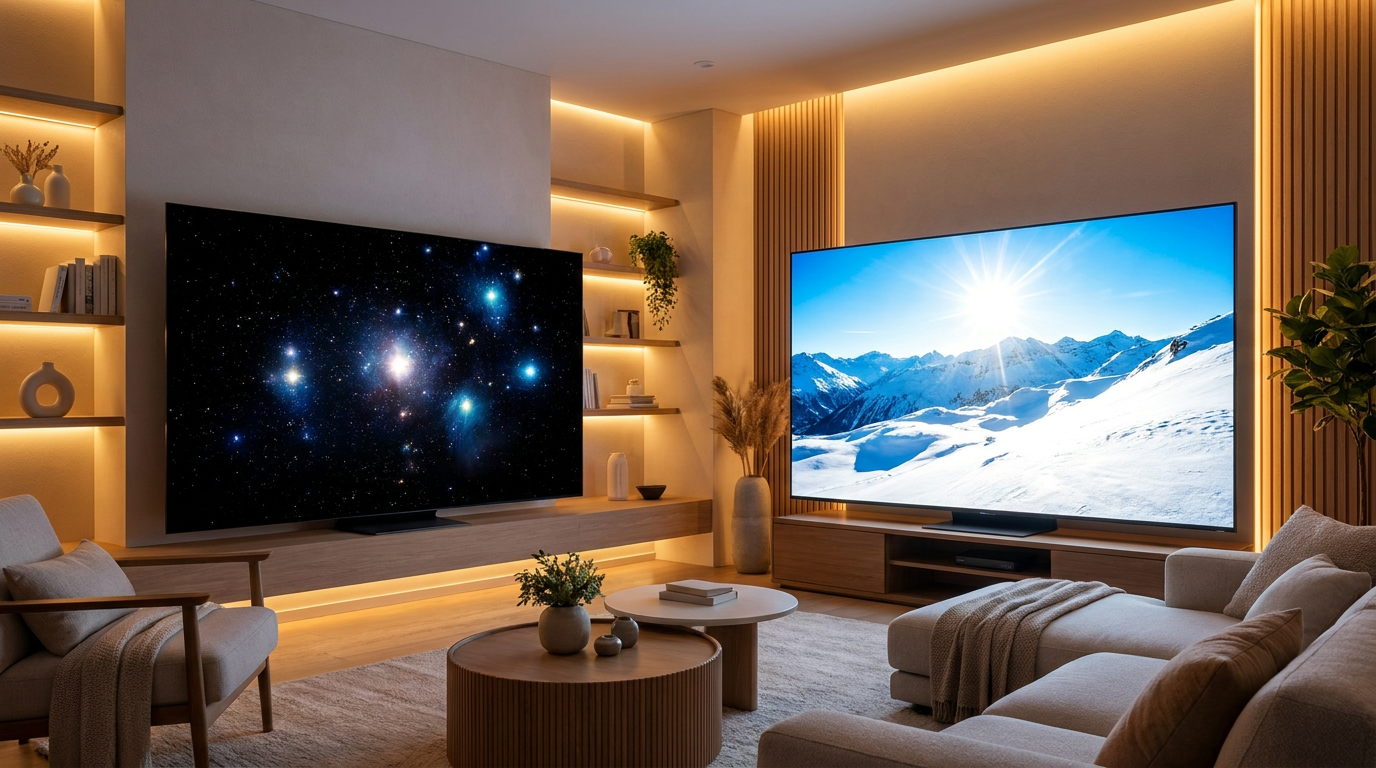
The strongest argument for OLED remains its absolute mastery of contrast and shadow detail. Because an OLED panel can turn individual pixels completely off, it achieves a true black level of exactly zero nits. This pixel-level precision means a bright star in a night sky will shine brilliantly without casting any hazy glow onto the surrounding black space. For cinematic purists watching high-dynamic-range movies in a dark room, this infinite contrast ratio creates a sense of depth and three-dimensionality that backlit technologies simply cannot replicate. Furthermore, OLED panels offer near-instantaneous pixel response times of 0.03 milliseconds and maintain perfect color accuracy even when viewed from extreme side angles.[3][5]

However, the case against OLED centers on its physical limitations regarding sustained brightness and long-term durability. To protect the organic materials from overheating and premature degradation, OLED televisions employ an Auto Brightness Limiter. While a 2026 Tandem OLED might hit impressive peak highlights in small areas, if a scene requires the entire screen to be bright—such as a hockey game or a snow-covered landscape—the television will aggressively dim the entire panel, often dropping to between 250 and 400 nits. Additionally, while modern mitigation software has vastly improved panel longevity, OLEDs still carry a fundamental risk of permanent burn-in if static elements like news tickers or video game interfaces are displayed for thousands of hours.[3][5]
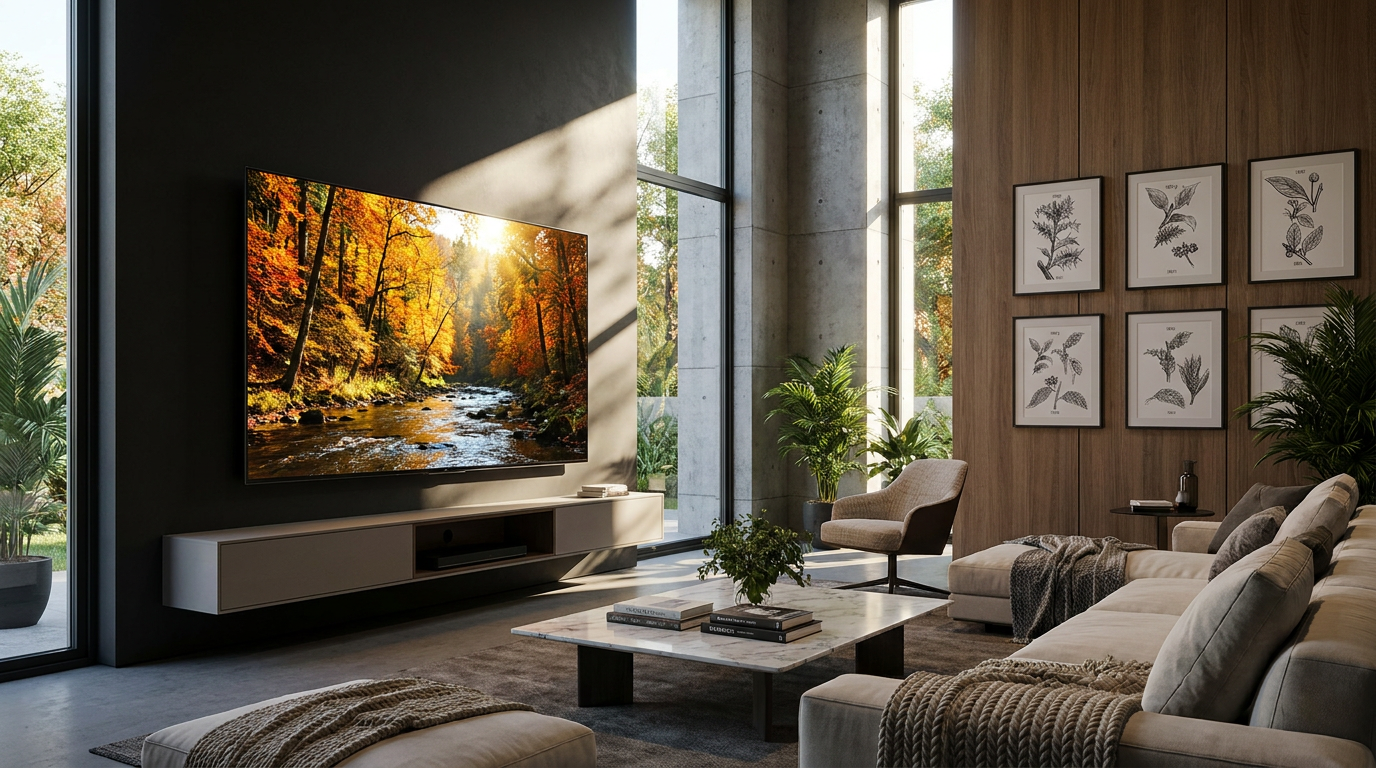
This is exactly where Mini-LED builds its strongest case: blinding, uncompromised brightness and absolute durability. Premium 2026 Mini-LED televisions operate as literal light cannons, routinely hitting peak brightness levels between 3,000 and 5,000 nits. More importantly, because they use inorganic materials, they do not require aggressive dimming limiters. A Mini-LED television can sustain a full-screen brightness of well over 1,000 nits indefinitely, allowing HDR highlights to punch through the glare of a sun-drenched living room with ease. Because there is zero risk of burn-in, these panels can be left on all day displaying static news channels or used as massive productivity monitors without any anxiety over panel degradation.[3][5][6]
This is exactly where Mini-LED builds its strongest case: blinding, uncompromised brightness and absolute durability.
The primary argument against Mini-LED lies in its reliance on local dimming zones. Even with flagship 2026 models boasting upwards of 5,000 independent zones, a single zone still illuminates thousands of pixels at once. When a bright object moves across a dark background, some light inevitably bleeds into the adjacent dark pixels, creating a faint halo effect known as blooming. While modern algorithms have reduced this artifact to a minimum, it remains visible to discerning eyes in dark-room viewing. Furthermore, because Mini-LEDs utilize LCD panels—typically VA-type panels to maximize contrast—their color saturation and black levels degrade quickly when viewed from off-center seating positions.[3][6]

Beyond picture quality, the most dramatic trade-off between the two technologies in 2026 is the relationship between screen size and price. Manufacturing massive sheets of flawless organic OLED material remains incredibly expensive, causing OLED pricing to skyrocket exponentially once screen sizes exceed 77 inches. A 97-inch OLED television remains a luxury item, often carrying a price tag north of $20,000. Mini-LED, utilizing standard LCD fabrication plants, scales much more efficiently. Consumers can now purchase highly capable 100-inch and even 115-inch Mini-LED televisions for a fraction of the cost of a comparable OLED, making Mini-LED the undisputed champion of the ultra-large-format home theater.[1][6]
For gamers, the trade-off requires weighing motion clarity against interface anxiety. Both technologies now universally support 4K resolution at 120Hz or 144Hz, alongside Variable Refresh Rate and Auto Low Latency Mode. Competitive gamers often favor OLED for its instantaneous pixel response, which eliminates motion blur during fast-paced camera pans. However, players who dedicate hundreds of hours to a single title with a static heads-up display—such as an unmoving health bar or mini-map—often gravitate toward Mini-LED to completely eliminate the lingering fear of permanent screen burn-in.[5][6]

Ultimately, choosing the right television requires matching the technology to the environment. OLED fits perfectly when the primary viewing space is a light-controlled room or a dedicated home theater. It is the definitive choice for cinephiles who demand perfect shadow detail, and for viewers who prioritize micro-contrast and wide viewing angles over sheer luminance. Conversely, OLED does not fit well in sun-drenched living rooms with wide, uncovered windows, or in households where the television serves as an always-on background appliance displaying static content for eight hours a day.[3][5]
On the other side of the aisle, Mini-LED fits exceptionally well in bright, open-concept living spaces where ambient daylight would easily wash out a lesser screen. It is the ideal technology for daytime sports viewing, heavy productivity use, and buyers looking to maximize their screen size without spending the equivalent of a new car. However, Mini-LED does not fit well for uncompromising dark-room purists who are highly sensitive to backlight blooming, or for viewers who frequently watch television from wide, off-center seating arrangements where the LCD panel's contrast begins to fade.[1][5]
How we got here
2013
First commercial large-screen OLED TVs hit the market, establishing a new benchmark for contrast.
2019
Mini-LED technology is introduced to consumer televisions, offering a brighter alternative to standard LCDs.
2024
Mini-LED zone counts cross the 2,000 mark, significantly reducing the blooming effect.
2026
Tandem OLEDs and 5,000-zone Mini-LEDs become widely available, pushing both technologies to new performance peaks.
Viewpoints in depth
Home Theater Purists
Advocates for OLED technology who prioritize perfect contrast and pixel-level precision above all else.
For cinematic purists, the television is a window into the director's exact vision, and any light bleed is an unacceptable distraction. This camp argues that OLED's ability to turn individual pixels completely off—achieving a true 0-nit black level—creates a sense of depth and three-dimensionality that no backlit LCD can replicate. They point to the 0.03-millisecond response time and perfect viewing angles as evidence that OLED remains the undisputed king of dark-room viewing, where absolute brightness matters less than micro-contrast.
Bright-Room Viewers
Consumers and analysts who argue that raw brightness and glare resistance are the most important factors for everyday living spaces.
This perspective highlights the reality of modern home design: open-concept living rooms with massive windows and abundant natural light. For these viewers, OLED's perfect blacks are irrelevant if the screen acts like a mirror during a Sunday afternoon football game. They champion Mini-LED's ability to push 3,000 to 5,000 nits of peak brightness, arguing that the technology's sheer luminous power and immunity to permanent burn-in make it the only logical choice for mixed-use, brightly lit environments.
Value & Size Maximizers
Shoppers focused on the price-to-inch ratio, favoring Mini-LED for its affordability at massive screen sizes.
As the demand for 85-inch, 98-inch, and even 115-inch televisions skyrockets, this camp evaluates display technology through the lens of manufacturing economics. Because OLED panels become exponentially more expensive to produce at massive scales, a 97-inch OLED can cost upwards of $25,000. In contrast, 100-inch Mini-LED models are now available for under $3,000. For these buyers, the slight trade-off in absolute black levels is a negligible price to pay for a genuinely cinematic, wall-filling screen size that fits within a realistic consumer budget.
What we don't know
- How long the new Tandem OLED structures will actually last under heavy real-world use before showing signs of degradation.
- Whether future Micro-LED technology will eventually become affordable enough to replace both OLED and Mini-LED in the consumer market.
Key terms
- OLED (Organic Light-Emitting Diode)
- A display technology where each individual pixel generates its own light and can turn off completely to create perfect blacks.
- Mini-LED
- An advanced LCD technology that uses thousands of microscopic LEDs behind the screen to create highly precise, intensely bright backlight zones.
- Nits
- A unit of measurement for screen brightness; one nit is roughly equivalent to the light of a single candle spread over a square meter.
- Blooming (Halo Effect)
- A visual artifact on backlit TVs where light from a bright object bleeds into the surrounding dark areas of the screen.
- ABL (Auto Brightness Limiter)
- A protective feature in OLED TVs that automatically dims the screen when a large portion of the image becomes intensely bright, preventing overheating and pixel wear.
- Tandem OLED
- A newer OLED architecture that stacks multiple light-emitting layers to increase overall brightness and extend the panel's lifespan.
Frequently asked
Will an OLED TV get burn-in from normal watching?
For varied, everyday viewing of movies and shows, modern OLEDs are highly resistant to burn-in. However, leaving static elements like news tickers or game HUDs on screen for many hours daily still poses a risk.
Why are Mini-LED TVs so much cheaper at larger sizes?
Manufacturing large sheets of organic OLED material without defects is incredibly difficult and expensive. Mini-LEDs use standard LCD fabrication processes, making 85-inch and 100-inch panels far more cost-effective to produce.
Which TV is better for a bright, sunny living room?
Mini-LED is the clear winner for bright rooms. Its ability to sustain full-screen brightness over 1,000 nits ensures the picture remains vibrant and visible even in direct sunlight.
Do Mini-LED TVs have perfect blacks?
While 2026 models with thousands of dimming zones come very close, they cannot achieve the absolute 0-nit perfect blacks of an OLED, and may still show slight light bleed around bright objects.
Sources
Source coverage
6 outlets
3 viewpoints surfaced






[1]TechRadarValue & Size Maximizers
100-inch mini-LEDs vs OLED: the big screen battle
Read on TechRadar →[2]RTINGSValue & Size Maximizers
LG 2026 TV Lineup: OLED and RGB Mini LED
Read on RTINGS →[3]DisplayModuleHome Theater Purists
OLED vs Mini LED | Contrast, Brightness & Use
Read on DisplayModule →[4]What Hi-Fi?Home Theater Purists
Best TVs 2026: our top picks
Read on What Hi-Fi? →[5]KTC PlayBright-Room Viewers
Tandem OLED vs. Mini-LED: Choosing the Best HDR Panel in 2026
Read on KTC Play →[6]CurrysBright-Room Viewers
OLED vs Mini LED comparison guide
Read on Currys →

Every angle. Every day.
Get shopping stories with full source coverage and perspective breakdowns delivered to your inbox.