
Solid-State Batteries Move from Lab to Pilot Production in 2026
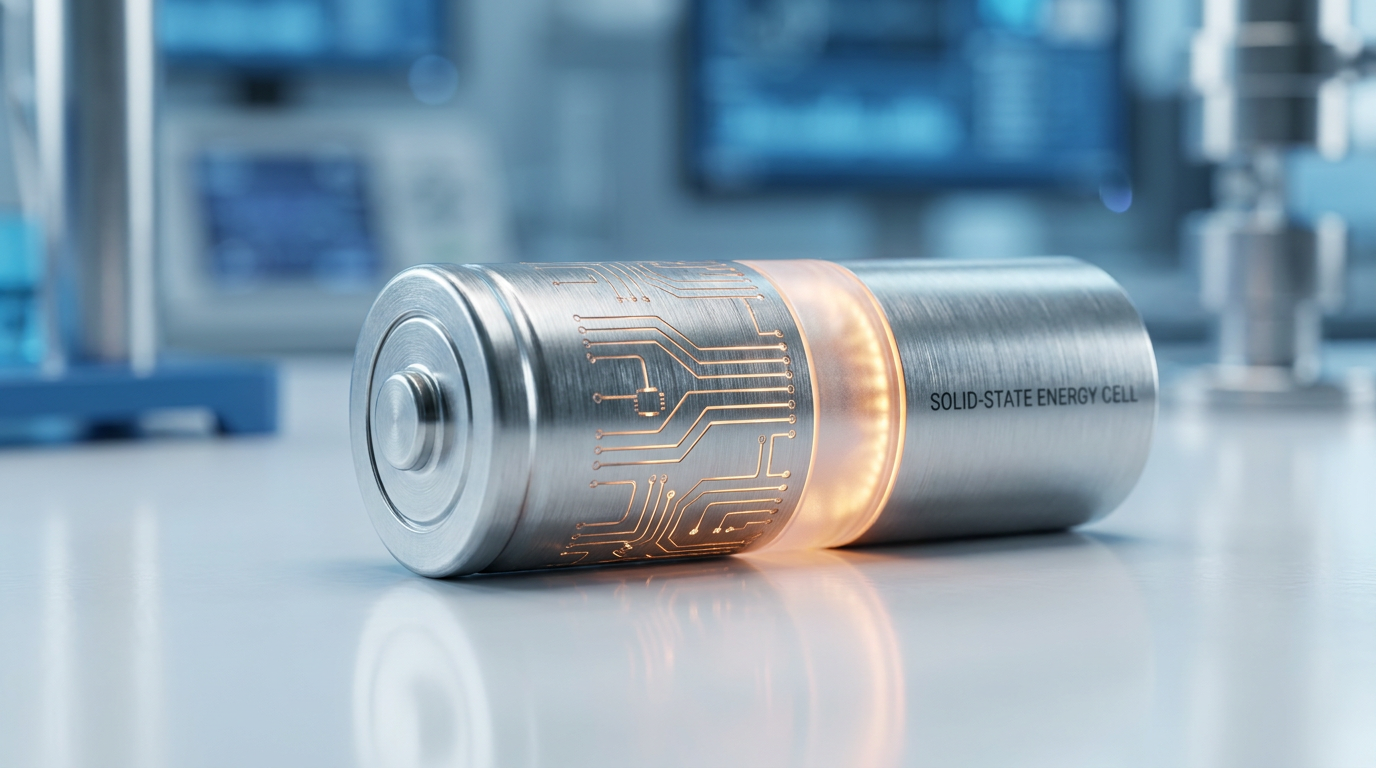
The automotive industry's 'holy grail' battery technology is officially entering pilot manufacturing, promising to double EV range and eliminate fire risks.
By Factlen Editorial Team
- Solid-State Pioneers
- Companies heavily invested in solid-state technology argue that pilot production proves the chemistry is ready for the real world.
- Incumbent Manufacturers
- Market leaders in liquid lithium-ion batteries emphasize the massive mechanical hurdles of scaling solid-state production.
- Industry Analysts
- Market researchers view 2026 as a validation year, predicting a phased rollout starting with hybrid designs.
What's not represented
- · Raw Material Suppliers
- · Mass-Market EV Consumers
Why this matters
Solid-state batteries solve the two biggest hurdles to universal EV adoption: range anxiety and charging time. By moving into pilot production, the industry is proving that 15-minute charges and 600-mile ranges are no longer science fiction, but impending commercial realities.
Key points
- Solid-state batteries replace flammable liquid electrolytes with rigid materials like ceramics or polymers.
- The technology enables lithium-metal anodes, potentially doubling the energy density of current EV batteries.
- Major developers like QuantumScape and Toyota have initiated pilot manufacturing programs in 2026.
- Manufacturing bottlenecks, particularly the 'solid-solid interface,' make mass production highly difficult.
- Analysts expect early commercialization in premium vehicles by 2028, with mass-market adoption in the 2030s.
The electric vehicle industry has chased a "holy grail" for over a decade: a battery that charges in 15 minutes, resists catching fire, and drives 600 miles on a single charge. In 2026, that technology—the solid-state battery—is finally crossing the chasm from laboratory science project to pilot manufacturing.[8]
The shift is visible across the globe. In early 2026, California-based battery developer QuantumScape inaugurated its "Eagle Line," a highly automated pilot facility in San Jose designed to produce solid-state cells for automotive sampling.[1][2]
Meanwhile, Toyota has received official certification from the Japanese government to begin producing next-generation batteries, breaking ground on a large-scale solid electrolyte facility in partnership with Idemitsu Kosan. Chinese automakers like GAC and Dongfeng are also preparing prototype vehicles for extreme weather testing, with China drafting its first national standards for solid-state cells this year.[4][7]
To understand why the automotive world is pouring billions into this transition, one must look at the fundamental chemistry of current electric vehicles. Today's lithium-ion batteries rely on a liquid electrolyte—a chemical solvent that shuttles lithium ions back and forth between the anode and cathode during charging and discharging.[7]

While highly effective, this liquid solvent has two major drawbacks: it is inherently flammable, and it limits how much energy the battery can safely store. If a conventional battery is punctured in a crash, overcharged, or severely overheated, the liquid can ignite, leading to a dangerous chain reaction known as thermal runaway.[5][6]
Solid-state batteries replace this liquid with a rigid, non-flammable material—typically a ceramic, polymer, or sulfide glass. By eliminating the combustible liquid, the battery becomes fundamentally safer. It can withstand extreme temperatures and physical damage without erupting into flames, drastically reducing the need for heavy, complex cooling systems.[6][7]
But safety is only half the equation. The solid electrolyte acts as a robust physical barrier that suppresses the growth of dendrites—microscopic metallic whiskers that can cause short circuits. This allows engineers to swap out the traditional heavy graphite anode for one made of pure lithium metal.[5][7]
The solid electrolyte acts as a robust physical barrier that suppresses the growth of dendrites—microscopic metallic whiskers that can cause short circuits.
A lithium-metal anode drastically increases the battery's energy density. Current top-tier lithium-ion cells max out around 250 to 300 watt-hours per kilogram (Wh/kg). Solid-state developers are currently targeting 400 to 500 Wh/kg for their first-generation commercial cells.[7]

In practical terms, this means an automaker could build an EV with double the range without increasing the battery's physical footprint, or maintain current ranges while slashing the battery's weight and size by half. Furthermore, companies like QuantumScape have demonstrated cells that can fast-charge from 10% to 80% in just 15 minutes over hundreds of cycles without degrading.[1]
Despite these breakthrough metrics, the road to mass commercialization remains steep. Building a flawless solid-state battery in a pristine laboratory is an entirely different endeavor than manufacturing millions of them at a competitive price.[5]
The primary engineering bottleneck lies in the "solid-solid interface." In a conventional battery, the liquid electrolyte naturally coats the porous electrodes, ensuring perfect contact for ions to flow. In a solid-state battery, two rigid, dry materials must be pressed together flawlessly.[3][5]
CATL, the world's largest battery manufacturer, recently detailed this exact challenge. Chairman Robin Zeng noted that binding these solid components currently requires warm isostatic pressing at up to 6,000 atmospheres of pressure. Any microscopic gaps or structural misalignments increase internal resistance and rapidly degrade the battery's lifespan.[3]
Because of these extreme manufacturing requirements, true solid-state batteries remain expensive and difficult to produce at scale. Industry analysts project that the first wave of solid-state EVs—expected between 2027 and 2028—will be strictly limited to premium, high-margin luxury vehicles and flagship sports cars.[4][5]

Mass-market adoption will require further breakthroughs in manufacturing scale and yield. Experts forecast that high-volume commercialization, where solid-state cells reach cost parity with today's lithium-ion packs, is realistically positioned for the early 2030s.[5][6]
In the interim, the industry will likely see a spectrum of hybrid or "semi-solid" batteries that bridge the gap, utilizing a mix of solid electrolytes and small amounts of liquid gels to ease manufacturing while still boosting performance.[5]
Ultimately, 2026 marks the critical inflection point for the industry. The fundamental science of solid-state batteries has been proven; the challenge has now officially shifted from chemical discovery to mechanical engineering and industrial scale.[6][8]

How we got here
Early 2020s
Automakers and startups invest billions into solid-state laboratory research to solve energy density limits.
2024
Toyota receives Japanese government certification to begin building solid-state production infrastructure.
Early 2026
QuantumScape inaugurates its 'Eagle Line' pilot facility to begin supplying test cells to automakers.
2027–2028
Projected timeline for the first limited commercial rollouts of solid-state batteries in premium EVs.
Viewpoints in depth
Solid-State Pioneers
Companies heavily invested in solid-state technology argue that pilot production proves the chemistry is ready for the real world.
Developers like QuantumScape and automakers like Toyota view 2026 as the definitive turning point. Having achieved their laboratory targets for energy density and fast-charging cycle life, these pioneers argue that the fundamental science is solved. Their focus is now entirely on scaling up pilot lines to supply automotive partners with test cells. They project that limited commercial rollouts in premium vehicles are achievable by 2027 or 2028, positioning solid-state as a near-term competitive necessity rather than a distant science project.
Incumbent Battery Manufacturers
Market leaders in liquid lithium-ion batteries emphasize the massive mechanical hurdles of scaling solid-state production.
Companies that currently dominate global battery production, such as CATL, offer a more cautious timeline. While acknowledging the superior chemistry of solid-state cells, they point to the severe engineering bottlenecks of the 'solid-solid interface.' Because binding rigid materials requires extreme pressure and flawless precision, incumbent manufacturers argue that achieving high yields at gigawatt-hour scales is industrially difficult. They predict that true mass-market adoption—reaching millions of vehicles—will not occur until well into the 2030s, relying on continued advancements in existing lithium-iron-phosphate (LFP) technology in the meantime.
Industry Analysts
Market researchers view 2026 as a validation year, predicting a phased rollout starting with hybrid designs.
Independent analysts and research firms see the solid-state transition as a gradual evolution rather than an overnight revolution. They note that the initial high costs of solid-state manufacturing will restrict the technology to luxury cars, aerospace, and defense applications in the late 2020s. To bridge the gap, analysts expect a surge in 'semi-solid' or hybrid batteries—which use mostly solid materials but retain a small amount of liquid gel to ease manufacturing—allowing the industry to incrementally improve safety and range while working toward true all-solid-state architectures.
What we don't know
- Exactly how much the first generation of commercial solid-state batteries will cost per kilowatt-hour.
- Which automaker will be the first to successfully deliver a fully solid-state EV to a retail customer.
- Whether hybrid 'semi-solid' batteries will become the long-term standard or just a temporary stepping stone.
Key terms
- Electrolyte
- The medium inside a battery that allows electrical charge (ions) to flow between the cathode and anode.
- Anode
- The negative electrode of a battery; solid-state technology allows this to be made of pure lithium metal instead of heavier graphite.
- Thermal runaway
- A dangerous chain reaction where a battery overheats and catches fire, a risk primarily associated with liquid electrolytes.
- Energy density
- A measure of how much energy a battery can hold relative to its weight, typically expressed in watt-hours per kilogram (Wh/kg).
- Solid-solid interface
- The physical boundary where two rigid battery materials meet, which must be perfectly flush to allow energy to flow efficiently.
Frequently asked
What makes a solid-state battery different?
It replaces the flammable liquid chemical soup found in standard batteries with a rigid, non-flammable solid material like ceramic or sulfide glass.
Will solid-state batteries catch fire?
They are vastly safer than current batteries. By eliminating combustible liquid solvents, they are highly resistant to thermal runaway even if punctured or overheated.
When can I buy a car with a solid-state battery?
The first vehicles equipped with solid-state batteries are expected in 2027 or 2028, but they will likely be expensive luxury models. Mass-market availability is projected for the early 2030s.
Do solid-state batteries charge faster?
Yes. Leading developers have demonstrated prototype cells that can safely fast-charge from 10% to 80% in roughly 15 minutes without damaging the battery's lifespan.
Sources
Source coverage
8 outlets
3 viewpoints surfaced








[1]ElectrekIndustry Analysts
QuantumScape inaugurates Eagle Line pilot for solid-state battery production
Read on Electrek →[2]QuantumScapeSolid-State Pioneers
QuantumScape Celebrates Inauguration of Eagle Line for Solid-State Battery Production
Read on QuantumScape →[3]CarNewsChinaIncumbent Manufacturers
CATL Chairman Details Solid-State Battery Manufacturing Bottlenecks
Read on CarNewsChina →[4]Toyota Motor CorporationSolid-State Pioneers
Toyota Receives METI Certification for Next-Generation and All-Solid-State Batteries
Read on Toyota Motor Corporation →[5]Battery Tech OnlineIndustry Analysts
Reality Check: Manufacturing Integration Will Determine the Solid-State Race
Read on Battery Tech Online →[6]IDTechExIndustry Analysts
Solid-State Batteries 2026-2036: Technology, Forecasts, Players
Read on IDTechEx →[7]EV Infrastructure NewsIndustry Analysts
Solid-state batteries: Technology fundamentals and commercialisation explained
Read on EV Infrastructure News →[8]Factlen Editorial TeamIndustry Analysts
Synthesis by Factlen editorial team
Read on Factlen Editorial Team →
Every angle. Every day.
Get automotive stories with full source coverage and perspective breakdowns delivered to your inbox.