
2026 Rivian R2 vs. Tesla Model Y: The Midsize Electric SUV Showdown
Rivian's highly anticipated R2 arrives to challenge the best-selling Tesla Model Y, offering a rugged, off-road alternative to Tesla's on-road refinement.
By Factlen Editorial Team
- Utility and Off-Road Advocates
- Drivers and analysts who prioritize ground clearance, cargo space, and traditional SUV versatility.
- On-Road Performance Enthusiasts
- Reviewers and drivers who focus on acceleration, handling dynamics, and aerodynamic efficiency.
- Value and Budget Buyers
- Consumers focused on entry-level pricing, immediate availability, and overall cost of ownership.
What's not represented
- · Traditional Dealership Networks
- · Used EV Market Analysts
Why this matters
The midsize electric SUV segment is the most popular EV category in the world. Buyers finally have a choice between a traditional, rugged utility vehicle and a sleek, sports-oriented crossover at the exact same price point, fundamentally changing how families shop for their next car.
Key points
- The Rivian R2 Performance and Tesla Model Y Performance are priced almost identically at roughly $58,000 for 2026 buyers.
- Rivian's R2 offers true off-road capability with 9.6 inches of ground clearance, compared to Tesla's 6.0 inches.
- The Model Y remains the efficiency and acceleration leader, reaching 60 mph in 3.3 seconds.
- Both vehicles feature native NACS ports, granting them equal access to the Tesla Supercharger network.
- The R2 provides 90.1 cubic feet of cargo space with fold-flat seats, outperforming the Model Y's 76 cubic feet.
- Tesla holds a significant advantage for budget buyers in 2026, as Rivian's cheaper trims will not arrive until 2027.
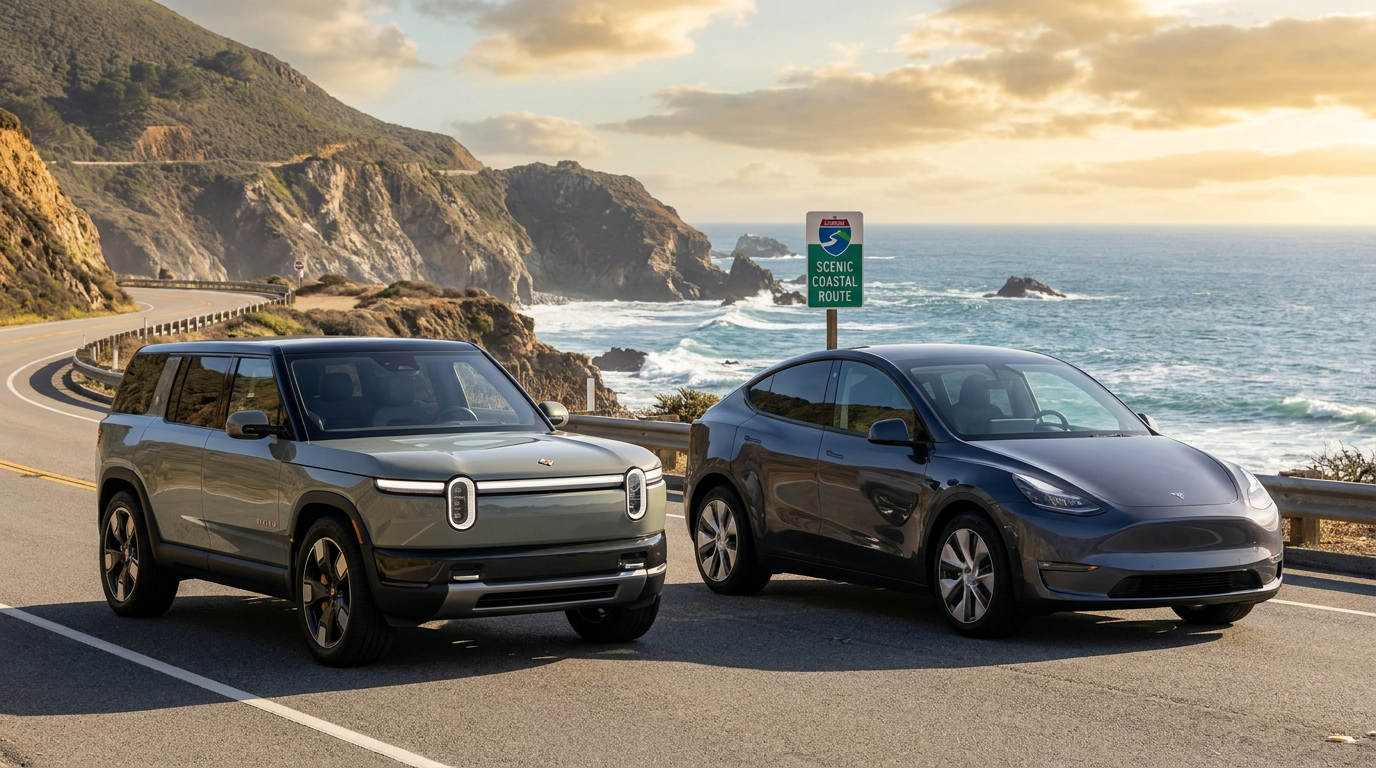
For years, the Tesla Model Y has operated without a direct, uncompromising rival in the midsize electric SUV segment, dominating global sales through a blend of efficiency, software, and charging convenience. That uncontested run ends in 2026 with the arrival of the Rivian R2. Designed specifically to challenge Tesla's supremacy, the R2 brings a fundamentally different philosophy to the same price bracket. Where Tesla built a sleek, aerodynamic crossover that drives like a sports sedan, Rivian has engineered a traditional, boxy utility vehicle designed for dirt trails and camping trips. Buyers in 2026 are no longer choosing between different flavors of the same concept; they are choosing between two entirely different definitions of what a modern family vehicle should be.[1][3]
The financial comparison requires immediate nuance, as the two automakers are operating on different production timelines. The argument for the Tesla Model Y is strongest at the entry level, where its rear-wheel-drive base model is available today for roughly $39,990. Against this, the Rivian R2's more affordable trims—targeting the $45,000 to $48,000 range—will not reach customers until 2027. However, the evidence shifts at the top of the market. For buyers shopping in 2026, Rivian is exclusively delivering the R2 Performance Launch Edition, priced at $57,990. This lines up almost exactly with the Tesla Model Y Performance, which sits at roughly $57,490. At this premium tier, the financial gap vanishes, forcing a decision based entirely on capability and design rather than budget.[1][5][7]
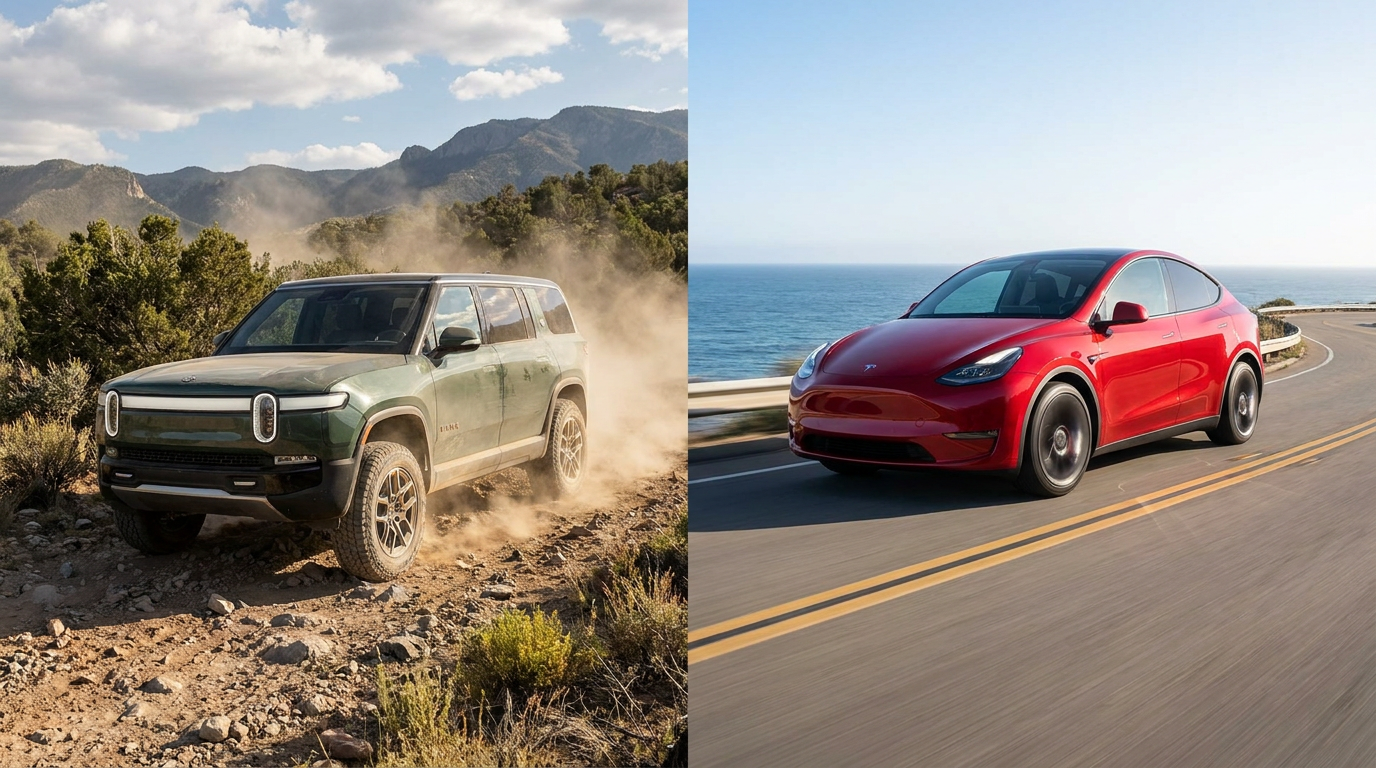
The primary argument for the Rivian R2 centers on its authentic sport-utility credentials. Unlike the Model Y, which shares its platform and much of its egg-like silhouette with the Model 3 sedan, the R2 was built from the ground up to prioritize outdoor versatility. The evidence for this capability is most visible in its stance. The R2 boasts 9.6 inches of ground clearance, a massive 60 percent increase over the Model Y's 6.0 inches. Combined with 32-inch tires and dedicated off-road driving modes for sand and rally conditions, the Rivian can navigate rutted trails and rocky inclines that would easily strand the lower-slung Tesla. For drivers who actually venture off the pavement, the R2 offers a level of mechanical confidence that its rival simply cannot match.[2][3][5]

The case for the R2 extends into the cabin, where its boxy dimensions translate into superior cargo logistics. The evidence is quantified in total volume: with the seats folded flat, the R2 offers 90.1 cubic feet of storage, significantly outperforming the Model Y's 76 cubic feet. Rivian also maximizes the front trunk, providing 5.2 cubic feet of space compared to Tesla's 4.1 cubic feet. Beyond raw numbers, the R2's interior architecture is designed for active lifestyles. Both the rear seats and the front driver and passenger seats fold completely flat, transforming the cabin into an impromptu camper or a cavernous cargo van for hauling long equipment like surfboards or lumber. It is a vehicle designed to swallow gear without compromise.[2][3][6]
The argument against the R2 focuses on the physical compromises inherent in its rugged design. A boxy, high-riding SUV is fundamentally less aerodynamic than a teardrop-shaped crossover, and the R2 carries a weight penalty, tipping the scales roughly 370 pounds heavier than the Model Y Performance. This added mass and aerodynamic drag mean the R2 requires a larger, heavier battery pack to achieve its range targets. Furthermore, while the R2's suspension is highly capable on dirt, the taller ride height and off-road-oriented tires introduce slightly more body roll and road noise at highway speeds. It is a highly refined vehicle, but physics dictates that it cannot slice through the air or hug a sweeping corner quite as effortlessly as its sleeker competitor.[5][7]
The argument against the R2 focuses on the physical compromises inherent in its rugged design.
The case for the Tesla Model Y rests on its exceptional on-road dynamics and sports-car-like agility. Tesla engineered the Model Y to prioritize tarmac performance, outfitting it with a lower center of gravity, stiffer suspension, and a highly responsive steering rack. The evidence is clear on a winding road, where the Model Y feels significantly more planted and eager to change direction than the taller Rivian. It drives much smaller than its dimensions suggest, offering a level of engagement that appeals to driving enthusiasts. For the vast majority of buyers whose daily routines consist of highway commutes and suburban errands rather than rock crawling, the Model Y's road-biased tuning provides a more engaging and efficient daily driving experience.[1][4]
The evidence for Tesla's engineering edge is most apparent in its acceleration and efficiency metrics. Despite the Rivian R2 Performance generating a massive 656 horsepower—considerably more than the Model Y Performance—the lighter, more aerodynamic Tesla is actually quicker in a straight line. The Model Y rockets from zero to 60 mph in just 3.3 seconds, edging out the R2's 3.6-second sprint. Tesla also maintains a slight advantage in fast-charging speeds, leveraging years of battery management optimization to complete a 10-to-80 percent charge a few minutes faster than the Rivian. These margins are narrow, but they underscore Tesla's ongoing mastery of electric powertrain efficiency and power delivery.[1][2][6]

The argument against the Model Y centers on its polarizing minimalism and lack of traditional utility. The aggressive sloping roofline that gives the Tesla its aerodynamic efficiency severely cuts into vertical cargo space, making it difficult to haul bulky, square items like furniture or large dog crates. Inside, the cabin's ultra-minimalist aesthetic remains a point of contention. Tesla routes almost every vehicle function—from adjusting the mirrors to viewing the speedometer—through a single central touchscreen, completely omitting a digital driver display behind the steering wheel. For many buyers, this stark environment feels less like a premium automobile and more like a rolling appliance, lacking the warmth, physical controls, and character found in more traditional luxury vehicles.[4][6]
Historically, any comparison between a Tesla and a competitor included a massive caveat regarding charging infrastructure, but the 2026 landscape has neutralized this advantage. The Rivian R2 is equipped with a native North American Charging Standard (NACS) port straight from the factory. This means R2 owners have seamless, adapter-free access to the vast Tesla Supercharger network, completely leveling the playing field for long-distance travel. Furthermore, the range estimates for the top-tier models are remarkably close. The R2 Performance, when equipped with 21-inch wheels, boasts an EPA-estimated 330 miles of range, slightly outpacing the Model Y Performance's 307 miles. Range anxiety and charging logistics are no longer deciding factors between these two vehicles.[1][2][7]
The contrast between the two vehicles is perhaps most striking from the driver's seat. Rivian has adopted a nature-inspired minimalism that feels distinctly premium and thoughtful. The R2 features a dedicated digital instrument cluster behind the steering wheel, dual gloveboxes for practical storage, and tactile scroll wheels on the steering yoke. It utilizes open-pore woods and durable, easy-to-clean materials that align with its outdoor branding. Tesla, conversely, doubles down on its stark, screen-centric environment. The Model Y's cabin is undeniably clean and features excellent build quality in its latest iteration, but it demands that the driver adapt to its software-first interface. The choice here is highly subjective: buyers must decide between Rivian's warm, functional layout and Tesla's futuristic, unadorned aesthetic.[3][4][6]

Ultimately, neither vehicle is objectively superior; they simply serve different masters. The Rivian R2 fits well when a buyer prioritizes interior space, genuine off-road capability, and a rugged aesthetic, and is willing to accept a slightly heavier vehicle to get it. It is the definitive choice for campers, outdoor enthusiasts, and families who need maximum cargo flexibility. The Tesla Model Y does not fit when a driver needs high ground clearance or physical cabin controls. However, the Model Y fits well when a buyer wants sports-sedan handling, maximum aerodynamic efficiency, and the lowest possible entry price in the current market. It remains the sensible, high-performance choice for the urban and suburban commuter.[1][3]
How we got here
March 2024
Rivian officially unveils the R2 midsize SUV, announcing its target price and design philosophy.
Late 2025
Tesla releases the heavily updated 'Juniper' refresh for the Model Y, improving interior materials and cabin insulation.
Spring 2026
The first Rivian R2 Performance Launch Edition models begin reaching customers, directly challenging the Model Y Performance.
2027
Rivian's lower-priced R2 trims, including the $45,000 base model, are scheduled to enter production.
Viewpoints in depth
Utility and Off-Road Advocates
Drivers and analysts who prioritize ground clearance, cargo space, and traditional SUV versatility.
This camp views the Rivian R2 as the first genuine electric SUV in its price bracket, rather than a lifted hatchback. They point to the 9.6 inches of ground clearance, the fold-flat seating that turns the cabin into a camper, and the 90.1 cubic feet of total storage as evidence that the R2 is built for actual utility. For these advocates, the slight aerodynamic penalty is a worthwhile trade-off for a vehicle that can confidently navigate rutted trails and haul bulky outdoor gear without compromise.
On-Road Performance Enthusiasts
Reviewers and drivers who focus on acceleration, handling dynamics, and aerodynamic efficiency.
This perspective favors the Tesla Model Y for its sports-sedan driving dynamics and superior efficiency. They emphasize that despite the R2's massive horsepower advantage, the lighter and more aerodynamic Model Y is quicker to 60 mph and feels significantly more agile on winding pavement. Because the vast majority of SUV owners rarely leave the tarmac, this camp argues that Tesla's lower center of gravity, stiffer suspension, and proven battery management software make it the superior daily driver.
Value and Budget Buyers
Consumers focused on entry-level pricing, immediate availability, and overall cost of ownership.
For budget-conscious buyers, the current market reality heavily favors Tesla. While the top-tier Performance models are priced identically, this camp highlights that a base rear-wheel-drive Model Y can be purchased today for under $40,000. Because Rivian's more affordable $45,000 to $48,000 trims will not arrive until 2027, analysts in this camp argue that the Model Y remains the only viable option for buyers who want to transition to a midsize electric SUV in 2026 without spending nearly $60,000.
What we don't know
- How Rivian's upcoming point-to-point hands-free driving software will perform in real-world conditions compared to Tesla's Autopilot.
- Whether Rivian can scale production fast enough in 2027 to meet the demand for its lower-priced $45,000 base models.
- How the long-term reliability of the brand-new R2 platform will compare to the mature, highly optimized Model Y architecture.
Key terms
- NACS (North American Charging Standard)
- The charging plug design originally developed by Tesla, which has now been adopted by most major automakers, including Rivian, to allow access to the Supercharger network.
- Frunk
- A portmanteau of 'front trunk,' referring to the enclosed storage space located under the hood of an electric vehicle where an engine would traditionally sit.
- Torque Vectoring
- A technology that allows a vehicle's computer to control the amount of power sent to each individual wheel, improving grip and handling on both winding roads and slippery off-road trails.
- MPGe
- Miles Per Gallon Equivalent, a metric used by the EPA to compare the energy efficiency of electric vehicles to traditional gas-powered cars.
Frequently asked
When will the cheaper Rivian R2 models be available?
While the $57,990 Performance Launch Edition arrives in spring 2026, Rivian's lower-priced trims, including a $45,000 base model, are not expected to reach customers until 2027.
Can the Rivian R2 use Tesla Superchargers?
Yes. The Rivian R2 is built with a native NACS (North American Charging Standard) port, allowing it to plug directly into compatible Tesla Superchargers without needing an adapter.
Which SUV has more cargo space?
The Rivian R2 offers significantly more storage. With the seats folded flat, the R2 provides 90.1 cubic feet of total cargo space, compared to the Model Y's 76 cubic feet.
Is the Tesla Model Y faster than the Rivian R2?
Yes, slightly. Despite the R2 Performance having more horsepower, the lighter Model Y Performance accelerates from zero to 60 mph in 3.3 seconds, edging out the R2's 3.6 seconds.
Sources
Source coverage
7 outlets
3 viewpoints surfaced







[1]Road EthosOn-Road Performance Enthusiasts
Tesla Model Y: An Honest Comparison For 2026 Buyers
Read on Road Ethos →[2]CarBuzzUtility and Off-Road Advocates
Here's every way the new SUV is ready to beat the Model Y
Read on CarBuzz →[3]AutoblogValue and Budget Buyers
Rivian R2 vs Tesla Model Y
Read on Autoblog →[4]CarwowOn-Road Performance Enthusiasts
Rivian R2 vs Tesla Model Y: which should you buy?
Read on Carwow →[5]ElectrekUtility and Off-Road Advocates
Rivian R2 specs price vs Model Y
Read on Electrek →[6]AutoNocionUtility and Off-Road Advocates
Tesla Model Y vs. Rivian R2: Range and driving experience
Read on AutoNocion →[7]EdmundsValue and Budget Buyers
2026 Rivian R2
Read on Edmunds →
Every angle. Every day.
Get automotive stories with full source coverage and perspective breakdowns delivered to your inbox.