
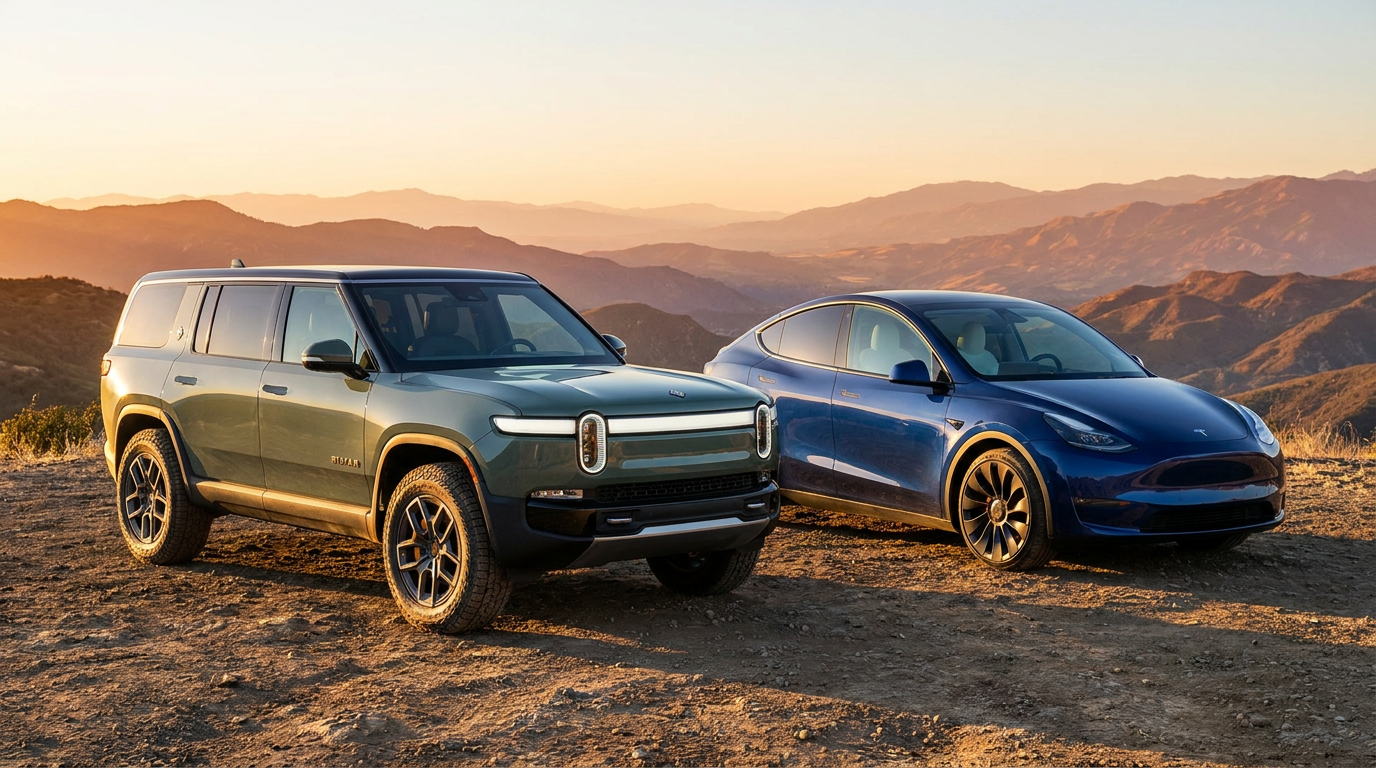
2026 Rivian R2 vs. Tesla Model Y: The Electric SUV Showdown
The highly anticipated Rivian R2 brings rugged off-road utility to challenge the aerodynamic efficiency and market dominance of the Tesla Model Y.
By Factlen Editorial Team
- Efficiency & Value Advocates
- Argue that the Model Y's lower entry price, superior aerodynamics, and proven charging efficiency make it the pragmatic choice.
- Adventure & Utility Seekers
- Emphasize the Rivian R2's off-road geometry, larger cargo capacity, and lifestyle features as game-changers for the segment.
- General Market Analysts
- View the vehicles as equals that cater to entirely different buyer identities, noting the closing gap in charging access.
What's not represented
- · Traditional Auto Manufacturers
- · Used EV Buyers
Why this matters
For buyers navigating the booming electric SUV market, this rivalry finally breaks Tesla's monopoly on the mid-size segment. Choosing between the Model Y and the R2 dictates not just how much you spend, but whether your vehicle is optimized for daily commuting efficiency or weekend off-road adventures.
Key points
- The Tesla Model Y starts at $39,990, while the Rivian R2 currently starts at $59,485 for the Launch Edition.
- The Model Y Performance is slightly faster, hitting 60 mph in 3.3 seconds compared to the R2's 3.6 seconds.
- The Rivian R2 offers genuine off-road capability with 9.6 inches of ground clearance and a torque-vectoring system.
- Both vehicles use the NACS charging standard, granting them access to the Tesla Supercharger network.
- The R2 provides significantly more cargo space, boasting 90.1 cubic feet total versus the Model Y's 75.5 cubic feet.
- Rivian's unique lifestyle features include a roll-down rear window and seats that fold completely flat for camping.
The 2026 electric vehicle landscape features a definitive showdown in the mid-size crossover segment. For years, the Tesla Model Y has enjoyed virtually unchallenged dominance, becoming the best-selling car in the world by offering a compelling mix of range, software, and charging convenience. But the arrival of the 2026 Rivian R2 has finally given buyers a genuine, highly capable alternative. Rather than simply copying Tesla's homework, Rivian has introduced a vehicle with a completely different philosophy, pitting the sleek, aerodynamic efficiency of the Model Y against the boxy, rugged utility of the R2.[2][3]
The core difference between these two electric SUVs lies in their fundamental DNA. The Tesla Model Y is essentially a crossover built on a sedan platform, prioritizing a low drag coefficient, sporty handling, and a minimalist aesthetic. It is designed to slip through the air and carve corners. The Rivian R2, conversely, is a shrunken version of the brand's flagship R1S SUV. It retains a truck-like, go-anywhere persona, prioritizing ground clearance, interior volume, and off-road geometry over absolute aerodynamic perfection.[1][2]
When analyzing the trade-offs, the most immediate divergence is price and availability at the entry level. The strongest argument for the Model Y today is its accessibility. A rear-wheel-drive 2026 Model Y starts at an incredibly competitive $39,990 and is available for immediate delivery. Rivian's entry-level R2 Standard trim, which targets a sub-$48,000 price point, will not hit the market until 2027. For budget-conscious shoppers looking to buy right now, the Tesla wins by default.[3][6]
However, at the top of the lineup, the financial gap evaporates. The first Rivian models to reach customers in spring 2026 are the Performance Launch Editions, carrying a sticker price of $59,485. This puts the R2 in direct, head-to-head competition with the Tesla Model Y Performance, which retails for roughly $57,490. Separated by just a few hundred dollars, the decision at this premium tier comes down entirely to capability and lifestyle fit rather than raw economics.[1][3]

The evidence for Tesla's on-road supremacy is quantified by its acceleration metrics. Despite the Rivian R2 Performance boasting a massive 656 horsepower and 609 pound-feet of torque from its dual-motor setup, the Tesla is quicker in a straight line. Benefiting from a lighter curb weight and superior aerodynamics, the Model Y Performance rockets from zero to 60 mph in just 3.3 seconds. The heavier, blunt-nosed Rivian trails slightly, completing the same sprint in 3.6 seconds.[1][3]
This weight and aerodynamic disparity translates directly into driving dynamics. The case for the Model Y centers on its sports-car-like agility. It rides lower to the ground, features firmer suspension tuning, and offers highly direct steering, making it genuinely fun to hustle down a twisty backroad. The R2, while smooth and eerily quiet at highway speeds, feels more like a traditional SUV. Its suspension is tuned to absorb impacts rather than carve apexes, resulting in a slightly floatier ride on pavement.[5]
Conversely, the case against the Tesla centers on its complete lack of off-road capability—a category where the Rivian R2 absolutely dominates. The R2 is engineered with 9.6 inches of ground clearance, a 25-degree approach angle, and a 26-degree departure angle. Equipped with 32-inch tires and a sophisticated torque-vectoring system, the Rivian can tackle muddy trails, rocky inclines, and deep ruts that would easily strand the low-slung Model Y.[3][4][5]
Range anxiety is a critical factor in any EV comparison, and here the two vehicles trade remarkably close blows. The Rivian R2 Performance, when equipped with 21-inch wheels and all-season tires, achieves an EPA-estimated maximum range of 330 miles. This actually edges out the Model Y Performance, which tops out at 306 miles. However, equipping the Rivian with its optional 20-inch all-terrain tires drops its range to 307 miles, bringing the two SUVs back into a dead heat.[1][4]
Range anxiety is a critical factor in any EV comparison, and here the two vehicles trade remarkably close blows.
The charging experience, once a massive advantage for Tesla, has been entirely neutralized. The Rivian R2 features a native North American Charging Standard (NACS) port, granting it seamless, adapter-free access to Tesla's expansive Supercharger network. While the Model Y still charges slightly faster—completing a 10% to 80% fast charge in roughly 24 to 26 minutes compared to the Rivian's 29 minutes—the difference is marginal. Both vehicles offer top-tier road-trip convenience.[1][3]
The evidence for Rivian's utility advantage becomes glaringly obvious when measuring cargo capacity. The Model Y's sloping, coupe-like roofline severely limits its ability to haul tall, bulky items. The Rivian's boxy silhouette yields a cavernous interior. With the seats folded, the R2 boasts a total cargo capacity of 90.1 cubic feet, significantly overshadowing the Model Y's 75.5 cubic feet. Furthermore, the Rivian's lower load floor makes hauling heavy gear noticeably easier.[2][5]

This storage advantage extends to the front of the vehicle. Rivian claims the R2's front trunk, or frunk, offers 5.2 cubic feet of space, which is currently the best in its class. The Model Y taps out at 4.1 cubic feet. While both offer plenty of room for groceries or charging cables, the Rivian's extra volume provides a tangible benefit for families packing for extended road trips where every inch of storage matters.[2][4]
Inside the cabin, the two SUVs offer contrasting visions of modern luxury. The Tesla Model Y, benefiting from its recent Juniper refresh, features improved acoustic insulation, upgraded soft-touch materials, and a massive central touchscreen that controls nearly every vehicle function. The Rivian R2 opts for what the company calls nature-inspired minimalism, utilizing premium wood accents, tactile scroll wheels on the steering wheel, and a dedicated driver display behind the wheel—a feature the Tesla notably lacks.[2][5]
The Rivian also packs several unique lifestyle features designed specifically for outdoor enthusiasts. The R2's rear window can roll down completely into the tailgate, allowing for the transport of long items like surfboards or lumber. Additionally, both the rear and front seats can fold completely flat, transforming the cabin into an impromptu campsite. The Model Y, while highly practical for daily use, offers none of these specialized adventure features.[3][5]

Ultimately, the strongest argument for the Tesla Model Y is its proven, frictionless efficiency. It is cheaper to buy at the entry level, slightly cheaper to run due to its aerodynamic efficiency, and benefits from years of software refinement. It drives like a sports sedan, features an unmatched infotainment ecosystem, and has a track record of reliability that Rivian, as a newer automaker, is still working to establish.[3][5]
The case against the Tesla rests on its ubiquity and its limitations as a true utility vehicle. The Model Y is everywhere, lacking the distinctive character and head-turning appeal of the newer Rivian. More importantly, its low ground clearance and sloping roofline mean it is an SUV in name only, incapable of venturing far off the pavement or hauling the kind of bulky cargo that traditional SUV buyers expect.[2][3]
The Rivian R2's greatest strength is its uncompromising versatility. It successfully shrinks the rugged, premium experience of the flagship R1S into a more accessible package. It offers genuine off-road capability, superior passenger headroom, massive cargo volume, and a charming, distinctive design. It is a vehicle that feels special, offering a sense of adventure that the clinical Tesla struggles to match.[2][5]

However, the Rivian is not without its drawbacks. Its boxy shape makes it less aerodynamically efficient, meaning it requires a larger, heavier battery to achieve the same range as the Tesla. It is slightly slower to charge, its infotainment software is still evolving, and for buyers shopping in 2026, the lack of a sub-$50,000 trim level makes it a significantly more expensive proposition than a base Model Y.[1][3]
In the final analysis, the Tesla Model Y fits perfectly when the priority is commuting efficiency, on-road carving, and strict budget control. If you want a refined, lightning-fast electric crossover that handles like a sports car, maximizes every kilowatt-hour, and is available today at a highly competitive price point, the Model Y remains the most sensible and pragmatic choice on the market.[3][5]
The Rivian R2, on the other hand, is the ideal fit when weekend adventures, maximum cargo capacity, and a rugged aesthetic take precedence over pure on-road agility. If you regularly haul bulky gear, venture onto dirt roads, or simply desire an electric vehicle with undeniable character and true SUV utility, the R2 justifies its premium price tag and proves that Rivian has built a formidable challenger.[2][3]
How we got here
2020
Tesla launches the Model Y, which eventually becomes the world's best-selling vehicle.
March 2024
Rivian officially unveils the R2 mid-size SUV, targeting the Model Y's market share.
Late 2025
Tesla introduces the 'Juniper' refresh for the Model Y, upgrading its interior and ride quality.
Spring 2026
The first Rivian R2 Performance Launch Edition models begin reaching customers.
2027
Rivian plans to release the lower-priced Standard and Premium trims of the R2.
Viewpoints in depth
Efficiency & Value Advocates
Focuses on the Model Y's superior aerodynamics, lower starting price, and proven daily-driving efficiency.
For buyers prioritizing the daily commute and budget, this camp argues the Model Y remains untouchable. They point to the Tesla's lower entry price of $39,990 and its lighter, more aerodynamic frame, which extracts maximum mileage from every kilowatt-hour. Furthermore, they emphasize that the Model Y's sports-car-like handling and slightly faster charging curve make it the ultimate pragmatic choice for on-road driving, dismissing the R2's off-road hardware as unnecessary weight for the average suburban owner.
Adventure & Utility Seekers
Values the Rivian R2's rugged geometry, larger cargo capacity, and outdoor-focused lifestyle features.
This perspective champions the R2 as a true utility vehicle rather than a tall hatchback. Proponents highlight the Rivian's 9.6 inches of ground clearance, 32-inch all-terrain tires, and superior cargo volume as evidence that it can tackle trails the Model Y cannot. They also point to lifestyle innovations—like the roll-down rear window and seats that fold completely flat for camping—as proof that the R2 is designed for weekend adventures, offering a distinct character that the ubiquitous Tesla lacks.
What we don't know
- How Rivian's point-to-point hands-free driving software will perform in real-world conditions compared to Tesla's established Autopilot.
- The exact pricing and range specifications for the entry-level Rivian R2 Standard trim arriving in 2027.
- Whether Rivian can scale R2 production quickly enough to meet demand without suffering the bottleneck issues that plagued early R1 rollouts.
Key terms
- NACS Port
- The North American Charging Standard, originally developed by Tesla, which allows vehicles to plug directly into Tesla Superchargers without an adapter.
- Frunk
- A front trunk located under the hood of an electric vehicle, occupying the space where a traditional gas engine would sit.
- Torque Vectoring
- A system that actively distributes power between the wheels to improve grip and handling, especially useful in off-road or slippery conditions.
- Approach Angle
- The maximum angle of a ramp or obstacle a vehicle can climb from a flat surface without the front bumper hitting the ground.
Frequently asked
Which SUV is cheaper to buy?
Currently, the Tesla Model Y is significantly cheaper at the entry level, starting around $39,990. Rivian's cheaper trims won't arrive until 2027, making the $59,485 R2 Performance the only immediate option.
Can the Rivian R2 use Tesla Superchargers?
Yes. The Rivian R2 comes equipped with a native NACS port, allowing it to plug into Tesla Superchargers without needing an adapter.
Which vehicle has more cargo space?
The Rivian R2 offers more total cargo space, boasting 90.1 cubic feet compared to the Model Y's 75.5 cubic feet, aided by its boxier design.
Is the Tesla Model Y faster than the Rivian R2?
Yes, slightly. Despite the Rivian having more horsepower, the lighter Model Y Performance hits 60 mph in 3.3 seconds, edging out the R2's 3.6 seconds.
Sources
Source coverage
6 outlets
3 viewpoints surfaced






[1]EdmundsGeneral Market Analysts
2027 Rivian R2 First Impression
Read on Edmunds →[2]AutoblogAdventure & Utility Seekers
Rivian R2 vs Tesla Model Y: How they compare on paper
Read on Autoblog →[3]RoadEthosEfficiency & Value Advocates
Tesla Model Y vs Rivian R2: An Honest Comparison For 2026 Buyers
Read on RoadEthos →[4]CarBuzzAdventure & Utility Seekers
Here's Every Way The Rivian R2 Is Ready To Beat The Tesla Model Y
Read on CarBuzz →[5]CarwowGeneral Market Analysts
Rivian R2 vs Tesla Model Y: which electric SUV is best?
Read on Carwow →[6]InsideEVsEfficiency & Value Advocates
Rivian R2 Vs. Tesla Model Y Price Comparison
Read on InsideEVs →
Every angle. Every day.
Get automotive stories with full source coverage and perspective breakdowns delivered to your inbox.