
The 2026 Guide to Smart Motorcycle Safety Gear: Airbags and CE Ratings Explained
Motorcycle safety technology has leaped forward, with electronic airbag vests and standardized CE ratings making elite protection accessible to everyday riders. Here is how to navigate the new standards and choose the right gear.
By Factlen Editorial Team
- Electronic Tech Adopters
- Argue that millisecond deployment times and predictive algorithms offer the ultimate, seamless protection.
- Mechanical Reliability Advocates
- Value the simplicity, lack of batteries, and cheap, user-replaceable CO2 cartridges of tethered systems.
- Gear Certification Experts
- Focus on the importance of standardized EN 17092 testing to ensure riders aren't misled by unverified safety claims.
What's not represented
- · Budget-conscious commuters
- · Off-road exclusive riders
Why this matters
A Level 2 airbag system cuts the force transmitted to your back by up to 70% compared to traditional armor, turning potentially life-altering impacts into survivable ones. Understanding these systems and the EN 17092 safety ratings is crucial for any rider looking to upgrade their protection.
Key points
- Wearable airbag vests have transitioned from professional racing to mainstream consumer availability, offering unprecedented impact protection.
- Electronic systems use gyroscopes and algorithms to deploy in under 60 milliseconds, while mechanical systems rely on a physical tether.
- A deployed Level 2 airbag reduces the blunt force transmitted to the rider's spine by over 70% compared to traditional foam armor.
- The EN 17092 standard categorizes motorcycle jackets and pants into A, AA, and AAA ratings based on their abrasion resistance.
- Riders must ensure their outer jacket has enough loose space to accommodate the rapid inflation of an airbag vest underneath.
For decades, the pinnacle of motorcycle safety gear was confined to professional racing circuits. Everyday riders had to settle for heavy leather and rigid foam pads that offered limited impact absorption. But in 2026, a quiet revolution has transformed the consumer market. Advanced wearable airbag systems and standardized European safety ratings have trickled down from MotoGP to the daily commute, making elite protection accessible to anyone on two wheels. This shift represents the most significant leap in rider safety since the invention of the full-face helmet, fundamentally changing the calculus of surviving a crash.[7]
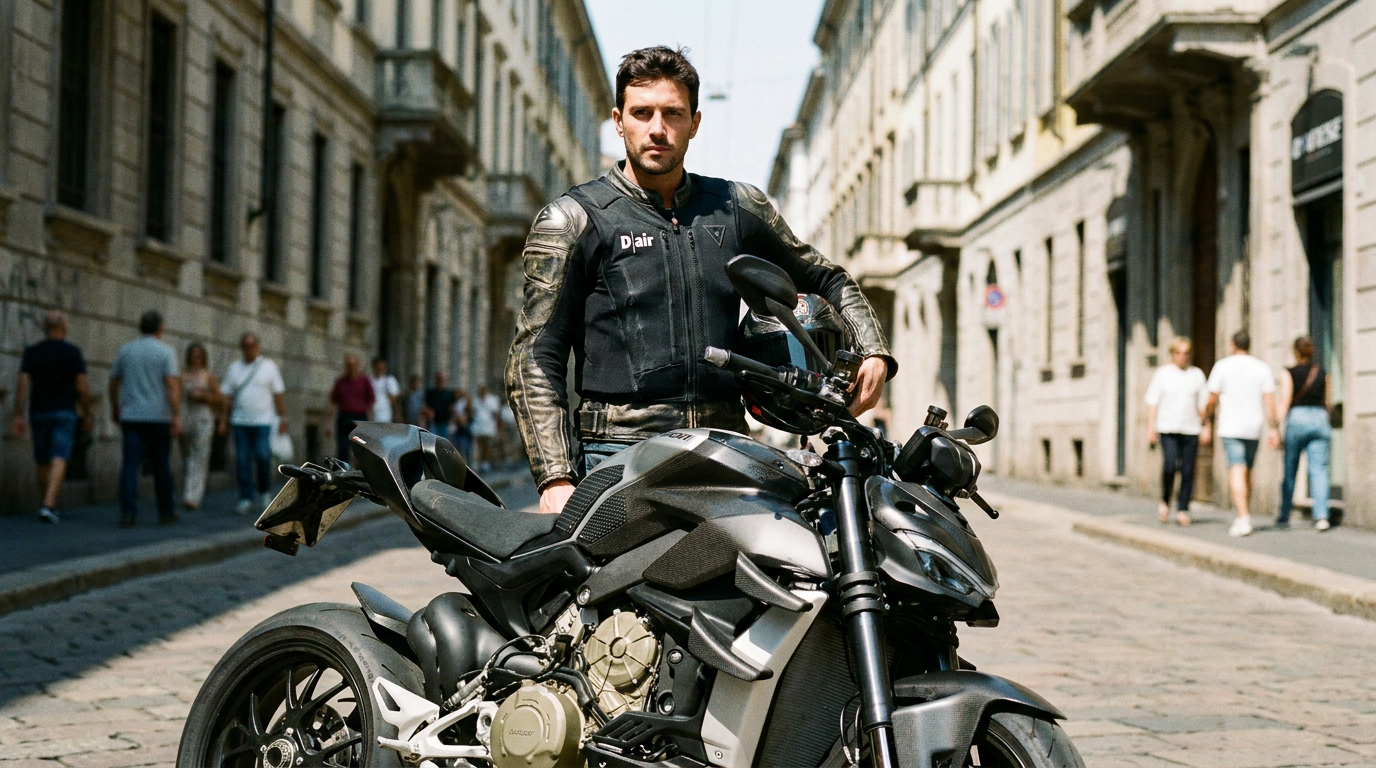
At the forefront of this safety renaissance is the wearable motorcycle airbag vest. Unlike the airbags in passenger cars, which deploy from the vehicle's chassis, motorcycle airbags are worn directly on the rider's body. These vests are designed to inflate in a fraction of a second, creating a rigid cushion of air that stabilizes the neck, spine, collarbones, and torso. Leading manufacturers like Dainese and Alpinestars have spent over a decade refining these systems, transitioning them from bulky, track-only prototypes into sleek, lightweight garments that can be worn seamlessly under or over a standard riding jacket.[1][2]
The most sophisticated of these systems rely on electronic deployment mechanisms. Electronic airbag vests operate autonomously, functioning as wearable supercomputers. They are equipped with an Inertial Measurement Unit (IMU) that typically houses multiple gyroscopes, accelerometers, and a GPS receiver. These sensors monitor the rider's movements hundreds of times per second, feeding data into complex crash-detection algorithms. When the system detects the unmistakable physics of an impending crash—such as the sudden rotational force of a highsider or the rapid deceleration of a frontal impact—it triggers the airbag before the rider even hits the ground.[1][2]

The speed of electronic deployment is staggering. Systems like the Alpinestars Tech-Air 5 and the Dainese Smart Jacket can detect a crash and fully inflate their air bladders in under 45 to 60 milliseconds. To put that into perspective, a human eye blink takes about 300 milliseconds. Dainese's system utilizes patented microfilament technology inside the air bladder, ensuring that the inflated bag maintains a uniform, crushproof shape rather than bulging unevenly like a standard balloon. This rapid, high-pressure inflation creates a protective shield exactly when and where it is needed most.[1][2]
However, electronic systems are not the only option on the market. Mechanical airbag vests, championed by brands like Helite, offer a decidedly analog approach to rider safety. Instead of relying on batteries, sensors, and algorithms, a mechanical vest uses a physical tether connected directly to the motorcycle's frame. If the rider is thrown from the bike, the tension on the lanyard pulls a spring-loaded piston, which pierces a replaceable CO2 cartridge and inflates the vest. While the deployment time is slightly slower—typically around 100 milliseconds—it remains vastly faster than human reaction time.[3]
However, electronic systems are not the only option on the market.
The debate between electronic and mechanical systems often comes down to reliability and maintenance. Electronic vests require regular charging, and some models lock their crash-detection algorithms behind monthly subscription fees. Furthermore, if an electronic vest deploys, it often must be shipped back to the manufacturer for a costly repackaging and inspection process. Mechanical systems, by contrast, are entirely self-sufficient. They require no batteries, no firmware updates, and no subscriptions. If a Helite vest deploys in a minor slide, the rider can simply unscrew the spent CO2 cartridge, thread in a new one for roughly $30, and continue riding within minutes.[3][6]
Regardless of the trigger mechanism, the physical protection offered by an airbag is mathematically undeniable. Traditional back protectors absorb impact by compressing, but they still transfer a significant amount of blunt force to the rider's body. According to homologation testing, a standard Level 2 foam back protector subjected to a 50-joule impact will transmit up to 9 kilonewtons (kN) of force to the spine. A Level 2 airbag system subjected to the exact same impact transmits just 2.5 kN. By cutting the transmitted force by over 70%, an airbag can mean the difference between a bruised ego and a life-altering spinal injury.[1]

But an airbag vest is only one half of the modern safety equation. The outer layer of gear—the jacket or suit—must be able to withstand the brutal friction of sliding across asphalt. To help riders navigate the confusing landscape of abrasion resistance, the European Union introduced the EN 17092 safety standard in 2020. This certification process requires third-party laboratories to subject motorcycle apparel to rigorous mechanical tests, measuring tear strength, seam burst resistance, and the garment's ability to survive high-speed abrasion on a specialized machine.[4][5]
The EN 17092 standard categorizes gear into three primary safety levels: A, AA, and AAA. A 'Level A' garment is designed for low-speed urban riding, offering basic abrasion resistance and impact armor while maximizing airflow and comfort. 'Level AA' strikes a balance between safety and wearability, making it the standard for most touring and adventure gear. 'Level AAA' is the highest rating possible, reserved for heavy-duty leather racing suits and premium reinforced textiles designed to survive high-speed highway slides. By checking the CE label, riders can instantly verify whether a jacket is built for a track day or a grocery run.[4][5]

Beneath the abrasion-resistant shell, the impact armor inserted into the elbows, shoulders, and knees is graded on a separate scale. CE Level 1 armor is thinner, lighter, and transmits more impact energy, making it a popular choice for casual summer riding gear. CE Level 2 armor is thicker, heavier, and absorbs significantly more force, making it ideal for high-speed touring and track use. Many riders choose to upgrade the stock Level 1 pads in their jackets to Level 2 armor for a relatively low cost, instantly boosting the garment's protective capabilities.[5]
Integrating an airbag vest with an EN 17092-certified jacket requires careful consideration of fitment. Airbag vests are often classified as 'Class C' garments under the CE standard, meaning they are designed to hold impact protection in place but offer no abrasion resistance on their own. They must be worn in conjunction with an A, AA, or AAA-rated outer shell. Crucially, if a rider wears an airbag vest underneath their jacket, the jacket must have enough loose space—typically about two inches of clearance around the chest and back—to allow the internal bladders to fully inflate without crushing the rider's ribs.[2][5]

As the technology matures in 2026, the barrier to entry continues to fall. While early electronic airbag suits cost thousands of dollars, standalone vests from premium manufacturers can now be purchased for the price of a high-end helmet. The ongoing debate over subscription models and right-to-repair will likely shape the next generation of gear, but the fundamental value proposition is clear. For riders navigating distracted drivers and unpredictable road conditions, the combination of a CE-rated jacket and a wearable airbag offers an unprecedented level of control over their own survival.[6][7]
How we got here
1994
First concept of a wearable motorcycle airbag is sketched by Dainese founder Lino Dainese.
2006
The first electronic motorcycle airbag is successfully deployed during a controlled track test.
2020
The European Union introduces the EN 17092 standard, standardizing abrasion testing for all motorcycle apparel.
2024
Manufacturers release the first consumer-level airbag systems specifically calibrated for off-road and enduro riding.
2026
Airbag vests become mainstream consumer items, with prices dropping to match high-end helmets.
Viewpoints in depth
Electronic System Advocates
Prioritize predictive algorithms and millisecond deployment speeds.
Proponents of electronic systems argue that in a severe crash, every millisecond counts. By using gyroscopes and accelerometers to detect the physics of a crash before the rider even leaves the bike, electronic vests can fully inflate in under 50 milliseconds. They also eliminate the need to remember to clip a tether, offering a seamless 'put it on and forget it' experience.
Mechanical System Purists
Value analog reliability, zero battery anxiety, and low maintenance costs.
Advocates for mechanical tethers point out that electronic systems introduce unnecessary complexity and hidden costs. A mechanical vest never runs out of battery, never requires a firmware update, and never locks its safety features behind a subscription paywall. Furthermore, if a mechanical vest deploys in a minor slide, the rider can simply replace the $30 CO2 cartridge themselves, whereas electronic vests often require expensive factory repacking.
Safety Standard Regulators
Focus on objective, third-party testing to eliminate guesswork from gear shopping.
Safety experts emphasize that an airbag is useless if the jacket covering it shreds upon contact with the asphalt. They champion the EN 17092 standard because it forces manufacturers to submit their gear to brutal, standardized laboratory tests. This transparency prevents brands from using vague marketing terms like 'ballistic nylon' and instead gives riders a verifiable A, AA, or AAA rating to base their purchasing decisions on.
What we don't know
- How the ongoing debate over 'right-to-repair' will affect the high cost of repacking deployed electronic airbag vests.
- Whether major motorcycle manufacturers will eventually integrate airbag tethers and electronic sensors directly into the bikes as standard equipment.
- How future iterations of the EN 17092 standard will adapt to rate the abrasion resistance of the airbag bladders themselves.
Key terms
- EN 17092
- The official European safety standard that grades motorcycle clothing (A, AA, AAA) based on its ability to withstand abrasion and tearing.
- IMU (Inertial Measurement Unit)
- An electronic sensor package containing gyroscopes and accelerometers that tracks a rider's movement to detect crashes.
- Highsider
- A violent motorcycle crash where the rear tire loses and then suddenly regains traction, flipping the rider over the handlebars.
- Lowsider
- A crash where the motorcycle's tires lose grip and the bike slides out from under the rider, usually during a turn.
- CE Level 2 Armor
- The highest European safety rating for impact-absorbing pads, transmitting less than 20 kilonewtons of force during a crash.
Frequently asked
Can I wear an airbag vest under my current motorcycle jacket?
Yes, but your jacket must have enough loose space—typically about two inches of clearance around the chest and back—to allow the bladders to fully inflate without restricting your breathing.
Do electronic airbag vests require a monthly subscription?
It depends on the brand. Some manufacturers charge a monthly fee to keep the crash-detection algorithms active, while others include the software in the upfront purchase price.
What happens if I forget to unclip a mechanical airbag tether?
Mechanical tethers require a significant amount of force (usually around 60 pounds) to trigger the CO2 cartridge, so simply forgetting to unclip and stepping off the bike will not accidentally deploy the airbag.
Is AAA-rated gear too hot to wear in the summer?
AAA-rated gear is generally heavier and thicker due to the reinforced materials needed to survive high-speed slides. For hot weather, many riders prefer highly ventilated AA or A-rated mesh jackets.
Sources
Source coverage
7 outlets
3 viewpoints surfaced







[1]DaineseElectronic Tech Adopters
D-air® Motorcycle Airbag Technology
Read on Dainese →[2]AlpinestarsElectronic Tech Adopters
Tech-Air® Autonomous Airbag Systems
Read on Alpinestars →[3]HeliteMechanical Reliability Advocates
Helite Motorcycle Airbag Technology
Read on Helite →[4]BennettsGear Certification Experts
Motorcycle clothing safety CE ratings explained
Read on Bennetts →[5]RevZillaGear Certification Experts
CE ratings for motorcycle gear explained
Read on RevZilla →[6]RoadRUNNERMechanical Reliability Advocates
8 Best Airbag Vests for Safe Motorcycling in 2026
Read on RoadRUNNER →[7]Factlen Editorial TeamGear Certification Experts
Synthesis by Factlen editorial team
Read on Factlen Editorial Team →


Every angle. Every day.
Get shopping stories with full source coverage and perspective breakdowns delivered to your inbox.