
The Science of Adaptogens: How Herbs Like Ashwagandha Affect the Body's Stress Response
Adaptogens have moved from niche alternative medicine to mainstream wellness, promising to help the body resist stress. Clinical research is now mapping exactly how herbs like ashwagandha interact with the nervous system to lower cortisol.
By Factlen Editorial Team
- Integrative Health Advocates
- View adaptogens as powerful, natural tools to restore systemic balance and buffer the nervous system against modern chronic stress.
- Conventional Medical Skeptics
- Acknowledge the biological mechanisms but warn that commercial products are often underdosed and marketed with exaggerated claims.
- Clinical Researchers
- Focus on isolating active compounds like withanolides to run double-blind trials that quantify exact physiological changes.
What's not represented
- · Traditional Ayurvedic Practitioners
- · Dietary Supplement Regulators
Why this matters
With the global adaptogen market projected to reach $20 billion by 2030, consumers are bombarded with claims about stress relief and energy. Understanding the biological mechanisms behind these herbs helps separate evidence-based benefits from marketing hype.
Key points
- Adaptogens are botanical substances that help the body resist physical and mental stress by regulating the HPA axis.
- Ashwagandha, the most researched adaptogen, has been shown in clinical trials to significantly lower serum cortisol levels.
- The active compounds in ashwagandha, called withanolides, are believed to mimic the calming neurotransmitter GABA.
- Many commercial adaptogen products contain doses too low to provide clinical benefits.
- Medical professionals warn that adaptogens should supplement, not replace, foundational health habits like sleep and nutrition.
Walk down any modern grocery aisle, and you will likely spot the word "adaptogen" plastered across teas, sparkling waters, and protein bars. Once confined to the dusty shelves of niche apothecaries and traditional Ayurvedic practices, these botanical substances have exploded into a multi-billion-dollar wellness category.[2][6]
The promise is incredibly alluring: natural compounds that purportedly help the human body resist physical, chemical, and biological stress. In an era characterized by burnout and chronic fatigue, the idea of a botanical shield against modern anxieties has found a massive, eager audience seeking alternatives to pharmaceuticals.[6]
But what exactly is an adaptogen, and does the biological evidence support the marketing? To understand how these herbs function, one must look past the wellness branding and examine the body's hypothalamic-pituitary-adrenal (HPA) axis—the central command station for the human stress response.[4]
When the brain perceives a threat—whether it is a literal predator or a looming email deadline—the hypothalamus signals the pituitary gland, which in turn prompts the adrenal glands to release cortisol and adrenaline. This cascade prepares the body to fight or flee, raising heart rate, blood pressure, and blood glucose to provide immediate energy.[2]

In acute situations, this system is life-saving. However, chronic activation of the HPA axis leads to persistently high cortisol levels, which can degrade tissue, disrupt sleep, and impair cognitive function over time. Adaptogens theoretically intervene in this exact pathway, acting like a thermostat to keep the body's stress response in a state of homeostasis rather than allowing it to run entirely unchecked.[4][6]
The term "adaptogen" was actually coined in 1947 by Soviet toxicologist Nikolai Lazarev, who was searching for substances that could enhance the stamina of soldiers and athletes without the crash associated with stimulants like amphetamines. To qualify strictly as an adaptogen, a substance must be non-toxic at normal doses, produce a non-specific defensive response to stress, and have a normalizing influence on human physiology.[2][6]
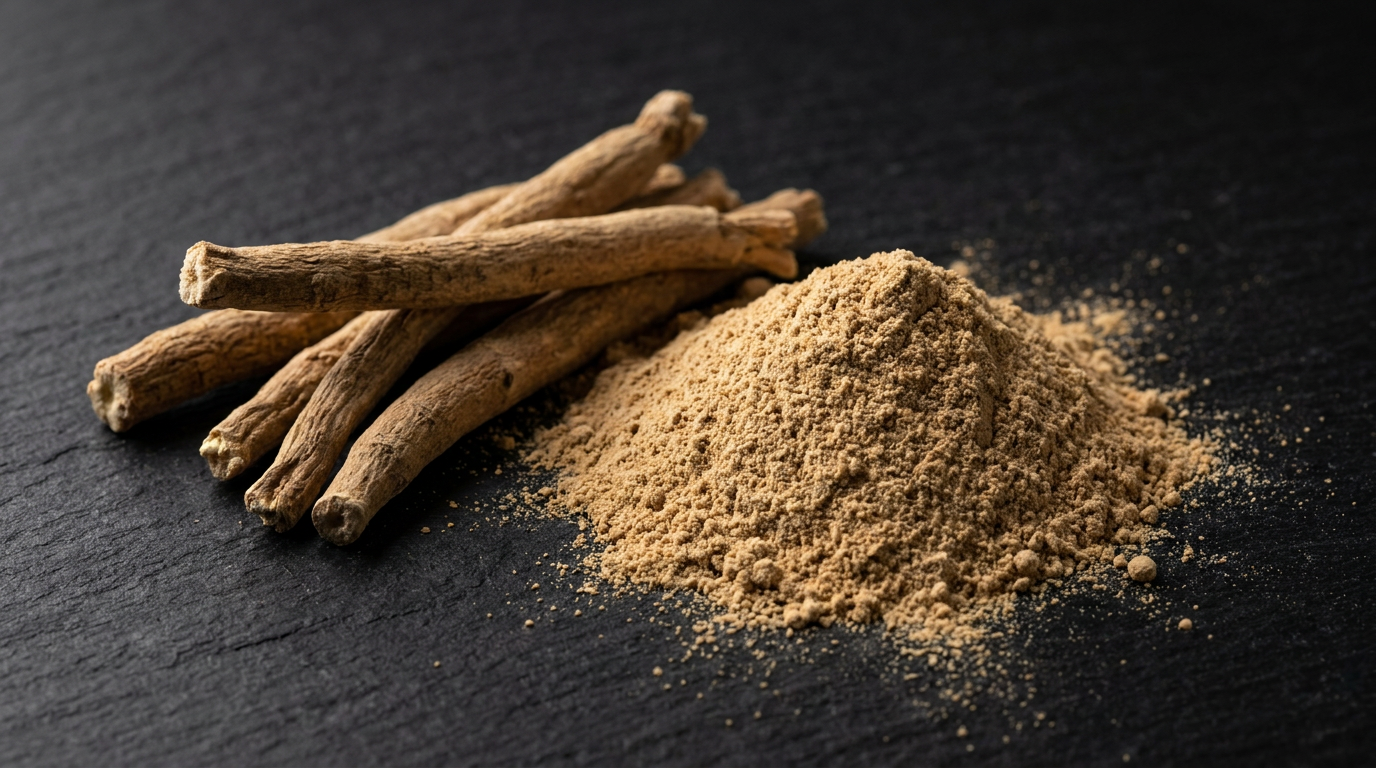
Today, the most heavily researched and widely consumed adaptogen is Ashwagandha (Withania somnifera), a foundational herb in traditional Indian Ayurvedic medicine. Unlike stimulants that push the nervous system up, or sedatives that push it down, ashwagandha is classified as an amphoteric—meaning it can theoretically modulate the system in either direction depending on what the body's baseline requires.[1][5]
Today, the most heavily researched and widely consumed adaptogen is Ashwagandha (Withania somnifera), a foundational herb in traditional Indian Ayurvedic medicine.
Clinical evidence for ashwagandha is surprisingly robust compared to many other dietary supplements. Multiple double-blind, placebo-controlled trials have demonstrated that standardized ashwagandha root extract significantly reduces both perceived stress and objective serum cortisol levels in human subjects.[3]
In several prominent studies, participants taking 300 to 600 milligrams of high-concentration ashwagandha extract daily for eight weeks showed cortisol reductions of 22% to 28% compared to placebo groups. Researchers believe the herb achieves this by mimicking the inhibitory neurotransmitter GABA, which helps calm hyperactive neurons in the brain and signals the HPA axis to stand down.[3][5]

Beyond ashwagandha, the adaptogen family includes Rhodiola rosea, which grows in cold, mountainous regions of Europe and Asia. While ashwagandha is generally utilized for its calming properties, Rhodiola is often sought for its anti-fatigue effects. Studies suggest it may help prevent the depletion of neurotransmitters like serotonin and dopamine during periods of intense physical or mental exertion.[2][5]
Despite these promising mechanisms, the medical community maintains a healthy skepticism, primarily directed at the commercialization of these herbs rather than the botanicals themselves. Because dietary supplements are not strictly regulated by the FDA for efficacy before they hit the market, the quality, purity, and potency of over-the-counter adaptogens vary wildly.[1][4]
Many commercial products, such as adaptogenic lattes or snack bars, contain only "fairy dust" amounts of the active herbs—doses far too low to replicate the results seen in clinical trials. Furthermore, the extraction method matters immensely; the active compounds in ashwagandha, known as withanolides, must be present in specific concentrations (typically 2.5% to 5%) to exert a measurable biological effect.[4][5]

There is also the risk of viewing adaptogens as a panacea for severe lifestyle deficits. Medical professionals frequently warn that no botanical extract can out-supplement chronic sleep deprivation, poor nutrition, or a toxic work environment. Adaptogens are best viewed as a biological buffer, not a cure for systemic exhaustion.[2][4]
Ultimately, the science suggests that adaptogens are not merely wellness hype, but biologically active compounds that can genuinely modulate the human stress response. As research continues to map their precise effects on the HPA axis, these ancient herbs are securing a legitimate, evidence-based place in modern integrative medicine.[1][6]
How we got here
1947
Soviet toxicologist Nikolai Lazarev coins the term 'adaptogen' while researching stamina-enhancing substances for soldiers.
1960s
Soviet researchers conduct extensive studies on Eleuthero (Siberian ginseng) for use in the space program and Olympic sports.
1998
The FDA officially defines dietary supplements, creating the regulatory framework under which adaptogens are sold in the US today.
2010s
Adaptogens experience a massive surge in Western popularity, moving from niche health stores to mainstream food and beverage products.
2020s
A wave of double-blind clinical trials begins to isolate specific mechanisms, validating the cortisol-lowering effects of standardized ashwagandha extracts.
Viewpoints in depth
Integrative Health Advocates
Focus on the holistic benefits of supporting the body's natural stress response systems.
Practitioners of integrative and functional medicine view adaptogens as a crucial bridge between lifestyle interventions and pharmaceuticals. They argue that modern life places an unnatural, chronic burden on the HPA axis that human biology did not evolve to handle. By utilizing herbs like ashwagandha and rhodiola, they believe patients can gently buffer their nervous systems, improving sleep quality and emotional resilience without the side effects or dependency risks associated with prescription anti-anxiety medications.
Conventional Medical Skeptics
Emphasize the lack of regulation and the prevalence of underdosed commercial products.
While acknowledging the promising data from controlled trials, conventional medical skeptics focus on the realities of the supplement market. Because the FDA does not evaluate supplements for efficacy before they are sold, skeptics warn that consumers are often paying premium prices for 'adaptogenic' snacks and drinks that contain negligible amounts of the active herbs. They advocate for stricter standardization of extracts and caution patients against using botanicals to mask symptoms of severe burnout or underlying medical conditions.
Clinical Researchers
Prioritize isolating active compounds to understand exact biological mechanisms.
For researchers, the focus is entirely on the biochemistry. They are working to map exactly how compounds like withanolides interact with GABA receptors and cortisol production pathways. This camp is less interested in the ancient history of the herbs and more focused on conducting large-scale, double-blind, placebo-controlled trials to determine optimal dosing, long-term safety profiles, and potential contraindications with modern pharmaceuticals.
What we don't know
- The long-term effects of taking high-dose adaptogen extracts continuously for multiple years.
- Exactly how different adaptogens interact with one another when combined in commercial 'stress blends'.
- Why some individuals experience significant cortisol reduction from ashwagandha while others are non-responders.
Key terms
- HPA Axis
- The hypothalamic-pituitary-adrenal axis; a complex set of interactions between three glands that controls how the body responds to stress.
- Cortisol
- The body's primary stress hormone, produced by the adrenal glands, which increases sugars in the bloodstream and enhances the brain's use of glucose.
- Withanolides
- The naturally occurring active chemical compounds found in ashwagandha root that are believed to be responsible for its stress-relieving properties.
- Homeostasis
- A state of steady internal, physical, and chemical conditions maintained by living systems, which adaptogens aim to support.
- Amphoteric
- In herbalism, a substance that can normalize function in an organ or system, either stimulating or relaxing it depending on what the body needs.
Frequently asked
How long does it take for adaptogens to work?
Unlike stimulants like caffeine, adaptogens typically require consistent daily use over several weeks to build up in the system. Clinical trials usually measure significant cortisol reductions after 4 to 8 weeks of continuous supplementation.
Are adaptogens safe to take with other medications?
While generally considered safe, adaptogens can interact with certain medications. Ashwagandha may amplify the effects of sedatives or interfere with thyroid and blood pressure medications, so consulting a doctor is recommended.
What is the difference between ashwagandha and rhodiola?
Ashwagandha is generally used for its calming, anxiety-reducing effects and its ability to lower cortisol. Rhodiola rosea is more stimulating and is typically used to combat physical and mental fatigue.
Sources
Source coverage
6 outlets
3 viewpoints surfaced






[1]National Center for Complementary and Integrative HealthIntegrative Health Advocates
Ashwagandha: What You Need To Know
Read on National Center for Complementary and Integrative Health →[2]Cleveland ClinicConventional Medical Skeptics
What Are Adaptogens and What Do They Do?
Read on Cleveland Clinic →[3]Journal of Clinical MedicineClinical Researchers
Adaptogenic and Anxiolytic Effects of Ashwagandha Root Extract
Read on Journal of Clinical Medicine →[4]Harvard Health PublishingConventional Medical Skeptics
Understanding adaptogens: Can they help you manage stress?
Read on Harvard Health Publishing →[5]ExamineIntegrative Health Advocates
Ashwagandha: Health Benefits, Dosage, and Side Effects
Read on Examine →[6]Factlen Editorial TeamClinical Researchers
Synthesis by Factlen editorial team
Read on Factlen Editorial Team →

Every angle. Every day.
Get health stories with full source coverage and perspective breakdowns delivered to your inbox.