
The Science of Tangzhong and Yudane: How Pre-Gelatinized Starch Transforms Home Baking
By hacking the chemistry of starch gelatinization, home bakers are using traditional Asian techniques to create ultra-soft breads that resist staling for days.
By Factlen Editorial Team
- Baking Science Educators
- Focuses on the precise chemistry of starch gelatinization, retrogradation, and hydration mechanics.
- Artisan Home Bakers
- Focuses on practical application, crumb texture, recipe conversion, and dough handling.
- Culinary Historians
- Focuses on the Asian origins of the techniques and their evolution into global baking staples.
- Factlen Editorial Team
- Synthesizes the scientific mechanisms with the practical benefits for the everyday home cook.
What's not represented
- · Commercial Dough Conditioner Manufacturers
- · Gluten-Free Formulation Scientists
Why this matters
Understanding how heat and water alter flour allows home cooks to achieve bakery-level softness and shelf-life without artificial dough conditioners or preservatives.
Key points
- Tangzhong and yudane are dough-preparation techniques that pre-cook a portion of a recipe's flour.
- Heating the flour to 65°C triggers starch gelatinization, allowing it to trap massive amounts of water.
- This trapped water allows for higher dough hydration without creating a sticky, unworkable mess.
- The bound moisture physically prevents starch retrogradation, keeping the bread from staling for days.
- Yudane uses boiling water to activate natural amylase enzymes, adding natural sweetness to the loaf.
- The techniques can be adapted to almost any soft bread recipe, including whole wheat and gluten-free.
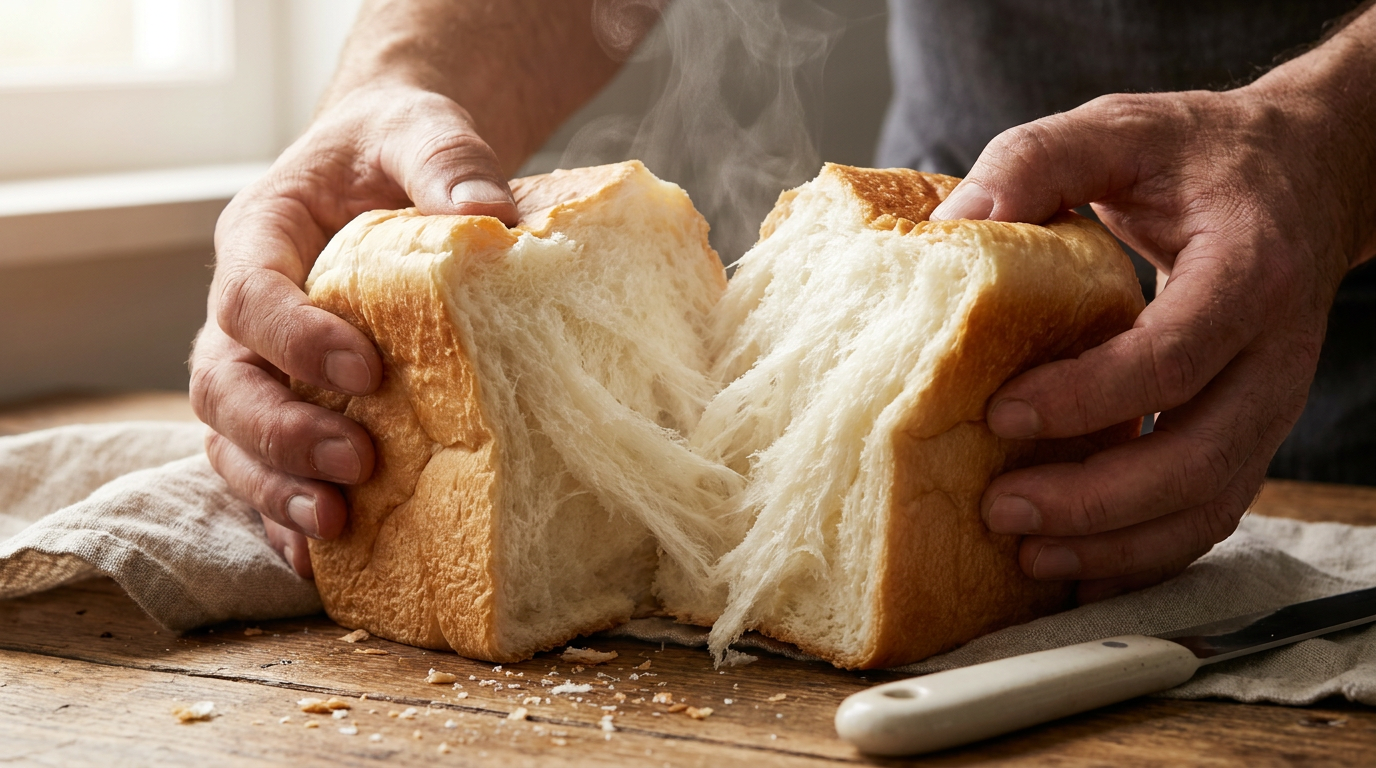
There is a fleeting magic to a loaf of freshly baked bread pulled straight from the oven. The crumb is tender, the crust is delicate, and the texture is impossibly soft. Yet, for home bakers, this perfection is notoriously short-lived. Within twenty-four hours, standard enriched breads—like sandwich loaves, dinner rolls, and brioche—begin to dry out, turning crumbly and stiff. Commercial bakeries solve this problem by pumping their doughs full of artificial conditioners and preservatives. But a growing movement of home bakers is achieving even better results using a piece of culinary chemistry that requires nothing more than flour, water, and a little bit of heat.[4]
The secret lies in two closely related Asian dough-preparation techniques: tangzhong and yudane. While they have been staples in Eastern bakeries for decades, they have recently taken the global baking community by storm, fundamentally changing how recipes are formulated. Both methods rely on the exact same scientific principle—pre-cooking a small portion of the recipe's flour in liquid before adding it to the main dough. This single, five-minute extra step radically alters the molecular structure of the bread, yielding a cotton-soft, shreddable crumb that stays fresh for days.[3]
To understand why heating flour and water works such miracles, one must look at the microscopic structure of a wheat kernel. Raw flour is packed with tightly coiled starch granules that are relatively inert at room temperature. When a baker mixes standard dough, these granules absorb a modest amount of water, while the rest of the liquid goes toward hydrating the proteins that form gluten. But when flour is subjected to heat, the rules of hydration change entirely.[2]
The core mechanism at play is known as starch gelatinization. When a mixture of flour and water is heated to approximately 65°C (150°F), the intermolecular bonds within the starch granules begin to break down. The heat forces the tightly packed molecules to relax and open up, exposing new binding sites that eagerly grab onto surrounding water molecules. As the temperature rises, the starch granules swell dramatically, eventually bursting and releasing complex carbohydrates into the liquid.[3][5]

The physical transformation is profound. Through gelatinization, the starch can absorb and trap up to twenty times its own dry mass in water. What begins as a thin, milky liquid rapidly thickens into a viscous, pudding-like paste. Because this water is now chemically bound inside the gelatinized starch matrix, it behaves differently than free water in a standard dough. It is locked in place, unable to easily evaporate during the baking process or migrate through the crumb once the loaf cools.[5]
For the baker, this bound water acts like a cheat code for dough hydration. Typically, adding more water to a bread recipe makes the dough impossibly sticky and difficult to knead. But because the liquid in a tangzhong or yudane is trapped inside the swollen starch, bakers can push the overall hydration of their recipes much higher. The resulting dough feels strong, cohesive, and easy to handle on the bench, yet it carries a massive payload of moisture into the oven.[2][5]
While tangzhong and yudane share this underlying chemistry, their execution differs. Tangzhong, which translates to "soup type" or "broth," has Chinese origins and was widely popularized across Asia by Taiwanese cookbook author Yvonne Chen. It typically uses a ratio of one part flour to five parts liquid by weight. The baker whisks the mixture over medium heat on the stove until it thickens into a smooth paste that leaves distinct lines when stirred, then cools it before incorporating it into the main dough.[4][5]
Yudane, on the other hand, hails from Japan and is the foundational technique behind shokupan—the famously feathery, square Japanese milk bread. Yudane uses a much thicker one-to-one ratio of flour to boiling water. Instead of cooking it on the stove, the baker simply pours boiling water directly over the raw flour, mixes it into a stiff, dough-like clump, and leaves it to rest, often overnight. The residual heat from the boiling water is sufficient to trigger gelatinization.[3][4]
Yudane, on the other hand, hails from Japan and is the foundational technique behind shokupan—the famously feathery, square Japanese milk bread.
Beyond the preparation method, the two techniques interact with the dough's chemistry in slightly different ways. Tangzhong acts primarily as a starch emulsion. Because it is cooked into a smooth paste, it distributes seamlessly through the dough, functioning much like an emulsifier—similar to how egg yolks or lecithin tenderize a crumb. It generally utilizes only 5% to 10% of the recipe's total flour.[3]

Yudane, which can utilize up to 20% to 40% of the total flour, brings an additional chemical advantage to the table: enzymatic activity. Wheat flour naturally contains alpha-amylase, an enzyme that breaks down complex starches. The boiling water used in yudane provides the perfect thermal shock to activate these enzymes before the heat ultimately denatures them.[5]
As the yudane rests, the activated amylase goes to work, rapidly cleaving the long, complex starch chains into smaller, simpler sugars. This enzymatic breakdown serves a dual purpose. First, it provides a readily available food source for the yeast, promoting a vigorous rise. Second, it imparts a distinct, natural sweetness to the finished loaf, allowing bakers to achieve a rich flavor profile without relying heavily on added refined sugars.[5]
But the most celebrated benefit of both methods is their ability to halt the enemy of fresh bread: staling. Bread does not go stale simply by drying out; it stales through a chemical process called starch retrogradation. After a loaf is baked and begins to cool, the gelatinized starch molecules—specifically amylose and amylopectin—slowly attempt to recrystallize and return to their original, ordered state. As they recrystallize, they physically expel water and firm up the crumb, turning the bread hard and crumbly.[4][5]
Tangzhong and yudane effectively hack this retrogradation process. The sheer volume of bound water introduced by the pre-cooked paste physically interferes with the starch molecules' ability to re-order themselves. Furthermore, the smaller carbohydrate chains produced by the enzymatic activity in yudane actively resist crystallization. The result is a loaf that stays remarkably soft, moist, and pliable for days on the counter, defying the normal lifecycle of homemade bread.[4]

The introduction of heat also alters the protein structure of the dough. When the flour for the tangzhong or yudane is scalded, the heat denatures the gluten-forming proteins in that specific portion of flour. This means that the pre-cooked flour will not contribute to the gluten network of the final loaf.[5]
Counterintuitively, this localized destruction of gluten is exactly what makes the bread so soft. By degrading a percentage of the total gluten, the baker ensures the final dough is looser and more extensible. As long as the remaining raw flour in the main dough is kneaded thoroughly to provide structural support, the weakened overall protein network allows the dough to expand higher in the oven, resulting in a lighter, fluffier, and more delicate crumb.[2][5]
Adapting a standard recipe to use these methods requires a bit of baker's math, but the formula is straightforward. The flour and liquid used in the tangzhong must be subtracted from the recipe's total ingredients, not added on top. For example, if a recipe calls for 300 grams of flour and 200 grams of milk, a baker might take 20 grams of that flour and 100 grams of that milk to cook the tangzhong, leaving 280 grams of flour and 100 grams of milk for the main dough mix.[1][3]

While the technique is most famous for producing cloud-like white breads, its applications extend far beyond shokupan. Bakers are increasingly applying tangzhong to whole wheat and whole grain loaves, which are notoriously prone to dryness and dense textures. Because the cooked slurry holds onto moisture so effectively, it can transform a heavy, crumbly whole wheat dough into a soft, supple sandwich loaf. It is even being utilized in gluten-free baking to provide the moisture retention and structural binding that gluten-free flours naturally lack.[1]
In an era where home cooking is increasingly aided by high-tech gadgets and specialized ingredients, the rise of tangzhong and yudane is a testament to the power of fundamental food science. By simply understanding how heat and water interact with the microscopic structure of a wheat kernel, bakers can unlock a level of quality and longevity that was once the exclusive domain of commercial bakeries. It is a few minutes over the stove that pays dividends for days.[6]
How we got here
Ancient origins
Chinese bakers use 'tang mian' (hot water dough) to make soft dumpling wrappers and scallion pancakes.
Early 2000s
Japanese commercial bakeries pioneer the yudane method to mass-produce ultra-soft shokupan milk bread with extended shelf life.
2007
Taiwanese author Yvonne Chen publishes '65°C Bread Doctor,' popularizing the tangzhong method for home bakers across Asia.
2020s
The techniques go viral globally among artisan home bakers seeking to replicate bakery-quality softness without artificial preservatives.
Viewpoints in depth
The Chemistry Perspective
Examines the microscopic interactions between heat, starch, and water.
From a purely scientific standpoint, tangzhong and yudane are exercises in manipulating molecular bonds. Food chemists focus on how the 65°C thermal threshold breaks the intermolecular bonds of raw starch granules, allowing them to swell and absorb up to twenty times their weight in water. This perspective emphasizes that staling is not a loss of moisture, but a structural recrystallization (retrogradation) that the pre-gelatinized starch physically interrupts.
The Practical Baker's View
Focuses on dough handling, recipe conversion, and the tactile experience of baking.
For the artisan home baker, the science is secondary to the handling benefits. High-hydration doughs are notoriously difficult to knead, often requiring complex folding techniques to build structure. By locking a significant portion of the recipe's water inside a starch gel, bakers can achieve the crumb-softening benefits of a wet dough while maintaining the strong, cohesive handling properties of a dry dough. This camp values the techniques for making advanced baking accessible to novices.
The Culinary History Angle
Traces the lineage of cooked-dough techniques across Asian baking traditions.
Culinary historians view tangzhong and yudane not as modern hacks, but as the evolution of ancient Asian starch science. The techniques draw a direct line from traditional Chinese 'tang mian' (hot water doughs used for dumplings) to the post-war Japanese obsession with ultra-soft sandwich bread (shokupan). This perspective highlights how a regional commercial bakery technique was democratized by Taiwanese cookbook authors and eventually embraced by the global sourdough and artisan bread movements.
What we don't know
- While the macro effects of starch gelatinization are well understood, scientists are still studying the exact molecular interactions between the denatured proteins in the cooked roux and the raw gluten network in the main dough.
- It remains unclear exactly why yudane produces a slightly lighter crumb than tangzhong in side-by-side blind tests, despite tangzhong having a higher liquid ratio.
Key terms
- Starch Gelatinization
- The process where starch granules are heated in liquid, causing them to swell, burst, and absorb large amounts of water to form a viscous gel.
- Retrogradation
- The chemical process where gelatinized starches slowly recrystallize after baking, expelling moisture and causing bread to stale.
- Alpha-Amylase
- A naturally occurring enzyme in wheat flour that breaks down complex starches into simpler, sweeter sugars when activated by heat.
- Shokupan
- A Japanese style of pullman sandwich bread famous for its perfectly square shape, ultra-soft texture, and long shelf life, traditionally made using the yudane method.
- Hydration
- In baking, the ratio of liquid to flour in a dough, expressed as a percentage. Higher hydration generally leads to a more open, moist crumb.
Frequently asked
Can I use milk instead of water for tangzhong?
Yes. Milk, water, or a combination of both work perfectly. Milk adds extra fat and sugars, which further tenderizes the crumb and enriches the flavor.
Can I add tangzhong to a sourdough recipe?
Absolutely. Tangzhong works beautifully with natural leavening, helping to soften the sometimes chewy texture of sourdough and extending its shelf life.
Why did my tangzhong turn into a hard, rubbery lump?
It was likely cooked too long or at too high a temperature. Tangzhong should be heated gently just until it forms a thick paste (around 65°C/150°F); overheating causes the starches to set too firmly.
Do I need to let yudane rest overnight?
While resting yudane overnight in the fridge maximizes enzymatic activity and flavor development, letting it rest for just 4 hours until completely cool is sufficient for the starch gelatinization benefits.
Sources
Source coverage
6 outlets
4 viewpoints surfaced






[1]King Arthur BakingBaking Science Educators
Tangzhong in whole wheat yeast baking
Read on King Arthur Baking →[2]The Perfect LoafArtisan Home Bakers
How to Make Tangzhong (Water Roux) for Soft Bread
Read on The Perfect Loaf →[3]ChainBakerArtisan Home Bakers
Tangzhong & Yudane Explained
Read on ChainBaker →[4]CuisinopediaCulinary Historians
Shokupan and the Science of Staling
Read on Cuisinopedia →[5]CCC's Curious KitchenBaking Science Educators
Tangzhong Method for Bread
Read on CCC's Curious Kitchen →[6]Factlen Editorial TeamFactlen Editorial Team
Synthesis by Factlen editorial team
Read on Factlen Editorial Team →


Every angle. Every day.
Get food drink stories with full source coverage and perspective breakdowns delivered to your inbox.