
Enhanced Geothermal Systems Reach Commercial Scale as Cape Station Prepares for 2026 Launch
Next-generation geothermal technology is crossing the threshold from pilot to bankable infrastructure, promising 24/7 carbon-free baseload power. With drilling costs plummeting and seismic monitoring breakthroughs, the U.S. grid is preparing for a massive influx of engineered geothermal energy.
By Factlen Editorial Team
- Geothermal Developers
- Focused on rapid scaling, cost reduction, and leveraging oil and gas technology.
- Seismologists & Risk Managers
- Focused on the safe deployment of engineered reservoirs and the prevention of induced earthquakes.
- Federal Policymakers
- Focused on grid decarbonization, energy security, and workforce transition.
- Corporate Energy Buyers
- Focused on securing reliable, 24/7 carbon-free electricity for data centers and grid stability.
What's not represented
- · Local communities near EGS sites
- · Water conservation advocates in the arid West
Why this matters
Wind and solar power are cheap but weather-dependent, requiring expensive batteries to maintain grid stability. Enhanced Geothermal Systems (EGS) provide firm, 24/7 carbon-free electricity anywhere with hot subsurface rock, offering a direct replacement for coal and natural gas plants.
Key points
- Fervo Energy's Cape Station in Utah will deliver 100 MW of commercial EGS power to the grid in late 2026.
- EGS uses horizontal drilling and hydraulic fracturing to create artificial geothermal reservoirs in hot, dry rock.
- Drilling costs and times have plummeted by roughly 70%, making the technology increasingly competitive with other baseload sources.
- A recent breakthrough by Berkeley Lab enables continuous seismic monitoring at extreme temperatures to prevent induced earthquakes.
- The Department of Energy projects next-generation geothermal could scale to 90 GW by 2050, a 20-fold increase.
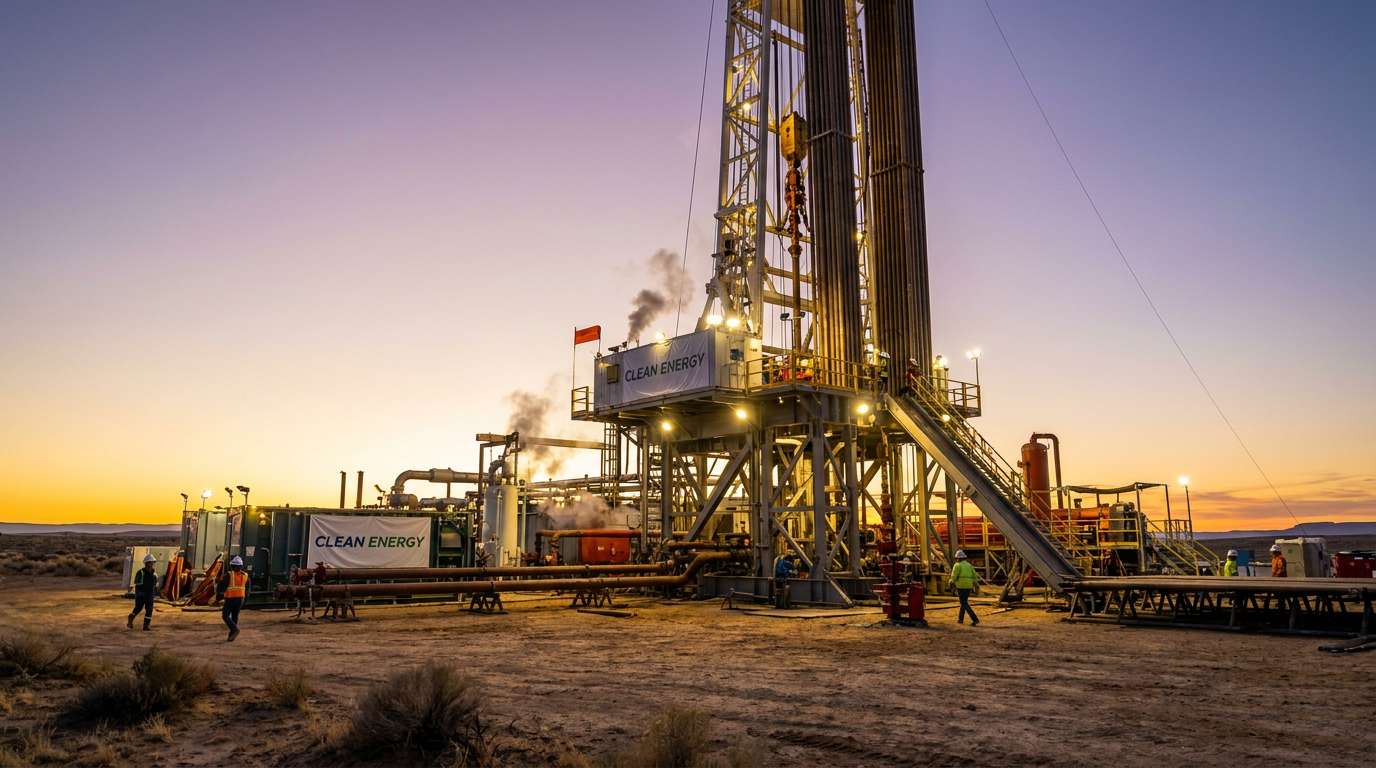
The transition to a carbon-free power grid has long faced a structural bottleneck: the intermittency of wind and solar power. To maintain grid stability, utilities require "firm" baseload power that generates electricity 24 hours a day. While conventional geothermal energy provides this constant output, it has historically been geographically constrained to rare locations with naturally occurring underground hot water reservoirs. In late 2026, that geographic limitation is being shattered. Fervo Energy is preparing to deliver the first 100 megawatts (MW) of commercial power from its Cape Station facility in Beaver County, Utah, marking the commercial arrival of Enhanced Geothermal Systems (EGS).[3][5][6]
The core mechanism of EGS represents a direct technology transfer from the oil and gas industry's shale revolution. Instead of hunting for natural underground aquifers, EGS developers drill deep into hot, dry, impermeable rock. They then use horizontal drilling and hydraulic fracturing techniques to create artificial fracture networks across vast subterranean areas. Water is injected into these engineered reservoirs, heated by the Earth's natural subsurface temperatures, and extracted through a parallel production well to drive steam turbines at the surface. This closed-loop or semi-closed approach theoretically allows geothermal power to be deployed anywhere with sufficient underground heat, decoupling the energy source from specific tectonic fault lines.[5]

The evidence supporting the scalability of EGS has rapidly accumulated over the past two years. According to the U.S. Department of Energy's "Pathways to Commercial Liftoff" report, next-generation geothermal technologies could increase U.S. geothermal capacity from its current 2.7 gigawatts (GW) to over 90 GW by 2050. This twenty-fold increase would be enough to power tens of millions of homes and fundamentally alter the nation's energy mix, providing a reliable complement to weather-dependent renewables.[2][4]
The primary barrier to EGS has historically been the exorbitant capital expenditure required for deep drilling, which can account for more than half of a project's total cost. However, recent operational data indicates a steep learning curve. Between 2022 and 2025, Fervo Energy reported reducing its drilling times by 75% and slashing per-foot drilling costs by approximately 70%. By applying iterative manufacturing principles to well construction, developers are pushing the levelized cost of EGS electricity toward parity with other baseload sources.[3]

This cost compression has triggered a wave of commercial investment and off-take agreements. In April 2026, Fervo signed a binding agreement with Turboden America to supply 1.75 GW of organic Rankine cycle turbines for its forthcoming U.S. projects. The company's development pipeline now exceeds 3.65 GW of capacity in various stages of construction and permitting. Major corporate energy buyers, including Google, and regional utilities like Southern California Edison, have signed long-term Power Purchase Agreements (PPAs) to secure this 24/7 carbon-free electricity, driven largely by the surging power demands of data centers and artificial intelligence infrastructure.[3][5][8]
This cost compression has triggered a wave of commercial investment and off-take agreements.
Despite the commercial momentum, EGS deployment carries inherent geophysical risks, most notably induced seismicity. The process of injecting high-pressure fluids to fracture deep rock formations inevitably generates micro-earthquakes as the rock shifts and settles. While these events are typically too small to be felt at the surface, the creation of larger, engineered fracture networks raises the possibility of triggering larger seismic events. This poses a tangible risk to local infrastructure and threatens the public acceptance of future projects. Managing this risk requires precise, real-time monitoring of the subsurface fracture network to ensure the rock behaves exactly as modeled.[7]
A critical breakthrough in seismic risk management was achieved in early 2026 by geophysicists from the Lawrence Berkeley National Laboratory (LBNL). Operating at Fervo's Cape Station, the LBNL team successfully deployed a custom-built high-temperature seismometer nearly 7,000 feet underground. The instrument continuously monitored microseismic activity for seven months in extreme conditions where temperatures reached 338°F—surpassing previous benchmarks for long-duration monitoring in such hostile environments.[1]

The ability to continuously monitor deep, high-temperature reservoirs allows operators to implement dynamic "traffic light protocols." As outlined by the European DEEP Consortium's good practice guidelines, these protocols use near-real-time seismic data to govern operations. If microseismic activity approaches predefined safety thresholds, operators can immediately throttle back injection pressures or halt operations entirely, mitigating the risk of triggering a larger, damaging earthquake.[7]
Federal policy and funding are actively accelerating the de-risking of these technologies to bridge the gap between pilot projects and full commercialization. In February 2026, the Department of Energy announced $171.5 million in funding to support next-generation geothermal field tests and characterization drilling. This federal backing is designed to validate EGS performance across diverse geological settings, proving the technology's viability outside of the American West. By underwriting the high-risk, early-stage exploration phases, the government aims to unlock the private debt financing necessary for nationwide deployment.[2]
The expansion of EGS also offers a unique workforce transition pathway that few other renewable technologies can match. Because the technology relies heavily on advanced drilling, reservoir engineering, and subsurface modeling, it directly utilizes the existing skill sets and heavy machinery of the oil and gas workforce. As the broader energy transition accelerates, EGS provides a seamless mechanism to redeploy fossil-fuel industry expertise and capital equipment toward the generation of permanent, carbon-free baseload power, preserving high-paying industrial jobs in the process.[4]

Several uncertainties remain as the industry scales from pilot projects to gigawatt-level infrastructure. The long-term thermal drawdown of engineered reservoirs—how quickly the artificial fracture networks cool down after years of continuous water injection—is not yet fully understood at commercial scales. Additionally, the water consumption required to maintain these systems poses a potential challenge in the arid regions of the American West where early EGS projects are concentrated.
Nevertheless, the activation of Cape Station's first 100 MW phase in late 2026 represents a watershed moment for the global energy grid. By proving that engineered geothermal reservoirs can be drilled economically, monitored safely under extreme conditions, and integrated reliably into the commercial power market, the industry is moving decisively past the proof-of-concept phase. Enhanced Geothermal Systems are now positioned as a bankable, scalable pillar of the future clean energy economy, capable of providing the firm power necessary to finally phase out fossil fuels.[3][6]
How we got here
2023
Fervo Energy breaks ground on the Cape Station EGS project in Beaver County, Utah.
March 2024
The Department of Energy releases its Liftoff report, projecting EGS could supply 90 GW of power by 2050.
February 2026
Lawrence Berkeley National Laboratory completes a record 7-month continuous seismic monitoring test at 338°F at Cape Station.
April 2026
Fervo signs a massive 1.75 GW turbine supply agreement with Turboden America to equip its future power plants.
Late 2026
Cape Station Phase I is scheduled to deliver its first 100 MW of commercial baseload power to the grid.
Viewpoints in depth
Geothermal Developers
Focused on rapid scaling, cost reduction, and leveraging oil and gas technology to meet baseload demand.
Developers argue that EGS is the missing piece of the clean energy puzzle. By applying iterative manufacturing and horizontal drilling techniques perfected during the shale boom, they believe they can drive costs down exponentially. Their primary goal is securing long-term power purchase agreements with data centers and utilities to prove bankability and unlock massive project financing.
Seismologists & Risk Managers
Focused on the safe deployment of engineered reservoirs and the prevention of induced earthquakes.
This camp emphasizes that public acceptance is the single biggest vulnerability for EGS. They argue that aggressive fluid injection must be strictly governed by real-time subsurface monitoring and rigid "traffic light protocols." While optimistic about recent monitoring breakthroughs, they caution that scaling to thousands of wells will require unprecedented regulatory oversight to ensure seismic risks remain negligible.
Grid Operators & Corporate Buyers
Focused on securing reliable, 24/7 carbon-free electricity to balance intermittent renewables and power AI infrastructure.
For utilities and tech giants, EGS is a premium asset. Wind and solar are cheap but weather-dependent, requiring expensive battery storage. Grid operators view EGS as a direct, clean replacement for coal and natural gas baseload plants. Corporate buyers are willing to pay a premium for EGS power today to catalyze the industry, ensuring they have the firm power necessary to run gigawatt-scale data centers tomorrow.
What we don't know
- How quickly the artificial fracture networks will cool down (thermal drawdown) over decades of continuous commercial operation.
- Whether the steep cost reductions seen in early drilling will plateau as developers move to more complex geological formations.
- How the high water consumption required for EGS injection will be managed long-term in the arid regions of the American West.
Key terms
- Baseload Power
- The minimum level of electricity demand on a grid over a 24-hour period, typically met by power plants that can run continuously, such as nuclear, coal, or geothermal.
- Enhanced Geothermal Systems (EGS)
- A technology that creates artificial underground reservoirs by injecting water into hot, impermeable rock to extract heat for electricity generation.
- Induced Seismicity
- Minor earthquakes or tremors caused by human activity, such as the injection of fluids deep underground during geothermal or oil and gas operations.
- Traffic Light Protocol
- A risk management system used in fluid injection projects where operations are modified or halted (yellow or red light) if seismic activity reaches predefined safety thresholds.
- Organic Rankine Cycle
- A type of turbine system that uses a fluid with a lower boiling point than water to generate electricity from lower-temperature heat sources.
Frequently asked
What is an Enhanced Geothermal System (EGS)?
Unlike traditional geothermal plants that rely on natural hot springs, EGS uses advanced drilling to create artificial reservoirs in hot, dry rock deep underground. Water is injected into these fractures, heated by the Earth, and extracted to generate power.
Why is EGS important for the power grid?
EGS provides 'firm' or baseload power, meaning it generates electricity 24/7. This makes it a crucial carbon-free complement to wind and solar, which only produce power when the wind blows or the sun shines.
Does EGS cause earthquakes?
The process of fracturing rock and injecting high-pressure water generates micro-earthquakes, which are usually too small to be felt. However, operators use continuous seismic monitoring and 'traffic light protocols' to manage injection rates and prevent larger, damaging seismic events.
When will EGS become commercially available?
The first major commercial EGS plant, Fervo Energy's Cape Station in Utah, is scheduled to begin delivering 100 megawatts of power to the grid in late 2026.
Sources
Source coverage
8 outlets
4 viewpoints surfaced








[1]Lawrence Berkeley National LaboratorySeismologists & Risk Managers
Custom sensor monitors seismicity for months straight more than a mile below ground
Read on Lawrence Berkeley National Laboratory →[2]U.S. Department of EnergyFederal Policymakers
Next-Generation Geothermal Energy Field Tests and Liftoff
Read on U.S. Department of Energy →[3]Canary MediaGeothermal Developers
Fervo Energy has 3.6 GW of projects in its pipeline
Read on Canary Media →[4]ThinkGeoEnergyFederal Policymakers
DOE publishes Pathways to Commercial Liftoff report for next-gen geothermal
Read on ThinkGeoEnergy →[5]Engineering News-RecordCorporate Energy Buyers
Fervo Energy Gets Federal OK for 2-GW Geothermal Project in Utah
Read on Engineering News-Record →[6]Fervo EnergyGeothermal Developers
Fervo Energy Secures $206 Million to Advance Cape Station
Read on Fervo Energy →[7]DEEP ConsortiumSeismologists & Risk Managers
Good practice guidelines to minimize seismic risk at Enhanced Geothermal Systems
Read on DEEP Consortium →[8]District EnergyGeothermal Developers
Fervo Energy inks big turbine deal to build more next-gen geothermal
Read on District Energy →
Every angle. Every day.
Get energy stories with full source coverage and perspective breakdowns delivered to your inbox.