
JWST Solves Cosmology's 'Chicken or Egg' Mystery: Black Holes Came Before Galaxies
New data from the James Webb Space Telescope reveals that supermassive black holes existed before the stars that surround them, upending decades of astronomical theory. The discovery suggests these cosmic giants acted as the building blocks of early galaxies rather than their byproducts.
By Factlen Editorial Team
- Heavy Seed Proponents
- Argue that early black holes formed directly from collapsing gas clouds.
- Co-evolution Theorists
- Focus on the symbiotic relationship between black hole outflows and star formation.
- Observational Astronomers
- Maintain cautious optimism while seeking a larger sample size of early galaxies.
What's not represented
- · Theoretical physicists studying alternative gravity models
- · Cosmologists focused on dark matter's role in early galaxy formation
Why this matters
For decades, astronomers assumed galaxies formed first and slowly birthed supermassive black holes over billions of years. Proving that black holes actually came first—and actively forged the galaxies around them—forces a complete rewrite of how our universe, including the Milky Way, came to exist.
Key points
- JWST data reveals a supermassive black hole that existed before the stars in its host galaxy.
- The black hole in Abell 2744-QSO1 accounts for roughly two-thirds of its galaxy's mass, compared to 0.1% in modern galaxies.
- The discovery mathematically disproves the theory that early supermassive black holes formed solely from collapsed stars.
- Researchers propose a 'heavy seed' model where massive primordial gas clouds collapsed directly into black holes.
- Powerful outflows from these early black holes likely triggered the rapid star formation that built the surrounding galaxies.
The ultimate chicken-or-egg question in astrophysics has perplexed scientists for decades. At the center of nearly every major galaxy in the universe—including our own Milky Way—lies a supermassive black hole containing millions or billions of times the mass of the sun. But which came first? Did a galaxy form its stars over billions of years, eventually birthing a central black hole from stellar corpses? Or did the black hole form first, acting as the gravitational anchor that built the galaxy around it?[1][6]
For years, the consensus leaned toward the stars. The classical model suggested that the first generation of massive stars burned through their fuel, collapsed into stellar-mass black holes, and slowly merged over eons to create the supermassive giants we see today.[3][5]
But the James Webb Space Telescope (JWST) has just upended that timeline. By peering deep into the cosmic dawn, astronomers have found definitive proof that supermassive black holes existed before the galaxies that surround them.[2][4]
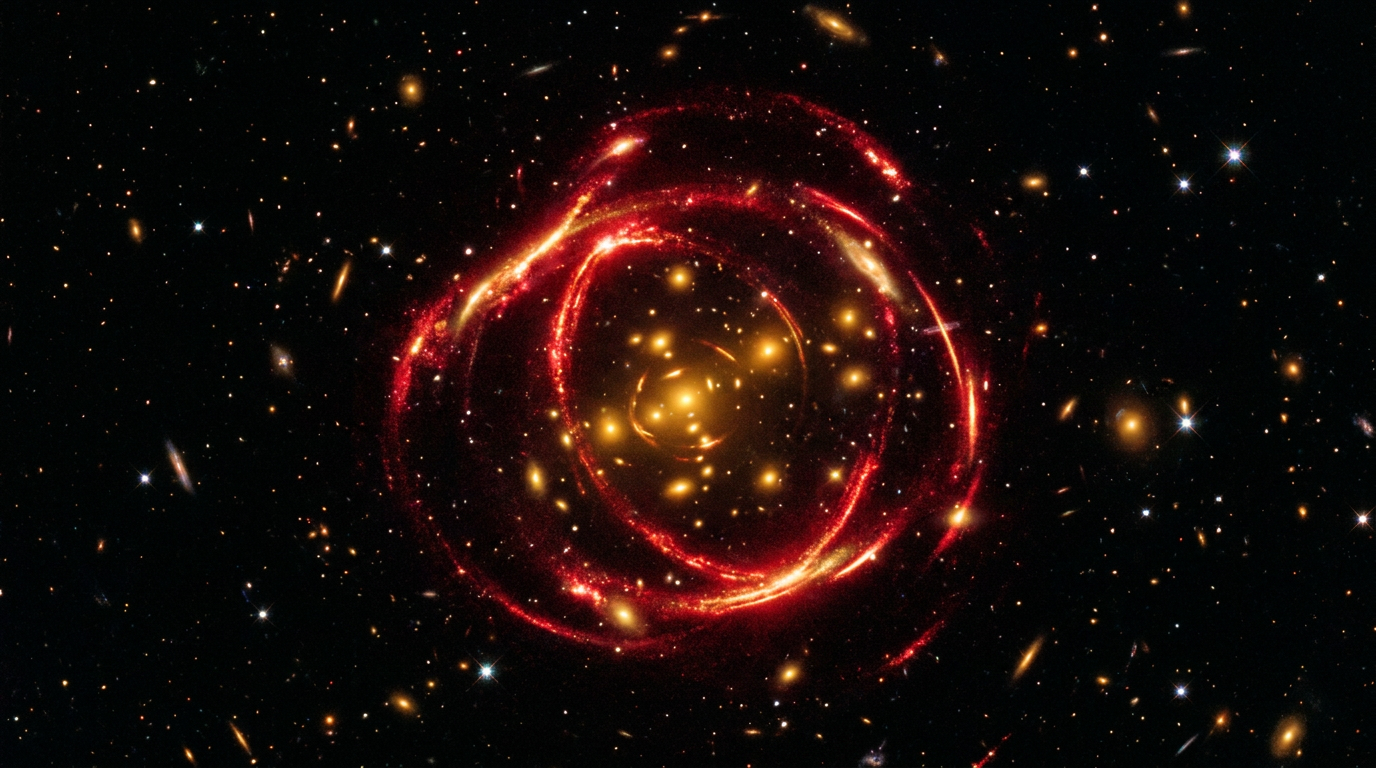
The breakthrough centers on a distant object known as Abell 2744-QSO1. Located behind a massive foreground galaxy cluster, the object's light was gravitationally lensed—magnified and stretched into three distinct images—allowing JWST to study it in unprecedented detail.[4][7]

The light from QSO1 reaches us from just 700 million years after the Big Bang, a time when the universe was only 5 percent of its current age. Despite this extreme youth, researchers achieved a direct dynamic measurement of the black hole's mass, confirming it weighs a staggering 40 to 50 million times the mass of our sun.[2][5]
The sheer size of the black hole wasn't the only shock; it was the ratio of the black hole to its host galaxy. In the modern, local universe, a central supermassive black hole typically accounts for about 0.1 percent of its galaxy's total mass.[2][8]
In QSO1, the black hole accounts for roughly two-thirds of the entire galaxy's mass. It is a "naked" black hole, dominating its environment and proving that it was "born big" long before a substantial population of stars had time to form around it.[2][4]
In QSO1, the black hole accounts for roughly two-thirds of the entire galaxy's mass.
This discovery mathematically eliminates the old stellar-collapse model for the early universe. There simply wasn't enough time for small stellar black holes to merge into a 50-million-solar-mass behemoth in just 700 million years.[3][5]

Instead, theoretical physicists point to a "heavy seed" mechanism. In the pristine, dense environment of the early universe, massive clouds of primordial hydrogen and helium may have collapsed directly under their own gravity, bypassing the star-formation phase entirely to instantly create massive black hole seeds.[3][7]
Once these heavy seeds formed, they didn't just sit passively in the dark. As they accreted surrounding gas, they generated immense friction and magnetic fields, shooting powerful plasma outflows into the cosmos.[3][6]
These outflows acted as gigantic cosmic snowplows. They slammed into surrounding gas clouds, compressing them and triggering explosive, rapid bursts of star formation. In essence, the black hole acted as an amplifier, actively constructing the stellar halo of its own host galaxy.[1][6]
This symbiotic relationship explains why the earliest galaxies observed by JWST—often appearing as mysterious "Little Red Dots"—are surprisingly bright and teeming with young stars. The black holes were the engines driving this early brilliance.[4][8]

However, this aggressive star-building phase was temporary. Theoretical models suggest that after about a billion years, the black holes grew so powerful that their outflows blew the remaining gas out of the galaxy entirely, quenching star formation and leaving the mature galaxies we recognize today.[3][6]
The ability to directly measure the gas dynamics around a black hole at such an extreme distance is a testament to JWST's infrared capabilities, which can pierce through the thick dust of the early universe that blinded previous observatories like Hubble.[4][7]
As astronomers continue to catalog these primordial Little Red Dots, the textbooks on cosmic evolution are being rapidly rewritten. The discovery of QSO1 proves that the universe's earliest days were far more dynamic, violent, and top-down than previously imagined—a reality where the monsters came before the stars.[1][5]
How we got here
13.8 Billion Years Ago
The Big Bang initiates the expansion of the universe.
First 50-100 Million Years
Massive primordial gas clouds collapse directly into 'heavy seed' black holes.
700 Million Years (z=7.04)
The Abell 2744-QSO1 black hole reaches 50 million solar masses, dominating its host galaxy.
1 Billion Years
Black hole outflows blow away remaining gas, halting early rapid star formation.
Present Day
Supermassive black holes represent only a tiny fraction (0.1%) of their host galaxies' mass.
Viewpoints in depth
Heavy Seed Proponents
Argue that early black holes formed directly from collapsing gas clouds.
This camp points to the sheer mass of the QSO1 black hole as proof that the 'stellar death' model is mathematically impossible for the early universe. They argue that massive primordial gas clouds collapsed directly into black holes tens of thousands of times more massive than the sun, bypassing the star-formation phase entirely. This 'heavy seed' mechanism explains how a black hole could reach 50 million solar masses just 700 million years after the Big Bang.
Co-evolution Theorists
Focus on the symbiotic relationship between black hole outflows and star formation.
Rather than just looking at which object appeared first, these researchers emphasize the feedback loop. They argue that the immense magnetic outflows from early supermassive black holes acted as cosmic snowplows, compressing surrounding gas and triggering the rapid star formation seen in JWST's 'Little Red Dots.' In their view, the black hole is the engine of the galaxy, actively constructing its own stellar halo before eventually blowing the remaining gas away.
Observational Astronomers
Maintain cautious optimism while seeking a larger sample size of early galaxies.
While acknowledging the groundbreaking nature of the Abell 2744-QSO1 discovery, observational astronomers caution against rewriting all cosmological models based on a single 'naked' black hole. They are currently using JWST to catalog hundreds of other high-redshift active galactic nuclei to determine if QSO1 is the standard blueprint for early galaxy formation, or an extreme statistical outlier.
What we don't know
- Whether the 'heavy seed' direct-collapse mechanism requires specific dark matter conditions to function.
- If the Abell 2744-QSO1 black hole is a standard blueprint for all early galaxies or an extreme statistical outlier.
- Exactly how the powerful black hole outflows eventually transition from triggering star formation to shutting it down entirely.
Key terms
- Supermassive Black Hole
- A black hole containing millions to billions of times the mass of our sun, typically found at the center of a galaxy.
- Gravitational Lensing
- A phenomenon where the gravity of a massive foreground object bends and magnifies the light of a more distant object behind it.
- Redshift
- The stretching of light toward the red end of the spectrum as it travels across the expanding universe, used to measure cosmic distances and age.
- Accretion Disk
- A swirling, superheated disk of gas and dust spiraling into a black hole, generating immense friction and light.
Frequently asked
Did the black hole or the galaxy come first?
According to new JWST data, the supermassive black hole came first. It formed before the vast majority of the stars in its host galaxy.
How did the first black holes get so big?
Scientists now believe they formed from the direct collapse of massive primordial gas clouds, creating 'heavy seeds' that bypassed the normal star-formation process.
Will our sun become a supermassive black hole?
No. Our sun is too small to become even a regular stellar-mass black hole, and supermassive black holes require millions of times more mass.
Sources
Source coverage
8 outlets
3 viewpoints surfaced








[1]Factlen Editorial TeamObservational Astronomers
Synthesis by Factlen editorial team
Read on Factlen Editorial Team →[2]NatureHeavy Seed Proponents
Direct dynamic measurement of a supermassive black hole in the early universe
Read on Nature →[3]The Astrophysical Journal LettersCo-evolution Theorists
Which Came First: Supermassive Black Holes or Galaxies? Insights from JWST
Read on The Astrophysical Journal Letters →[4]NASAObservational Astronomers
Webb Telescope Uncovers 'Naked' Black Hole in the Early Universe
Read on NASA →[5]University of CambridgeHeavy Seed Proponents
Webb discovers black hole that predates its host galaxy
Read on University of Cambridge →[6]Johns Hopkins UniversityCo-evolution Theorists
Which came first: The galaxy or the black hole?
Read on Johns Hopkins University →[7]European Space Agency (ESA)Observational Astronomers
Webb finds evidence of heavy black hole seeds in cosmic dawn
Read on European Space Agency (ESA) →[8]arXivHeavy Seed Proponents
Spectroscopic Identification of Low-Mass, Broad-Line AGN at z > 5
Read on arXiv →

Every angle. Every day.
Get science stories with full source coverage and perspective breakdowns delivered to your inbox.