
OLED vs. Mini-LED: The Definitive 2026 TV Buying Guide
As television technology reaches new heights in 2026, the choice between OLED and Mini-LED comes down to a battle between perfect cinematic blacks and blinding daytime brightness.
By Factlen Editorial Team
- Home Theater Purists
- Values perfect blacks, infinite contrast, and cinematic accuracy in dark rooms.
- Bright Room Viewers
- Values peak brightness, glare reduction, and vibrant colors in sunlit living spaces.
- Value & Large-Screen Buyers
- Focuses on cost-per-inch, longevity, and getting massive screens without spending a fortune.
What's not represented
- · Projector Enthusiasts
- · Budget LCD Buyers
Why this matters
A premium television is a decade-long investment that anchors your home entertainment. Choosing the wrong panel technology for your room's lighting can lead to frustrating glare during the day or distracting visual artifacts during movie nights.
Key points
- OLED televisions offer perfect black levels and infinite contrast by turning off individual pixels.
- Mini-LED televisions deliver significantly higher peak brightness, making them ideal for sunlit rooms.
- OLED carries a slight risk of burn-in over time, whereas Mini-LED is immune to permanent image retention.
- Mini-LED is much more cost-effective at massive screen sizes, such as 85 inches and above.
The 2026 television market has officially consolidated into a two-horse race. For anyone upgrading their living room centerpiece, the era of deciphering a dozen confusing acronyms has largely passed, leaving buyers with one definitive choice: OLED or Mini-LED. Both technologies have reached a level of maturity that makes them capable of producing breathtaking, cinematic visuals. Yet, they achieve these results through fundamentally opposite engineering philosophies, creating distinct trade-offs depending on how and where you watch.[1][2]
Understanding the battle begins with the underlying technology. OLED, which stands for Organic Light-Emitting Diode, is a self-emissive display. This means that every single pixel on the screen generates its own light and color. In a standard 4K OLED television, there are roughly 8.3 million individual pixels operating completely independently. When a scene calls for absolute darkness—like a starship moving through deep space—the pixels in that area simply turn off, emitting zero light.[3][5]
Mini-LED takes a radically different approach. It builds upon traditional LCD technology but replaces the old, chunky backlights with thousands of microscopic light-emitting diodes. These tiny lights are grouped into "local dimming zones"—often numbering in the thousands on premium 2026 models. A sophisticated algorithm tells these zones to dim or brighten based on the image on screen. While the pixels themselves don't turn off, the backlight behind them does its best to mimic the precision of an OLED.[2][4]
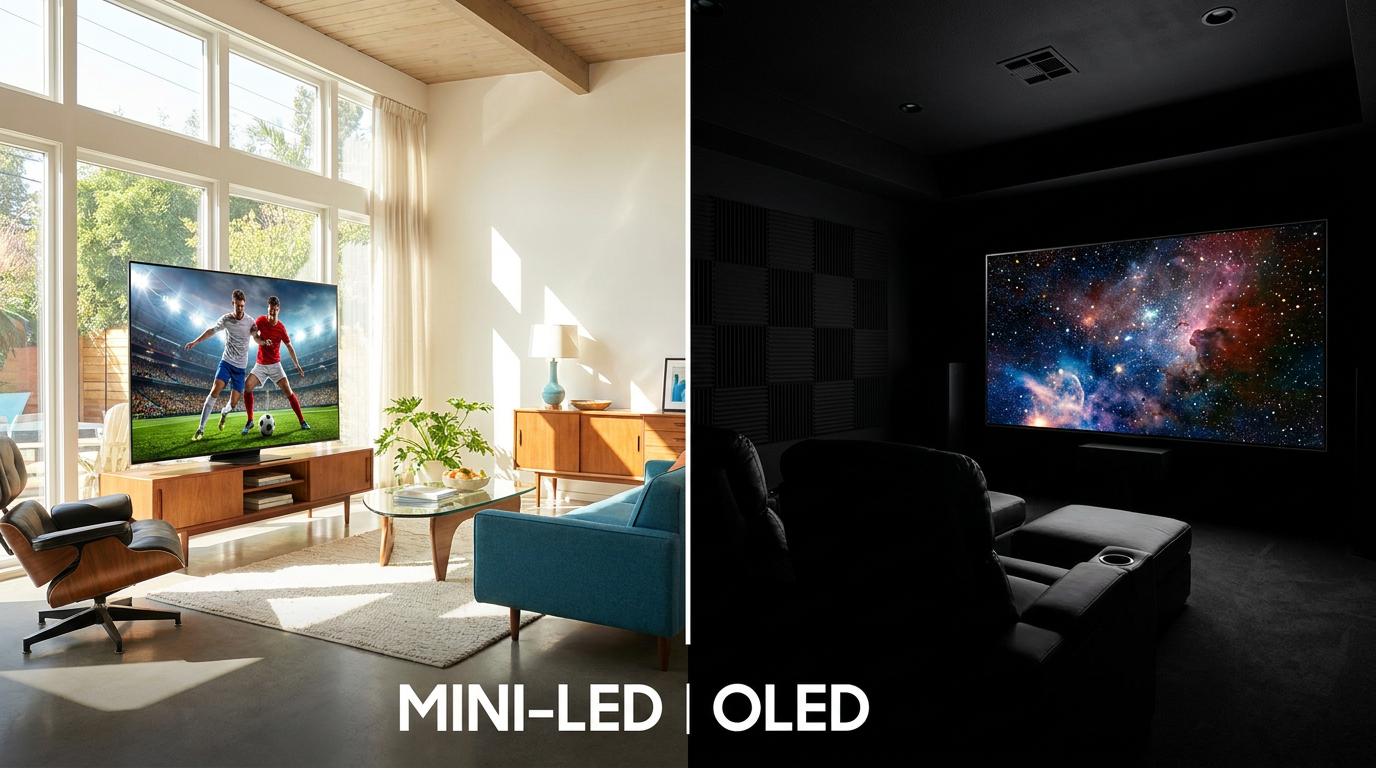
The most striking difference between the two technologies becomes apparent the moment you turn on the lights. Mini-LED is the undisputed champion of brightness. Premium Mini-LED panels in 2026 can easily push past 2,500 to 3,000 nits of peak brightness. This sheer luminous power allows them to punch through the glare of a sun-drenched living room, keeping sports broadcasts and daytime television looking vibrant and saturated even with the blinds wide open.[1][6]

OLED televisions, by contrast, are inherently limited in their peak brightness. While advancements like Tandem OLED—which stacks multiple organic layers—and Quantum Dot OLED (QD-OLED) have pushed peak highlights to around 1,500 nits, they cannot sustain that brightness across the entire screen. When an OLED attempts to display a bright, full-screen image like a hockey rink or a snow-covered landscape, an Automatic Brightness Limiter (ABL) aggressively dims the panel to prevent overheating and protect the organic compounds.[2][6]
However, when the sun goes down, OLED reclaims its crown. In a dark room, the contrast ratio of a television becomes the single most important factor in perceived picture quality. Because OLED pixels can achieve true, perfect black, the contrast ratio is technically infinite. This pixel-level precision gives high-quality movies an almost three-dimensional depth, rendering shadow details with a flawless, inky perfection that no backlit television can fully replicate.[3][5]
Mini-LED's reliance on a backlight introduces its greatest weakness: the halo effect, also known as blooming. Because a single dimming zone illuminates multiple pixels, bright objects on dark backgrounds can cause light to bleed into the surrounding area. If you are watching a movie with white subtitles over black letterbox bars, a Mini-LED television will often produce a faint, distracting glow around the text. While 2026 dimming algorithms have drastically reduced this artifact, it remains a physical limitation of the technology.[1][4]

Mini-LED's reliance on a backlight introduces its greatest weakness: the halo effect, also known as blooming.
Color performance has become a fascinating battleground. Historically, OLED held a slight edge in color accuracy and viewing angles. Because the pixels emit light directly outward, an OLED screen looks virtually identical whether you are sitting dead center or off to the side. Mini-LED panels, particularly those using VA (Vertical Alignment) LCD technology, suffer from color shifting and washed-out contrast when viewed from wide angles, making them less ideal for wide, wrap-around seating arrangements.[2][3]
Yet, Mini-LED has fought back with sheer color volume. By utilizing Quantum Dot layers and new RGB Mini-LED architectures, these televisions can maintain deep, saturated colors at extreme brightness levels where traditional OLEDs might look slightly washed out. If you are watching brilliantly mastered HDR content featuring explosions, neon lights, or vibrant nature documentaries, the high-key impact of a Mini-LED can be visually staggering.[5][6]
For gamers, the decision requires weighing motion clarity against sustained impact. OLED is widely considered the ultimate gaming display due to its near-instantaneous pixel response time. Because the pixels change state in a fraction of a millisecond, fast-paced action in first-person shooters or racing games remains incredibly crisp, with virtually zero motion blur behind moving objects. Both technologies now routinely support 144Hz to 240Hz refresh rates, but OLED's motion handling feels inherently smoother.[1][3]

The counterargument for gaming on Mini-LED centers on durability and peace of mind. OLED televisions carry a risk of permanent burn-in—a phenomenon where static elements, like a video game heads-up display or a news channel ticker, leave a permanent ghost image on the screen after thousands of hours of use. While modern OLEDs feature pixel-shifting and automatic logo-dimming to mitigate this, the risk is never zero. Mini-LED televisions are entirely immune to burn-in, making them the stress-free choice for users who leave their screens on all day.[4][6]
Longevity testing further supports the durability of Mini-LED. Independent laboratory tests have verified that modern Mini-LED panels can easily surpass 10,000 hours of intense use without significant degradation. Because the thermal load is distributed across tens of thousands of microscopic diodes, the panels run efficiently and maintain their peak performance for well over a decade, making them a highly reliable long-term investment.[1][4]
The final, and often most decisive, factor is economics—specifically when scaling up to massive screen sizes. Manufacturing large OLED panels remains an incredibly expensive endeavor. While 55-inch and 65-inch OLEDs have become competitively priced, jumping to a 77-inch or 83-inch model commands a massive premium. Mini-LED technology scales much more cost-effectively, allowing consumers to purchase 85-inch, 98-inch, or even 115-inch behemoths for the price of a standard-sized premium OLED.[5][6]

So, how do you choose? The decision should not be based on which technology is objectively better, but rather which set of compromises best fits your lifestyle. A side-by-side trade-off analysis reveals that the environment dictates the winner. If your television lives in a dedicated home theater or a room where you primarily watch movies and prestige dramas with the lights off, OLED is the undisputed choice. It fits perfectly when cinematic accuracy, perfect blacks, and wide seating arrangements are your top priorities.[2][3]
Conversely, Mini-LED is the ultimate everyday powerhouse. It fits perfectly if your living room has large windows, if you frequently host daytime sports watch parties, or if you want a massive, wall-consuming screen without taking out a second mortgage. It does not fit well if you are highly sensitive to blooming around subtitles in dark rooms, but for the vast majority of mixed-use households, Mini-LED offers a brighter, more resilient, and highly practical path to premium 2026 picture quality.[1][6]
How we got here
2013
LG releases the first commercially viable large-screen OLED televisions, establishing a new benchmark for contrast.
2019
Mini-LED technology enters the consumer market, offering a brighter alternative to traditional full-array local dimming.
2022
Quantum Dot OLED (QD-OLED) debuts, merging the brightness of quantum dots with the perfect blacks of OLED.
2026
Tandem OLED and RGB Mini-LED architectures push both technologies to unprecedented levels of brightness and color volume.
Viewpoints in depth
The Home Theater Purist's View
Advocates for OLED due to its unmatched contrast and pixel-level precision.
For cinephiles and dark-room viewers, the conversation begins and ends with OLED. This camp argues that peak brightness is a secondary metric compared to absolute black levels, as true contrast is what gives an image its three-dimensional depth. They point out that Mini-LED's blooming—no matter how advanced the local dimming algorithms become—will always compromise the integrity of starfields, subtitles, and moody shadow details. For these viewers, OLED's self-emissive nature is the only way to watch a film exactly as the director intended.
The Bright-Room Power User's View
Favors Mini-LED for its sheer luminous output and immunity to burn-in.
This perspective prioritizes real-world living conditions over pitch-black theater environments. Advocates argue that most people watch television during the day, with windows open and lights on, making Mini-LED's 3,000-nit peak brightness a massive advantage for cutting through glare. Furthermore, they emphasize the peace of mind that comes with Mini-LED; without the organic compounds found in OLED, users can leave news tickers, sports scores, or video game HUDs on the screen all day without the lingering anxiety of permanent image retention.
The Value and Large-Screen Buyer's View
Focuses on the cost-per-inch scaling and the accessibility of massive displays.
For this camp, the ultimate luxury is sheer size. They argue that the immersive impact of an 85-inch or 98-inch screen far outweighs the microscopic contrast differences between the two technologies. Because manufacturing massive OLED panels remains prohibitively expensive, Mini-LED is championed as the great democratizer of the home theater. Buyers in this category are willing to accept minor blooming in exchange for a wall-consuming display that costs a fraction of what an equivalently sized OLED would demand.
What we don't know
- Whether Micro-LED—a technology that combines the brightness of Mini-LED with the pixel-level control of OLED—will ever become affordable enough for the average consumer.
- How the long-term degradation curve of the newest Tandem OLED panels compares to traditional single-layer OLEDs after a decade of use.
Key terms
- Local Dimming Zones
- Specific areas of a Mini-LED backlight that can independently dim or turn off to improve contrast in dark scenes.
- Nits
- A unit of measurement for screen brightness. More nits mean a brighter display capable of fighting room glare.
- Blooming (Halo Effect)
- A visual artifact where light bleeds from bright objects into adjacent dark areas on an LCD or Mini-LED screen.
- Self-emissive
- A display technology, like OLED, where every single pixel generates its own light and can turn completely off.
- Burn-in
- Permanent image retention caused by leaving static elements on an organic screen for thousands of hours.
Frequently asked
Does Mini-LED suffer from burn-in like OLED?
No. Because Mini-LED uses a traditional backlight array rather than organic compounds, it is immune to permanent burn-in, making it ideal for static content like news tickers or desktop monitors.
Is OLED bright enough for a living room?
Yes, modern OLEDs are bright enough for most average rooms, but they will struggle with glare in heavily sun-drenched rooms compared to the sheer output of a Mini-LED.
What is the 'halo effect' or blooming?
Blooming occurs on Mini-LEDs when light from a bright object bleeds into the surrounding dark zones, creating a faint glow around things like white subtitles on a black background.
Which TV type is better for gaming?
Both are excellent, but OLED has a slight edge due to near-instantaneous pixel response times, which eliminates motion blur in fast-paced games.
Sources
Source coverage
6 outlets
3 viewpoints surfaced






[1]RTINGSHome Theater Purists
OLED vs Mini LED: Which Panel Technology Is Better?
Read on RTINGS →[2]Tom's GuideBright Room Viewers
OLED vs Mini-LED: Which TV tech is right for you?
Read on Tom's Guide →[3]TechRadarHome Theater Purists
OLED vs mini-LED: which TV technology is better?
Read on TechRadar →[4]PCWorldValue & Large-Screen Buyers
OLED vs. Mini-LED: The next big display battle
Read on PCWorld →[5]CurrysBright Room Viewers
OLED vs Mini LED: What's the difference?
Read on Currys →[6]Data Wire SolutionsValue & Large-Screen Buyers
Best TVs for 2026: 10 OLED and Mini-LED Picks
Read on Data Wire Solutions →
Every angle. Every day.
Get shopping stories with full source coverage and perspective breakdowns delivered to your inbox.