
How Micro-Fragmentation and Acoustic Enrichment Are Rebuilding Coral Reefs
Marine biologists are deploying a new generation of active interventions—from accelerated cloning to underwater soundscapes and heat-resistant 'super corals'—to restore degraded reefs. These breakthroughs are buying critical time for the ocean's most vulnerable ecosystems.
By Factlen Editorial Team
- Marine Technologists
- Focus on scaling active interventions to rapidly rebuild reef architecture.
- Evolutionary Biologists
- Prioritize identifying and propagating heat-resistant genetics to ensure corals survive future warming.
- Ecological Realists
- Emphasize that technological interventions are only temporary stopgaps if global climate change is not addressed.
What's not represented
- · Coastal Fishing Communities
- · Tourism Industry Operators
Why this matters
Coral reefs support a quarter of all marine life and provide food security and coastal protection for a billion people. These technological breakthroughs offer the first scalable blueprint for actively rebuilding these critical ecosystems before climate change wipes them out.
Key points
- Marine biologists are shifting from passive conservation to active, high-tech reef restoration.
- Micro-fragmentation accelerates the growth of slow-building massive corals by up to 50 times.
- Acoustic enrichment uses underwater speakers to attract free-swimming coral larvae to degraded reefs.
- Scientists are selectively breeding 'super corals' that can survive in water temperatures up to 4°C hotter.
- Probiotics and microbiome stewardship are being used to boost the thermal resilience of vulnerable corals.
- These technologies buy critical time for reef ecosystems while global climate change is addressed.
For decades, the primary strategy for saving the world’s coral reefs was passive protection: establishing marine reserves, limiting fishing, and hoping the ecosystems would recover on their own. But as ocean temperatures continue to break records, conservationists have realized that simply leaving reefs alone is no longer enough. A paradigm shift is underway across marine biology, transitioning from observation to active, high-tech intervention. Armed with new discoveries in biology, acoustics, and genetics, scientists are deploying unprecedented methods to rebuild the "rainforests of the sea" before they vanish.[7]
The fundamental bottleneck in reef restoration has always been time. Reef-building species—such as massive brain, boulder, and star corals—are the foundational architecture of marine ecosystems, but they grow agonizingly slowly. In the wild, these dense calcium-carbonate structures might expand by only a few millimeters a year, meaning a large, functional colony can take centuries to form. When a bleaching event or severe storm wipes out a reef, natural recovery operates on a timeline that modern climate change no longer permits.[4]
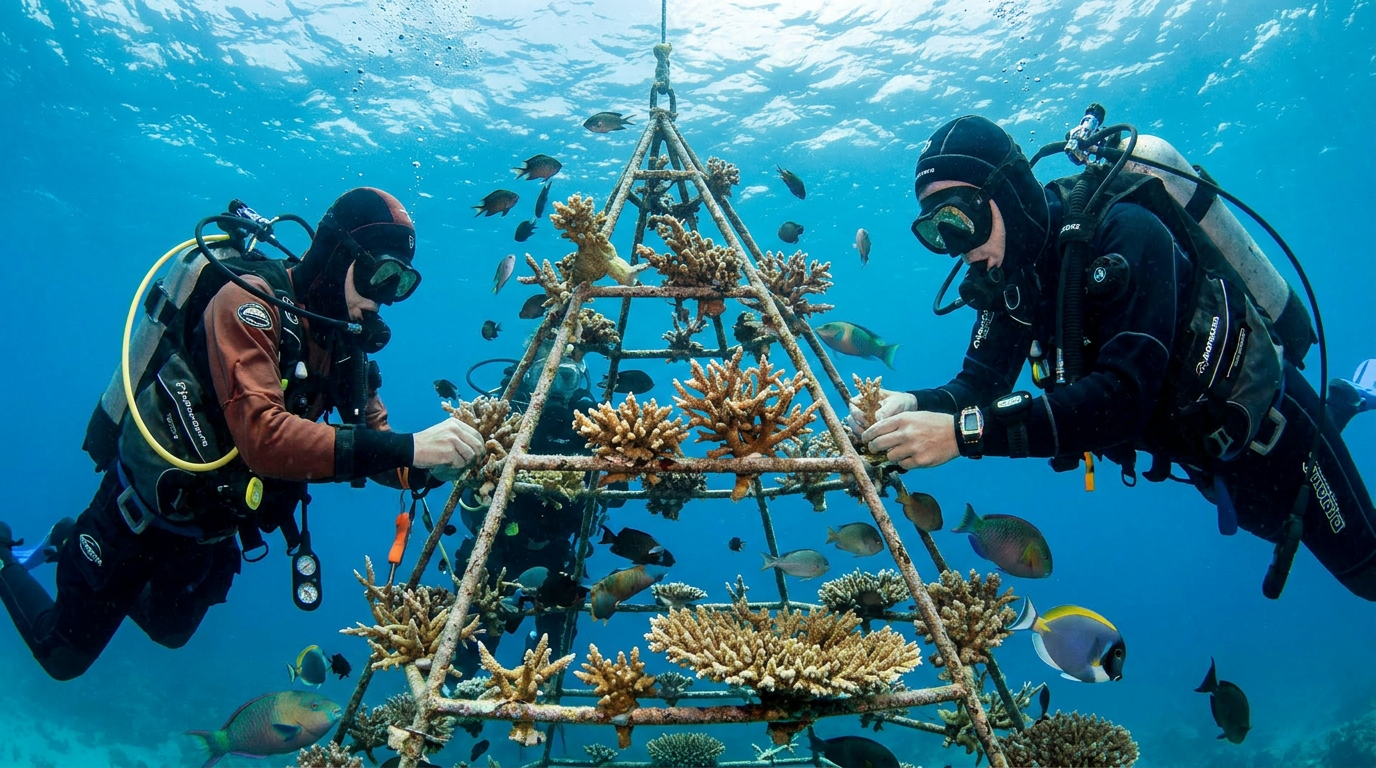
The solution to this speed limit was discovered largely by accident. In a Florida laboratory, a marine scientist inadvertently broke a small piece of slow-growing coral. Rather than dying, the shattered fragments exhibited an astonishing biological response: over the next few weeks, they began growing at an explosive rate. This mishap birthed a revolutionary restoration technique known as micro-fragmentation, which has since transformed the possibilities for rebuilding degraded marine habitats.[3][4]
The micro-fragmentation process essentially hacks the coral’s natural healing mechanisms. Using specialized diamond-blade saws, restoration practitioners cut parent colonies into tiny pieces, often no larger than a single square centimeter. This severe trauma triggers an emergency growth response as the tiny fragments rush to heal their exposed edges. Driven by this biological imperative, the micro-fragments grow up to 50 times faster than their natural, undisturbed rate.[4]

The true magic of micro-fragmentation occurs during the outplanting phase. When these rapidly growing clones are placed close to one another on a degraded reef, they recognize their shared genetics. Instead of competing for space, they seamlessly fuse together. By combining the accelerated growth rate with this fusion behavior, scientists can cultivate massive coral heads in just two to three years—a process that would normally take between 25 and 100 years in the wild.[3][4]
Yet, growing adult corals is only half the battle; a reef must also be able to reproduce and recruit new generations. During their larval stage, corals are microscopic, free-swimming organisms drifting through the ocean currents. To survive and mature, they must eventually drop out of the water column and attach themselves to a hard, suitable surface on the seafloor—a process known as larval settlement.[1][2]
For years, scientists struggled to understand exactly how these drifting larvae chose where to settle. It turns out they are listening. A vibrant, healthy coral reef is an incredibly noisy environment, echoing with a constant chorus of crackling snapping shrimp, grunting fish, and the general acoustic chaos of a thriving ecosystem. In contrast, a bleached, degraded reef is eerily silent.[1][2]
Researchers at the Woods Hole Oceanographic Institution (WHOI) have pioneered a technique called "acoustic enrichment" to exploit this sensory behavior. By deploying underwater loudspeakers—often termed Reef Acoustic Playback Systems—scientists broadcast the recorded soundscapes of healthy, vibrant reefs into areas of dead coral rubble. The goal is to artificially recreate the sensory cues that signal a safe, productive habitat.[1]

Researchers at the Woods Hole Oceanographic Institution (WHOI) have pioneered a technique called "acoustic enrichment" to exploit this sensory behavior.
The results have been remarkably effective. Although coral larvae lack ears, they possess exterior, hair-like structures called cilia that allow them to detect and swim toward underwater acoustic vibrations. Studies have shown that when healthy reef sounds are played, larval settlement rates can be up to seven times higher than in acoustically silent control areas. The technique not only attracts corals but also draws in juvenile fish, kickstarting the entire food web.[1][2]
However, accelerating growth and boosting settlement rates solve only the mechanical challenges of reef restoration. The existential threat remains the rising temperature of the ocean itself. If newly planted, fast-growing corals are simply wiped out by the next marine heatwave, the restoration effort is futile. To address this, marine biologists are increasingly turning their attention to the genetic resilience of the corals themselves.[8]
This has sparked a global hunt for "super corals"—strains that have naturally evolved to withstand extreme thermal stress. Researchers have discovered these resilient survivors in some of the ocean’s most hostile environments, from the shallow, sun-baked tidal pools of American Samoa to the semi-enclosed lagoons of the Tatakoto atoll in French Polynesia, and the naturally warm waters of the Red Sea.[3][5]
In these extreme micro-climates, water temperatures can regularly spike up to 4°C hotter than the surrounding open ocean. While standard corals would quickly expel their symbiotic algae and bleach under such conditions, these super corals thrive. By studying their genetics, scientists have confirmed that this heat tolerance is often hardwired into their DNA, meaning it can be passed down to future generations.[5]

Armed with this knowledge, conservationists are engaging in "assisted evolution." By selectively breeding these heat-tolerant strains in land-based aquaculture facilities, scientists aim to cultivate a new generation of corals engineered to survive the oceans of tomorrow. These resilient specimens are then strategically outplanted to act as genetic anchors, spreading their robust traits through natural reproduction.[5][8]
The resilience of super corals isn't solely in their own DNA; it also lies in their microbiome. Researchers studying Red Sea corals have found that specific strains of symbiotic algae, such as those in the Cladocopium genus, provide crucial heat tolerance. Scientists are now experimenting with coral "probiotics"—cocktails of beneficial bacteria and algae designed to inoculate vulnerable corals and boost their thermal resistance before a heatwave strikes.[5]
Despite the immense promise of super corals, geneticists urge caution. Selectively breeding corals for a single trait—heat tolerance—carries significant ecological risks. If restoration efforts rely on a narrow pool of super-resilient clones, the resulting reefs could suffer from a genetic bottleneck. A lack of broad genetic diversity might leave the population highly vulnerable to novel diseases, ocean acidification, or other unforeseen environmental shocks.[6]
To mitigate this risk, modern restoration frameworks emphasize "managed breeding." This approach balances the introduction of heat-tolerant traits with the preservation of natural genetic variance. Rather than trying to engineer a single perfect coral, the goal is to equip diverse populations with enough adaptive capacity to survive, allowing natural selection to continue shaping the reef's future in the wild.[6]

The ultimate challenge for these breakthrough technologies is scale. Transitioning from successful laboratory experiments and pilot plots to restoring thousands of miles of degraded coastline requires massive logistical coordination, sustained funding, and the integration of local communities. Organizations are increasingly training citizen scientists and local stakeholders to operate micro-fragmentation saws and acoustic playback systems.[4][7]
No marine biologist claims that micro-fragmentation, acoustic enrichment, or super corals are a silver bullet. These interventions cannot lower the temperature of the oceans or reverse global carbon emissions. However, they are powerful, necessary tools. By dramatically accelerating recovery and boosting resilience, these technologies are buying the world's coral reefs the one thing they need most: time.[6][7]
How we got here
2016
The technique of micro-fragmentation gains prominence after researchers discover that broken coral pieces grow exponentially faster.
2019
Researchers in Australia demonstrate that playing healthy reef sounds can significantly increase juvenile fish populations on degraded reefs.
2021
Expeditions to the Tatakoto atoll begin studying naturally occurring 'super corals' surviving in abnormally warm lagoons.
2024
Woods Hole Oceanographic Institution publishes research proving acoustic enrichment boosts larval settlement across multiple coral species.
Viewpoints in depth
Marine Technologists
Focus on scaling active interventions to rapidly rebuild reef architecture.
This camp argues that passive conservation is no longer viable. By treating coral restoration as an engineering and aquaculture challenge, they believe we can outpace natural degradation. Proponents point to the success of micro-fragmentation, which accelerates growth by up to 50 times, and acoustic enrichment, which actively draws life back to dead zones. Their primary goal is to industrialize these processes, moving from small-scale nurseries to massive, automated underwater farms that can deploy millions of resilient coral fragments annually.
Evolutionary Biologists
Prioritize identifying and propagating heat-resistant genetics to ensure corals survive future warming.
For geneticists and evolutionary biologists, rebuilding a reef is pointless if the new corals will simply bleach in the next heatwave. This perspective focuses on 'assisted evolution'—finding naturally resilient 'super corals' in extreme environments and selectively breeding them. They also emphasize microbiome stewardship, arguing that inoculating corals with heat-tolerant symbiotic algae and probiotics is the most effective way to armor reef ecosystems against the inevitable rise in ocean temperatures.
Ecological Realists
Emphasize that technological interventions are only temporary stopgaps if global climate change is not addressed.
While supportive of restoration technologies, this camp warns against technological hubris. They argue that selectively breeding for heat tolerance risks creating genetic bottlenecks, leaving reefs vulnerable to novel diseases. Furthermore, they stress that micro-fragmentation and acoustic enrichment cannot fundamentally alter the chemistry of a warming, acidifying ocean. For ecological realists, these tools are strictly a means to buy time and preserve genetic diversity while society tackles the root cause: global carbon emissions.
What we don't know
- Whether selectively bred 'super corals' will maintain their heat tolerance when transplanted to entirely different ocean environments.
- How long the accelerated growth effects of micro-fragmentation last before the coral returns to its natural metabolic rate.
- If acoustic enrichment can be scaled cost-effectively across thousands of miles of degraded coastline.
Key terms
- Micro-fragmentation
- A technique where corals are cut into tiny pieces to stimulate rapid healing and accelerated growth.
- Acoustic Enrichment
- The use of underwater speakers to broadcast the sounds of a healthy reef, attracting marine life and coral larvae to degraded areas.
- Super Corals
- Coral strains that have naturally evolved or been selectively bred to withstand higher ocean temperatures without bleaching.
- Assisted Evolution
- Human intervention to accelerate the natural adaptation of species to changing environments, such as selectively breeding heat-tolerant corals.
- Larval Settlement
- The crucial life stage where free-swimming coral larvae attach themselves to a hard surface on the seafloor to grow into adult colonies.
Frequently asked
Can we rebuild coral reefs fast enough to save them?
While traditional coral growth takes decades, new techniques like micro-fragmentation can accelerate growth up to 50 times, allowing massive corals to reach maturity in just a few years.
How does sound help coral reefs grow?
Coral larvae use tiny hairs called cilia to swim toward the sounds of healthy reefs. Playing these sounds through underwater speakers encourages them to settle on degraded reefs.
What are 'super corals'?
They are specific strains of coral that have demonstrated an unusual ability to survive in abnormally warm waters without bleaching, making them prime candidates for selective breeding.
Will these technologies solve the coral bleaching crisis?
Not entirely. Scientists emphasize that these interventions are stopgap measures to buy time and preserve genetic diversity while the root cause—global climate change—is addressed.
Sources
Source coverage
8 outlets
3 viewpoints surfaced








[1]Woods Hole Oceanographic InstitutionMarine Technologists
WHOI researchers reinforce acoustic enhancement as a reef restoration method
Read on Woods Hole Oceanographic Institution →[2]Earth.OrgMarine Technologists
Can Soundscapes Save Coral Reefs?
Read on Earth.Org →[3]National GeographicEcological Realists
Five reasons why our coral reefs have hope
Read on National Geographic →[4]Coral VitaMarine Technologists
Coral Fragmentation: Key to Reef Restoration
Read on Coral Vita →[5]EcoMENAEvolutionary Biologists
Red Sea 'Super Corals' - A Ray of Hope for Global Reef Survival
Read on EcoMENA →[6]ResearchGateEcological Realists
Managing expectations for breeding 'super corals'
Read on ResearchGate →[7]Factlen Editorial TeamEcological Realists
Synthesis by Factlen editorial team
Read on Factlen Editorial Team →[8]Inside SeychellesEvolutionary Biologists
Heat-resilient 'super corals'
Read on Inside Seychelles →
Every angle. Every day.
Get environment stories with full source coverage and perspective breakdowns delivered to your inbox.