
US-Iran Peace Deal Hangs in Balance After Israeli Airstrikes on Beirut
President Trump is urging restraint to save an imminent peace agreement with Iran after Israeli forces launched fresh strikes on Hezbollah targets in Lebanon's capital.
By Factlen Editorial Team
- US Administration
- Focused on securing the diplomatic win and reopening global shipping lanes, viewing regional skirmishes as dangerous distractions.
- Israeli Security Establishment
- Deeply distrustful of the 60-day framework, prioritizing immediate tactical deterrence against Hezbollah.
- Iranian Leadership & Allies
- Balancing the economic need to unfreeze assets against the ideological imperative to project strength and protect allied militant groups.
- International Mediators
- Focused on keeping both sides at the table to secure the 60-day framework and stabilize the region.
What's not represented
- · Lebanese Civilians
- · European Energy Importers
Why this matters
A collapse of the US-Iran peace deal would likely trigger a wider regional war, keeping the vital Strait of Hormuz closed to global shipping and sending energy prices soaring. Conversely, a successful agreement would stabilize the Middle East and establish a framework to dismantle Iran's near-weapons-grade uranium stockpile.
Key points
- The US and Iran are close to signing a peace deal to end their three-month conflict.
- Israeli airstrikes on Hezbollah targets in Beirut on Sunday threatened to derail the agreement.
- President Trump urged all sides to stand down, insisting the deal is still on track.
- The agreement would reopen the Strait of Hormuz and set a 60-day framework for nuclear discussions.
- Iranian hardliners are protesting the deal, while mediators from Qatar and Pakistan scramble to save it.
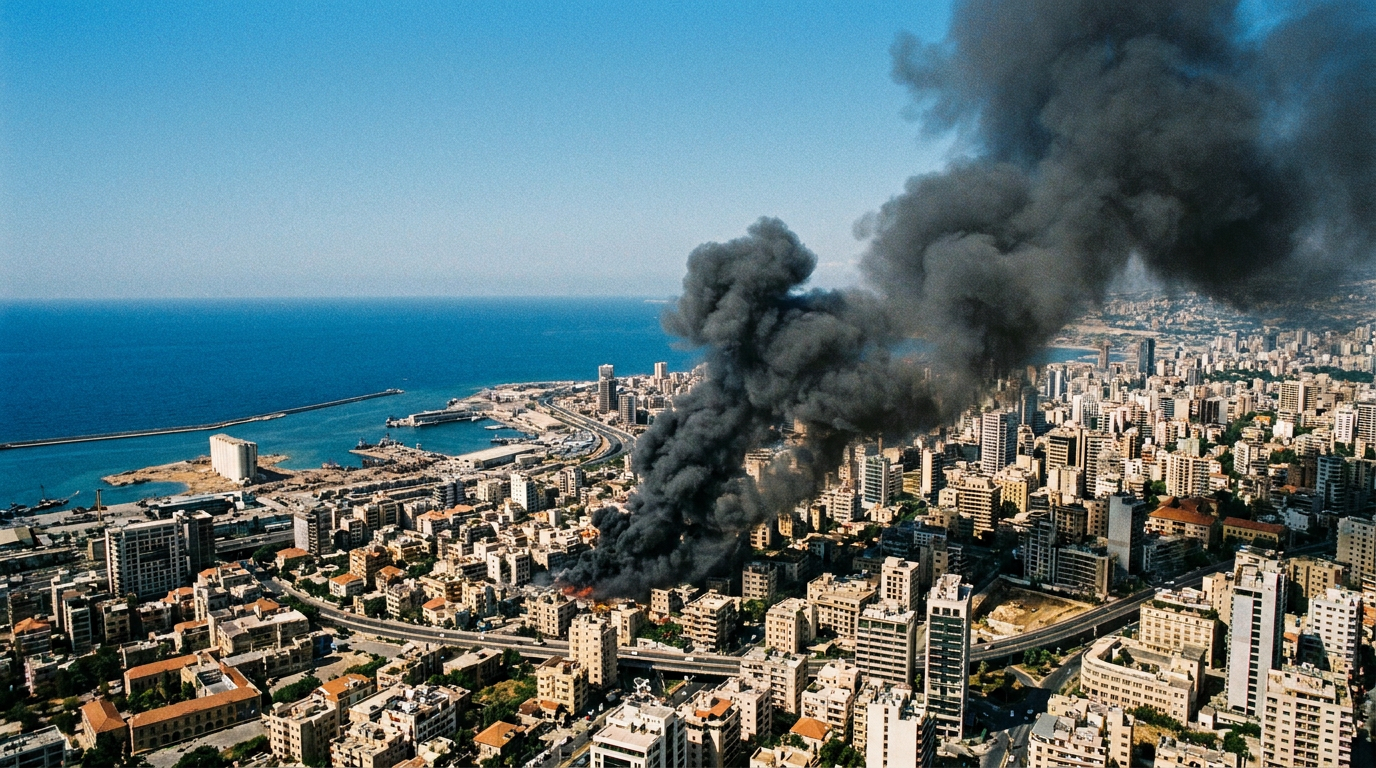
The United States and Iran are on the brink of signing a historic peace agreement to end their three-month conflict, but the diplomatic breakthrough was thrown into jeopardy Sunday morning when Israeli forces launched fresh airstrikes on the Lebanese capital of Beirut.[2][6]
Smoke billowed over Dahieh, Beirut's southern suburbs, after the Israeli military targeted what it described as Hezbollah infrastructure. The Lebanese Health Ministry reported that three people were killed and 16 others wounded when the strikes heavily damaged the lower floors of a five-story residential building.[3][5][7]
The office of Israeli Prime Minister Benjamin Netanyahu defended the bombardment, stating it was a direct response to Hezbollah launching three projectiles into northern Israel earlier in the day.[7]

President Donald Trump, who has staked significant political capital on securing the US-Iran agreement, quickly moved to salvage the diplomatic process. In a post on Truth Social, he called the Israeli attack "very small and meaningless" and insisted it "should not have happened."[4][5]
"We are very close to a Deal that will bring peace to the region, including to Lebanon, and all sides should stand down," Trump wrote, urging both Israel and Hezbollah to halt all attacks. "This could be the beginning of a long and beautiful peace — Let's not blow it!"[5][6]
Privately, the frustration in Washington is palpable. Speaking to Axios, Trump reportedly criticized Netanyahu's judgment in authorizing the strike at such a sensitive moment, though he maintained that the electronic signing of the deal remains on track for Sunday.[1]
In Tehran, the strikes triggered immediate outrage and threats of retaliation. Iranian Parliament Speaker Mohammad Bagher Ghalibaf warned that the attack proved Washington either lacks the will or the ability to control its allies, complicating the path forward.[6]
In Tehran, the strikes triggered immediate outrage and threats of retaliation.
The Iranian negotiating team is also facing intense domestic pressure. Hardline factions held protest rallies in Tehran and Mashhad on Sunday, accusing Foreign Minister Abbas Araghchi of compromising with the US while Iranian allies in Lebanon remain under fire.[4]
Qatari negotiators flew to Tehran on Sunday morning in a frantic bid to keep the agreement alive, joining a months-long mediation effort spearheaded by Pakistan that has repeatedly pulled the talks back from the brink of collapse.[4][7]
If signed, the preliminary agreement would immediately reopen the Strait of Hormuz—a vital artery for global energy markets—and formalize the tenuous ceasefire that has largely held since early April.[4][5]

Crucially, the deal does not immediately resolve the core disputes over Iran's nuclear program or its billions of dollars in frozen assets. Instead, it establishes a 60-day framework for technical discussions on those thorny issues.[7]
Trump has asserted that once the region is calm, the US will move to "downblend and destroy" Iran's enriched uranium. The International Atomic Energy Agency estimates Iran currently holds roughly 440.9 kilograms of uranium enriched to 60% purity—a short technical step from weapons-grade.[5]

The emerging framework is viewed with deep skepticism by the Israeli security establishment, which feels sidelined by the US-led negotiations and remains focused on degrading Hezbollah's military capabilities on its northern border.[5][7]
As Sunday evening approaches in the Middle East, the fate of the agreement hangs on whether Iran chooses to retaliate for the Beirut strikes or accepts the diplomatic off-ramp. Iranian Foreign Ministry spokesperson Esmail Baghaei suggested the signing could slip to the coming days, leaving the region in a tense holding pattern.[5]
How we got here
April 2026
A tenuous ceasefire between the US and Iran takes hold.
June 7, 2026
Israel strikes Beirut suburbs, setting off a serious escalation in fighting.
June 13, 2026
Trump and Pakistani PM Shehbaz Sharif announce a peace deal will be signed on Sunday.
June 14, 2026
Israel launches fresh airstrikes on Beirut; Trump urges all sides to stand down.
Viewpoints in depth
The US Administration
Focused entirely on securing the diplomatic win and reopening global shipping lanes.
For the White House, the preliminary agreement represents a major foreign policy objective that would stabilize global energy markets by reopening the Strait of Hormuz. The administration views the ongoing skirmishes between Israel and Hezbollah as dangerous distractions that threaten to derail months of delicate mediation by Pakistan and Qatar. President Trump has made it clear that he expects all allied parties to stand down and prioritize the broader strategic framework over immediate tactical retaliations.
The Israeli Security Establishment
Prioritizing immediate tactical deterrence against Hezbollah over the broader diplomatic framework.
Israeli officials feel largely sidelined by the US-led negotiations and are deeply skeptical of the proposed 60-day framework, which they argue leaves Iran's nuclear infrastructure intact while providing Tehran with economic relief. From Israel's perspective, the immediate threat posed by Hezbollah on its northern border cannot be ignored for the sake of a US-Iran diplomatic timeline, prompting the decision to launch preemptive and retaliatory strikes on Beirut regardless of the ongoing peace talks.
Iranian Leadership
Balancing severe economic needs against the ideological imperative to project strength.
Tehran is caught between the urgent need to unfreeze billions of dollars in assets and the necessity of maintaining credibility with its regional proxy network, the 'Axis of Resistance.' Hardline factions within Iran view the Israeli strikes on Beirut as proof that the US cannot be trusted to rein in its allies, putting immense pressure on the Iranian negotiating team to walk away from the table. However, the prospect of immediate economic relief and the reopening of maritime trade routes continues to keep Iranian diplomats engaged in the Qatari-brokered talks.
What we don't know
- Whether Iran will launch a military retaliation for the Beirut strikes before the deal is signed.
- The exact mechanism and location for the electronic signing of the agreement.
- How the US plans to enforce the 'downblending' of Iran's uranium stockpile during the 60-day framework.
Key terms
- Strait of Hormuz
- A crucial maritime chokepoint between the Persian Gulf and the Gulf of Oman, through which a significant portion of the world's oil passes.
- Dahieh
- A predominantly Shia suburb south of Beirut, Lebanon, known as a stronghold for Hezbollah.
- Downblending
- The process of reducing the concentration of the U-235 isotope in enriched uranium, rendering it unusable for nuclear weapons.
Frequently asked
Why did Israel strike Beirut?
The Israeli military stated the strikes targeted Hezbollah infrastructure in response to three projectiles launched into northern Israel earlier in the day.
What is in the proposed US-Iran deal?
The agreement would extend the current ceasefire, immediately reopen the Strait of Hormuz, and establish a 60-day framework to discuss Iran's nuclear program and frozen assets.
Is Israel part of the peace deal?
No, the Israeli government has been largely sidelined in the negotiations, which are being mediated primarily by Pakistan and Qatar.
Will the deal still be signed?
President Trump insists the deal will be signed electronically on Sunday, though Iranian officials have cautioned it may take a few more days to finalize.
Sources
Source coverage
7 outlets
4 viewpoints surfaced







[1]AxiosUS Administration
Trump to Axios: Netanyahu has "no fucking judgment" but Iran deal still on
Read on Axios →[2]The GuardianIsraeli Security Establishment
Trump calls for restraint after Israel launches fresh airstrikes on Beirut
Read on The Guardian →[3]Al JazeeraIranian Leadership & Allies
Al Jazeera reports from Israeli attack site in southern Beirut
Read on Al Jazeera →[4]Fox NewsUS Administration
Trump says Israel shouldn't have attacked Beirut as US-Iran deal 'very close'
Read on Fox News →[5]ITV NewsIsraeli Security Establishment
'Let's not blow it': Trump says strike on Beirut 'should not have happened'
Read on ITV News →[6]The Washington PostIranian Leadership & Allies
Trump says U.S., Iran 'very close' to deal and urges calm after Israeli strikes
Read on The Washington Post →[7]CBC NewsInternational Mediators
Trump warns Israel and Iran not to 'blow it' after new strikes threaten emerging ceasefire deal
Read on CBC News →

Every angle. Every day.
Get news politics stories with full source coverage and perspective breakdowns delivered to your inbox.