
The Science and Economics of Lab-Grown Diamonds in High Jewelry
Heritage luxury houses like Prada and LVMH are embracing lab-grown diamonds in their highest-end collections, shifting the definition of luxury from natural rarity to technological mastery and sustainability.
By Factlen Editorial Team
- Heritage Innovators
- Luxury houses embracing lab-grown diamonds argue that technology unlocks unprecedented creative freedom and aligns with modern values.
- Traditionalist Jewelers
- Legacy brands maintaining exclusive use of natural diamonds emphasize their intrinsic rarity and historical investment value.
- Conscious Consumers
- A younger demographic of luxury buyers prioritizing ethical transparency, environmental impact, and verifiable sourcing.
What's not represented
- · Diamond mining communities in developing nations
- · Independent artisanal jewelers
Why this matters
The integration of lab-grown diamonds into haute joaillerie fundamentally rewrites the economics of luxury. It signals a shift where human ingenuity, sustainability, and brand craftsmanship are becoming more valuable than geological scarcity, changing how wealth and status are signaled in the 21st century.
Key points
- Heritage luxury houses like Prada and LVMH's Fred are integrating lab-grown diamonds into their highest-end collections.
- Lab-grown stones offer unprecedented creative freedom, allowing for custom shapes like the 'Prada Cut' and rare colors.
- Unlike the mass market, luxury brands are maintaining ultra-premium pricing, shifting value from geological scarcity to brand craftsmanship.
- The market is bifurcating, with traditionalists favoring natural stones for investment and innovators favoring lab-grown for design and sustainability.
For centuries, the pinnacle of high jewelry—haute joaillerie—was defined almost entirely by geological chance. The intrinsic value of a masterpiece was inextricably tied to the extreme rarity of the earth-mined stones it contained, with natural diamonds serving as the ultimate, unassailable symbol of enduring wealth, status, and tradition. But as the global luxury landscape evolves rapidly in 2026, a profound philosophical and economic shift is redefining what it means for a material to be considered truly precious. The industry is moving away from a pure reliance on what can be extracted from the earth, looking instead toward what can be perfected in a laboratory.[1][4]
A growing and influential cohort of heritage luxury houses is now openly embracing lab-grown diamonds (LGDs), elevating them from their previous status as mass-market alternatives to the glittering centerpieces of highly exclusive, top-tier collections. Italian fashion powerhouse Prada and the esteemed LVMH-owned Parisian jeweler Fred have both boldly integrated man-made stones into their finest, most expensive offerings. This high-profile transition signals to the broader market that lab-grown gems are no longer viewed as a budget compromise. Instead, they represent a thrilling new chapter in luxury that prioritizes technological mastery, ethical sourcing, and boundless design innovation over sheer geological scarcity.[1][2][3]
The scientific reality of modern lab-grown diamonds is absolutely foundational to their newfound acceptance in the upper echelons of the luxury sphere. It is crucial to understand that unlike traditional diamond simulants such as cubic zirconia, white sapphire, or moissanite, LGDs are chemically, physically, and optically identical to natural diamonds. They are composed of pure crystallized carbon, rendering them completely indistinguishable to the naked eye, the jeweler's loupe, and even standard diamond testers. It requires highly specialized, advanced spectroscopic equipment in a gemological laboratory to identify their man-made origins by detecting microscopic growth patterns.[4][9]
These flawless stones are cultivated using incredibly advanced technological processes, primarily relying on Chemical Vapor Deposition (CVD) or High Pressure High Temperature (HPHT) methods. In the highly precise CVD process, a microscopic diamond seed is placed in a sealed vacuum chamber filled with carbon-rich hydrocarbon gases; under intense heat and microwave energy, the gases break down into plasma, and pure carbon bonds to the seed, layer by microscopic layer. This meticulously controlled environment allows scientists and master jewelers to achieve levels of structural perfection and clarity that nature only rarely, and unpredictably, produces.[6]

For luxury designers and creative directors, this controlled growth process unlocks an unprecedented era of creative freedom. Historically, high jewelry houses were strictly constrained by the natural supply of rough stones available on the market, forcing artisans to design their collections around the limitations, flaws, and specific dimensions of what was unearthed. Lab-grown technology flips this dynamic entirely, allowing brands to precisely calculate, simulate, and dictate a diamond's exact size, clarity, and color profile before the crystallization process even begins.[1][2]
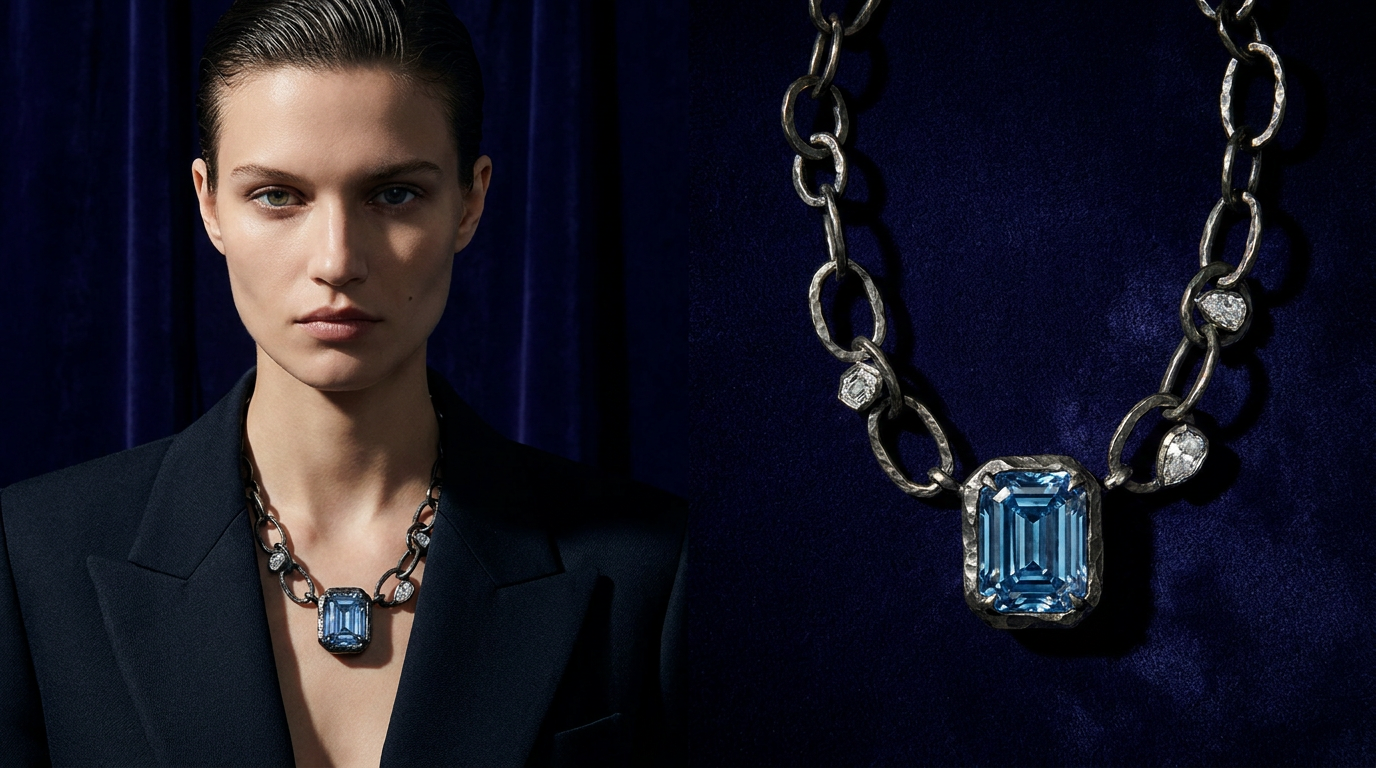
This remarkable capability was vividly demonstrated by Fred, which disrupted centuries of industry norms by unveiling its spectacular Audacious Blue collection. The LVMH maison successfully cultivated lab-grown blue diamonds—a vibrant color that is astronomically rare and prohibitively expensive to source in nature—and featured them prominently in a revolutionary high jewelry set. The collection was triumphantly crowned by a breathtaking 8.88-carat loose lab-grown blue diamond, custom-created as a heartfelt, technologically advanced tribute to the company's visionary founder, Fred Samuel.[3]
Prada has similarly leveraged this cutting-edge technology to reinforce its distinct brand identity at the highest levels of luxury. For its highly anticipated Eternal Gold collection, the Italian house developed the proprietary 'Prada Cut,' a bespoke diamond shape that perfectly mimics the brand's iconic, instantly recognizable triangular logo. Achieving such highly specific, non-traditional geometric cuts across an entire fine jewelry collection would be nearly impossible with natural diamonds without incurring catastrophic material waste and astronomical, unrecoverable costs.[2][5]
Prada has similarly leveraged this cutting-edge technology to reinforce its distinct brand identity at the highest levels of luxury.
The economic strategy driving these high-jewelry LGD collections sharply diverges from the trends seen in the broader, commercial diamond market. While the mass-market adoption of lab-grown stones by accessible retailers like Pandora has successfully driven down entry-level prices and democratized sparkle, luxury houses are fiercely protecting their premium, ultra-exclusive positioning. They are actively proving to the market that man-made diamonds do not have to be underpriced if they are backed by elite craftsmanship, rich brand heritage, and highly exclusive distribution channels.[4][5]
Fred, for instance, has confidently priced pieces in its lab-grown high jewelry collections between $500,000 and $600,000, placing them squarely in the realm of ultra-luxury. This bold pricing model reflects a fundamental, structural shift in luxury economics: the intrinsic value of the piece is no longer heavily weighted toward the raw material's geological origin. Instead, the massive premium is derived from the maison's storied heritage, the patented avant-garde design, the hundreds of hours of master craftsmanship required to set the stones, and the absolute exclusivity of the final product.[5][6]

This evolution in value aligns perfectly with the rapidly shifting priorities of the modern luxury consumer. Younger demographics, particularly affluent Millennials and Gen Z buyers, are currently driving a massive generational wealth transfer and bringing their uncompromising demand for ethical transparency and environmental responsibility directly into the world's most exclusive high-jewelry boutiques. For these socially conscious buyers, the narrative behind the stone—specifically how it was made, who was involved, and its overall impact on the planet—is just as critical as its refractive brilliance.[1][4]
To meet these rigorous new demands, forward-thinking brands are pairing lab-grown diamonds with other sustainable, ethically sourced materials to create entirely circular luxury products. Prada's Eternal Gold collection, for example, sets its custom-cut lab-grown diamonds exclusively in 100% certified recycled gold, ensuring no new mining was required for the metal. This holistic, top-to-bottom approach allows heritage brands to offer what industry analysts call 'quiet sustainability,' where profound environmental consciousness is seamlessly integrated into the product without ever compromising its aesthetic grandeur or luxurious feel.[2][4]
This commitment to transparency is further guaranteed through the widespread integration of cutting-edge digital ledgers. Platforms like the Aura Blockchain Consortium—founded collaboratively by luxury giants including LVMH, Prada Group, and Richemont—are increasingly being utilized to create immutable, tamper-proof digital certificates for fine jewelry. These sophisticated blockchain-backed passports document the entire lifecycle of a piece, from the specific laboratory where the diamond was grown to the artisan who meticulously set it, ensuring permanent traceability and absolute authentication for the buyer.[4]
Despite these thrilling innovations, the luxury jewelry market is experiencing a distinct and fascinating bifurcation, as not all heritage brands are ready to abandon the earth-mined tradition. Traditionalist strongholds, including major legacy players like Cartier and its parent company Richemont, continue to experience surging, record-breaking demand for natural high-end jewelry. For these venerable houses and their loyal clientele, the core appeal of a natural diamond lies precisely in its finite nature and its undeniable status as a billion-year-old historical artifact.[4][7]

This ideological divide suggests that the future of haute joaillerie will not be a zero-sum game between natural and lab-grown stones, but rather a thriving, dual-track market catering to different definitions of value. Natural diamonds will increasingly be positioned as ultra-rare investment assets, finite geological wonders, and irreplaceable family heirlooms. Conversely, lab-grown diamonds will completely dominate the rapidly expanding space of avant-garde design, bespoke customization, and modern ethical luxury, appealing to those who value innovation over antiquity.[4][6]
Ultimately, the successful integration of lab-grown diamonds into high jewelry represents a profound maturation of the global luxury industry. By enthusiastically embracing human ingenuity over geological chance, pioneering brands like Prada, TAG Heuer, and Fred are proving that true luxury is no longer merely about what the earth can passively produce. It is fundamentally about the intentionality, boundless creativity, and masterful execution that transform a raw material—whether painstakingly mined from the ground or brilliantly grown in a lab—into a timeless, breathtaking work of art.[1][2][8]
How we got here
2021
Pandora announces a complete shift to exclusively using lab-grown diamonds, signaling mass-market acceptance.
Oct 2022
Prada launches its fine jewelry line, emphasizing recycled gold and setting the stage for sustainable luxury.
Oct 2023
LVMH's Fred unveils the Audacious Blue collection, featuring high-end lab-grown blue diamonds.
Nov 2023
Prada integrates lab-grown diamonds into its Eternal Gold collection, debuting the proprietary 'Prada Cut'.
2025-2026
Lab-grown diamonds achieve widespread acceptance in haute joaillerie, with luxury houses utilizing blockchain for complete traceability.
Viewpoints in depth
Heritage Innovators
Luxury houses embracing lab-grown diamonds argue that technology unlocks unprecedented creative freedom and aligns with modern values.
Brands like Prada and LVMH's Fred view lab-grown diamonds not as a budget alternative, but as a premium material that frees designers from the constraints of natural supply. By controlling the growth process, they can dictate exact colors, clarities, and proprietary cuts that would be prohibitively wasteful with mined stones. They argue that the true value of high jewelry lies in the brand's artistic vision and craftsmanship, rather than the geological origin of the carbon.
Traditionalist Jewelers
Legacy brands maintaining exclusive use of natural diamonds emphasize their intrinsic rarity and historical investment value.
For houses like Cartier and its parent company Richemont, the appeal of a natural diamond is inextricably linked to its billion-year geological history and absolute scarcity. Traditionalists argue that while lab-grown stones are chemically identical, they lack the romanticism and finite nature that make earth-mined diamonds enduring stores of wealth. They position natural high jewelry as irreplaceable heirlooms that will only appreciate as global diamond reserves deplete.
Conscious Consumers
A younger demographic of luxury buyers prioritizing ethical transparency, environmental impact, and verifiable sourcing.
Millennial and Gen Z consumers are fundamentally redefining luxury to include moral and environmental imperatives. This camp demands complete supply chain transparency, often verified by blockchain technology, to ensure their purchases are free from the human rights abuses and ecological devastation historically associated with diamond mining. For these buyers, a lab-grown diamond set in recycled gold represents the highest form of modern luxury because it reflects their personal values without sacrificing aesthetic brilliance.
What we don't know
- How the secondary resale market will value high-jewelry pieces featuring lab-grown diamonds over a multi-decade horizon.
- Whether traditionalist holdouts like Richemont will eventually integrate lab-grown stones into their secondary or experimental lines.
Key terms
- Lab-Grown Diamond (LGD)
- A diamond created in a controlled laboratory environment that is chemically, physically, and optically identical to earth-mined diamonds.
- Chemical Vapor Deposition (CVD)
- A method of growing diamonds from a hydrocarbon gas mixture, allowing for precise control over the stone's purity and color.
- Haute Joaillerie
- High jewelry; custom-fitted, hand-crafted pieces made from the finest materials, representing the pinnacle of a luxury house's craftsmanship.
- Aura Blockchain Consortium
- A digital ledger platform founded by luxury groups to provide immutable certificates of authenticity and origin for high-end goods.
Frequently asked
Are lab-grown diamonds real diamonds?
Yes. They share the exact same chemical, physical, and optical properties as natural diamonds and are indistinguishable to the naked eye.
Why are luxury brands using lab-grown diamonds?
They offer unprecedented design flexibility, such as custom cuts and rare colors, while appealing to younger consumers who prioritize environmental and ethical transparency.
Do lab-grown high jewelry pieces cost less?
Not necessarily. While the raw material may be less expensive to produce, luxury houses maintain high price points based on brand heritage, patented designs, and master craftsmanship.
Sources
Source coverage
9 outlets
3 viewpoints surfaced








[1]The Jewel CurationConscious Consumers
Why Luxury Jewellery Brands Are Embracing Lab-Grown Diamonds
Read on The Jewel Curation →[2]MadestonesHeritage Innovators
Prada Launches Lab-Grown Diamond Jewellery Collection
Read on Madestones →LVMH's Luxury Brand Fred Introduces Its Inaugural Lab-Grown Diamond Collection
Read on Madestones Industry Insights →[4]Data Insights MarketTraditionalist Jewelers
Market Deep Dive: Exploring Luxury Gems and Jewelry Trends 2026-2034
Read on Data Insights Market →[5]LaBrillianteHeritage Innovators
Another Win for Lab-Grown Diamonds as Prada Debuts Lab Diamond Jewelry Collection
Read on LaBrilliante →[6]Factlen Editorial TeamConscious Consumers
Synthesis by Factlen editorial team
Read on Factlen Editorial Team →[7]Financial TimesTraditionalist Jewelers
Cartier owner Richemont's sales boosted by high-end jewellery demand
Read on Financial Times →[8]National JewelerHeritage Innovators
TAG Heuer Unveils Timepiece with Lab-Grown Diamonds
Read on National Jeweler →[9]Harper's BazaarConscious Consumers
The difference between lab-grown vs natural diamonds in 2025
Read on Harper's Bazaar →
Every angle. Every day.
Get lifestyle stories with full source coverage and perspective breakdowns delivered to your inbox.