
The Evidence Behind 'Green Prescribing' for Mental Health
As healthcare systems increasingly prescribe time in nature for anxiety and depression, a growing body of clinical evidence reveals how targeted outdoor exposure physically alters brain chemistry.
By Factlen Editorial Team
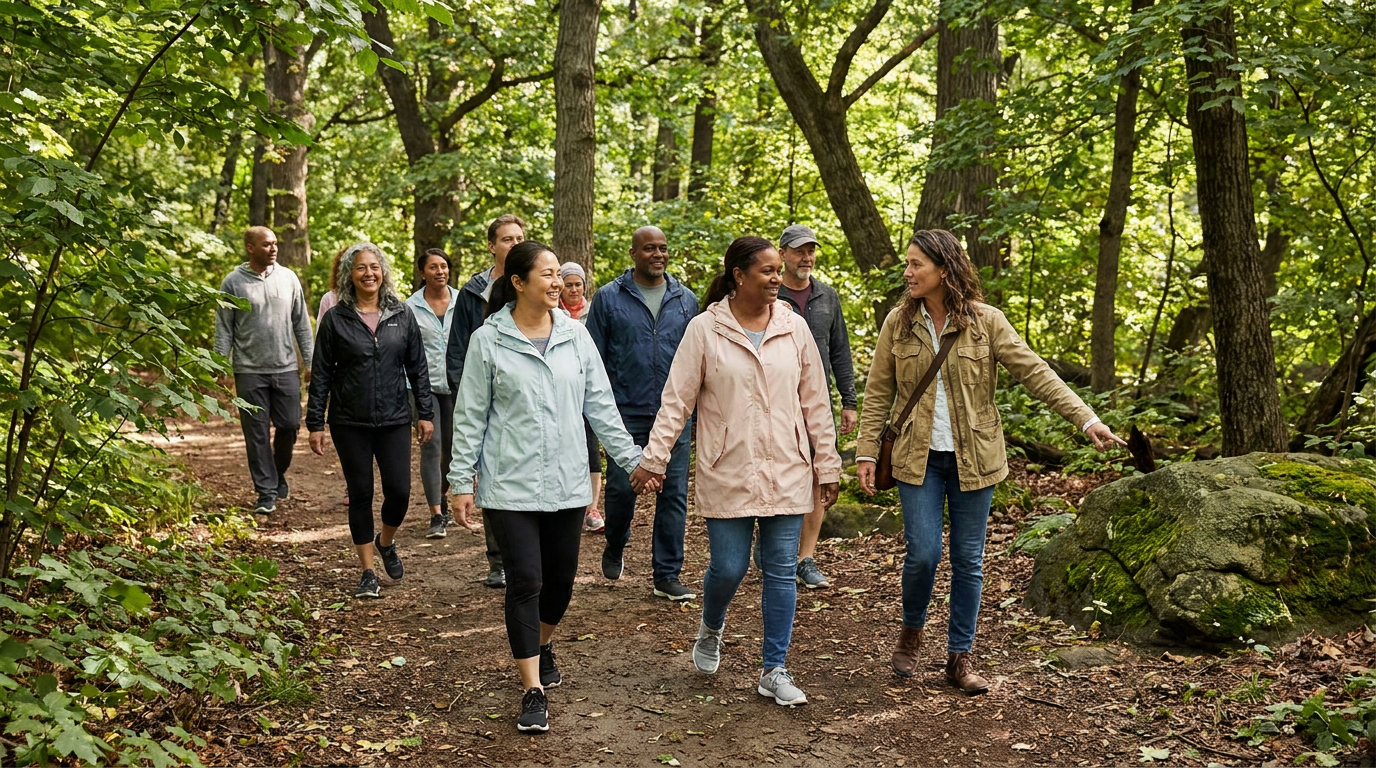
- Clinical Researchers
- Focuses on the measurable neurological and physiological biomarkers that validate nature as a medical intervention.
- Public Health Advocates
- Prioritizes the scalable, cost-effective nature of the intervention and highlights the need for equitable access to green spaces.
- Integrative Medicine Analysts
- Views green prescribing as a vital adjunct therapy that bridges the gap between traditional psychiatric care and holistic well-being.
What's not represented
- · Patients with severe mobility limitations who cannot easily access outdoor terrain
- · Indigenous communities whose traditional ecological knowledge predates clinical frameworks
Why this matters
With mental health challenges placing unprecedented strain on global healthcare systems, evidence-backed, low-cost interventions like nature prescriptions offer a scalable tool to complement traditional therapies.
Key points
- Healthcare systems are formally prescribing time in nature to treat mild to moderate anxiety and depression.
- Evidence shows a minimum threshold of 120 minutes per week in green spaces yields significant psychological benefits.
- Nature exposure physically alters brain chemistry, reducing activity in regions associated with depressive rumination.
- UK trials of 'green social prescribing' resulted in a 35% reduction in depressive symptoms among participants.
- The intervention is highly cost-effective but faces challenges regarding equitable access to safe urban green spaces.
For decades, the idea that a walk in the woods is good for the mind was treated as a pleasant cultural anecdote rather than a medical intervention. Today, that paradigm has fundamentally shifted. Across Europe, North America, and parts of Asia, primary care physicians and psychiatrists are increasingly utilizing 'green prescribing'—the formal, documented recommendation of specific time spent in natural environments to treat mild to moderate anxiety, depression, and chronic stress. This transition from wellness trend to clinical protocol is being driven by a robust wave of neurological and physiological evidence that quantifies exactly how nature alters human biology.[2][6]
At the center of this medicalization is the discovery of a specific 'dose-response' threshold. A landmark systematic review published in The Lancet Planetary Health aggregated data from over 20,000 patients, revealing that the psychological benefits of nature exposure only become statistically significant when an individual spends a minimum of 120 minutes per week in green spaces. Those who met this two-hour threshold reported consistently higher levels of self-reported well-being and lower psychological distress compared to those who spent zero to 119 minutes outdoors, establishing a baseline target for clinicians.[3]
Crucially, the research indicates that this 120-minute weekly dose does not need to be consumed in a single continuous session. Patients who broke their exposure into smaller, 20-to-30-minute daily walks through urban parks achieved the same neurochemical benefits as those who took a single two-hour weekend hike in a dense forest. This flexibility has been vital for public health officials attempting to design interventions that are actually realistic for working adults and urban populations who lack immediate access to wilderness.[3][4]

The physiological mechanism behind green prescribing is rooted in the body's autonomic nervous system. Studies tracked by the National Institutes of Health demonstrate that targeted exposure to natural environments rapidly down-regulates the sympathetic nervous system—the network responsible for the 'fight or flight' stress response. Within just 15 minutes of sitting in a forested area, patients exhibit measurable drops in salivary cortisol levels, a reduction in resting heart rate, and lowered blood pressure, signaling a shift toward the parasympathetic 'rest and digest' state.[5]
Beyond basic stress reduction, functional magnetic resonance imaging (fMRI) has provided a window into how nature impacts the specific neural pathways associated with clinical depression. Researchers have focused heavily on the subgenual prefrontal cortex, a region of the brain that is highly active during 'rumination'—the repetitive, negative self-focused thought patterns that characterize depressive episodes. Brain scans of participants before and after a 90-minute walk in a natural setting showed significantly reduced neural activity in this exact region, whereas participants who walked in high-traffic urban environments showed no such deactivation.[2][5]
This neurological evidence has prompted large-scale clinical trials, most notably within the United Kingdom's National Health Service (NHS). Over the past three years, the NHS has invested heavily in 'green social prescribing' pilots across several high-need demographic areas. Rather than simply telling patients to go outside, general practitioners refer them to community link workers who connect them with structured outdoor activities, ranging from community gardening and guided bird-watching to therapeutic woodland walks.[1]
This neurological evidence has prompted large-scale clinical trials, most notably within the United Kingdom's National Health Service (NHS).
The outcomes of the NHS pilot programs have been striking enough to warrant national expansion. According to recent data, patients referred to green prescribing programs experienced an average 35% reduction in depressive symptoms over an eight-week period, alongside marked improvements in self-reported anxiety and social isolation. Furthermore, the intervention proved highly cost-effective; the reduction in subsequent primary care visits and pharmaceutical reliance generated savings that far outweighed the administrative costs of the link-worker programs.[1][6]

The World Health Organization has recently integrated these findings into its urban mental health frameworks, urging member states to view city parks, botanical gardens, and urban tree canopies not merely as aesthetic amenities, but as critical public health infrastructure. The WHO report emphasizes that as the global population becomes increasingly urbanized, the intentional design of accessible green spaces is a primary preventative measure against the rising tide of urban-associated psychiatric disorders.[4]
However, the clinical rollout of green prescribing has exposed significant disparities in environmental equity. Public health advocates point out that the communities suffering from the highest rates of chronic stress and mental health disorders are often the same communities living in 'park deserts'—urban areas devoid of safe, accessible green spaces. A prescription for a daily nature walk is medically useless if the patient lives in a heavily industrialized zone with poor air quality and no local parks.[2][4]
To address this, some healthcare networks in the United States have begun partnering directly with state and national park systems to eliminate barriers to entry. Programs like ParkRx provide patients not only with a medical directive to spend time outdoors but also with free transit passes and waived entry fees to protected nature reserves. These logistical bridges are essential for translating the clinical science into equitable public health outcomes.[2][6]

Emerging research is also expanding the definition of therapeutic environments to include 'blue spaces'—areas adjacent to oceans, lakes, and rivers. Early comparative studies suggest that coastal environments may offer even greater psychological benefits than green spaces for certain demographics, potentially due to the acoustic properties of moving water and the wider visual horizons, which have been shown to induce states of mild psychological awe that further disrupt depressive rumination.[3][6]
Despite the overwhelming positive data, clinical researchers are careful to define the boundaries of green prescribing. It is universally categorized as an adjunct therapy, not a replacement for acute psychiatric care, cognitive behavioral therapy, or necessary pharmacological interventions. The consensus is that nature exposure builds psychological resilience and accelerates recovery, but it is not a standalone cure for severe, treatment-resistant psychiatric conditions.[5][6]

The next frontier in this field involves establishing highly specific 'dosages' for different conditions. Just as a physician prescribes different physical therapy routines for a torn ligament versus a strained muscle, researchers are currently mapping whether a patient with generalized anxiety disorder benefits more from active outdoor exercise, while a patient with clinical depression might benefit more from stationary, mindful immersion in a forest environment.[3][5]
Ultimately, the integration of green prescribing into standard medical practice represents a profound shift in how modern medicine views the human relationship with the environment. By quantifying the healing properties of nature through the rigorous lens of biomarkers and brain imaging, the medical community is reclaiming an ancient intuition and transforming it into one of the most promising, accessible, and uplifting mental health interventions of the 21st century.[4][6]
How we got here
2018
ParkRx America launches, allowing US physicians to formally prescribe park visits in patient electronic health records.
2019
A landmark study in Nature Scientific Reports establishes the 120-minute weekly threshold for measurable psychological benefits.
2021
The UK's National Health Service (NHS) launches a multi-million-pound green social prescribing pilot program.
2024
The World Health Organization issues standardized guidelines for integrating green and blue spaces into urban mental health care.
2026
Green prescribing becomes a formally reimbursable intervention in several major European healthcare systems.
Viewpoints in depth
Clinical Researchers
Focuses on the hard biological data that proves nature is a measurable medical intervention.
For clinical researchers and neuroscientists, the value of green prescribing lies entirely in the biomarkers. This camp emphasizes that nature therapy is no longer a soft science relying on self-reported mood questionnaires. By utilizing fMRI scans and continuous cortisol monitoring, researchers have proven that specific environments trigger predictable, replicable down-regulations of the sympathetic nervous system. Their current focus is on refining the 'dose-response' curve to determine exactly which types of environments (e.g., dense forest vs. open water) are most effective for specific psychiatric diagnoses.
Public Health Advocates
Prioritizes the scalable, cost-effective nature of the intervention and the urgent need for equitable access.
Public health officials and urban planners view green prescribing through the lens of population health and resource allocation. While they celebrate the clinical efficacy of the intervention, they argue that prescribing nature is futile if a patient lives in a concrete-heavy 'park desert.' This camp advocates for systemic changes, arguing that city planning, tree canopy restoration, and public transit access to national parks must be treated as critical healthcare infrastructure. They frequently cite the immense cost savings that preventative green prescribing can offer overburdened national health systems.
Integrative Medicine Analysts
Views green prescribing as a vital bridge between traditional psychiatric care and holistic well-being.
Integrative medicine specialists emphasize that green prescribing represents a necessary evolution in modern psychiatry, moving away from a purely pharmacological approach to one that treats the whole patient. They are careful to stress that nature is an adjunct therapy—not a replacement for SSRIs or acute psychiatric intervention—but argue that it provides patients with a sense of agency over their own recovery. By formalizing the prescription, they believe doctors validate the patient's experience and provide a structured, actionable path toward building long-term psychological resilience.
What we don't know
- The exact 'dose-response' curve required for specific, severe psychiatric conditions like PTSD or bipolar disorder.
- Whether high-fidelity virtual reality (VR) nature experiences offer comparable physiological benefits for bedridden or hospitalized patients.
Key terms
- Green Prescribing
- The formal practice of healthcare professionals recommending specific outdoor, nature-based activities to patients to improve mental or physical health.
- Subgenual Prefrontal Cortex
- A region of the brain that is highly active during periods of negative, self-focused thought and rumination, which has been shown to quiet down during nature exposure.
- Rumination
- The repetitive, negative thought patterns and dwelling on distress that are strongly associated with clinical depression and anxiety.
- Dose-Response Relationship
- A clinical term describing how the magnitude of a treatment's effect changes as the amount (or dose) of the treatment increases.
- Adjunct Therapy
- A treatment used together with the primary medical intervention to assist in recovery and maximize effectiveness.
Frequently asked
Can green prescribing replace my antidepressants?
No. Medical professionals universally categorize nature prescriptions as an adjunct (complementary) therapy, meant to be used alongside, not instead of, necessary medications or acute psychiatric care.
Does walking in a city park count as nature exposure?
Yes. While dense, wild forests offer strong benefits, studies show that spending time in urban parks, botanical gardens, and tree-lined paths significantly reduces stress markers and improves mood.
How much time do I need to spend outside?
Clinical evidence points to a threshold of 120 minutes per week. This can be achieved in a single two-hour block or broken up into smaller daily sessions of 15 to 30 minutes.
What are 'blue spaces' in this context?
Blue spaces refer to environments near water, such as oceans, lakes, and rivers. Emerging research suggests these areas provide unique psychological benefits, particularly in disrupting negative thought loops.
Sources
Source coverage
6 outlets
3 viewpoints surfaced






[1]The GuardianPublic Health Advocates
NHS 'green prescribing' trials show significant drops in anxiety and depression
Read on The Guardian →[2]The Washington PostPublic Health Advocates
Doctors are writing prescriptions for the park. Here is the science behind why it works.
Read on The Washington Post →[3]The Lancet Planetary HealthClinical Researchers
Dose-response relationships between nature exposure and psychiatric outcomes: A systematic review
Read on The Lancet Planetary Health →[4]World Health OrganizationPublic Health Advocates
Integrating Green and Blue Spaces into Urban Mental Health Frameworks
Read on World Health Organization →[5]National Institutes of HealthClinical Researchers
Neurological mechanisms of nature-based interventions on rumination and the subgenual prefrontal cortex
Read on National Institutes of Health →[6]Factlen Editorial TeamIntegrative Medicine Analysts
Synthesis by Factlen editorial team
Read on Factlen Editorial Team →

Every angle. Every day.
Get health stories with full source coverage and perspective breakdowns delivered to your inbox.