
How SpaceX and OpenAI Are Ending Wall Street's Era of 'Stock Scarcity'
A wave of historic mega-IPOs from frontier tech giants is reversing a decades-long decline in the number of publicly traded companies, democratizing access to the space and AI economies.
By Factlen Editorial Team
- Retail Investors & Advocates
- Celebrate the democratization of access to high-growth tech companies that were previously locked behind private equity.
- Institutional Asset Managers
- Focus on the mechanics of portfolio rebalancing and the potential drain of capital from existing AI proxy stocks.
- Private Market Operators
- View the mega-IPOs as a necessary evolution but emphasize the ongoing value of private equity for early-stage incubation.
What's not represented
- · Early-stage startup founders facing a higher bar to go public
- · Retail investors who lost money in previous SPAC booms
Why this matters
For decades, the explosive wealth generated by early-stage tech unicorns was locked behind the velvet ropes of private equity. The mega-IPOs of SpaceX and OpenAI are democratizing access to the 21st century's most important industries, allowing everyday retirement accounts to directly own a piece of the space economy and the race to artificial general intelligence.
Key points
- The number of publicly traded U.S. companies has fallen from roughly 8,000 in 1997 to under 4,000 today.
- SpaceX's $1.77 trillion IPO and OpenAI's impending $852 billion listing are reversing this decades-long shrinkage.
- The influx of pure-play frontier tech stocks will end the 'scarcity value' that inflated legacy AI proxy stocks.
- Institutional investors are expected to rebalance their portfolios, shifting capital from existing tech winners to the new mega-IPOs.
- The shift democratizes access to high-growth tech, allowing retail investors to participate in the space and AI economies.
For the better part of three decades, the American stock market has been quietly shrinking. But a tidal wave of frontier technology is about to reverse that trend, expanding Wall Street at a scale not seen since the dot-com era.[1]
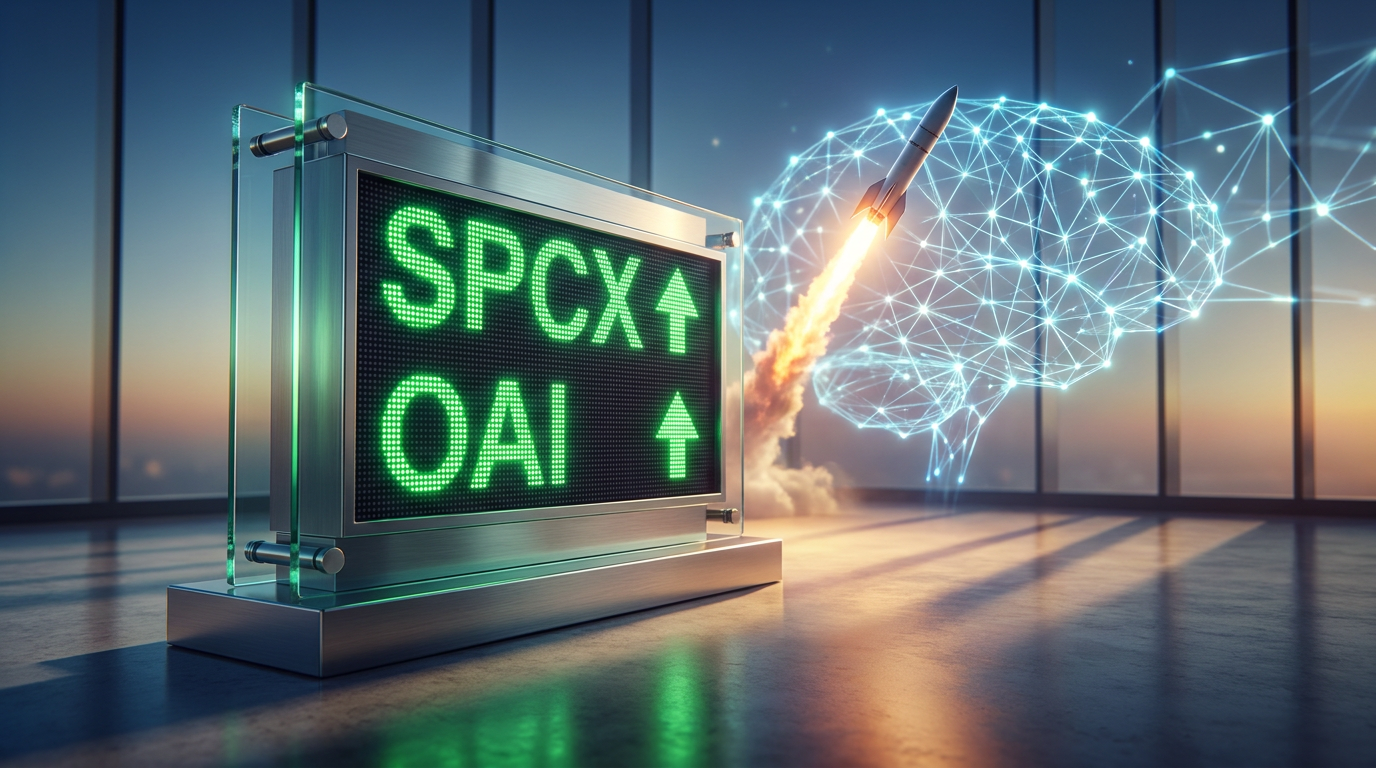
The catalysts are the two most anticipated financial events of the decade: the record-shattering initial public offering of SpaceX, and the aggressive corporate restructuring of OpenAI as it prepares for its own public debut. Together with AI rival Anthropic, these mega-IPOs are poised to inject trillions of dollars of new equity into the public sphere.[1][3]
To understand why this matters, one must look at the "stock scarcity" crisis that has defined modern finance. In 1997, there were roughly 8,000 publicly traded companies in the United States. Today, that number has plummeted to just under 4,000.[2][7]
The famed Wilshire 5000 index—created in 1974 to track the entire breadth of the U.S. market—now contains only about 3,600 equities. The decline was driven by a combination of corporate consolidation and the explosive growth of private equity, which allowed companies to delay or entirely avoid the scrutiny of public markets.[2][7]

As private equity assets under management ballooned from $600 billion in 2000 to over $8.2 trillion, the most explosive growth phases of the world's most innovative companies were locked behind velvet ropes. Everyday retail investors and standard retirement accounts were largely boxed out of the wealth generated by early-stage tech unicorns.[2][7]
That era of exclusivity is ending. In June 2026, SpaceX finalized its IPO price at $135 per share, cementing a staggering $1.77 trillion valuation. It stands as the largest public offering in history, instantly eclipsing the market capitalizations of legacy aerospace giants combined.[4][5]
The financial engine making SpaceX's public debut possible is Starlink. While the company's reusable rockets capture the public imagination, its satellite internet constellation contributes an estimated 58% of total revenue. By generating massive, high-margin cash flows, Starlink justifies the capital-intensive nature of deep space exploration to Wall Street analysts.[4][6]
The financial engine making SpaceX's public debut possible is Starlink.
Hot on SpaceX's heels is the artificial intelligence sector. OpenAI has confidentially filed its IPO paperwork, targeting a valuation that could reach $852 billion. To make this possible, the company is undergoing a fundamental rewrite of its corporate DNA.[8][9]

OpenAI is shedding its highly unusual capped-profit nonprofit structure to become a standard Delaware C-Corporation. This legal transition resolves years of governance complexity, clarifies its deep partnership with Microsoft, and provides public investors with standard voting rights and fiduciary protections.[8]
The sudden arrival of SpaceX, OpenAI, and Anthropic is expected to dismantle the "scarcity value" that has artificially propped up existing tech giants. For years, public market investors desperate for AI exposure had to buy proxy stocks—like chipmaker Nvidia or cloud provider Microsoft—because pure-play AI companies were strictly private.[3]
Now, a "Great Rebalancing" is underway. Institutional investors and mutual funds will likely need to trim their positions in those existing AI winners to free up capital for the new mega-IPOs. This isn't a market crash, but a healthy broadening of the technology sector's footprint on the major indices.[3]

The shift also brings a new level of rigor to these frontier companies. Public markets demand relentless transparency. SpaceX's prospectus, for example, revealed that while Starlink's subscriber base has doubled to over 10 million, its average revenue per user has dipped as it expands into price-sensitive global markets.[6]
Similarly, OpenAI faces the daunting task of proving it can achieve profitability while pouring tens of billions of dollars into compute infrastructure. The public market will no longer accept vague promises of future dominance; it demands quarterly progress and GAAP-compliant accounting.[6][9]
Despite these hurdles, the transparency forced by these public listings is a victory for the broader economy. For the first time, the true economics of the global space economy and the race to artificial general intelligence will be laid bare in quarterly earnings reports, rather than whispered in private venture capital circles.[6][9]
Ultimately, the end of the stock scarcity era represents a massive democratization of growth. The technologies that will define the 21st century are finally moving out of the private gated communities and onto the public exchanges, where anyone with a brokerage account can own a piece of the future.[1][2]

How we got here
1997
The number of publicly traded U.S. companies peaks at roughly 8,000 before beginning a decades-long decline.
2019
SpaceX begins launching its Starlink satellite constellation, creating the high-margin revenue engine that will eventually justify its massive IPO valuation.
October 2025
OpenAI finalizes a major restructuring, beginning the transition away from its capped-profit model to attract institutional capital.
April 2026
SpaceX confidentially files for its initial public offering with a consortium of 21 major investment banks.
June 2026
SpaceX finalizes its IPO at $135 per share, cementing a record-breaking $1.77 trillion valuation, while OpenAI confidentially files its own IPO paperwork.
Viewpoints in depth
Retail Investors & Advocates
Celebrating the democratization of access to high-growth tech companies.
For decades, retail investors have watched from the sidelines as private equity and venture capital firms captured the most explosive growth phases of technology companies. By the time a company like Uber or Airbnb went public, much of the exponential value creation had already occurred. Advocates for public markets view the SpaceX and OpenAI IPOs as a long-overdue correction. By listing on public exchanges, these frontier companies are allowing everyday retirement accounts and retail traders to participate directly in the economic upside of the space economy and artificial general intelligence.
Institutional Asset Managers
Focusing on the mechanics of portfolio rebalancing and 'scarcity value'.
Wall Street strategists are less focused on the romance of space and AI, and more concerned with the sheer gravitational pull these mega-IPOs will exert on global capital. For years, institutional funds desperate for AI exposure piled into a handful of public proxies like Nvidia, Microsoft, and Broadcom, artificially inflating their 'scarcity value.' Asset managers warn that absorbing over $2 trillion in new equity from SpaceX, OpenAI, and Anthropic will require a 'Great Rebalancing.' Funds will inevitably trim their positions in those legacy winners to buy into the new pure-play options, fundamentally reshaping the weighting of major tech indices.
Private Market Operators
Emphasizing the ongoing necessity of private capital for early-stage incubation.
While the public markets celebrate the arrival of these titans, private equity and venture capital operators point out that SpaceX and OpenAI could never have reached this scale under the glare of quarterly public earnings. Developing reusable rockets and training frontier AI models required years of massive capital burn and high-risk experimentation—conditions that public shareholders historically punish. Private market advocates argue that while the IPOs are a successful graduation, the private ecosystem remains the essential incubator for the next generation of deep tech.
What we don't know
- Whether retail demand for SpaceX and OpenAI will outstrip institutional profit-taking from legacy tech stocks.
- The exact timeline for OpenAI's public debut and its final share pricing.
- How quickly OpenAI can achieve GAAP profitability given its massive ongoing infrastructure investments.
Key terms
- Wilshire 5000
- A stock market index created in 1974 to track the entire breadth of the U.S. market, which ironically now contains only about 3,600 companies due to market shrinkage.
- Initial Public Offering (IPO)
- The process by which a private company offers shares of its stock to the public for the first time, allowing anyone to invest.
- Private Equity
- Investment funds that buy and manage companies outside of the public stock market, often keeping them private to avoid regulatory scrutiny and quarterly earnings pressure.
- Scarcity Value
- The premium investors are willing to pay for a stock when there are very few public companies available in a highly desired sector, such as artificial intelligence.
- Delaware C-Corporation
- The standard legal structure for major publicly traded companies in the U.S., offering standard voting rights and fiduciary protections for shareholders.
Frequently asked
Why did the stock market shrink in the first place?
The decline was driven by a combination of corporate consolidation (mergers and acquisitions) and the rise of private equity, which allowed companies to raise massive amounts of capital without the regulatory burdens of going public.
How much is SpaceX worth in its IPO?
SpaceX finalized its IPO price at $135 per share, giving the aerospace company a record-breaking valuation of $1.77 trillion.
Can I buy OpenAI stock right now?
Not yet. OpenAI has confidentially filed its IPO paperwork, but it has not yet set a date for its public trading debut.
Will these IPOs hurt existing tech stocks?
Analysts expect a 'Great Rebalancing,' where institutional investors may sell off portions of their current tech holdings to free up the capital needed to buy into the massive new SpaceX and OpenAI offerings.
Sources
Source coverage
9 outlets
3 viewpoints surfaced








[1]BloombergRetail Investors & Advocates
SpaceX and OpenAI Are Ending Wall Street's Era of Stock Scarcity
Read on Bloomberg →[2]ForbesRetail Investors & Advocates
The Decline In U.S. Stocks To Choose From: What It Means For Investors
Read on Forbes →[3]Business InsiderInstitutional Asset Managers
How giant IPOs from Anthropic and OpenAI will reshape the stock market's AI trade
Read on Business Insider →[4]MorningstarInstitutional Asset Managers
SpaceX: What Investors Need to Know About Its Enormous Upcoming IPO
Read on Morningstar →SpaceX Opens At $150—Surging 20% After Largest IPO Ever
Read on Forbes →[6]Hargreaves LansdownInstitutional Asset Managers
Inside SpaceX's IPO filing – revenue, Starlink, AI and key financials
Read on Hargreaves Lansdown →[7]Landmark Wealth ManagementPrivate Market Operators
The Vanishing Public Markets: Why Fewer Companies Are Going Public and Private Equity Is Thriving
Read on Landmark Wealth Management →[8]TechCrunchPrivate Market Operators
OpenAI Converts to For-Profit: What the IPO Restructuring Means for Developers
Read on TechCrunch →[9]CNNPrivate Market Operators
OpenAI confidentially files its IPO paperwork as it inches closer to stock market debut
Read on CNN →

Every angle. Every day.
Get business stories with full source coverage and perspective breakdowns delivered to your inbox.