
The Science Behind the World's Bioluminescent Beaches
From the ephemeral red tides of California to the permanent glowing bays of Puerto Rico, marine bioluminescence is driven by microscopic organisms using light as a defense mechanism.
By Factlen Editorial Team
- Marine Biologists
- Focus on the ecological role of dinoflagellates, the chemical mechanisms of luciferin oxidation, and the evolutionary 'burglar alarm' defense system.
- Bio Hunters & Forecasters
- Focus on the challenge of predicting ephemeral blooms using satellite imagery, ocean current data, and crowdsourced social media reports.
- Eco-Tourism Operators
- Focus on providing sustainable access to permanent bioluminescent bays while enforcing strict rules to protect the microorganisms.
- Conservationists
- Focus on the threats of coastal light pollution, climate change, and chemical runoff to these fragile marine ecosystems.
What's not represented
- · Local coastal residents
- · Commercial fishermen
Why this matters
Understanding the delicate biology behind glowing beaches helps travelers find these rare natural wonders while highlighting the urgent need to protect coastal ecosystems from light pollution and chemical runoff.
Key points
- Marine bioluminescence is primarily caused by dinoflagellates, microscopic organisms that emit light when physically disturbed.
- The glow serves as a 'burglar alarm' defense mechanism, illuminating small predators to attract larger ones.
- Ephemeral blooms are difficult to predict, but permanent 'bio bays' exist in places like Puerto Rico and Jamaica.
- These fragile ecosystems are increasingly threatened by coastal light pollution, climate change, and chemical runoff.
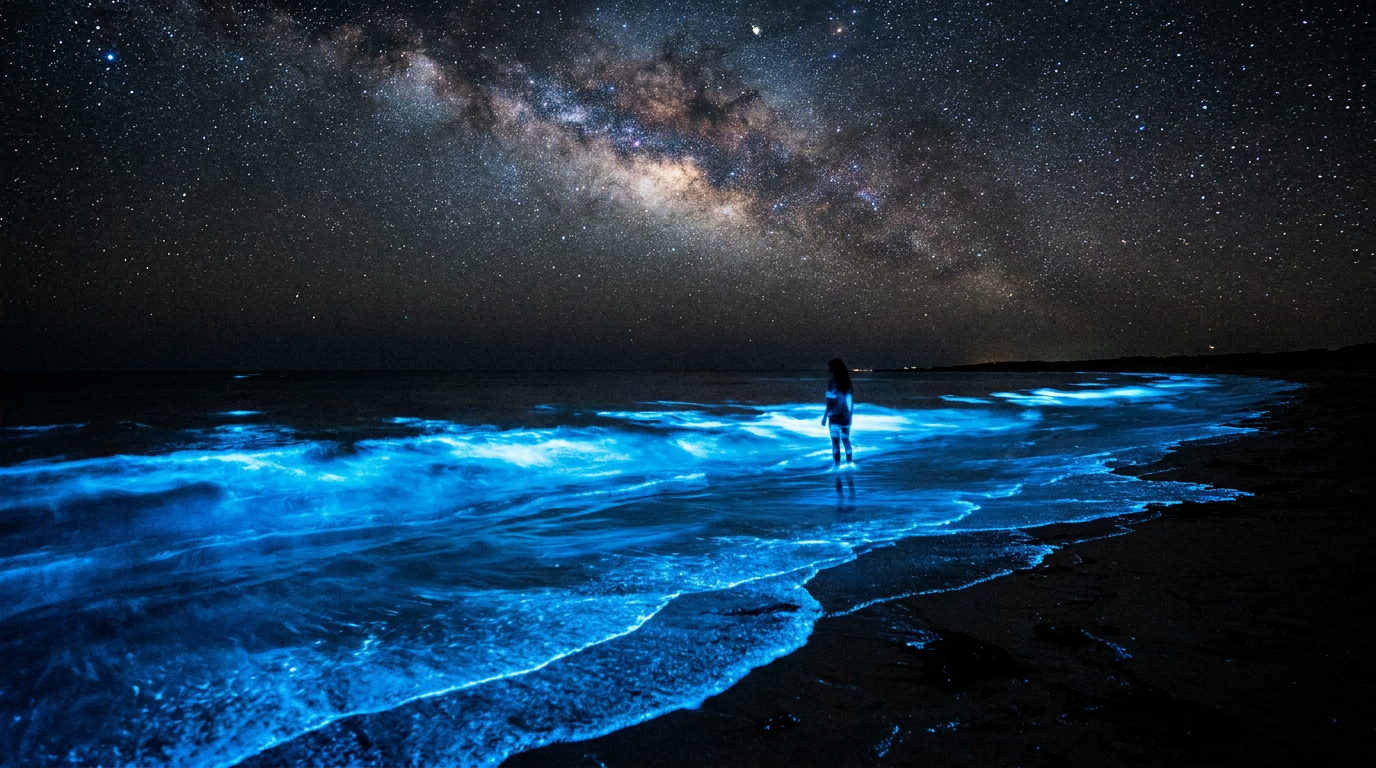
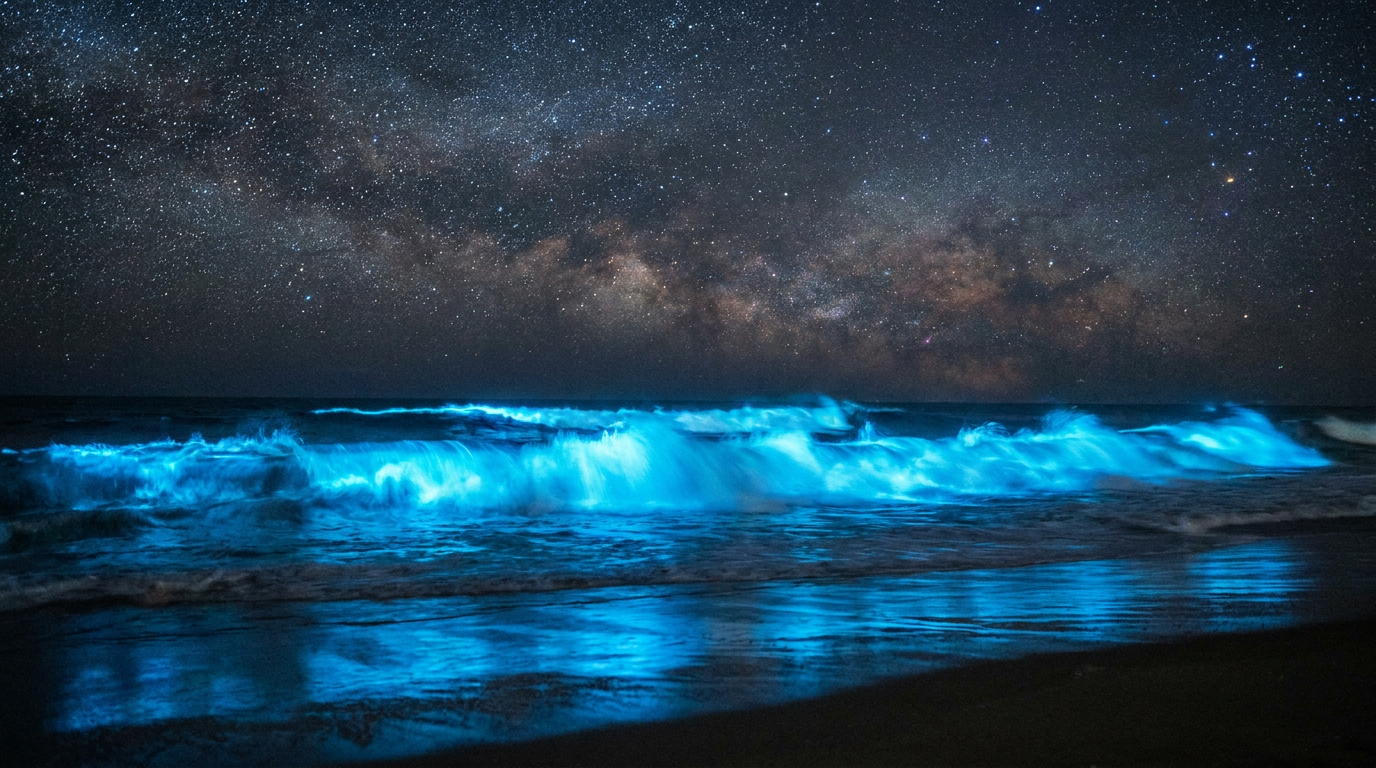
Stepping onto a dark beach and watching the ocean erupt into electric blue light is one of the most surreal experiences nature has to offer. As waves crash against the shoreline, they leave behind a glowing, neon-tinted froth that looks like liquid starlight. For travelers and late-night beachgoers, witnessing this phenomenon feels like stepping into a science fiction film, where every splash, footstep, or paddle stroke ignites a temporary galaxy in the water. Yet, this mesmerizing display is not magic, nor is it merely a reflection of the moon. It is a highly calibrated biological mechanism, a hidden world of microscopic life reacting to the physical forces of the ocean.[4][9]
The phenomenon is known as marine bioluminescence, a trait shared by a variety of deep-sea creatures but rarely seen in such concentrated, accessible displays along the coast. While deep-ocean bioluminescence is often used by predators like anglerfish to lure prey, coastal bioluminescence is entirely different. It is a "cold light," meaning the chemical reaction that produces the glow generates almost zero heat, making it incredibly energy-efficient. This radiant display requires specific environmental conditions, including the right balance of water temperature, salinity, and nutrient availability, which is why it only appears on certain beaches under precise circumstances.[3][8]
The primary architects of these glowing shores are dinoflagellates, a type of single-celled phytoplankton that drift near the ocean's surface. These microscopic organisms are a crucial component of the marine food web, converting sunlight into energy through photosynthesis during the day and serving as a foundational food source for larger marine life. While there are thousands of species of phytoplankton, only a specific subset of dinoflagellates possesses the unique biological machinery required to emit light. When millions of these organisms gather in a concentrated area, their collective glow can illuminate entire bays and coastlines.[7][9]
The secret to their glow lies in a rapid chemical reaction housed within the cell. When a dinoflagellate is physically disturbed, it triggers the oxidation of a light-emitting molecule called luciferin, catalyzed by an enzyme known as luciferase. This reaction produces a brilliant flash of blue light that lasts for just one-tenth of a second. Because the individual flashes are so brief, the continuous glow seen by human eyes is actually the result of millions of dinoflagellates firing simultaneously as they are tumbled by a breaking wave or the hull of a boat.[6][8]

From an evolutionary standpoint, scientists believe this spectacular light show serves as a sophisticated defense mechanism, often referred to as the "burglar alarm" hypothesis. When a dinoflagellate is disturbed by a small predator, such as a grazing copepod, it flashes its neon light. This sudden burst of illumination acts as an alarm, exposing the small predator's location to even larger predators, like fish, which then swoop in to consume the threat. By lighting up the dark water, the microscopic plankton effectively summon their own bodyguards.[4][8]
For those hoping to witness this phenomenon, the best clue often appears in broad daylight. Massive concentrations of dinoflagellates frequently manifest as "red tides"—dense algal blooms that turn the ocean water a murky, reddish-brown hue. During the day, these blooms gather near the surface to photosynthesize, creating visible streaks across the coastline. When the sun sets and the dinoflagellates' circadian rhythms shift, that same murky red water transforms into a canvas of electric blue.[2][4]
However, catching an ephemeral bloom is notoriously difficult. In coastal regions like Southern California or New Zealand, bioluminescence is highly unpredictable. A spectacular light show might last for a few weeks, or it might vanish after a single night. The blooms are at the mercy of shifting ocean currents, wind patterns, and rainfall, which can either concentrate the dinoflagellates in a specific cove or scatter them out to sea. Even marine biologists admit that forecasting exactly when and where a bloom will occur remains an elusive challenge.[2][4]
However, catching an ephemeral bloom is notoriously difficult.
This unpredictability has given rise to a dedicated community of "bio hunters"—enthusiasts and citizen scientists who actively track the glowing waves. By monitoring high-resolution satellite imagery, such as data from the Sentinel-2 satellite, researchers can identify the distinct multi-spectral signatures of large red algal blooms forming offshore. When a bloom moves toward the coast, these networks rely on real-time social media alerts to mobilize. A single confirmed sighting can send hundreds of people rushing to the beach in the middle of the night.[1][2]

To truly appreciate the bioluminescence, optimal viewing conditions are essential. The dinoflagellates' glow is easily washed out by ambient light, meaning absolute darkness is required. Experts recommend hunting for bioluminescence during a new moon, when the night sky is at its darkest, and venturing to beaches far from city streetlights. Once on the sand, observers should allow their eyes to adjust to the darkness for at least ten minutes without looking at a smartphone screen, as the initial glow in smaller waves can sometimes be faint.[2][5]
While ephemeral blooms require a stroke of luck to witness, there are a few rare locations on Earth where bioluminescence is a permanent fixture. These "bio bays" feature a unique geographical structure—usually a narrow inlet that traps the dinoflagellates inside a shallow, warm lagoon. Surrounded by mangrove forests that drop nutrient-rich leaves into the water, these bays provide a constant, perfect food source for the microorganisms, allowing them to thrive in staggering numbers year-round.[3][5]
The undisputed crown jewel of these permanent locations is Mosquito Bay, located on the Puerto Rican island of Vieques. Holding the Guinness World Record for the brightest bioluminescent bay on Earth, Mosquito Bay boasts an astonishing concentration of up to 720,000 dinoflagellates per gallon of water. Because the bay is so densely populated, even the slightest movement—a fish darting through the water or a raindrop hitting the surface—triggers a blindingly bright blue reaction that can be seen for miles.[5][6]

Puerto Rico is uniquely blessed with this phenomenon, hosting three of the world's five officially recognized permanent bioluminescent bays. In addition to Mosquito Bay, the island is home to Laguna Grande in Fajardo and La Parguera in the southwest. La Parguera is particularly notable because it is the only protected bay in Puerto Rico where visitors are legally permitted to swim in the glowing water, allowing snorkelers to completely immerse themselves in the neon light.[5]
Beyond the Caribbean, a handful of other global hotspots offer reliable displays. Jamaica's Luminous Lagoon benefits from the precise mixing of warm, fresh river water and salty ocean currents, creating an ideal incubator for the glowing plankton. Meanwhile, the Maldives is famous for its "Sea of Stars," where bioluminescent organisms wash up onto the pristine white sand, making the shoreline look as though it has been dusted with glowing blue diamonds.[5][9]
Despite their beauty, these bioluminescent ecosystems are incredibly fragile. The dinoflagellates require a precise balance of salinity, temperature, and nutrients to survive. Heavy rainfall can dilute the salt content of a bay, temporarily extinguishing the glow, while severe hurricanes can alter the physical shape of the inlets, flushing the microorganisms out to sea. Climate change and shifting ocean temperatures pose an ongoing threat to the delicate equilibrium that sustains both permanent bays and seasonal blooms.[3][7]

Human activity also presents a significant challenge. Coastal development brings increased light pollution, which doesn't harm the dinoflagellates directly but renders their glow invisible to the human eye and potentially disrupts the natural predator-prey dynamics of the "burglar alarm" system. Furthermore, chemical runoff from sunscreens, boat exhaust, and agriculture can poison the water, leading to the collapse of local plankton populations.[4][8]
Protecting these glowing shores requires a concerted effort to minimize light pollution, regulate boat traffic, and preserve the mangrove forests that feed the bays. As travelers increasingly seek out these magical nighttime displays, the focus must remain on sustainable eco-tourism. Witnessing a bioluminescent beach is a profound reminder of the ocean's hidden complexities—a beautiful, fleeting intersection of biology and earth science that deserves to be protected for generations to come.[7][10]
Viewpoints in depth
Marine Biologists
Scientists studying the ecological role and chemical mechanisms of dinoflagellates.
For marine biologists, bioluminescence is far more than a visual spectacle; it is a complex evolutionary tool. Researchers focus on the 'burglar alarm' hypothesis, studying how dinoflagellates use light to manipulate the marine food web by exposing their predators to larger threats. Biologists also study the precise chemical oxidation of luciferin, noting that this 'cold light' is one of the most energy-efficient reactions in nature. Their primary concern is understanding how changes in ocean acidity and temperature might disrupt this delicate biological machinery.
Bio Hunters and Forecasters
Enthusiasts and researchers attempting to predict ephemeral bioluminescent blooms.
This community treats bioluminescence as a meteorological challenge. Because coastal blooms are highly dependent on wind, rain, and ocean currents, forecasters use high-resolution satellite imagery to track the multi-spectral signatures of offshore red tides. When a bloom approaches the coast, they rely on crowdsourced social media reports to pinpoint exact locations. For bio hunters, the thrill lies in the chase—racing against shifting tides and unpredictable weather to witness a light show that might vanish by the next morning.
Eco-Tourism Operators
Guides and businesses managing access to permanent bioluminescent bays.
Operators in places like Puerto Rico's Mosquito Bay face the difficult task of balancing high tourist demand with strict environmental preservation. They advocate for zero-impact tourism, utilizing clear-bottom kayaks and banning powered boats to prevent exhaust from poisoning the water. These operators emphasize that strict rules—such as prohibiting swimming to keep sunscreen and bug spray out of the water—are the only way to ensure the dinoflagellates survive and the bays continue to glow for future generations.
What we don't know
- Exactly what triggers an offshore red tide to suddenly move toward the coastline.
- How long-term increases in global ocean temperatures will permanently alter the habitats of dinoflagellates.
- Why some red tides produce brilliant bioluminescence while others of the exact same species do not.
Key terms
- Dinoflagellate
- A type of single-celled marine plankton responsible for most coastal bioluminescence.
- Luciferin
- The light-emitting compound found within bioluminescent organisms that produces a glow when oxidized.
- Red Tide
- A dense daytime bloom of algae that turns the water reddish-brown and often precedes nighttime bioluminescence.
- Phytoplankton
- Microscopic marine algae that form the base of the ocean's food web and produce much of the Earth's oxygen.
Frequently asked
What causes the ocean water to glow?
The glow is produced by microscopic single-celled organisms called dinoflagellates. When physically disturbed by a wave or movement, they trigger a chemical reaction involving a molecule called luciferin, which emits a flash of blue light.
When is the best time to see a bioluminescent beach?
The best time is during a new moon when the night sky is completely dark. The glow is easily washed out by moonlight or city streetlights, so absolute darkness is required for the best visibility.
Can you swim in bioluminescent water?
It depends on the location. In places like La Parguera in Puerto Rico, swimming is permitted. However, many protected bays, such as Mosquito Bay, ban swimming to prevent chemicals like sunscreen from harming the fragile ecosystem.
How do you predict when a beach will glow?
Predicting ephemeral blooms is very difficult. The best method is to look for murky, reddish-brown water (a 'red tide') during the day, or to follow local social media alerts and satellite tracking networks.
Sources
Source coverage
10 outlets
4 viewpoints surfaced










[1]Extreme PursuitBio Hunters & Forecasters
Tracking Bioluminescence with Satellite Imagery
Read on Extreme Pursuit →[2]Orange County OutdoorsBio Hunters & Forecasters
How to Predict Bioluminescence at the Beach
Read on Orange County Outdoors →[3]Ocean ClockMarine Biologists
The Phenomenon of Bioluminescent Beaches
Read on Ocean Clock →[4]Visit CaliforniaMarine Biologists
Where to See Bioluminescence in California
Read on Visit California →[5]ViatorEco-Tourism Operators
9 of the Best Bioluminescent Bays Around the World
Read on Viator →[6]Travelers Guide 360Eco-Tourism Operators
Best Bioluminescent Bays In The World
Read on Travelers Guide 360 →[7]Krabi Sunset CruisesEco-Tourism Operators
The Science of Bioluminescent Plankton
Read on Krabi Sunset Cruises →[8]Visionary CIOsMarine Biologists
50 Rare Natural Phenomena in the World
Read on Visionary CIOs →[9]Indian ExpressConservationists
Under The Night Sky: Exploring The World's Best Bioluminescent Beaches
Read on Indian Express →[10]Factlen Editorial TeamConservationists
Synthesis by Factlen editorial team
Read on Factlen Editorial Team →
Every angle. Every day.
Get travel stories with full source coverage and perspective breakdowns delivered to your inbox.