
Brazil and Japan Set the Pace as Expanded Men's Volleyball Nations League Opens
The 2026 Men's Volleyball Nations League has kicked off its 18-team era with high drama, featuring an undefeated start for Brazil and a historic victory by Japan over defending champion Poland.
By Factlen Editorial Team
- Title Contenders
- Established powerhouses focused on securing top seeding for the Ningbo finals.
- Emerging Challengers
- Rising programs using the expanded format to climb the global hierarchy.
- Rebuilding Programs
- Teams fighting to avoid relegation and integrate new talent.
What's not represented
- · Host City Organizers
- · Injured Star Players
Why this matters
The expanded VNL format is providing unprecedented opportunities for rising nations to challenge established volleyball powerhouses, reshaping the global rankings ahead of major international championships.
Key points
- Brazil leads the expanded 18-team VNL standings with a flawless 9 points.
- Japan dethroned Poland as the world's number one team after a 3-2 victory.
- The United States and Slovenia sit tied in the chasing pack with 6 points each.
- Ukraine emerged as an early surprise, sweeping Cuba to rise to 16th globally.
- Only the top eight teams will advance to the knockout finals in Ningbo, China.
The 2026 Men's Volleyball Nations League (VNL) has roared to life, showcasing an expanded 18-team field and a flurry of early-season upsets that have immediately scrambled the global hierarchy. As the first week of preliminary play concludes across host cities in Brazil, Canada, and China, the standings are already taking a dramatic shape. The decision to expand the tournament from 16 to 18 teams has injected fresh unpredictability into the grueling international circuit, giving emerging programs a chance to test their mettle against established powerhouses and proving that the depth of global men's volleyball has never been stronger.[1][4]
Brazil has surged to the top of the table, reminding the volleyball world of their enduring pedigree and tactical brilliance. Playing in front of a passionate home crowd in Brasília, the South American giants secured a flawless 3-0 start, accumulating a maximum nine points without dropping a single match. Their commanding straight-sets sweep over Serbia highlighted a week where their offensive coordination and blocking schemes looked in mid-season form, sending an early and emphatic message to the rest of the field that they fully intend to reclaim the VNL crown this summer.[1][5]
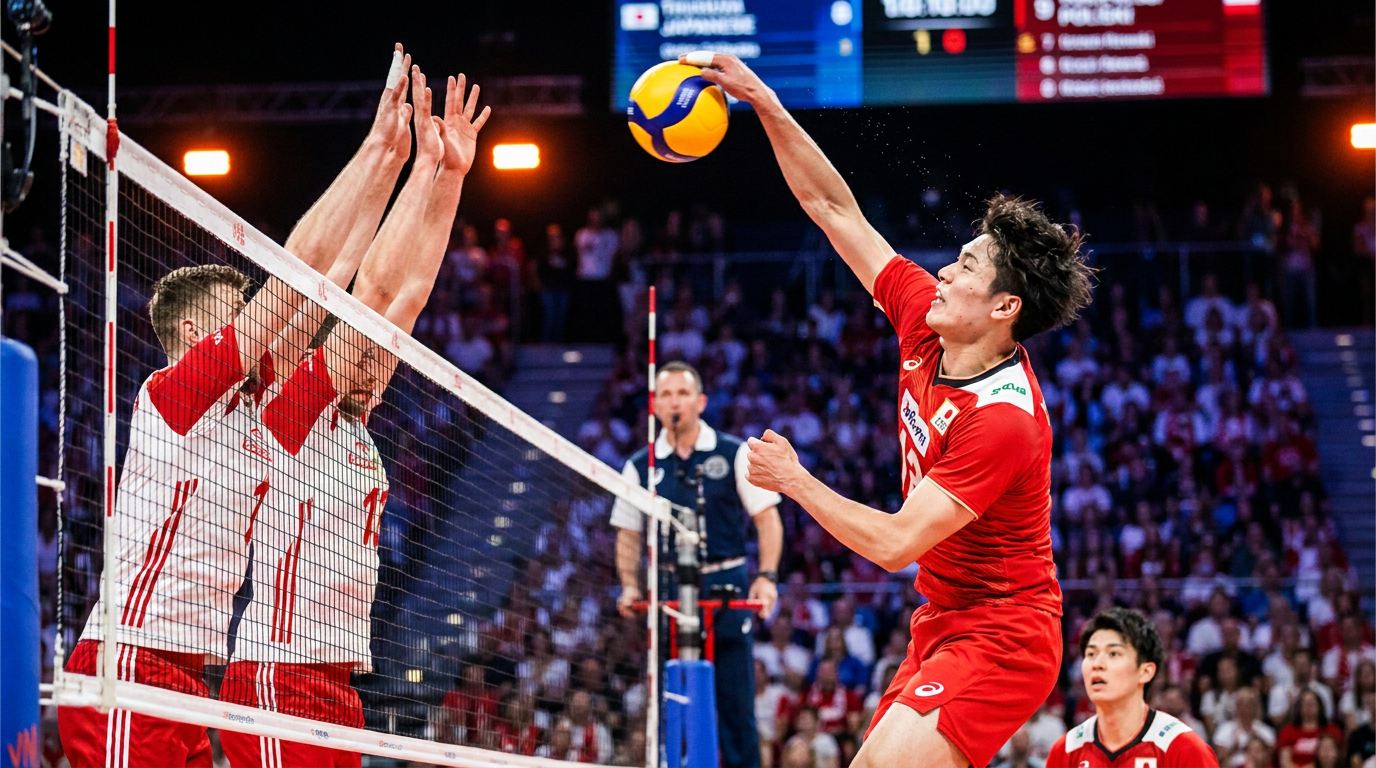
Hot on Brazil's heels is Japan, whose electrifying start has fundamentally reshaped the sport's global landscape. The Japanese squad currently sits in second place with eight points, a position fueled by a historic, marathon five-set victory over defending VNL champion Poland in Linyi, China. The highly anticipated clash lived up to its heavyweight billing, delivering one of the highest-quality matches of the young season and proving that Japan's rapid offensive system and relentless floor defense can effectively dismantle the world's tallest and most physical blocks.[2][6]

That 3-2 triumph—with dramatic set scores of 25-21, 21-25, 25-21, 22-25, and a nail-biting 17-15 finish—was a masterclass in defensive resilience and rapid counter-attacks. Beyond securing crucial VNL standings points, the victory carried massive historical weight: it officially propelled Japan to the top of the FIVB world rankings. Dethroning the long-reigning Polish side from the number one spot marks a monumental milestone for Asian volleyball on the global stage, confirming Japan's status as a legitimate gold-medal threat. The result has sent shockwaves through the international community, signaling a shift in the traditional balance of power.[6]
The United States and Slovenia are tied in the chasing pack with six points each, having navigated their opening slates with impressive grit. The Americans, playing their initial pool matches in Ottawa, demonstrated immense mental toughness during a spectacular comeback against host nation Canada. Facing a raucous crowd of nearly 6,000 at TD Place and staring down a daunting two-set deficit, the U.S. squad engineered a thrilling reverse sweep to keep themselves firmly anchored near the top of the fiercely competitive league table.[1][3]
The United States and Slovenia are tied in the chasing pack with six points each, having navigated their opening slates with impressive grit.
The American comeback was anchored by a phenomenal individual performance from Cole Hartke, who poured in a match-high 33 points, including 24 kills, six blocks, and three aces. After dropping the first two sets 20-25 and 33-35 in exhausting fashion, the United States clawed back to win the next two before edging out the Canadians 15-11 in the decisive fifth set. The marathon match, which lasted two hours and 44 minutes, underscored the razor-thin margins and intense physical demands that define the VNL's preliminary phase.[3]

Further down the standings, the tournament's expansion has provided a platform for breakout narratives, none more compelling than Ukraine's early surge. One of the primary beneficiaries of the expanded format and the FIVB Volleyball Empowerment program, the Ukrainian squad has proven they belong among the elite. They secured a convincing 3-0 sweep over Cuba, dominating the net with nine blocks to Cuba's four. That result pushed Ukraine to six points in the standings and elevated them to 16th in the world rankings, a historic high for the program.[4][6]
Meanwhile, traditional powerhouses are finding the deeper, more talented field incredibly challenging to navigate. Reigning Olympic champion France suffered a shock defeat to Turkey, leaving the French squad lingering in the bottom half of the table with just two points. Similarly, Argentina sits at the very bottom of the standings, searching for answers after a winless start that has raised alarm bells for their coaching staff. These early stumbles highlight how quickly elite teams can be punished if they fail to bring their absolute best to every single match.[1][6]
For newly promoted teams, the opening week has been a trial by fire, but certainly not without its successes. Belgium, who replaced the relegated Netherlands following the 2025 season, has already managed to put three points on the board. In a league where every set won can significantly impact the final tiebreakers, their early competitiveness suggests they are well-equipped to fight off relegation. Establishing a permanent foothold in the VNL is crucial for their long-term development, and their opening performances have given their supporters genuine reason for optimism.[1][2]

The stakes for the remainder of the preliminary phase are immense. Teams will play a total of 12 matches spread across three grueling competition weeks, rotating through different global host cities. Only the top seven teams—plus the host nation, China—will advance to the high-stakes knockout finals in Ningbo this August. With the standings already tightly packed and multiple tiebreakers likely to come into play, the race for those eight coveted spots promises to be the most fiercely contested in the tournament's history.[2]
The demanding travel schedule adds another layer of complexity to the standings race. As teams pack up their gear and prepare to cross multiple time zones for Week 2, squad depth and injury management will become just as critical as tactical execution on the court. Coaches will be forced to meticulously rotate their rosters, balancing the immediate need to secure standings points with the long-term imperative of keeping their star players fresh for the Ningbo finals and the grueling international calendar that follows.[2][5]
Ultimately, the opening week of the 2026 Men's Volleyball Nations League has delivered exactly what fans hoped for: breathtaking rallies, monumental upsets, and a leaderboard that refuses to respect historical pedigree. With Brazil setting a flawless pace at the top and Japan proving that the old guard can be successfully toppled, the stage is set for a thrilling summer of volleyball. As the preliminary phase continues, it is abundantly clear that no point, and no position in the standings, can be taken for granted.[1][6]
How we got here
June 10, 2026
The expanded 18-team Men's Volleyball Nations League officially begins preliminary play.
June 12, 2026
Brazil sweeps Serbia to cement their flawless start and take the top spot in the standings.
June 13, 2026
Japan defeats Poland in five sets, dethroning them as the number one team in the FIVB world rankings.
June 13, 2026
The United States completes a dramatic reverse sweep against Canada in Ottawa.
Viewpoints in depth
Title Contenders
Established powerhouses focused on securing top seeding for the Ningbo finals.
For historically dominant programs like Brazil, Poland, and the United States, the preliminary phase is a balancing act. Their primary objective is to accumulate enough points to comfortably secure a top-eight finish and advance to the Ningbo finals without overtaxing their veteran stars. These teams view the VNL standings not just as a race for a mid-summer trophy, but as a critical laboratory for testing playoff rotations and maintaining peak FIVB world ranking points ahead of major global championships.
Emerging Challengers
Rising programs using the expanded format to climb the global hierarchy.
Teams like Japan, Slovenia, and Ukraine represent a shifting tide in international volleyball. For these squads, the VNL standings are a direct reflection of their programmatic growth. Japan's ascent to the number one world ranking proves that speed and technical precision can overcome traditional size advantages. Meanwhile, Ukraine views every standings point as validation of their inclusion in the expanded 18-team field, using the high-level competition to accelerate their development and prove they belong permanently among the sport's elite.
Rebuilding Programs
Teams fighting to avoid relegation and integrate new talent.
At the lower end of the table, the pressure is entirely different. For newly promoted Belgium and struggling traditional sides like Argentina, the standings represent a desperate fight for survival. The VNL's relegation system means that finishing at the bottom has severe consequences for a federation's funding and global exposure. These programs are forced to prioritize immediate results, fighting for every single set to win crucial tiebreakers while simultaneously trying to blood younger players into the unforgiving speed of the international game.
What we don't know
- Whether Japan can maintain their number one world ranking throughout the grueling three-week preliminary phase.
- Which teams will successfully manage player fatigue as the tournament rotates across multiple global time zones.
- If traditional powerhouses like France and Argentina can recover from their slow starts to qualify for the Ningbo finals.
Key terms
- Reverse Sweep
- Winning a match by taking the final three sets after losing the first two.
- Preliminary Phase
- The initial round-robin stage of the VNL where teams play 12 matches to determine who advances to the finals.
- Tiebreaker
- A method used to rank teams with the same number of match wins, typically relying on total standings points or set win/loss ratios.
- FIVB World Rankings
- The official global ranking system for international volleyball teams, updated after every recognized match.
- Relegation
- The process where the lowest-performing challenger team is removed from the VNL for the following season.
Frequently asked
How many teams advance to the VNL finals?
The top seven teams in the standings at the end of the preliminary phase, plus the host nation China, will advance to the knockout finals in Ningbo.
Why is Japan's victory over Poland significant?
Japan's five-set win not only secured crucial VNL points but also propelled them to the number one spot in the FIVB world rankings, dethroning Poland.
How does the VNL scoring system work?
Teams earn 3 points for a 3-0 or 3-1 win, 2 points for a 3-2 win, 1 point for a 3-2 loss, and 0 points for a 3-0 or 3-1 loss.
Who replaced the Netherlands in the 2026 VNL?
Belgium replaced the Netherlands after earning promotion as the highest-ranked non-VNL team following the 2025 season.
Sources
Source coverage
6 outlets
3 viewpoints surfaced






[1]Volleyball WorldTitle Contenders
VNL Standings 2026 | Men's Volleyball Nations League Table
Read on Volleyball World →[2]Olympics.comTitle Contenders
Men's Volleyball Nations League 2026 - Schedule, results, and standings - full list
Read on Olympics.com →[3]CFJC TodayRebuilding Programs
U.S. rallies to bump off Canadian men in Volleyball Nations League match
Read on CFJC Today →[4]FIVBEmerging Challengers
Empowerment-supported teams shine in VNL's first week
Read on FIVB →[5]FlashscoreRebuilding Programs
Volleyball Nations League 2026 live scores
Read on Flashscore →[6]World of VolleyEmerging Challengers
Japan dethroned Poland from No. 1 in the world, Turkey shocked France, day 3 VNL review
Read on World of Volley →
More in sports
See all 11 stories →NWSL Expansion
NWSL Launches 'Summer of Soccer' Campaign to Capitalize on World Cup Momentum
0 sources

Roster Construction
How the New York Knicks Built a Championship Franchise Under the NBA's Restrictive New Financial Rules
0 sources

Flag Football
How Flag Football is Adapting for Its Olympic Debut at LA 2028
0 sources

Injury
Malaysian Badminton Champion Toh Ee Wei Suffers ACL Tear, Urges Partner to Play On
0 sources
Every angle. Every day.
Get sports stories with full source coverage and perspective breakdowns delivered to your inbox.