
How AI is Decoding Animal Languages and Revolutionizing Conservation
Artificial intelligence is unlocking the hidden languages of the natural world, transforming bioacoustics from a passive listening tool into a revolutionary force for wildlife conservation and interspecies understanding.
By Factlen Editorial Team
- Bioacoustics Researchers
- Focus on decoding animal language to understand cognition, culture, and the evolutionary roots of communication.
- Conservation Technologists
- Focus on scaling monitoring capabilities, utilizing edge computing to protect habitats and detect real-time threats like poaching.
- Ecological Ethicists
- Warn against the risks of two-way communication and demand strict regulations to prevent the commercial exploitation of animal language.
What's not represented
- · Indigenous Communities
- · Wildlife Policymakers
Why this matters
For decades, conservation relied on visual sightings and physical tags. By decoding the acoustic landscape of the planet, scientists can now monitor endangered ecosystems in real-time and prove that animal communication is far more complex than previously imagined, fundamentally shifting how humanity values the natural world.
Key points
- AI models are transforming bioacoustics from a passive listening tool into a real-time conservation engine.
- Edge computing allows solar-powered sensors to process audio in remote jungles without internet access.
- Project CETI has used machine learning to discover a phonetic alphabet in sperm whale clicks.
- The Earth Species Project is building foundation models to decode communication across the entire Tree of Life.
- Researchers can now identify individual African lions with 95% accuracy based solely on inaudible frequencies in their roars.
- Scientists are proceeding cautiously with two-way communication to avoid causing ecological distress.
For centuries, human understanding of the animal kingdom has been limited by our own senses. We relied on what we could see—tracking footprints, deploying camera traps, and attaching GPS collars to monitor wildlife. But the natural world is overwhelmingly auditory. From the deep rumbles of elephants to the high-frequency clicks of cetaceans, ecosystems are saturated with complex acoustic data that has long remained indecipherable to human ears.[1]
That sensory barrier is now collapsing. The intersection of artificial intelligence and bioacoustics is triggering a golden age of ecological discovery. Researchers are no longer just recording the sounds of the forest; they are deploying advanced machine learning models to isolate, identify, and decode the communications of thousands of species simultaneously.[1]
This shift represents a fundamental upgrade in conservation technology. Traditional acoustic monitoring required human researchers to manually scrub through thousands of hours of audio, a bottleneck that left vast amounts of data unanalyzed. Today, AI models can process years of ecological recordings in minutes, identifying individual animals and mapping entire soundscapes with unprecedented precision.[1][4]
The scale of this capability was recently demonstrated by Google’s DeepMind, which unveiled Perch 2.0 in late 2025. Trained on massive datasets encompassing birds, mammals, amphibians, and human-made noise, the open-source model acts as a universal translator for ecosystem health. Perch 2.0 can cut through the "cocktail party problem" of a dense rainforest or a noisy coral reef, isolating specific species calls from overlapping background noise.[4]

But processing data in the cloud is only half the battle; the wilderness rarely offers a reliable internet connection. To solve this, initiatives like Microsoft’s AI for Good Lab have developed Project SPARROW (Solar Powered Acoustic and Remote Recording Observation Watch).[6]
SPARROW brings "edge computing" directly into the field. Instead of transmitting heavy audio files over satellite networks, these solar-powered devices run lightweight AI models locally on the sensor itself. When a specific vocalization—such as the call of an endangered bird or the sound of an illegal chainsaw—is detected, the device instantly beams a tiny text alert to conservation teams, enabling real-time intervention.[6]
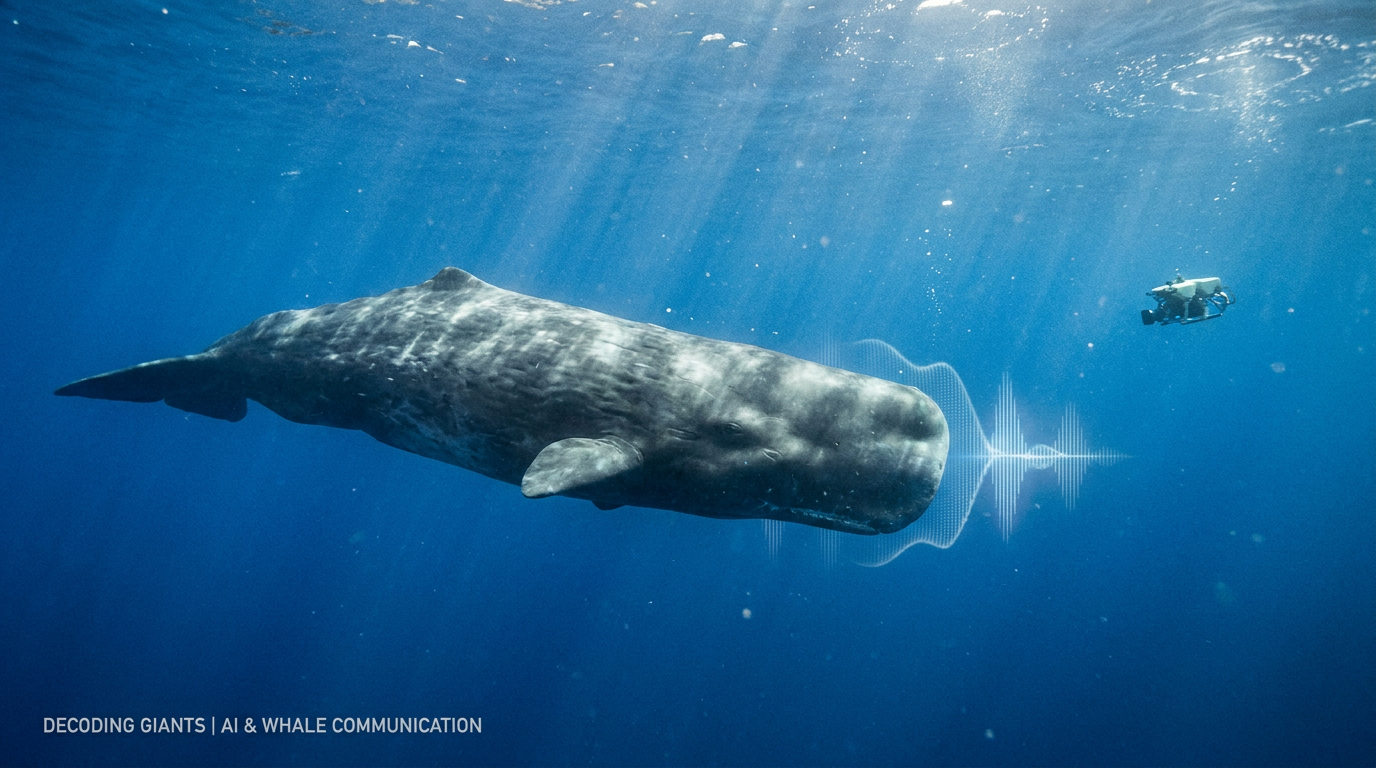
Beyond simply identifying species, AI is now pushing into the realm of linguistics. The Cetacean Translation Initiative (Project CETI) is a multidisciplinary effort utilizing robotics, cryptography, and natural language processing to decode the communication of sperm whales off the coast of Dominica.[2]
Sperm whales possess the largest brains on Earth and communicate using "codas"—short bursts of clicks interspersed with silences of variable duration. Historically, marine biologists treated these clicks like simple Morse code. However, by feeding decades of recordings into advanced machine learning algorithms, CETI researchers made a staggering discovery: sperm whales possess a phonetic alphabet.[2]
Sperm whales possess the largest brains on Earth and communicate using "codas"—short bursts of clicks interspersed with silences of variable duration.
The AI revealed that whales combine these basic click components into complex phrases, varying their structure depending on social context and the specific pod members present. The models have identified over 150 distinct codas, suggesting a level of conversational complexity that rivals human language.[2]

This linguistic revolution is not limited to the ocean. The Earth Species Project (ESP), backed by the Paul G. Allen Family Foundation, is building "foundation models" for the entire Tree of Life. Much like how ChatGPT was trained on the human internet, ESP’s NatureLM-audio is trained on massive datasets of animal vocalizations, human speech, and environmental noise to learn the underlying structures of communication.[3]
ESP’s models are already yielding results in the field. In northern Spain, the organization partnered with local scientists to analyze the calls of cooperatively breeding carrion crows. The AI successfully categorized over 127,000 distinct vocalizations, helping researchers map the intricate social dynamics of the flock without ever needing to trap or tag the birds.[3]
Even the most iconic animal sounds are revealing new secrets under algorithmic scrutiny. In late 2025, researchers at the University of Exeter applied deep learning models to the roars of African lions in Tanzania and Zimbabwe. The AI detected an "intermediate roar"—a deeper, more uniform vocalization that is entirely inaudible to human observers.[5]
More remarkably, the deep learning model proved that every lion possesses a unique acoustic signature. The AI could identify individual lions with over 95 percent accuracy based solely on their roar, while also extracting data on the animal's age and gender. This breakthrough allows conservationists to conduct highly accurate population counts across vast savannas using only hidden microphones, eliminating the need for stressful darting and collaring.[5]
As these models grow more sophisticated, the scientific community is grappling with the profound implications of interspecies communication. The ultimate goal for some researchers is two-way interaction—using AI to generate synthetic animal calls to communicate directly with wildlife.[1][3]

This prospect, however, introduces significant ethical and scientific hurdles. Communication is deeply contextual; it relies on body language, environmental cues, and social hierarchy. An AI might perfectly synthesize a whale coda, but broadcasting it without understanding the cultural context could cause confusion or distress.[1]
Traditional "playback experiments," where recorded sounds are broadcast to animals, have historically yielded mixed results, sometimes causing animals to fall silent or flee. Researchers are proceeding with extreme caution, emphasizing that the immediate priority is to listen and understand, rather than to speak.[2][3]
A global survey conducted by the Collective Intelligence Project found that while 70 percent of people are eager to understand what animals are thinking, 85 percent strongly prefer strict ethical regulations on how this technology is used, particularly to prevent commercial exploitation.[7]

Ultimately, the bioacoustics revolution is about more than just data collection; it is an exercise in ecological empathy. By proving that animals possess complex languages, distinct cultures, and individual identities, AI is dismantling the long-held assumption of human cognitive exceptionalism.[1]
If we can truly hear what the natural world is saying, it becomes exponentially harder to ignore its collapse. In the race to halt the biodiversity crisis, the ability to listen may prove to be our most powerful conservation tool.[1]
How we got here
1960s
Marine biologists begin recording whale clicks, initially treating them as simple Morse code.
2020
Project CETI is founded to apply advanced machine learning to decode sperm whale communication.
2023
Earth Species Project receives major funding to build multimodal foundation models for the animal domain.
2024
Researchers publish findings detailing a 'phonetic alphabet' used by sperm whales.
2025
Google DeepMind releases Perch 2.0, and researchers successfully use AI to identify individual lions by their roars.
Viewpoints in depth
Conservation Technologists
Focus on the urgency of the biodiversity crisis and how AI scales human effort in the field.
For technologists, the primary value of bioacoustics lies in its ability to act as a planetary alarm system. By deploying edge-computing sensors in remote habitats, conservationists can instantly detect the sounds of illegal logging, poaching, or the presence of critically endangered species. They argue that perfecting these monitoring tools is the most immediate way AI can halt ecological collapse.
Bioacoustics Researchers
Focus on the intrinsic value of understanding animal minds and mapping the Tree of Life.
Researchers studying animal linguistics argue that proving animals have complex language and culture will fundamentally shift human empathy. By demonstrating that sperm whales use a phonetic alphabet or that crows have intricate social dialects, they hope to dismantle the idea of human cognitive exceptionalism, potentially paving the way for new legal frameworks regarding animal rights.
Ecological Ethicists
Warn about the 'domain gap' and the dangers of playing god with interspecies communication.
Ethicists caution that synthesizing animal calls without understanding their cultural context could severely disrupt ecosystems. They argue that a machine might perfectly replicate a whale's distress call or mating song, but broadcasting it could cause mass confusion or alter natural behaviors. This camp demands strict global guardrails to ensure AI is used to listen and protect, rather than to exploit or interfere.
What we don't know
- Whether AI can ever truly bridge the 'domain gap' to understand animal communication without human bias.
- How animals will react if researchers begin using AI to synthesize and broadcast complex, context-heavy calls.
- How legal frameworks will adapt if science definitively proves that certain species possess complex language and culture.
Key terms
- Bioacoustics
- The scientific study of sound production, dispersion, and reception in animals.
- Edge computing
- Processing data locally on a device (like a remote sensor) rather than sending it to a centralized cloud server, which is crucial for remote areas without internet.
- Foundation model
- A large-scale AI model trained on a vast quantity of unlabeled data that can be adapted to a wide range of specific tasks, similar to the architecture behind ChatGPT.
- Coda
- A distinct pattern of clicks used by sperm whales to communicate with one another.
- Playback experiment
- A research method where recorded or synthetic sounds are broadcast to animals in the wild to observe their behavioral response.
Frequently asked
Can AI translate animal sounds into English?
Not exactly. AI can identify patterns, syntax, and context in animal calls, but it cannot map them perfectly to human concepts. The goal is to understand their communication on their own terms, not to create a direct English dictionary.
How do acoustic sensors survive in the wild?
Modern sensors are built into rugged, weatherproof casings and powered by solar panels. Projects like Microsoft's SPARROW use 'edge computing' to process data locally, meaning they don't need a constant internet connection to function.
Will humans ever be able to talk back to animals?
Technologically, AI can already synthesize realistic animal calls. However, researchers are highly cautious about two-way communication due to ethical concerns, as broadcasting sounds without understanding the cultural context could cause distress to the animals.
Sources
Source coverage
7 outlets
3 viewpoints surfaced







[1]Factlen Editorial TeamBioacoustics Researchers
Synthesis by Factlen editorial team
Read on Factlen Editorial Team →[2]Project CETIBioacoustics Researchers
Decoding the language of sperm whales
Read on Project CETI →[3]Earth Species ProjectBioacoustics Researchers
The Next Frontier of Understanding Life on Earth
Read on Earth Species Project →[4]QuantilusConservation Technologists
When Nature Speaks, AI Listens: Google's New Wildlife Conservation Tool
Read on Quantilus →[5]AivancityBioacoustics Researchers
Recognizing a lion by the sound of its voice: AI ushers in a new era for wildlife
Read on Aivancity →[6]WildlabsConservation Technologists
Project SPARROW: Edge AI for Biodiversity Monitoring
Read on Wildlabs →[7]Collective Intelligence ProjectEcological Ethicists
Global Perspectives on AI, Nature, and Interspecies Understanding
Read on Collective Intelligence Project →

Every angle. Every day.
Get environment stories with full source coverage and perspective breakdowns delivered to your inbox.