
The Rise of Mass Timber: How Wooden Skyscrapers Are Reshaping City Skylines
Engineered wood products like cross-laminated timber are allowing architects to build taller, faster, and greener, turning modern high-rises into massive carbon sinks.
By Factlen Editorial Team
- Sustainable Architects & Developers
- Advocate for mass timber to decarbonize construction and improve building aesthetics.
- Environmental & Forestry Experts
- Focus on the economic incentives for sustainable land management and rural job creation.
- Fire Safety Researchers
- Prioritize rigorous testing and code compliance to ensure life safety in wooden high-rises.
What's not represented
- · Traditional concrete and steel manufacturers facing market disruption
- · Local construction unions adapting to smaller crew sizes required for prefabricated timber assembly
Why this matters
The construction industry is responsible for nearly 40% of global carbon emissions. Replacing concrete and steel with mass timber dramatically reduces this footprint while sequestering carbon for the lifetime of the building, offering a scalable climate solution that also builds faster and quieter.
Key points
- Milwaukee's Neutral Edison tower is set to become the world's tallest mass timber building at 31 stories by 2026.
- Cross-laminated timber (CLT) panels offer immense structural strength, allowing wood to replace concrete and steel.
- Mass timber acts as a carbon sink, storing 0.9 tons of CO2 per cubic meter and drastically reducing embodied carbon.
- Thick timber panels provide natural fire resistance by charring at a predictable rate, protecting the structural core.
- Prefabricated timber components can reduce construction schedules by up to 25% while minimizing job site waste.
The skyline of Milwaukee is becoming the epicenter of a quiet revolution in architecture. The Neutral Edison tower, currently rising along the Milwaukee River, is set to reach 31 stories by the time it tops out in 2026.[1][2]
When completed in 2027, the 362-foot structure will claim the title of the world's tallest mass timber building, surpassing another Milwaukee high-rise, the 25-story Ascent. But this isn't just a local architectural rivalry; it is a demonstration of how engineered wood is fundamentally reshaping what is possible in modern construction.[1][8]
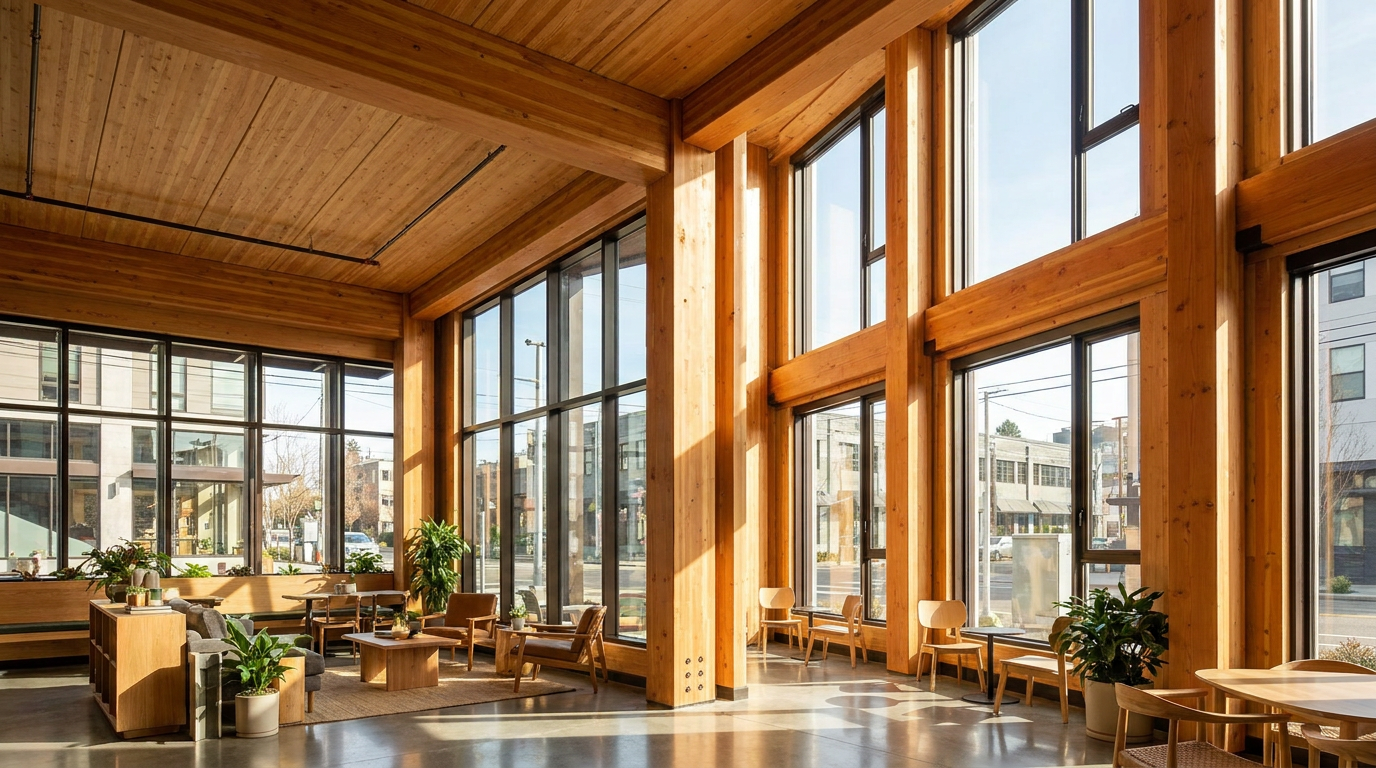
Mass timber is not the traditional light-wood framing used in single-family homes. It refers to a family of highly engineered, solid wood panels and beams capable of supporting immense structural loads. The most prominent of these is Cross-Laminated Timber (CLT), often described by architects as "super plywood."[7]
CLT is manufactured by taking layers of kiln-dried lumber and gluing them together at alternating right angles. This crosswise arrangement gives the resulting massive panels exceptional strength, dimensional stability, and rigidity in two directions, allowing them to replace concrete slabs and steel beams for floors, walls, and elevator cores.[5][7]

The primary driver behind the mass timber boom is its profound environmental benefit. The traditional construction industry—specifically the production of steel and cement—is highly energy-intensive and responsible for a massive share of global greenhouse gas emissions.[4]
Wood, by contrast, acts as a natural carbon sink. As trees grow, they absorb carbon dioxide from the atmosphere through photosynthesis. Every cubic meter of wood stores approximately 0.9 tons of CO2. When that wood is harvested and locked into the structure of a building, the carbon remains safely sequestered for the lifetime of the structure.[4][8]
Furthermore, mass timber has roughly one-fourth the "embodied carbon"—the emissions generated during manufacturing, transport, and construction—of conventional concrete and steel buildings. This dual benefit of lower initial emissions and long-term carbon storage effectively turns urban high-rises into massive carbon vaults.[4][8]

Despite the environmental appeal, the most common question the public asks about wooden skyscrapers is inevitable: What happens in a fire?[6]
Despite the environmental appeal, the most common question the public asks about wooden skyscrapers is inevitable: What happens in a fire?
Counterintuitively, mass timber performs exceptionally well under extreme heat. Unlike light-frame wood, which ignites easily, large solid timber panels resist burning. When exposed to fire, the outer layer of the wood burns and forms a protective layer of char.[6]
This char acts as an insulator, starving the fire of oxygen and protecting the structural integrity of the unburned wood inside. Extensive testing by organizations like the ATF Fire Research Laboratory and Oregon State University has shown that mass timber chars at a highly predictable rate of about 1.5 inches per hour.[3][6]

In worst-case scenario fire tests, mass timber structures have maintained their load-bearing capacity for hours, performing comparably to non-combustible materials like steel, which can warp and buckle under intense heat. These proven safety metrics led the International Building Code to update its standards in 2021, paving the way for timber buildings up to 18 stories, with hybrid structures pushing even higher.[3][6][8]
Beyond sustainability and safety, developers are embracing mass timber for its efficiency. CLT panels are prefabricated off-site in controlled factory environments, milled by computer-controlled machines to millimeter accuracy.[5][7]
When the components arrive at the construction site, they are assembled much like a giant piece of flat-pack furniture. This precision reduces waste, requires smaller construction crews, and can shave up to 25% off the construction schedule compared to pouring concrete.[8]
The economic ripple effects extend far beyond the city limits. Forestry experts note that a strong market for mass timber incentivizes private landowners to keep their land forested and invest in sustainable stewardship, rather than selling to developers for urban sprawl.[5]
In regions with surplus timber growth, such as East Texas and the Pacific Northwest, mass timber creates a circular economy that supports rural forestry jobs while decarbonizing dense urban centers.[5]

Challenges remain as the industry scales. The supply chain for CLT manufacturing is still developing in North America, and navigating local building codes and insurance underwriting for unprecedented heights requires specialized expertise.[1][8]
To reach heights like the 31-story Neutral Edison, architects currently rely on hybrid systems—combining a concrete elevator core for lateral wind stability with mass timber floors and columns.[1]
Yet, the trajectory is clear. As the technology matures and the urgency of the climate crisis grows, the skylines of the 21st century will increasingly be defined not by the cold gray of concrete, but by the warm, sustainable strength of engineered wood.[8]
How we got here
2015
Cross-Laminated Timber (CLT) is first recognized as a structural building component in the International Building Code (IBC).
2021
The IBC is updated to allow mass timber buildings to reach up to 18 stories in height.
2022
The Ascent building in Milwaukee is completed, setting a record at 25 stories for the tallest mass timber hybrid building.
2025
Construction begins on the Neutral Edison tower in Milwaukee, designed to reach 31 stories.
2026
The Neutral Edison tower is scheduled to top out, claiming the title of the world's tallest mass timber building.
Viewpoints in depth
Sustainable Architects & Developers
View mass timber as the most viable tool to decarbonize the built environment.
For the architectural and engineering communities, mass timber represents a paradigm shift. Because the built environment is responsible for nearly 40% of global carbon emissions, professionals in this camp argue that transitioning away from concrete and steel is a climate imperative. They highlight that mass timber not only drastically reduces upfront embodied carbon but also turns buildings into long-term carbon sinks. Furthermore, they champion the aesthetic and biophilic benefits of exposed wood, which studies suggest improves occupant well-being and productivity.
Environmental & Forestry Experts
See mass timber as an economic driver that promotes sustainable forest stewardship.
Forestry experts and rural landowners emphasize the economic and ecological benefits at the start of the supply chain. A robust market for engineered wood provides a financial incentive for landowners to maintain and sustainably manage their forests rather than selling the land for agricultural or commercial development. By selectively harvesting timber and replanting, they argue that the industry can create a circular economy that supports rural jobs, reduces the risk of catastrophic wildfires by thinning overstocked forests, and continuously sequesters carbon.
Fire Safety Researchers
Cautiously supportive but insist on rigorous testing and hybrid designs for extreme heights.
Building code officials, fire marshals, and insurance underwriters approach mass timber with a focus on life safety. While acknowledging the proven charring properties of thick timber, this camp requires exhaustive, large-scale fire testing before approving unprecedented heights. They advocate for strict adherence to updated building codes (like the IBC Type IV standards) and often mandate hybrid structural systems—such as concrete elevator cores—for high-rises to ensure lateral stability and compartmentalization during a severe fire event.
What we don't know
- How quickly the North American supply chain for manufacturing CLT panels can scale to meet surging demand.
- How the insurance industry will adjust long-term premiums for mass timber high-rises as the buildings age.
- The ultimate height limit for hybrid timber-concrete structures before wind and lateral forces make them economically unviable.
Key terms
- Cross-Laminated Timber (CLT)
- An engineered wood panel made by gluing layers of lumber together at alternating right angles, providing immense strength in two directions.
- Glulam (Glued Laminated Timber)
- A structural timber product made by gluing layers of wood with the grain all running in the same direction, typically used for columns and beams.
- Embodied Carbon
- The total greenhouse gas emissions generated by the manufacturing, transportation, and installation of building materials.
- Carbon Sequestration
- The process of capturing and storing atmospheric carbon dioxide; in this case, trees absorbing CO2 and locking it into the wood used for construction.
- Char Rate
- The predictable speed at which the outer layer of thick timber burns and turns to charcoal, which insulates the unburned wood inside.
Frequently asked
Is mass timber safe in a fire?
Yes. Unlike light-frame wood, thick mass timber panels resist burning. The outer layer chars at a predictable rate of 1.5 inches per hour, which insulates and protects the structural core of the wood.
Does building with mass timber cause deforestation?
When sourced from sustainably managed forests, it can actually prevent deforestation. A strong timber market financially incentivizes landowners to keep their land forested and replant trees rather than selling it for other types of development.
How tall can a mass timber building be?
The 2021 International Building Code allows pure mass timber buildings up to 18 stories. However, by using hybrid systems with concrete cores, developers are currently building towers over 30 stories tall, such as the 31-story Neutral Edison in Milwaukee.
Is it cheaper to build with mass timber?
While the raw materials can sometimes cost more than concrete, mass timber often results in overall cost savings. The prefabricated panels require smaller crews and can reduce construction time by up to 25%.
Sources
Source coverage
8 outlets
3 viewpoints surfaced








[1]Construction DiveSustainable Architects & Developers
Milwaukee tower to become world's tallest mass timber building
Read on Construction Dive →[2]Construction BriefingSustainable Architects & Developers
Construction started on Neutral Edison, a 31-storey mass timber tower
Read on Construction Briefing →[3]Oregon State UniversityFire Safety Researchers
Large-scale tests to understand fire behavior in mass timber structures
Read on Oregon State University →[4]American UniversityEnvironmental & Forestry Experts
Fact Sheet: Mass Timber Construction as Carbon Removal
Read on American University →[5]Texas A&M UniversityEnvironmental & Forestry Experts
The quiet revolution of cross-laminated timber in sustainable architecture
Read on Texas A&M University →[6]Naturally WoodFire Safety Researchers
Rigorous fire testing of mass timber buildings
Read on Naturally Wood →[7]DezeenSustainable Architects & Developers
The Dezeen guide to mass timber in architecture
Read on Dezeen →[8]Factlen Editorial TeamSustainable Architects & Developers
Synthesis by Factlen editorial team
Read on Factlen Editorial Team →


Every angle. Every day.
Get home stories with full source coverage and perspective breakdowns delivered to your inbox.