
How the 'Dark Sky' Movement is Transforming US National Parks
As light pollution obscures the night sky for most Americans, a booming astrotourism industry is driving millions to certified Dark Sky Parks. The movement is protecting nocturnal ecosystems while injecting billions of dollars into rural economies.
By Factlen Editorial Team
- Conservationists & Ecologists
- Argue that protecting dark skies is primarily an ecological necessity to save nocturnal wildlife from the harmful effects of artificial light.
- Local Tourism Boards
- Value dark skies as a powerful economic engine that drives lucrative overnight stays and extends the tourism season.
- Dark Sky Advocates
- Focus on preserving the night sky as a shared human heritage and expanding public access to astronomy.
What's not represented
- · Indigenous communities whose ancestral astronomical traditions are tied to these specific landscapes.
- · Lighting manufacturers navigating the transition to dark-sky compliant commercial fixtures.
Why this matters
As light pollution erases the stars for 80% of Americans, the National Park Service's push to certify 'Dark Sky Parks' is creating a booming astrotourism economy. This shift not only protects nocturnal wildlife but provides a massive financial windfall for rural gateway communities by converting day-trippers into overnight guests.
Key points
- Astrotourism is rapidly growing as travelers seek out destinations with pristine, unpolluted night skies.
- DarkSky International has certified 18 U.S. National Parks after rigorous lighting audits and retrofits.
- Overnight astrotourists spend roughly three times as much in local gateway communities as day-trippers.
- Protecting dark skies is crucial for nocturnal wildlife, which suffer when exposed to artificial light.
- Even parks near urban centers, like Saguaro National Park, are earning 'Urban Night Sky' certifications.
For decades, the defining image of a United States National Park visit was a sun-drenched vista: the sweeping depths of the Grand Canyon, the towering granite of Yosemite, or the geothermal eruptions of Yellowstone. But a growing contingent of travelers is waiting until the sun goes down to begin their exploration. Driven by a desire to escape the pervasive glow of urban centers, visitors are fueling a boom in "astrotourism"—travel specifically planned around celestial viewing and the preservation of natural darkness.[6]
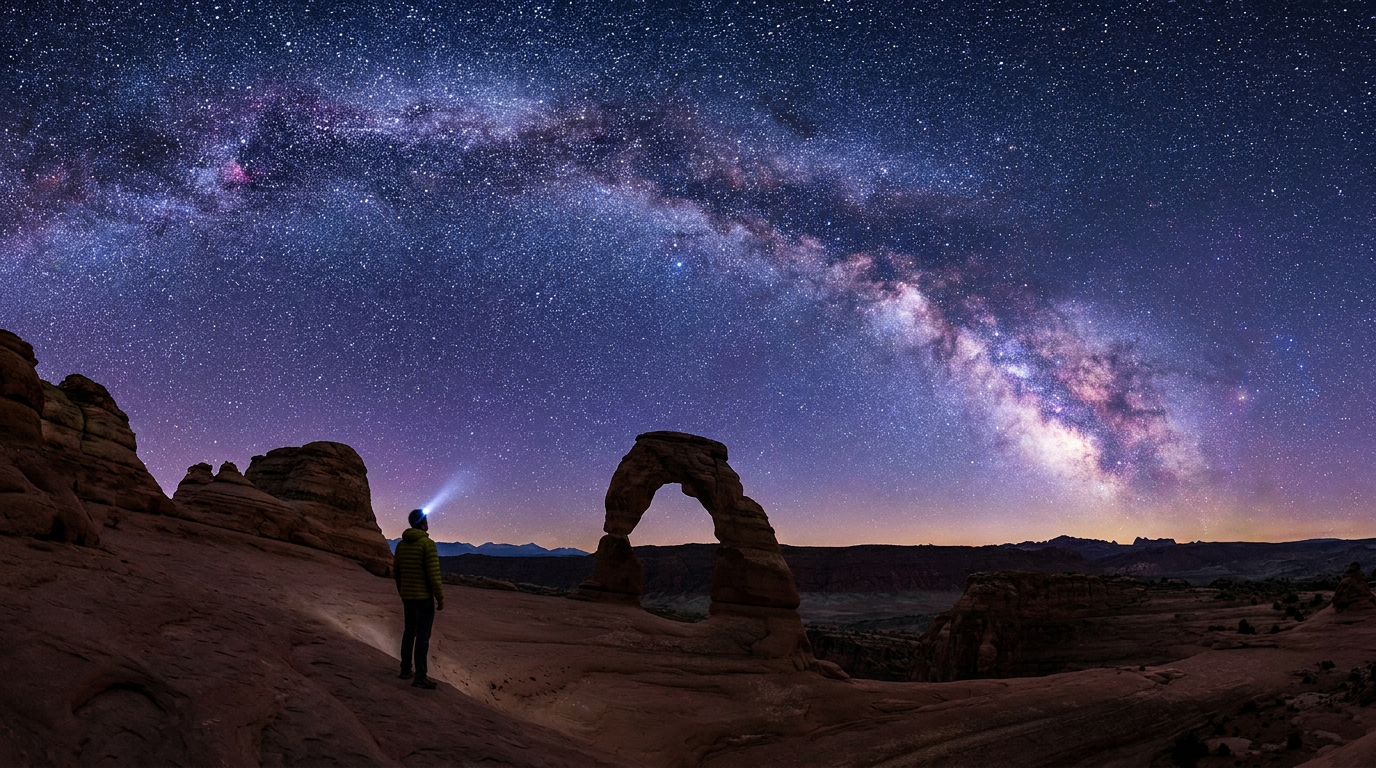
The contrast between a city sky and a protected nocturnal environment is staggering. In a typical American suburb, a resident might be able to spot roughly 500 stars on a clear night. In a designated dark-sky sanctuary, that number can explode to 15,000, revealing the dense, cloudy band of the Milky Way galaxy stretching from horizon to horizon. This profound visual difference has transformed stargazing from a niche hobby into a major driver of national park visitation, reshaping how public lands are managed and marketed.[6]
At the center of this movement is DarkSky International, a non-profit organization that certifies "International Dark Sky Places." The certification process is rigorous, often taking one to three years from initial inquiry to final approval. Parks must conduct comprehensive audits of their existing lighting, retrofit fixtures to be fully shielded and energy-efficient, and commit to ongoing public education about light pollution. It is not merely a recognition of geographic isolation, but an active, ongoing commitment to nocturnal conservation.[1]

The National Park Service (NPS) has embraced this framework enthusiastically. As of 2026, 18 of the 63 headline U.S. National Parks—including Big Bend, Arches, Glacier, and Joshua Tree—have achieved official Dark Sky Park status. These designations require parks to maintain their pristine night skies through strict lighting policies, ensuring that the glow of visitor centers and campgrounds does not bleed into the wilderness.[2]
The economic implications of this shift are substantial. Astrotourism inherently requires visitors to stay after dark, which naturally translates into overnight lodging. According to tourism industry data, overnight visitors spend an average of three times as much in local gateway communities as day-trippers—roughly $270 per party compared to $90. This extended dwell time injects crucial revenue into rural economies that border public lands.[4]
Astrotourism inherently requires visitors to stay after dark, which naturally translates into overnight lodging.
A landmark 2019 study conducted by Missouri State University researchers for the NPS quantified this windfall. Focusing solely on the Colorado Plateau—a region encompassing parts of Utah, Arizona, Colorado, and New Mexico—the study projected that non-local astrotourists would spend $5.8 billion over a ten-year period. This localized spending was estimated to support over 10,000 additional jobs annually and generate $2.4 billion in higher wages.[3]

Beyond the financial benefits, the push for dark skies is fundamentally an ecological imperative. Artificial light at night (ALAN) severely disrupts the natural behaviors of nocturnal wildlife, which rely on darkness for hunting, mating, and navigation. Migratory birds, sea turtles, and countless insect species suffer population declines when their habitats are flooded with artificial illumination. By protecting the night sky, parks are simultaneously preserving the delicate balance of their ecosystems.[5]
The infrastructure changes required for certification also yield direct operational benefits. By replacing outdated, omnidirectional bulbs with targeted, amber-hued LED fixtures, parks significantly reduce their energy consumption. This transition lowers utility costs and shrinks the carbon footprint of park facilities, aligning with broader federal mandates for sustainability and climate resilience.[1]
The movement is also expanding beyond remote wilderness areas. In recent years, DarkSky International introduced the "Urban Night Sky Place" designation to recognize sites near heavily populated areas that actively promote authentic nighttime experiences despite surrounding light pollution. Saguaro National Park in Arizona and Timpanogos Cave National Monument in Utah have both earned this distinction, proving that dark-sky advocacy can thrive even on the edges of major metropolitan zones.[4]

However, the economic and ecological gains of astrotourism remain fragile. A recent survey of visitors to Great Sand Dunes National Park—a Gold Tier Dark Sky Park—found that 47% of respondents would reduce their future visits if light pollution from neighboring municipalities increased. Researchers estimated that such a decline in visitation could cost the immediate region hundreds of thousands of dollars in lost GDP annually, highlighting the need for gateway communities to adopt their own dark-sky ordinances.[4]
To cement public support, parks are heavily investing in educational outreach. "Star parties" and ranger-led astronomy programs have become some of the most popular events on the NPS calendar. At Voyageurs National Park in Minnesota, thousands of visitors gather annually for telescope sessions and guided constellation tours, learning not just about astrophysics, but about the cultural and historical significance of the stars to Indigenous peoples and early navigators.[2][5]

Ultimately, the rise of astrotourism represents a rare alignment of conservation and commerce. By protecting a resource that costs nothing to produce and requires no heavy infrastructure to access, national parks are fostering a sustainable, low-impact form of recreation. As light pollution continues to erase the stars from urban skies, these protected pockets of darkness serve as vital sanctuaries—not just for wildlife, but for the human capacity for awe.[6]
How we got here
1988
DarkSky International (formerly International Dark-Sky Association) is founded to combat light pollution.
2001
Flagstaff, Arizona, becomes the world's first International Dark Sky Place.
2007
Natural Bridges National Monument in Utah becomes the first certified International Dark Sky Park.
2019
Grand Canyon National Park earns Dark Sky Park status, bringing massive global visibility to the movement.
2023
Saguaro National Park earns the rare 'Urban Night Sky Place' certification, proving proximity to cities doesn't preclude night-sky conservation.
Viewpoints in depth
Conservationists & Ecologists
Argue that protecting dark skies is primarily an ecological necessity to save nocturnal wildlife from the harmful effects of artificial light.
For ecologists, the astrotourism boom is a welcome byproduct of a much more urgent mission: mitigating the devastating effects of Artificial Light at Night (ALAN). Biologists point out that nearly half of all species on Earth are nocturnal, relying on darkness for navigation, predator evasion, and reproduction. When parks install unshielded white lights, they inadvertently disrupt the circadian rhythms of local fauna, leading to fatal bird collisions and declining insect populations. Conservationists view Dark Sky certification not just as a tourism badge, but as a critical habitat protection measure.
Local Tourism Boards
Value dark skies as a powerful economic engine that drives lucrative overnight stays and extends the tourism season.
Gateway communities bordering national parks have historically struggled with the 'day-tripper' problem—visitors who drive through the park, buy a sandwich, and leave before dinner. Tourism boards champion astrotourism because it fundamentally alters visitor behavior. Stargazing requires staying after dark, which forces visitors to book hotel rooms, eat at local restaurants, and buy breakfast the next morning. Furthermore, because the night sky is often clearest in the colder months, astrotourism helps smooth out the highly seasonal nature of park visitation, providing year-round economic stability to rural towns.
Dark Sky Advocates
Focus on preserving the night sky as a shared human heritage and expanding public access to astronomy.
For amateur astronomers and dark-sky advocates, the erasure of the stars by urban skyglow is a profound cultural loss. They argue that the night sky is a shared human heritage—the same canvas that inspired ancient navigators, mythologies, and early scientists. By establishing and fiercely protecting Dark Sky Parks, these advocates believe they are preserving the public's right to experience the cosmos without needing expensive telescopes or specialized filters. They view the National Park Service's ranger-led 'star parties' as vital educational tools to reconnect a screen-fatigued public with the natural world.
What we don't know
- Whether gateway communities will universally adopt local lighting ordinances to protect the parks they border.
- How the rapid deployment of low-earth orbit satellite mega-constellations will impact the pristine viewing quality of Dark Sky Parks.
Key terms
- Astrotourism
- Travel focused on observing celestial phenomena and visiting areas with minimal light pollution.
- Light Pollution
- The inappropriate or excessive use of artificial light at night, which obscures the stars and disrupts ecosystems.
- Bortle Scale
- A nine-level numeric scale that measures the night sky's brightness, with Class 1 being the darkest and Class 9 being inner-city skies.
- Artificial Light at Night (ALAN)
- A scientific term for man-made illumination that alters natural light levels in the environment, often harming wildlife.
- Skyglow
- The brightening of the night sky over inhabited areas, caused by artificial light scattering in the atmosphere.
Frequently asked
How long does it take a park to get Dark Sky certified?
The process typically takes one to three years and requires comprehensive lighting audits, retrofits, and a commitment to public education.
Can you see the Milky Way with the naked eye?
Yes. In certified Dark Sky Parks with minimal light pollution, the Milky Way is clearly visible as a dense, cloudy band across the sky.
Do I need a telescope to enjoy a Dark Sky Park?
No. While telescopes enhance the experience, visitors can see up to 15,000 stars, meteor showers, and the Milky Way using just their naked eyes.
Why do parks ask visitors to use red flashlights?
Red light does not disrupt the human eye's natural night vision or disturb nocturnal wildlife as severely as bright white light.
Sources
Source coverage
6 outlets
3 viewpoints surfaced






[1]DarkSky InternationalDark Sky Advocates
International Dark Sky Places Program
Read on DarkSky International →[2]National Park ServiceDark Sky Advocates
International Dark Sky Park Certification
Read on National Park Service →[3]Missouri State UniversityLocal Tourism Boards
Dark sky tourism: economic impacts on the Colorado Plateau
Read on Missouri State University →[4]Miles PartnershipLocal Tourism Boards
Studying Dark Sky Tourism's Potential Economic Impacts
Read on Miles Partnership →[5]Voyageurs ConservancyConservationists & Ecologists
Protecting and Sharing Minnesota's Starry Skies
Read on Voyageurs Conservancy →[6]Factlen Editorial TeamDark Sky Advocates
Synthesis by Factlen editorial team
Read on Factlen Editorial Team →
Every angle. Every day.
Get travel stories with full source coverage and perspective breakdowns delivered to your inbox.