
Hardside vs. Softside Carry-On Luggage: Which is Better for Your Travel Style?
Choosing between rigid polycarbonate and flexible ballistic nylon comes down to a trade-off between uncompromising protection and organizational flexibility. Here is how to match the right suitcase to your specific travel habits.
By Factlen Editorial Team
- Hardside Advocates
- Prioritizes maximum protection for belongings, superior security against theft, and weather resistance.
- Softside Loyalists
- Values packing flexibility, lightweight materials, and the convenience of quick-access exterior pockets.
- Neutral Travel Experts
- Argues that the choice depends entirely on the specific travel context, balancing trade-offs between durability and flexibility.
What's not represented
- · Airline baggage handlers who interact with both materials daily.
- · Sustainable travel advocates concerned about the environmental impact of polycarbonate versus synthetic nylon.
Why this matters
Luggage is the defining tool of any trip, and choosing the wrong material can lead to damaged valuables, overweight baggage fees, or frustrating transit experiences. Understanding the exact trade-offs between hardside and softside designs ensures your gear works with your travel style rather than against it.
Key points
- Hardside luggage utilizes rigid materials like polycarbonate or aluminum to provide superior impact protection and security.
- Softside luggage relies on flexible fabrics like nylon, offering expandable capacity and convenient exterior pockets.
- Hardside bags typically feature a clamshell design requiring more space to open, while softside bags use a space-saving top-lid opening.
- Softside carry-ons generally weigh between 5 and 10 pounds, giving them a slight weight advantage over 10-to-15-pound hardside options.
- The best choice depends entirely on travel habits: hardside excels for checked bags and harsh weather, while softside wins for tight spaces and organization.
The luggage carousel anxiety and the overhead bin struggle are universal travel experiences. At the center of these moments is the suitcase itself, and the choice between hardside and softside luggage is a defining decision for any traveler. Getting it right makes a bag an invisible, seamless part of the journey, while getting it wrong can result in wrestling with an overstuffed bin at dawn or watching a cracked shell roll off a baggage belt.[2][6]
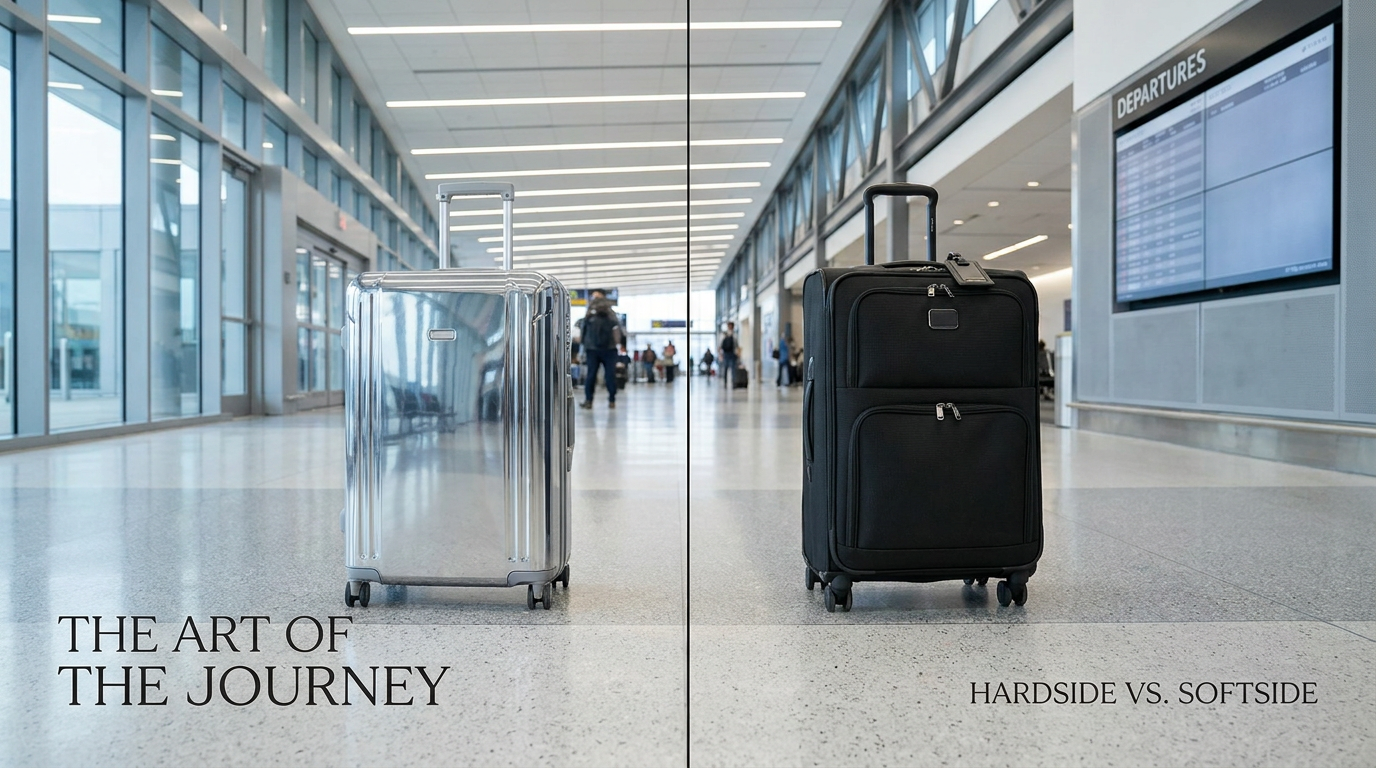
The core difference between the two categories lies entirely in their material construction. Hardside suitcases are crafted from rigid elements like polycarbonate, polypropylene, ABS plastic, or heavy-duty aluminum. In contrast, softside luggage relies on flexible fabrics, predominantly ballistic nylon, high-denier polyester, or canvas blends.[1][3]
The case for hardside luggage centers on uncompromising protection. Evidence of this lies in the material science of modern polycarbonate engineering, which has made rigid shells lighter and more resilient over the last decade. A rigid exterior absorbs and distributes impact across the surface area without transmitting that blunt force to the contents inside.[2][3]
For travelers packing fragile items, expensive electronics, or highly structured clothing, this impact resistance is a non-negotiable advantage. Furthermore, hardside luggage offers superior security. A rigid shell cannot be slashed open with a blade—a vulnerability inherent to fabric bags—and virtually all premium hardside models feature integrated TSA-approved combination locks built directly into the frame.[2][5]

Weather resistance is another significant point in favor of hardside designs. A polycarbonate or aluminum shell naturally sheds rain, snow, and accidental spills, keeping the interior completely dry. While premium softside bags often feature water-resistant chemical coatings, they cannot match the impermeable seal of a hard shell during sustained exposure to the elements on a rainy tarmac.[2][3]
The argument against hardside designs focuses on their inherent rigidity. Evidence of this limitation is seen at the boarding gate and in the hotel room. The most notable drawback is the lack of exterior pockets. Travelers who prefer to stash a boarding pass, a book, or a laptop in an easily accessible outer compartment will find hardside designs frustratingly sleek and streamlined.[1][3]
Additionally, hardside suitcases are entirely unforgiving when it comes to overpacking. The shell holds its shape regardless of how much pressure is applied, meaning that if the zipper cannot close, the traveler must remove items. While some modern hardside bags offer zippered expansion gussets, the core structure remains inflexible, which can make squeezing the bag into a tight overhead bin a significant physical challenge.[2][3]
Additionally, hardside suitcases are entirely unforgiving when it comes to overpacking.
The case for softside luggage champions flexibility and organizational convenience. Evidence of this utility is found in the fabric construction, which inherently offers more give. This allows travelers to squeeze in that one last souvenir or compress the bag slightly to fit into a restrictive space, such as a crowded car trunk or a smaller regional jet's overhead bin.[1][4]

This flexibility extends to storage at home; many softside bags can compress flat, taking up significantly less closet space than their rigid counterparts. The presence of exterior pockets is a massive advantage for softside loyalists, providing quick access to essential documents, snacks, or electronics without needing to open the main compartment in the middle of a crowded terminal.[3][4]
The argument against softside luggage highlights its vulnerability to the elements and rough handling. Evidence shows that while ballistic nylon is highly resistant to tearing, it cannot distribute heavy impacts. A fragile item packed near the surface of a soft bag remains susceptible to crushing if a heavier bag is stacked on top of it in the cargo hold. Furthermore, fabric bags are inherently more difficult to clean, absorbing dirt and requiring soap and water rather than a simple wipe-down.[1][5]
Weight is a critical metric in this side-by-side trade-off analysis. Historically, softside luggage was universally lighter, but modern engineering has narrowed the gap. Today, most softside carry-ons range from five to ten pounds empty, whereas standard polycarbonate hardside options typically fall between ten and fifteen pounds. This gives softside a slight but meaningful advantage for travelers navigating strict airline weight limits.[1][2]
The evidence of this weight penalty is most pronounced at the premium end of the hardside market. Aluminum suitcases, while offering the ultimate in durability and a striking aesthetic, are the heaviest option available. High-end aluminum models can weigh nearly twelve pounds empty, eating into strict weight allowances before a single garment is packed.[1][5]

Beyond materials, the fundamental architecture of the bags differs significantly. Hardside luggage typically utilizes a clamshell design, opening perfectly in half into two equal compartments. This requires a large, flat surface—like a hotel bed—to pack and unpack. Conversely, most softside bags feature a top-lid opening, where the main compartment is a single deep cavity accessed by unzipping the front panel, requiring far less horizontal space to remain open.[1][4]
Ultimately, the decision requires matching the tool to the task. Hardside luggage fits well when the itinerary involves checking bags, transporting fragile electronics, navigating inclement weather, or traveling to destinations where baggage security is a primary concern. It does not fit well for travelers who rely heavily on exterior pockets, need to squeeze bags into tight spaces, or have limited storage space at home.[3][6]
Conversely, softside luggage fits well when the traveler prioritizes lightweight carry-on travel, values quick-access organization, frequently travels by car where bags must be stacked in tight trunks, or tends to return home with more items than they left with. It does not fit well when checking highly fragile items or when traveling through heavy rain. There is no single winner; the best luggage is the one that seamlessly adapts to the specific conditions of the journey.[2][6]

How we got here
1987
The first commercially successful rolling luggage with two wheels is introduced, revolutionizing travel.
2000
Polycarbonate is first used in luggage manufacturing, creating the modern lightweight hardside category.
2004
Four-wheel spinner luggage becomes widely available, changing how travelers navigate airports.
2010s
Direct-to-consumer brands popularize sleek, minimalist hardside designs, shifting consumer aesthetics away from traditional softside bags.
Viewpoints in depth
Hardside Advocates
Focuses on the uncompromising protection and security offered by rigid materials.
Proponents of hardside luggage argue that the primary function of a suitcase is to protect its contents from the brutal realities of modern travel. They point to the fact that polycarbonate and aluminum shells absorb impact, preventing fragile items from being crushed under the weight of other bags in a cargo hold. Furthermore, this camp emphasizes the security benefits; a rigid shell cannot be slashed open with a box cutter, and the lack of exterior pockets means there are fewer vulnerable entry points for opportunistic theft.
Softside Loyalists
Champions the practical flexibility and organizational superiority of fabric luggage.
Those who favor softside luggage argue that rigid bags are inherently impractical for the realities of packing and transit. They highlight the forgiveness of ballistic nylon, which can stretch to accommodate last-minute additions and compress to fit into stubborn overhead bins. This perspective also heavily values the top-lid opening style and exterior pockets, arguing that travelers need quick access to laptops, liquids, and travel documents without having to splay their entire suitcase open on an airport floor.
Neutral Travel Experts
Emphasizes a situational approach, matching the luggage type to the specific demands of the trip.
Industry analysts and travel experts reject the idea of a universal winner, instead advocating for a context-driven choice. They note that hardside luggage is statistically superior for checked baggage and international flights where durability is tested, while softside luggage remains the undisputed champion for road trips and strict carry-on scenarios. This camp advises travelers to audit their most frequent type of journey—assessing factors like airline weight limits, typical destinations, and packing habits—before committing to a material.
What we don't know
- How upcoming airline regulations regarding overhead bin sizes might disproportionately affect rigid hardside designs versus compressible softside bags.
- Whether emerging sustainable materials, like recycled ocean plastics, will eventually match the durability of virgin polycarbonate in hardside manufacturing.
Key terms
- Polycarbonate
- A highly durable, lightweight, and flexible plastic commonly used in premium hardside luggage to absorb impact without cracking.
- Ballistic Nylon
- A thick, tough synthetic fabric originally developed for military use, prized in softside luggage for its resistance to tearing and abrasion.
- Clamshell Design
- A suitcase design that opens perfectly in half into two equal compartments, typical of hardside luggage.
- ABS Plastic
- Acrylonitrile butadiene styrene, a cheaper and more rigid plastic used in budget hardside luggage that is more prone to cracking than polycarbonate.
Frequently asked
Is hardside or softside luggage better for international travel?
Hardside luggage is generally preferred for international travel because it offers better protection against the rough handling typical of long-haul transit and provides enhanced security with slash-proof shells.
Which type of luggage is lighter?
Softside luggage is typically lighter, with carry-ons ranging from 5 to 10 pounds. However, modern polycarbonate hardside bags have narrowed the gap significantly.
Can softside luggage protect fragile items?
While high-quality ballistic nylon offers some padding, softside luggage cannot protect fragile items from being crushed under heavy weight as effectively as the rigid shell of a hardside suitcase.
Do hardside suitcases crack easily?
Cheaper ABS plastic hardside bags can crack under pressure, but premium polycarbonate and aluminum shells are engineered to flex and absorb impact without breaking.
Sources
Source coverage
6 outlets
3 viewpoints surfaced





[1]ForbesNeutral Travel Experts
Hardside Vs. Softside Luggage: Which Is Right For You?
Read on Forbes →[2]Empire Luggage CenterNeutral Travel Experts
Hardside vs. Softside Luggage: How to Choose the Right Suitcase
Read on Empire Luggage Center →[3]DelseyHardside Advocates
What's the Difference Between Hardside and Soft-Side Luggage?
Read on Delsey →[4]TravelproSoftside Loyalists
Hardside vs Softside Luggage - What's Best for You?
Read on Travelpro →[5]BG BerlinHardside Advocates
Hardside vs Softside Luggage | A Comparison
Read on BG Berlin →[6]Factlen Editorial TeamNeutral Travel Experts
Synthesis by Factlen editorial team
Read on Factlen Editorial Team →
More in shopping
See all 7 stories →Display Tech
OLED vs. Mini-LED: Choosing the Right TV Technology in 2026
0 sources

Summer Sales
Amazon and Target Move Major Summer Sales to June, Sparking an Early Retail War
0 sources

E-Reader Market
The Best E-Readers of 2026: Kindle, Kobo, and Boox Compared
0 sources

Red Light Therapy
Do Red Light Therapy Masks Actually Work? An Evidence-Based Review
0 sources

Every angle. Every day.
Get shopping stories with full source coverage and perspective breakdowns delivered to your inbox.