
OLED vs. Mini-LED: Choosing the Right TV Technology in 2026
As television technology advances in 2026, the gap between OLED and Mini-LED has narrowed, making the choice less about price and more about your specific viewing environment. Here is a definitive guide to the trade-offs between perfect contrast and maximum brightness.
By Factlen Editorial Team
- Cinematic Purists
- Viewers who prioritize absolute image accuracy, perfect contrast, and filmmaker intent above all else.
- Bright-Room Viewers
- Consumers with open-plan, sunlit living rooms who need a television that can overpower natural glare.
- Competitive Gamers
- Users who spend thousands of hours playing video games with static HUDs or using the TV as a PC monitor.
What's not represented
- · Budget-conscious consumers
- · Commercial display installers
Why this matters
Buying a premium television is a major multi-year investment. Understanding the specific strengths of self-emissive OLEDs versus the blinding brightness of modern Mini-LEDs ensures you don't overpay for the wrong technology for your living room's lighting.
Key points
- The performance gap between OLED and Mini-LED has narrowed significantly in 2026.
- OLED remains the best choice for dark rooms, offering perfect black levels and infinite contrast.
- Mini-LED is the superior choice for bright, sunlit rooms, reaching up to 5,000 nits of peak brightness.
- New Tandem OLED and QD-OLED panels have pushed OLED brightness to roughly 2,000 nits.
- Mini-LEDs carry zero risk of permanent burn-in, making them ideal for heavy gaming or static content.
- For massive screens (85 inches and above), Mini-LED offers significantly better value than OLED.
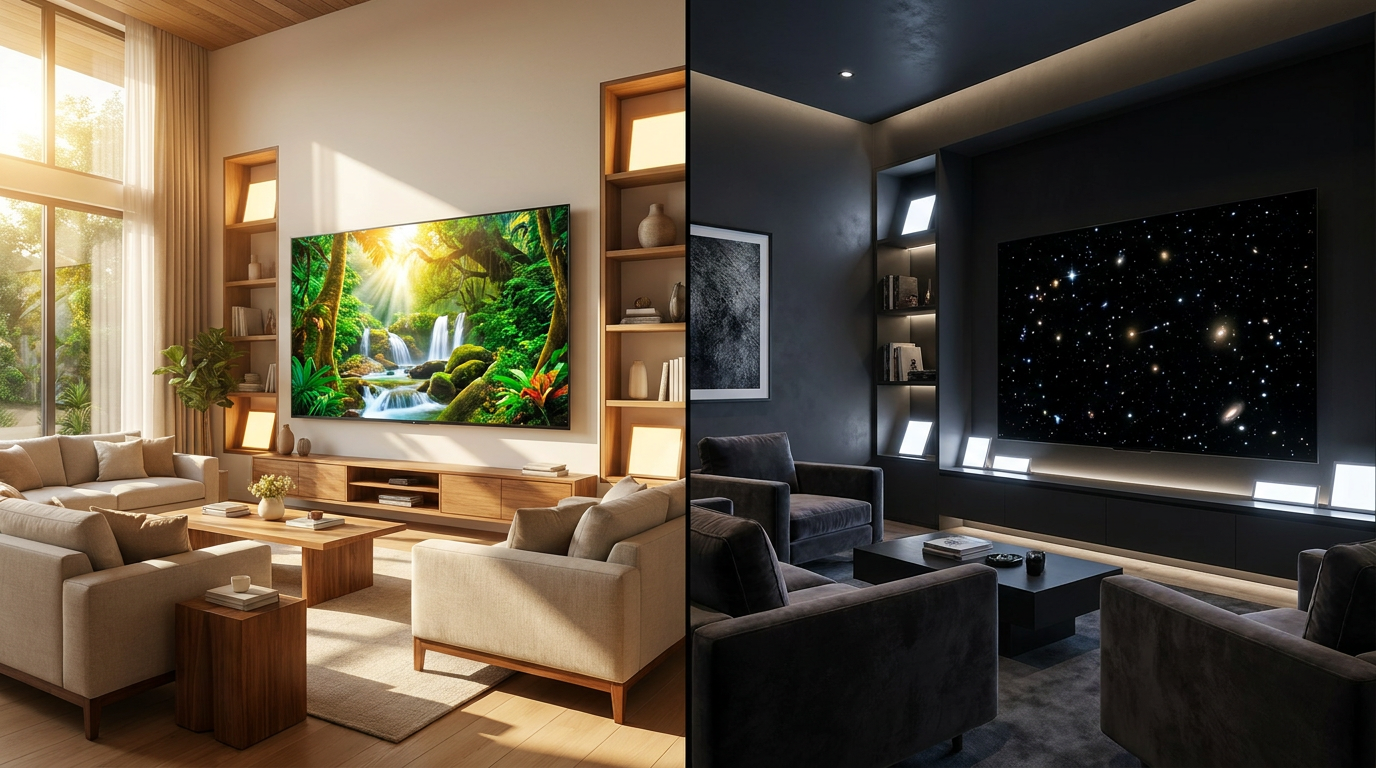
The 2026 television market has reached a fascinating inflection point, effectively ending the traditional advice that guided consumer purchases for the last decade. For years, the rule of thumb was simple: buy an OLED if you have a dark room and a premium budget, or buy a standard LED if you watch daytime television and want to save money. Today, the engineering landscape has shifted dramatically, blurring the lines between these two distinct visual philosophies.[1][3]
The gap between the two dominant premium technologies—OLED and Mini-LED—has narrowed to a sliver. It is no longer a battle of budget versus premium, but rather a choice between two distinct flagship engineering paths that cater to different environmental realities. High-end Mini-LEDs now command the same premium prices as flagship OLEDs, meaning consumers must choose based on physics rather than price tags.[2][5]
To make the right investment, buyers need to look past the marketing jargon and understand how these panels generate light. The core difference lies in how they illuminate the image, which dictates everything from peak brightness to long-term durability.[3]
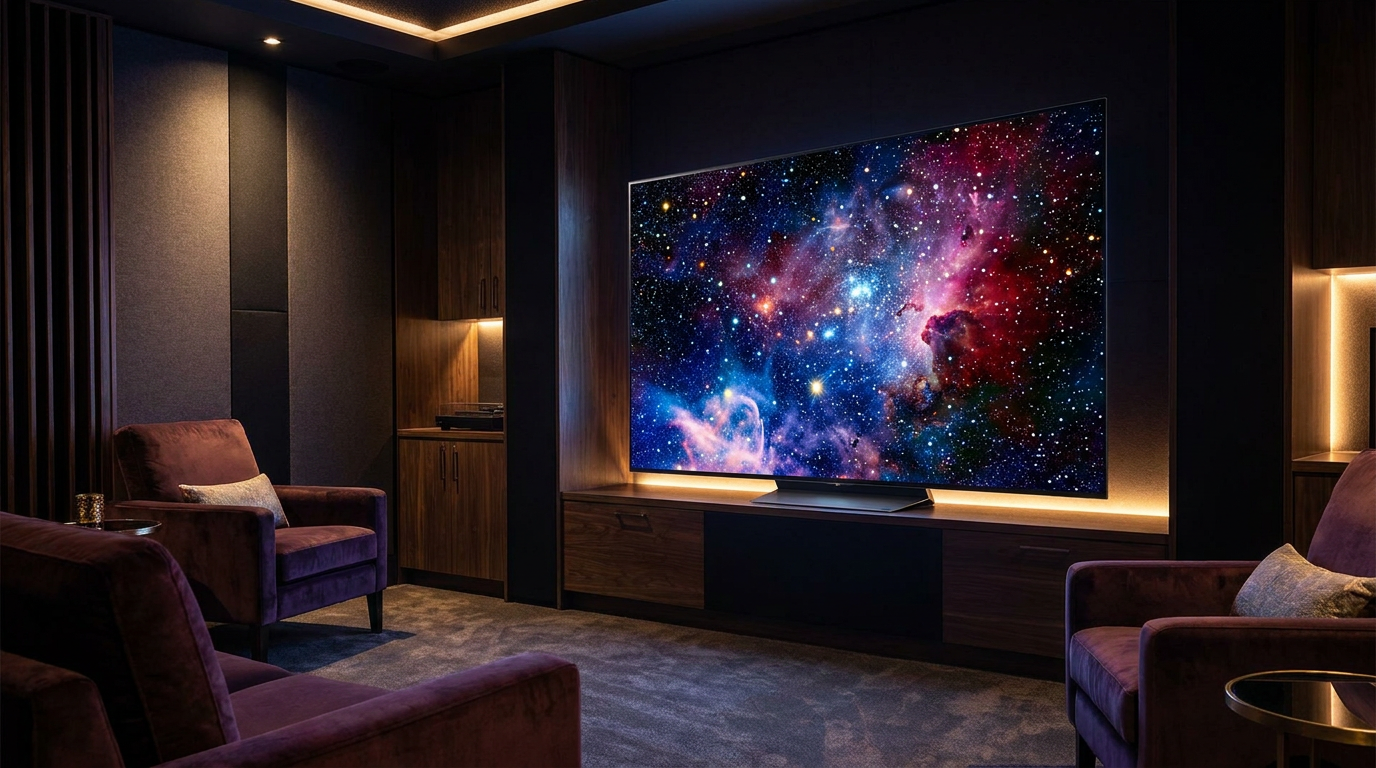
OLED, which stands for Organic Light-Emitting Diode, remains the undisputed king of contrast. Because each of its millions of pixels generates its own light and can turn off completely independently of its neighbors, OLED panels deliver perfect, inky blacks. There is zero light bleed, ensuring that a starfield in a sci-fi movie looks perfectly crisp against the void of space.[3][6]

Historically, OLED's greatest weakness was its inability to get bright enough to compete with ambient sunlight. However, in 2026, the technology has evolved significantly. The introduction of QD-OLED, which uses quantum dots for better color volume, and Tandem OLED, which stacks multiple emissive layers, has pushed peak brightness to roughly 1,500 to 2,000 nits. This makes modern OLEDs vastly more versatile than their predecessors.[1][4][5]
On the other side of the aisle is Mini-LED, a technology that has matured rapidly to challenge OLED's dominance. Instead of organic compounds, these televisions use thousands of microscopic inorganic LEDs clustered behind the screen. These are grouped into "local dimming zones" that can dim or brighten independently to simulate OLED's contrast.[6]
The sheer power of modern Mini-LEDs is staggering. Flagship models in 2026 are routinely hitting 3,000 to 5,000 nits of peak brightness. They act as literal light cannons, easily overpowering the glare of a sunlit living room and delivering HDR highlights—like explosions or direct sunlight—with blinding realism.[3][5][6]

Flagship models in 2026 are routinely hitting 3,000 to 5,000 nits of peak brightness.
Furthermore, 2026 has seen the rollout of RGB Mini-LEDs. This new iteration replaces the traditional blue LEDs and quantum dot layers with discrete red, green, and blue diodes, drastically improving color purity and closing the color-volume gap that previously favored QD-OLEDs.[1][2]
When comparing the two side-by-side, the room lighting trade-off becomes the most critical deciding factor. If your television sits in a room with massive windows, skylights, and uncontrolled sunlight, Mini-LED is the clear winner. It maintains its full-screen brightness effortlessly, whereas OLEDs still rely on an Automatic Brightness Limiter that dims the entire screen during bright scenes to protect the organic panel from overheating.[3][4]
Conversely, the contrast and blooming trade-off heavily favors OLED in dark environments. While Mini-LEDs have improved exponentially—with some 2026 models boasting over 20,000 individual dimming zones—they still cannot match OLED's pixel-level precision. In a pitch-black room, a Mini-LED might still show faint "blooming" or halos around bright objects on dark backgrounds, such as white subtitles resting on the black letterbox bars of a movie.[3][4]

The gaming landscape presents another fascinating split between the two technologies. For competitive esports players, OLED offers a near-instantaneous pixel response time of roughly 0.03 milliseconds. This virtually eliminates motion blur, keeping fast-pacing panning shots perfectly sharp.[4][5]
However, Mini-LEDs offer complete peace of mind against "burn-in." While modern OLEDs use deuterium stabilization and pixel-shifting to prevent permanent image retention, the risk is never truly zero if static elements—like video game health bars, PC taskbars, or 24-hour news tickers—are displayed for thousands of hours. Because Mini-LEDs use inorganic materials, they carry zero burn-in risk, making them the safer choice for heavy, static usage.[4][6]
Finally, the size and value equation cannot be ignored. Manufacturing massive, flawless OLED panels remains incredibly expensive. If you are looking to build a truly immersive home theater with an 85-inch or larger display, Mini-LED offers significantly better value. In many cases, an 85-inch flagship Mini-LED costs the same as a 65-inch OLED, and for most living rooms, the sheer immersion of a larger screen outweighs a slight difference in black levels.[5][6]

Ultimately, the best television in 2026 is entirely subjective and highly dependent on your specific living space. OLED fits perfectly when you prioritize cinematic accuracy, demand perfect blacks, and primarily watch movies in a controlled, dimly lit environment where the panel can truly shine.[3][5]
How we got here
Early 2010s
OLED technology enters the consumer market, establishing a new standard for perfect black levels and contrast.
2019
Mini-LED technology is introduced as a premium alternative to traditional LCDs, offering thousands of dimming zones to combat OLED.
2022
QD-OLED panels launch, combining quantum dots with OLED to significantly boost color volume and brightness.
2026
Tandem OLED and RGB Mini-LED technologies mature, closing the historical performance gaps between the two competing panel types.
Viewpoints in depth
Cinematic Purists
Viewers who prioritize absolute image accuracy, perfect contrast, and filmmaker intent above all else.
For home theater enthusiasts, OLED remains the undisputed champion. This camp argues that the absolute absence of light—perfect black—is the foundation of a cinematic image. They point out that even the most advanced Mini-LEDs with 20,000 dimming zones still suffer from microscopic blooming around high-contrast edges, such as starfields or subtitles. For these viewers, the slightly lower peak brightness of OLED is a non-issue, as critical viewing is done in a dark, light-controlled room where 1,500 nits is more than enough to deliver a blinding HDR highlight.
Bright-Room Viewers
Consumers with open-plan, sunlit living rooms who need a television that can overpower natural glare.
This perspective prioritizes sheer horsepower and sustained brightness. Advocates for Mini-LED argue that OLED's perfect black levels are entirely wasted if the screen is washed out by afternoon sunlight. Furthermore, they highlight the frustration of OLED's Automatic Brightness Limiter (ABL), which aggressively dims the screen during bright scenes like hockey games or snow-covered landscapes. For this camp, a Mini-LED pushing 4,000 sustained nits provides a vastly superior, punchier daytime viewing experience.
Heavy Gamers
Users who spend thousands of hours playing video games with static HUDs or using the TV as a PC monitor.
Gamers are often split, but those who play MMOs, strategy games, or use their display for PC productivity lean heavily toward Mini-LED. Their primary argument is the absolute elimination of burn-in anxiety. While OLEDs offer superior 0.03ms response times for competitive shooters, the inorganic nature of Mini-LED means users can leave a static health bar or Windows taskbar on the screen for 12 hours a day without fear of permanently damaging a multi-thousand-dollar investment.
What we don't know
- Whether the manufacturing costs of massive 85-inch and 97-inch OLED panels will ever drop enough to compete with Mini-LED on price.
- How the long-term durability of the new Tandem OLED stacked architecture compares to traditional single-layer OLEDs over a 10-year lifespan.
Key terms
- OLED (Organic Light-Emitting Diode)
- A display technology where each individual pixel generates its own light and can turn off completely, resulting in perfect black levels.
- Mini-LED
- An LCD display technology that uses thousands of microscopic inorganic LEDs as a backlight, grouped into zones that dim independently.
- Nits
- A unit of measurement for the brightness of a display. One nit is roughly equivalent to the light of one candle per square meter.
- Local Dimming Zones
- Specific areas of a Mini-LED backlight that can dim or brighten independently to improve contrast and black levels.
- Blooming (Halo Effect)
- A visual artifact where light from a bright object on a screen bleeds into the surrounding dark areas, common on LED TVs but absent on OLEDs.
- Automatic Brightness Limiter (ABL)
- A protective feature in OLED TVs that automatically dims the entire screen during very bright scenes to prevent the organic panel from overheating.
Frequently asked
Is OLED burn-in still a problem in 2026?
While modern OLEDs use deuterium stabilization and pixel-shifting to drastically reduce the risk, burn-in is still theoretically possible if static images (like news tickers or game HUDs) are displayed for thousands of hours.
What is Tandem OLED?
Tandem OLED is a newer architecture that stacks multiple organic light-emitting layers on top of each other. This allows the panel to achieve much higher brightness levels (up to 2,000 nits) while maintaining perfect black levels.
What is RGB Mini-LED?
RGB Mini-LED replaces the traditional blue LEDs and quantum dot layers with discrete red, green, and blue diodes. This improves color purity and volume, allowing Mini-LEDs to rival the color performance of QD-OLEDs.
Which TV is better for a bright living room?
Mini-LED is the superior choice for bright, sunlit rooms. Flagship models can reach up to 5,000 nits of brightness, easily overpowering glare without the screen dimming to protect itself.
Sources
Source coverage
6 outlets
3 viewpoints surfaced






[1]RTINGSCompetitive Gamers
2026 TV Lineup and Market Trends: RGB Mini LED and Tandem OLED
Read on RTINGS →[2]What Hi-Fi?Cinematic Purists
Best TVs 2026: flagship OLEDs and RGB Mini LEDs tested
Read on What Hi-Fi? →[3]Pocket-lintCinematic Purists
OLED vs QLED vs Mini-LED: Which TV panel is best for you?
Read on Pocket-lint →[4]DisplayNinjaCompetitive Gamers
OLED vs Mini LED Monitors & TVs In 2026
Read on DisplayNinja →[5]Data Wire SolutionsBright-Room Viewers
Best TVs for 2026: 10 OLED and Mini-LED Picks by Room, Brightness, and Install Reality
Read on Data Wire Solutions →[6]TCLBright-Room Viewers
Meet the Four Main TV Technologies: QD Mini LED vs OLED
Read on TCL →
More in shopping
See all 7 stories →Summer Sales
Amazon and Target Shift Massive Summer Deal Events to June 23-26
0 sources

Auto Tech
EV vs. PHEV in 2026: The Complete Cost, Range, and Lifestyle Comparison
0 sources

TV Tech
OLED vs. Mini-LED in 2026: The Definitive TV Technology Comparison
0 sources
Sustainable Tech
The End of Disposable Tech: How Modular Laptops and New Laws Are Changing Electronics
0 sources
Every angle. Every day.
Get shopping stories with full source coverage and perspective breakdowns delivered to your inbox.