
The End of Disposable Tech: How Modular Laptops and New Laws Are Changing Electronics
Sweeping Right to Repair laws taking effect in 2026 are combining with a new generation of modular laptops to give consumers unprecedented control over their hardware. The shift promises to save buyers money while tackling the 62-million-ton global e-waste crisis.
By Factlen Editorial Team
- Right to Repair Advocates
- Argue that true device ownership requires the ability to repair and upgrade hardware without manufacturer interference.
- Value-Conscious Consumers
- Emphasize that while modularity is a noble goal, the steep upfront costs and occasional bugs remain significant barriers.
- Corporate IT & Sustainability
- Focus on lifecycle management, compliance, and the financial benefits of remanufactured hardware fleets.
What's not represented
- · Independent repair shop owners
- · E-waste recycling facility operators
Why this matters
With 62 million metric tons of e-waste generated annually, the shift toward modular and repairable laptops gives consumers the power to save money and significantly reduce their environmental footprint. As new 2026 Right to Repair laws take effect, the era of treating expensive computers as disposable gadgets is finally coming to an end.
Key points
- New Right to Repair laws taking effect in 2026 mandate that electronics manufacturers provide access to parts and diagnostic tools.
- The global e-waste crisis has reached 62 million metric tons annually, driven largely by disposable consumer electronics.
- Modular laptops allow users to upgrade individual components like memory, processors, and graphics cards, extending the device's lifespan.
- While modular devices offer long-term savings and environmental benefits, they currently carry a higher upfront cost than single-build laptops.
- Corporate IT departments are increasingly adopting remanufactured laptops to cut costs and meet sustainability targets.
The consumer electronics industry is undergoing a quiet but profound revolution in 2026. For decades, the standard laptop lifecycle involved buying a sealed, glued-together machine, using it for three to four years, and discarding it the moment the battery degraded or the processor felt sluggish. This model of planned obsolescence was highly profitable for manufacturers, but it left consumers trapped in an expensive, never-ending upgrade cycle.[5]
That disposable hardware model has generated a staggering environmental toll. According to the Global E-Waste Monitor, the world now produces approximately 62 million metric tons of electronic waste annually, a number that continues to climb. Because the vast majority of a laptop's lifetime carbon emissions and water usage occur during the intensive manufacturing process, constantly churning out brand-new hardware is environmentally devastating.[6][7]
But a combination of strict new state legislation and rapidly maturing modular hardware is finally offering consumers a viable alternative. Starting in 2026, sweeping "Right to Repair" laws are officially taking effect across the United States, fundamentally altering the balance of power between tech giants and everyday users.[3]

Legislation in states including Colorado, Washington, and Texas now mandates that original equipment manufacturers (OEMs) provide consumers and independent repair shops with fair access to replacement parts, diagnostic software, and detailed repair manuals. Crucially, these new laws also target "parts pairing"—a controversial software lock used by major brands to prevent third-party or salvaged components from functioning properly inside a device.[3][4]
As the legal landscape shifts to favor consumers, hardware startups are proving that repairability does not require sacrificing premium performance. Framework, the most prominent pioneer of the modular laptop movement, has released its 2026 lineup, which directly challenges the high-end single-build devices dominating the market.[2][5]
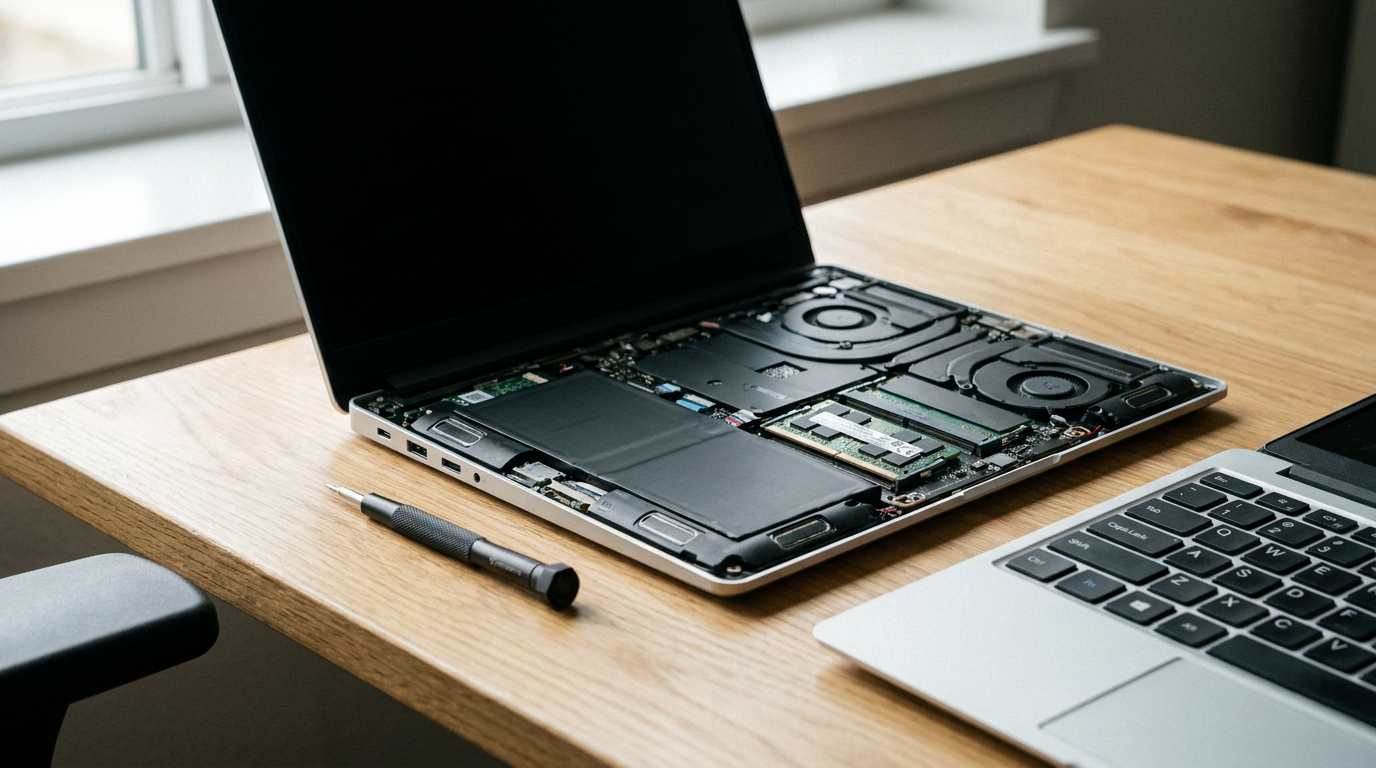
The newly released Framework Laptop 13 Pro features a rigid CNC-machined aluminum chassis, Intel Core Ultra Series 3 processors, and high-speed LPCAMM2 memory. Unlike traditional thin-and-light laptops that feature soldered RAM and heavily glued batteries, nearly every component inside the Framework machine can be swapped out by the user with a single captive screwdriver included in the box.[2][5]
For power users, the larger Framework Laptop 16 takes modularity a step further by offering an upgradeable discrete graphics module. This unique expansion bay allows gamers and creative professionals to replace just their GPU—such as slotting in a new NVIDIA RTX 5070—when it ages, rather than throwing away an entire $2,500 machine just to get better frame rates.[1][2]

For power users, the larger Framework Laptop 16 takes modularity a step further by offering an upgradeable discrete graphics module.
The corporate sector is also rethinking its hardware strategy in response to the e-waste crisis. Businesses replace massive fleets of laptops, phones, and servers annually, contributing heavily to the millions of tons of discarded electronics.[6]
To meet aggressive ESG (Environmental, Social, and Governance) goals and reduce capital expenditures, many enterprise IT departments are turning to certified remanufactured laptops. Unlike basic refurbished units, remanufactured devices are completely disassembled, rigorously tested, and rebuilt to perform exactly like new.[7]
This corporate shift toward the circular economy allows companies to save up to 40 percent on their hardware budgets while drastically cutting the water use and carbon emissions associated with buying brand-new fleets.[7]
Despite the clear environmental and philosophical wins, the modular computing movement still faces a significant hurdle for everyday consumers: the upfront cost.[1]

Laptop modularity currently comes at a premium. Because designing a durable chassis with swappable, standardized interfaces is inherently more complex than soldering components onto a single unified board, modular laptops are noticeably more expensive than comparable single-build models. A fully configured modular machine can easily cross the $2,000 threshold, placing it in the same pricing tier as a premium MacBook Pro.[1][2][8]
There are also lingering user-experience trade-offs. Reviewers note that while the 2026 modular designs are vastly improved over early iterations, they still occasionally struggle to match the flawless "fit and finish" of Apple's unibody laptops.[8]
Furthermore, managing a highly modular system can sometimes introduce software instability. Some users report ongoing driver issues, thermal management challenges, and louder fan noise compared to tightly integrated, fanless ARM-based laptops.[8]
For many buyers, the calculation ultimately comes down to upfront price versus long-term value. While a modular laptop costs more today, the ability to replace a degraded battery for $60 or upgrade a mainboard in three years can make it significantly cheaper over a decade. With 2026's legislative mandates forcing the door open, the era of the disposable computer may finally be drawing to a close.[1][3][5]
How we got here
2020
Framework is founded with the mission of creating fully modular, user-repairable laptops.
2022
Global e-waste generation hits a record 62 million metric tons, highlighting the environmental cost of disposable tech.
2025
States including Colorado, Washington, and Texas pass sweeping Right to Repair legislation.
2026
New Right to Repair laws take effect, banning parts pairing and forcing OEMs to provide repair documentation.
Viewpoints in depth
Right to Repair Advocates
Argue that true device ownership requires the ability to repair and upgrade hardware without manufacturer interference.
This camp, supported by organizations like Consumer Reports, views the 2026 legislative wave as a crucial victory against planned obsolescence. They argue that practices like "parts pairing"—where software locks reject third-party components—are monopolistic tactics designed to force consumers into buying new devices. For these advocates, modular laptops represent the ethical baseline for consumer electronics, prioritizing open standards and long-term sustainability over razor-thin chassis designs.
Value-Conscious Consumers
Emphasize that while modularity is a noble goal, the steep upfront costs and occasional bugs remain significant barriers.
Tech reviewers and budget-conscious buyers point out that modular laptops currently carry a "sustainability premium." Because engineering a chassis with swappable, standardized interfaces is inherently more expensive than soldering components to a single board, modular devices often cost hundreds of dollars more than comparable single-build laptops. Furthermore, some users report that modular systems can suffer from driver instability, thermal management issues, and a less refined "fit and finish" compared to tightly integrated machines like Apple's MacBooks.
Corporate IT & Sustainability
Focus on lifecycle management, compliance, and the financial benefits of remanufactured hardware fleets.
For enterprise buyers, the e-waste conversation is driven by ESG (Environmental, Social, and Governance) reporting and bottom-line efficiency. Rather than buying expensive modular laptops for every employee, many IT departments are turning to certified remanufactured electronics. By purchasing devices that have been completely disassembled, tested, and rebuilt, companies can reduce their hardware acquisition costs by up to 40 percent while meeting strict new environmental compliance standards and drastically reducing their corporate carbon footprints.
What we don't know
- It remains unclear if mainstream tech giants will adopt modular designs or simply do the bare minimum to comply with new repair laws.
- The long-term durability of modular expansion bays after multiple years of swapping components is still being tested by early adopters.
Key terms
- Parts pairing
- A software practice used by manufacturers to link specific hardware components to a device, preventing third-party or salvaged parts from functioning.
- LPCAMM2
- A new, compact memory standard introduced in 2026 that allows for high-speed, upgradeable RAM without taking up the space of traditional memory sticks.
- Remanufactured electronics
- Devices that are completely disassembled, tested, and rebuilt to factory standards, offering higher reliability than basic refurbished goods.
- Circular economy
- An economic model focused on minimizing waste by keeping materials, like laptop components, in use for as long as possible.
Frequently asked
Can I upgrade the graphics card in a modular laptop?
Yes, larger modular models feature an expansion bay that allows users to swap in new discrete graphics modules, such as the NVIDIA RTX 5070, without replacing the entire computer.
Are modular laptops cheaper than regular laptops?
Not upfront. Modular laptops typically carry a premium price tag due to their complex engineering, but they can save money over time by allowing you to replace individual parts instead of the whole machine.
What do the 2026 Right to Repair laws change?
Laws taking effect in states like Texas, Colorado, and Washington require manufacturers to provide consumers and independent shops with access to replacement parts, diagnostic tools, and repair manuals.
What is the difference between refurbished and remanufactured?
Refurbished devices are typically just cleaned and tested for basic functionality. Remanufactured devices are completely disassembled, rigorously tested, and rebuilt to perform and look like brand-new machines.
Sources
Source coverage
8 outlets
3 viewpoints surfaced








[1]BGRValue-Conscious Consumers
Modular Laptops Might Be The Future, But They Still Have One Big Problem
Read on BGR →[2]PCMagValue-Conscious Consumers
Framework Laptop 13 Pro Review 2026: A Premium Modular Machine
Read on PCMag →[3]Manufacturing DiveCorporate IT & Sustainability
Texas enacts right-to-repair law for consumer electronics
Read on Manufacturing Dive →[4]Consumer ReportsRight to Repair Advocates
Consumer Reports announced its support for the Fair Repair Act
Read on Consumer Reports →[5]TWiTRight to Repair Advocates
How Framework is Defining a New Ownership Model
Read on TWiT →[6]Ingram Micro LifecycleCorporate IT & Sustainability
Reducing Corporate E-Waste in 2026
Read on Ingram Micro Lifecycle →[7]Circular ComputingCorporate IT & Sustainability
Why We Need Sustainable Laptops Now
Read on Circular Computing →[8]Jeff GeerlingValue-Conscious Consumers
Framework 12 vs MacBook Neo
Read on Jeff Geerling →


Every angle. Every day.
Get shopping stories with full source coverage and perspective breakdowns delivered to your inbox.