
SpaceX, OpenAI, and Anthropic End Wall Street's Era of 'Stock Scarcity' With Trillion-Dollar IPO Wave
A historic wave of mega-cap initial public offerings is reshaping Wall Street, led by SpaceX's record-breaking $2.1 trillion debut. The sudden influx of public listings from AI giants OpenAI and Anthropic signals the end of 'stock scarcity' as companies seek massive capital to fund next-generation infrastructure.
By Factlen Editorial Team
- Retail Investors & Advocates
- Believes the IPO wave democratizes wealth creation by allowing the public to invest in frontier technology.
- Institutional Skeptics
- Warns that public markets are absorbing unprecedented risk by funding cash-burning companies at peak valuations.
- Frontier Tech Founders
- Argues that the sheer scale of capital required for next-generation infrastructure necessitates public market liquidity.
- Market Structural Analysts
- Focuses on the liquidity mechanics, questioning whether the broader stock market can absorb trillions in new equity without draining capital from other sectors.
What's not represented
- · Employees of legacy tech companies facing capital flight
- · Regulators concerned about index fund concentration
Why this matters
The public listings of SpaceX, OpenAI, and Anthropic are injecting trillions of dollars into the stock market, ending an era where the best tech returns were hoarded by private venture capitalists. Because these mega-companies will be fast-tracked into major index funds, your 401(k) and retirement savings will soon be directly tied to the success of artificial intelligence and commercial spaceflight.
Key points
- SpaceX executed the largest IPO in history on June 12, 2026, closing with a $2.1 trillion valuation and making Elon Musk the world's first trillionaire.
- OpenAI and Anthropic both confidentially filed for IPOs in early June, setting up a multi-trillion-dollar wave of public listings.
- The sudden rush to Wall Street is driven by the staggering capital requirements needed to build AI data centers and space infrastructure.
- The listings end an era of 'stock scarcity,' allowing retail investors and index funds to finally access the world's most valuable private tech companies.
- Skeptics warn that public markets are absorbing unprecedented risk, as these companies are entering at peak valuations while still burning billions of dollars annually.
For the past two decades, the United States stock market has been steadily shrinking. As private equity and venture capital funds grew exponentially, technology startups chose to stay private longer, hoarding their most explosive growth years for institutional backers. By the time household names like Uber or Airbnb finally debuted on Wall Street, their steepest valuation climbs were already behind them. Financial analysts dubbed this phenomenon "stock scarcity"—a dynamic where everyday retail investors were left fighting over a dwindling pool of public shares while the true engines of modern economic growth remained locked behind closed doors.[1]
That era of exclusivity abruptly ended this month. In the span of just two weeks, three of the most valuable and consequential private companies in history—SpaceX, OpenAI, and Anthropic—have either debuted on the public markets or formally filed the paperwork to do so. Together, they represent a multi-trillion-dollar injection of fresh equity into the public sphere, fundamentally reversing the long-term contraction of Wall Street and setting the stage for a dramatic realignment of global capital. Financial analysts note that this sudden influx of mega-cap listings is expanding the market at a scale not seen since the height of the dot-com boom.[1][3]
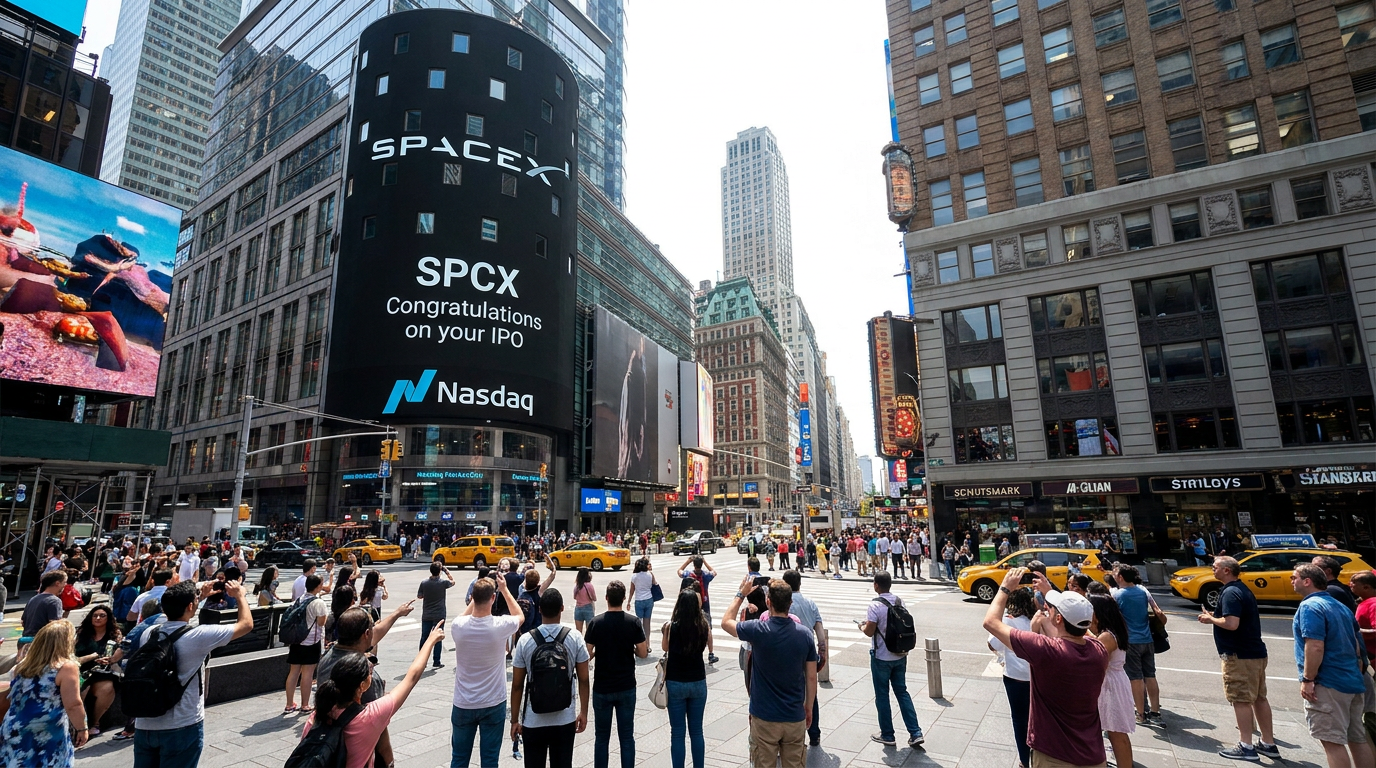
The dam officially broke on Friday, June 12, when SpaceX executed the largest initial public offering in the history of global finance. After nearly two and a half decades operating as a closely guarded private enterprise, Elon Musk’s rocket and satellite manufacturer opened its books to the world. The highly anticipated debut was treated as a cultural event on Wall Street, with company executives ringing the opening bell at the Nasdaq MarketSite in New York City while Elton John’s "Rocket Man" played across the trading floor.[2][4]
SpaceX’s public debut was as unconventional as it was massive. Breaking from the traditional IPO playbook of offering a price range and negotiating with institutional buyers, the company issued a take-it-or-leave-it share price of $135. The offering raised a staggering $75 billion in capital. By the time the closing bell rang on Friday afternoon, overwhelming investor demand had driven the stock price up nearly 20 percent to $160 per share, pushing SpaceX’s total market capitalization past the $2.1 trillion mark.[2][4]

The sheer scale of the SpaceX listing immediately reshaped the upper echelons of global wealth. As the company's majority shareholder, holding roughly 85 percent of its voting shares, Musk saw his personal fortune skyrocket alongside the stock price. When the markets closed on Friday, Forbes estimated his net worth at $1.1 trillion, officially making him the world’s first trillionaire. The milestone cemented the financial dominance of a single founder whose companies—including the $1.2 trillion electric vehicle maker Tesla—now anchor a massive portion of the American equities market.[2]
But SpaceX is only the vanguard of this historic market expansion. On June 8, OpenAI, the San Francisco-based artificial intelligence laboratory behind ChatGPT, announced that it had confidentially submitted a draft S-1 registration statement to the U.S. Securities and Exchange Commission. Acknowledging the intense public interest, the company published a brief statement noting that while it had not yet decided on an exact timeline for the listing, the filing provided the option to go public as soon as market conditions allowed.[3][5]
OpenAI’s transition to a publicly traded company marks the culmination of a meteoric rise. Founded in 2015 as a non-profit research lab dedicated to developing AI for the common good, the organization restructured into a capped-profit entity to attract investment. Following a massive $122 billion funding round in March 2026, OpenAI’s private valuation soared to approximately $852 billion. Now, the company is preparing to test whether public market investors will validate that near-trillion-dollar price tag.[3][5]
OpenAI’s transition to a publicly traded company marks the culmination of a meteoric rise.
The race to Wall Street is highly competitive. OpenAI’s filing came just a week after its chief rival, Anthropic, made an identical confidential submission to the SEC. Anthropic, the developer of the popular Claude chatbot, has experienced its own explosive growth, recently hitting a $965 billion valuation following a $65 billion funding round in May. By filing confidentially, both AI giants have initiated a quiet period where regulators will scrutinize their financial disclosures before their investor prospectuses are unsealed to the public.[3][6]

Why are these mega-unicorns suddenly rushing the public gates after years of fiercely guarding their independence? The answer lies in the staggering, almost incomprehensible capital requirements of the next technological frontier. Developing artificial general intelligence and establishing a permanent human presence on Mars are no longer software engineering projects; they have evolved into heavy-industry endeavors that require physical infrastructure on a planetary scale.[3][5]
The costs associated with this infrastructure are unprecedented. OpenAI and Anthropic are burning billions of dollars annually to secure specialized silicon chips, construct sprawling data centers, and secure the massive amounts of electricity required to train frontier AI models. Similarly, SpaceX requires immense, continuous capital to fund its Starship lunar lander development, deploy its Starlink satellite constellation, and pursue its ultimate goal of Martian colonization. The scale of these ambitions has simply outgrown the private markets.[2][3]
Venture capital firms, sovereign wealth funds, and private equity syndicates possess deep pockets, but they eventually hit structural concentration limits. No private syndicate can indefinitely sustain companies that require hundreds of billions of dollars in continuous capital expenditure. To fund the next decade of innovation, these founders have realized they have no choice but to tap the ultimate liquidity pool: the global public equities market, where trillions of dollars change hands daily.[1][3]
For everyday retail investors, this IPO wave represents a profound democratization of access. For years, retail advocates have complained that the general public was locked out of the most lucrative wealth-creation events of the modern era. By the time a retail investor could buy shares in a modern tech giant, the exponential growth phase had already been captured by early private backers. The public listings of SpaceX, OpenAI, and Anthropic finally allow ordinary portfolios to participate directly in the upside of the space and AI economies.[1][4]

Furthermore, the sheer size of these companies guarantees their rapid integration into the broader financial system. Because of their trillion-dollar valuations, companies like SpaceX will likely be fast-tracked into major index funds and mutual funds. This means that millions of Americans will soon hold these stocks automatically within their 401(k) retirement accounts and pension plans, inextricably linking the financial security of the middle class to the success of commercial spaceflight and artificial intelligence.[2][4]
However, this newfound access comes with unprecedented risk. Unlike the tech IPOs of the late 1990s or the software-as-a-service listings of the 2010s, these companies are entering the public sphere at peak valuations while still burning massive amounts of cash. Institutional skeptics warn that public market investors might be buying at the absolute top of the AI hype cycle, absorbing the financial risk just as the underlying technologies face mounting regulatory and physical constraints.[2][3]
The financial realities of the AI boom are stark. Despite generating billions in revenue from enterprise contracts and premium subscriptions, OpenAI is not projected to reach profitability until around 2030. Internal projections suggest the company could face net losses of $14 billion in 2026 alone as it races to build out its computing infrastructure. If public investors lose patience with these massive capital expenditures, the resulting selloff could be devastating for the broader market.[3][6]

The ultimate test over the coming months will be Wall Street’s absorption capacity. Financial analysts are closely watching to see if the broader stock market can digest trillions of dollars in new equity without triggering a liquidity drain elsewhere. If institutional capital rotates out of legacy technology stocks and traditional blue-chip companies to fund massive new positions in SpaceX, OpenAI, and Anthropic, it could spark a broader market realignment, punishing companies that fail to articulate a clear AI or space strategy.[1][3]
Regardless of the short-term volatility, the structural shift is permanent. The era of stock scarcity is officially over. The most consequential and ambitious companies of the 21st century are finally opening their books to the public, transforming Wall Street from a secondary market for mature businesses back into a primary engine for frontier innovation. For better or worse, the financial future of the public markets is now tied to the stars and the algorithms.[1]
How we got here
Late 2025
OpenAI CEO Sam Altman publicly floats the possibility of an IPO to fund the company's massive computing needs.
May 2026
Anthropic raises $65 billion in a private funding round, pushing its valuation to $965 billion.
June 1, 2026
Anthropic confidentially submits a draft S-1 registration statement to the SEC.
June 8, 2026
OpenAI announces it has confidentially filed for an IPO, setting up a race to the public markets.
June 12, 2026
SpaceX executes the largest IPO in history, closing its first day of trading with a $2.1 trillion valuation.
Viewpoints in depth
Retail Investors & Advocates
Believes the IPO wave democratizes wealth creation by allowing the public to invest in frontier technology.
For years, retail advocates have complained that the modern stock market is a secondary vehicle where everyday investors buy mature companies whose highest growth phases are already behind them. By going public, companies like SpaceX and OpenAI are finally allowing retirement accounts and retail portfolios to participate directly in the upside of the artificial intelligence and space economies. Advocates argue this reverses a decades-long trend of venture capitalists hoarding the most lucrative returns.
Institutional Skeptics
Warns that public markets are absorbing unprecedented risk by funding cash-burning companies at peak valuations.
Financial skeptics point to the staggering cash burn required to sustain these mega-unicorns. OpenAI is not projected to turn a profit until 2030, and SpaceX's capital expenditures for Mars colonization are virtually bottomless. By entering the public markets at valuations hovering around $1 trillion or more, these companies leave very little room for error. Skeptics argue that if the AI hype cycle cools or a major rocket program stalls, retail investors—who will automatically hold these stocks through index funds—could be left holding the bag.
Frontier Tech Founders
Argues that the sheer scale of capital required for next-generation infrastructure necessitates public market liquidity.
From the perspective of the companies themselves, going public is no longer an optional milestone—it is an existential necessity. Building artificial general intelligence and interplanetary transport requires hundreds of billions of dollars in specialized silicon, data centers, and physical manufacturing. Private equity and sovereign wealth funds, while massive, eventually hit concentration limits. Founders argue that only the global public equities market possesses the deep, liquid capital required to fund the next era of human technological advancement.
What we don't know
- Whether the broader stock market can absorb trillions of dollars in new equity without triggering a selloff in legacy technology stocks.
- How quickly the U.S. Securities and Exchange Commission will process the confidential S-1 filings for OpenAI and Anthropic.
- Whether retail investors buying into these companies at trillion-dollar valuations will see meaningful long-term returns, given the massive ongoing capital expenditures.
Key terms
- Stock Scarcity
- A market dynamic where the number of publicly traded companies shrinks as businesses stay private longer, limiting investment options for the general public.
- Initial Public Offering (IPO)
- The process by which a private company offers shares of its stock to the public for the first time.
- Confidential S-1 Filing
- A draft registration document submitted privately to the SEC, allowing a company to resolve regulatory questions before making its financial details public.
- Index Fund
- A mutual fund or ETF designed to follow certain preset rules so that the fund can track a specified basket of underlying investments, automatically buying shares of newly listed mega-cap companies.
- Capital Expenditure (CapEx)
- Funds used by a company to acquire, upgrade, and maintain physical assets such as property, data centers, or equipment.
Frequently asked
Why are these tech companies going public now?
Developing artificial general intelligence and space infrastructure requires hundreds of billions of dollars. These companies have outgrown private funding sources and need the deep liquidity of the public stock market to sustain their capital expenditures.
How much is SpaceX worth after its IPO?
SpaceX closed its first day of trading on June 12, 2026, with a valuation of approximately $2.1 trillion, making it one of the most valuable companies in the world.
Can I buy shares of OpenAI or Anthropic yet?
Not yet. Both companies have confidentially filed their paperwork with the SEC, meaning they are in the regulatory review process. They are expected to officially list their shares later in 2026.
How does this affect my retirement account?
Because of their massive valuations, companies like SpaceX will likely be fast-tracked into major index funds. This means everyday investors will automatically gain exposure to these stocks through their 401(k)s and pension plans.
Sources
Source coverage
6 outlets
4 viewpoints surfaced






[1]BloombergMarket Structural Analysts
SpaceX and OpenAI Are Ending Wall Street's Era of Stock Scarcity
Read on Bloomberg →[2]The GuardianInstitutional Skeptics
SpaceX makes biggest stock market debut in history, valuing company at $2tn
Read on The Guardian →[3]Financial TimesInstitutional Skeptics
OpenAI files for blockbuster IPO in race to list on Wall Street
Read on Financial Times →[4]Global NewsRetail Investors & Advocates
SpaceX officially launches as publicly traded company in largest Wall Street debut
Read on Global News →[5]Associated PressFrontier Tech Founders
ChatGPT maker OpenAI files preliminary paperwork for Wall Street debut
Read on Associated Press →[6]IGFrontier Tech Founders
Anthropic IPO: everything you need to know + how to buy shares
Read on IG →

Every angle. Every day.
Get business stories with full source coverage and perspective breakdowns delivered to your inbox.