
The Best E-Readers of 2026: Kindle, Kobo, and Boox Compared
As e-reader hardware reaches a plateau of excellence, choosing the right device in 2026 comes down to a trade-off between Amazon's seamless retail ecosystem, Kobo's library integration, and Boox's open Android flexibility.
By Factlen Editorial Team
- Amazon Ecosystem Loyalists
- Prioritize a frictionless retail experience, seamless audiobook integration, and massive store selection.
- Library & Open-Format Advocates
- Prioritize public library access, ownership of DRM-free files, and avoiding corporate lock-in.
- Power Users & Tinkerers
- Prioritize device flexibility and the ability to run any Android application on an e-ink screen.
What's not represented
- · Independent Bookstore Owners
- · Visually Impaired Readers
Why this matters
E-readers have evolved from simple digital screens into long-term investments in specific digital ecosystems. Choosing the wrong device can lock you out of free public library books or force you to repurchase your existing digital library.
Key points
- The 2024 Kindle Paperwhite remains the top choice for users heavily invested in Amazon's retail and Audible ecosystem.
- The Kobo Libra Colour is the preferred device for readers who rely on public library borrowing via OverDrive and Libby.
- Onyx Boox devices offer full Android flexibility, allowing users to install multiple reading apps on a single e-ink screen.
- Large-format devices like the Kindle Scribe and Kobo Elipsa 2E are transforming digital annotation for students and professionals.
- Color e-ink technology has gone mainstream, though it requires a slight trade-off in black-and-white text contrast.
- Hardware specifications have largely plateaued, making software ecosystem the most important purchasing factor.
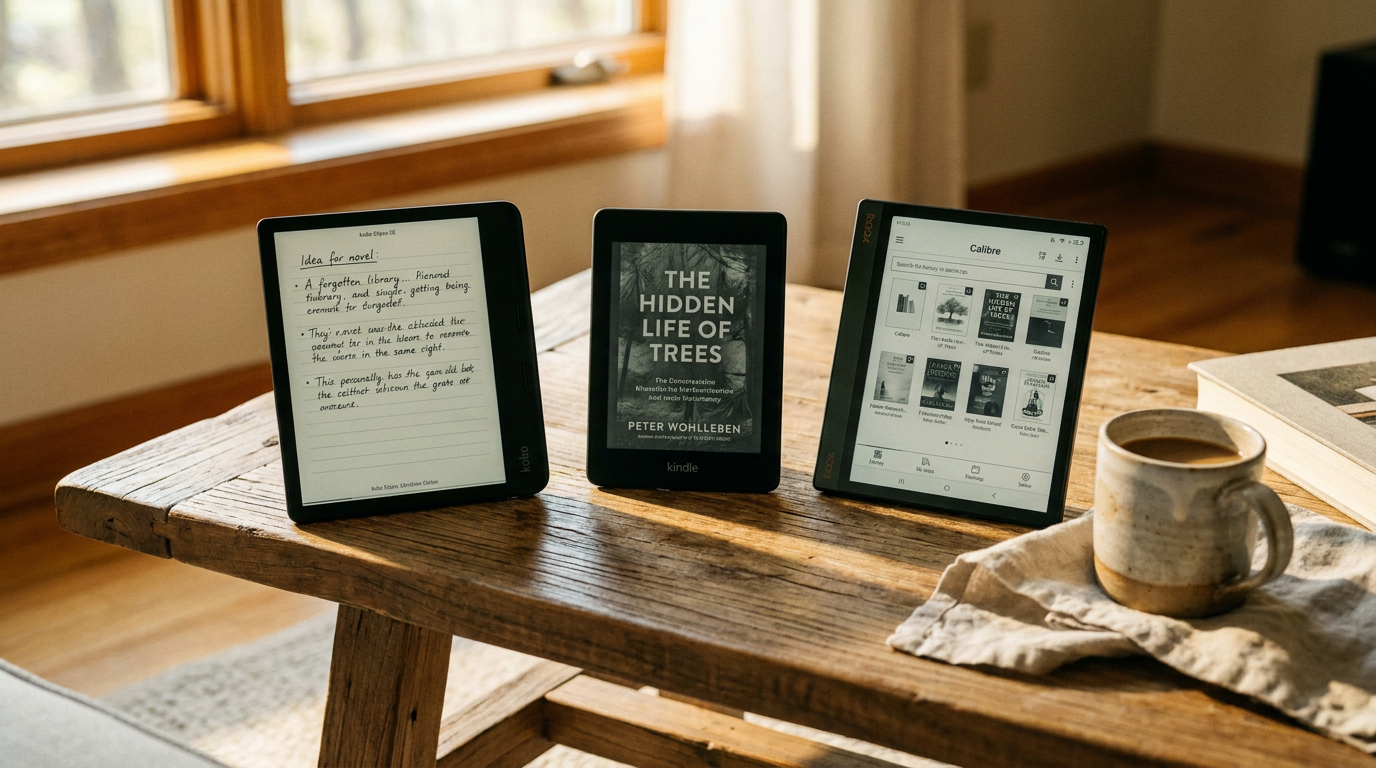
The e-reader market in 2026 has evolved far beyond the simple pursuit of the sharpest digital screen. Today, the devices are highly specialized portals into distinct digital ecosystems, each catering to a very specific type of reader. With base specifications largely plateauing—almost every premium device now boasts a 300 pixel-per-inch display, weeks of battery life, and waterproof casing—the decision matrix has fundamentally shifted. Consumers are no longer just buying a piece of hardware; they are committing to a long-term library management philosophy. Whether a reader prioritizes seamless retail purchases, public library borrowing, or open-source flexibility dictates the ideal device. This maturation means that there is no single objective winner in the e-reader space, but rather a perfect match for individual reading habits and format preferences.[3]
Industry analysts emphasize that the hardware differences between top-tier devices have become increasingly marginal. Reviewers at SolderMag point out that the true differentiator in 2026 is the software ecosystem, noting that buyers must choose between the deep retail integration of Amazon, the library-first approach of Kobo, or the unrestricted Android environment of Boox. This shift requires shoppers to evaluate their long-term reading habits before looking at spec sheets. A device with a beautiful screen becomes frustrating if it cannot easily load the user's preferred file types or connect to their local library branch. Consequently, the modern e-reader comparison is a trade-off analysis of digital walled gardens versus open platforms.[3][6]
The mechanics of borrowing digital books have become a central battleground for these devices. While Amazon allows library borrowing in the United States through a somewhat convoluted web-based process, Kobo has integrated the OverDrive and Libby networks directly into its operating system. This means Kobo users can browse their local library's catalog, place holds, and download books directly from the device itself without ever touching a smartphone or computer. Reviewers at ReaderTechHub emphasize that this frictionless borrowing experience is a massive financial advantage for avid readers, potentially saving hundreds of dollars annually. Understanding this structural difference is crucial, as the ease of accessing free content often outweighs minor differences in screen resolution or processor speed for budget-conscious consumers.[3][4]

When evaluating the Amazon Kindle Paperwhite (12th Gen), the arguments for the device center on its unmatched store selection, robust 12-week battery life, and a highly responsive 7-inch display. Against it, critics point to the strict ecosystem lock-in and the lack of native EPUB support without relying on Amazon's conversion tools. The evidence for its dominance is clear, with reviewers at PCMag noting that the 2024 edition offers the best blend of price and features for the average consumer, while Tom's Guide highlights its significantly faster page turns and flush-front design. Ultimately, this device fits well when a reader buys books directly from Amazon and listens to Audible, but it does not fit when someone relies heavily on local library borrowing through native apps.[1][2]
For readers who prioritize public library access, the Kobo Libra Colour presents a compelling alternative. The arguments for this device highlight its native OverDrive and Libby integration, out-of-the-box EPUB support, and the addition of physical page-turn buttons alongside a vibrant Kaleido 3 color screen. Against it, users note that the color filter layer slightly darkens the screen compared to pure black-and-white models, requiring higher backlight usage. Evidence from SolderMag and Good e-Reader praises the Libra Colour as the obvious choice for library power users, saving readers hundreds of dollars in book purchases annually. This e-reader fits well when you frequently borrow digital books from public libraries or read color graphics, but it does not fit when your existing library is entirely locked within the Amazon Kindle ecosystem.[3][5]
For readers who prioritize public library access, the Kobo Libra Colour presents a compelling alternative.
The Onyx Boox Go Color 7 (Gen II) caters to a completely different demographic by running a full Android 13 operating system. The arguments for the Boox device focus on its ultimate flexibility, allowing users to install the Kindle, Kobo, Libby, and Google Play Books apps simultaneously on a single e-ink screen. Against it, the device suffers from a steeper learning curve, a less polished out-of-the-box reading experience, and a higher price point compared to standard e-readers. Evidence from Good e-Reader highlights its powerful note-taking software and dedicated page-turning buttons, though reviewers caution that the software can feel fiddly. The Boox Go Color 7 fits well when a user demands total control over their file formats and reading apps, but it does not fit when someone wants a simple, distraction-free appliance.[3][5]

For students and professionals, the 2025 Kindle Scribe shifts the focus from pure reading to active annotation. The arguments for the Scribe emphasize its expansive 10.2-inch display, exceptional paper-like writing feel, and new AI-powered active canvas that automatically adjusts text around handwritten notes. Against it, the device is significantly heavier than standard e-readers, carries a premium price tag, and lacks the advanced third-party app integrations found on full tablets. Evidence from ReaderTechHub confirms that the Scribe balances its large screen with a 12-week battery life, making it a top performer for heavy annotators. This device fits well when you need to review PDFs, mark up documents, and read large-format textbooks, but it does not fit when portability and one-handed reading are your primary concerns.[2][4]
Another large-format contender is the Kobo Elipsa 2E, which directly challenges the Scribe in the academic and professional space. The arguments for the Elipsa 2E center on its superior file flexibility, allowing users to drop PDFs, EPUBs, and CBZ files directly into storage without conversion, alongside its robust native library integration. Against it, the device is slightly heavier at 383 grams and features a writing experience that some reviewers find less responsive than Amazon's premium stylus. Evidence from ReaderTechHub notes that the Elipsa's PDF annotation capabilities are highly capable, allowing users to export all margin notes and highlights as organized text files. This device fits well when a student or researcher relies on heavily annotated, non-Amazon PDFs, but it does not fit when a user demands the absolute lowest latency for digital handwriting.[4][5]
The broader trend defining 2026 is the mainstream arrival of color e-ink technology, which fundamentally alters the visual experience of digital reading. Devices utilizing the Kaleido 3 technology can now display book covers, graphic novels, and highlighted text in muted, pastel-like colors without sacrificing the eye-friendly nature of e-paper. However, this advancement requires a careful trade-off analysis. The addition of a color filter array inherently reduces the contrast of standard black text, making the background appear slightly grayer than the crisp white of traditional monochrome displays. For purists who exclusively read text-heavy novels, the classic black-and-white screens still offer superior clarity and battery efficiency. Color e-ink fits well when your reading diet includes comics, charts, or color-coded studying, but it does not fit when you demand the highest possible contrast for standard typography.[2][5]

For those unwilling to spend premium prices, the entry-level market remains highly competitive, led by the basic Amazon Kindle (11th Gen) and the Kobo Clara BW. The arguments for these budget models highlight their exceptional portability, weighing significantly less than their premium counterparts, and their highly accessible price points hovering around $100 to $130. Against them, buyers sacrifice luxury features like flush-front screens, wireless charging, and the larger displays that make reading more comfortable for aging eyes. Evidence from Tom's Guide points out that while the basic Kindle lacks waterproofing and warm lighting, it remains incredibly snappy and serves as a perfect entry point. These budget models fit well when you are new to e-readers or need a secondary, toss-in-a-bag device, but they do not fit when you frequently read near water or require expansive screen real estate.[2][3]
A fascinating sub-category that has gained immense traction in 2026 is the ultra-portable, smartphone-sized e-reader, exemplified by the Onyx Boox Palma 2. The arguments for the Palma 2 focus on its pocketable form factor, full Android capabilities, and ability to replace doomscrolling on a smartphone with distraction-free reading. Against it, the 6.1-inch screen requires more frequent page turns, and the device lacks the immersive feel of a standard 7-inch reader. Evidence from tech reviewers highlights that while it runs any app flawlessly, the small screen can cause eye strain during marathon reading sessions if held too closely. The Palma 2 fits well when you want to sneak in a few pages during a commute or while waiting in line, but it does not fit when you plan to read for hours in an armchair.[2][3]
Ultimately, the best e-reader of 2026 cannot be determined by a simple ranking of hardware specifications. The market has segmented into distinct philosophies, forcing consumers to align their purchase with their digital lifestyle. Amazon continues to offer the most frictionless retail experience, Kobo champions the public library system and open formats, and Boox provides a sandbox for power users willing to tinker. By explicitly weighing the trade-offs of ecosystem lock-in against hardware features, readers can select a device that seamlessly integrates into their daily routine. The true winner is the e-reader that disappears in your hands, leaving only the book behind.[1][3][6]
How we got here
2007
Amazon releases the first-generation Kindle, establishing the modern e-reader market.
2010
Kobo enters the market, focusing on open formats and international availability.
2021
The first mainstream color e-ink displays hit the market, though early versions suffer from low contrast.
2024
Amazon releases the 12th generation Kindle Paperwhite, standardizing 12-week battery life and faster page turns.
2025
The Kindle Scribe introduces AI-powered active canvas features for seamless document annotation.
Early 2026
Color e-readers like the Kobo Libra Colour and Boox Go Color 7 gain widespread adoption, utilizing Kaleido 3 technology.
Viewpoints in depth
Amazon Ecosystem Loyalists
Prioritize a frictionless retail experience and seamless audiobook integration.
This camp argues that hardware specs matter less than the sheer convenience of the Kindle store. They point to the massive library of Kindle Unlimited, seamless Whispersync between audiobooks and text, and the reliability of Amazon's cloud infrastructure. For these users, the inability to natively read EPUBs is a non-issue compared to the ease of one-click purchasing and unified library management.
Library & Open-Format Advocates
Prioritize public library access and ownership of DRM-free files.
This viewpoint strongly opposes digital walled gardens. Advocates argue that readers should not be locked into a single retailer and champion devices like Kobo that natively support OverDrive and EPUB formats. They cite the rising costs of digital books and emphasize that seamless, built-in library borrowing is the most critical financial and practical feature an e-reader can offer.
Power Users & Tinkerers
Prioritize device flexibility and the ability to run any Android application.
This camp views e-readers as specialized tablets rather than single-purpose appliances. They argue that users shouldn't have to choose between Kindle and Kobo; with an Android-based Boox device, they can run both apps simultaneously. While they acknowledge the software can be less polished, they value the freedom to install custom reading apps, RSS readers, and advanced note-taking tools without manufacturer restrictions.
What we don't know
- Whether Amazon will eventually adopt the open EPUB standard natively without requiring cloud conversion.
- How long the Kaleido 3 color e-ink technology will remain the standard before a higher-contrast generation arrives.
- If public libraries will continue to support seamless integration with third-party devices as digital licensing costs rise.
Key terms
- E-Ink (Electronic Ink)
- A display technology that mimics the appearance of ordinary ink on paper, reflecting light rather than emitting it, which significantly reduces eye strain.
- PPI (Pixels Per Inch)
- A measurement of screen resolution; 300 PPI is the current industry standard for crisp, print-like text on premium e-readers.
- EPUB
- A widely adopted, open standard file format for digital books, supported natively by most e-readers except standard Amazon Kindles.
- OverDrive / Libby
- A digital distribution service that allows users to borrow ebooks and audiobooks directly from their local public libraries.
- Kaleido 3
- The latest generation of color e-ink technology, capable of displaying muted colors while maintaining low power consumption and high refresh rates.
Frequently asked
Can I read library books on a Kindle?
Yes, but only in the US using the 'Send to Kindle' feature via a smartphone or computer. It is not built directly into the device interface like it is on Kobo e-readers.
Is a color e-reader better than black and white?
It depends on your reading habits. Color is excellent for comics and highlighting, but the color filter slightly reduces the contrast of standard black text, making the background appear slightly grayer.
Can I listen to audiobooks on these devices?
Yes, most modern e-readers support Bluetooth headphones. Kindles integrate seamlessly with Audible, while Android-based e-readers like Boox can download any audiobook app.
Do I need to buy a stylus separately?
It varies by model. The Kindle Scribe includes a pen in the box, whereas devices like the Kobo Libra Colour require purchasing the brand's proprietary stylus separately.
Sources
Source coverage
6 outlets
3 viewpoints surfaced






[1]PCMagAmazon Ecosystem Loyalists
The Best Ereaders for 2026
Read on PCMag →[2]Tom's GuideAmazon Ecosystem Loyalists
Best E-Readers 2026: Kindle, Kobo, Boox
Read on Tom's Guide →[3]SolderMagLibrary & Open-Format Advocates
Best E-Readers (2026): Kindle, Kobo, and Beyond
Read on SolderMag →[4]ReaderTechHubLibrary & Open-Format Advocates
Compare the best e-readers for students in 2026
Read on ReaderTechHub →[5]Good e-ReaderPower Users & Tinkerers
The Best E-Readers to Buy in Spring 2026
Read on Good e-Reader →[6]PickBestAmazon Ecosystem Loyalists
Best e-readers 2026
Read on PickBest →
More in shopping
See all 6 stories →Auto Tech
EV vs. PHEV in 2026: The Complete Cost, Range, and Lifestyle Comparison
0 sources
TV Tech
OLED vs. Mini-LED in 2026: The Definitive TV Technology Comparison
0 sources
Sustainable Tech
The End of Disposable Tech: How Modular Laptops and New Laws Are Changing Electronics
0 sources
Display Tech
OLED vs. Mini-LED in 2026: Choosing the Right TV for Your Space
0 sources
Every angle. Every day.
Get shopping stories with full source coverage and perspective breakdowns delivered to your inbox.