
OLED vs. Mini-LED in 2026: Choosing the Right TV for Your Space
As Tandem OLEDs and high-zone Mini-LEDs push display technology to new heights, the choice between perfect blacks and extreme brightness comes down to room lighting and screen size.
By Factlen Editorial Team
- Cinematic Purists
- Argues that perfect pixel-level black control and infinite contrast are the most important factors for picture quality.
- Bright-Room Maximizers
- Prioritizes sustained full-screen brightness, glare reduction, and massive screen sizes for daytime viewing.
- Hybrid Power Users
- Focuses on burn-in immunity, high refresh rates, and versatility for mixed PC, gaming, and media use.
What's not represented
- · Budget consumers seeking sub-$500 entry-level displays
- · Projector enthusiasts who prioritize wall-sized images over panel brightness
Why this matters
A premium TV is a multi-year investment that anchors your home entertainment. Understanding how these two dominant technologies interact with your specific room lighting and viewing habits prevents costly buyer's remorse.
Key points
- OLED TVs offer perfect black levels and infinite contrast by turning off individual pixels, making them ideal for dark rooms.
- Mini-LED TVs utilize thousands of dimming zones to achieve massive peak brightness, excelling in sunlit living spaces.
- Tandem OLED and QD-OLED technologies have significantly improved OLED brightness and color volume in 2026.
- Mini-LED dominates the large-format market, offering 85-inch to 115-inch screens at far more accessible prices than OLED.
- While OLED burn-in risk is vastly reduced, Mini-LED remains the only choice with zero risk for static content.
Never before have consumers had access to such extraordinary picture quality in the home. The 2026 television market has firmly consolidated around two premium display technologies: OLED and Mini-LED. While both deliver breathtaking 4K resolution and vibrant High Dynamic Range (HDR) performance, they achieve these results through fundamentally different engineering approaches, making each uniquely suited to different environments.[3][6]
The core architectural difference lies in how the screens generate light. OLED (Organic Light-Emitting Diode) features self-lit pixels, meaning each of the 8.3 million pixels in a 4K display generates its own light and color. Crucially, each pixel can turn off completely. Mini-LED, on the other hand, relies on a traditional LCD panel illuminated from behind by thousands of microscopic LEDs grouped into specific dimming zones.[1]
This year, the performance gap between the two has narrowed significantly. OLED manufacturers have introduced "Tandem OLED" architectures—stacking multiple light-emitting layers—and refined QD-OLEDs to boost peak brightness. Simultaneously, Mini-LED makers are deploying advanced panels with over 2,000 independent dimming zones, utilizing sophisticated algorithms to control light bleed and mimic OLED's precision.[3][5]
When it comes to sheer luminance and HDR impact, Mini-LED is the undisputed champion. Top 2026 models can push peak highlights to an eye-searing 2,500 nits. More importantly, they can sustain massive full-screen brightness without breaking a sweat, making explosions, sunlit landscapes, and bright sports broadcasts pop with incredible intensity.[4]

While new Tandem OLEDs can hit 1,500 to 2,000 nits in tiny, fleeting highlights, they face a structural limitation. To protect the organic materials from overheating, OLEDs employ an Automatic Brightness Limiter (ABL). This system aggressively dims the screen when a bright image—like a hockey rink or a snow-covered documentary scene—fills a large portion of the display.[5]
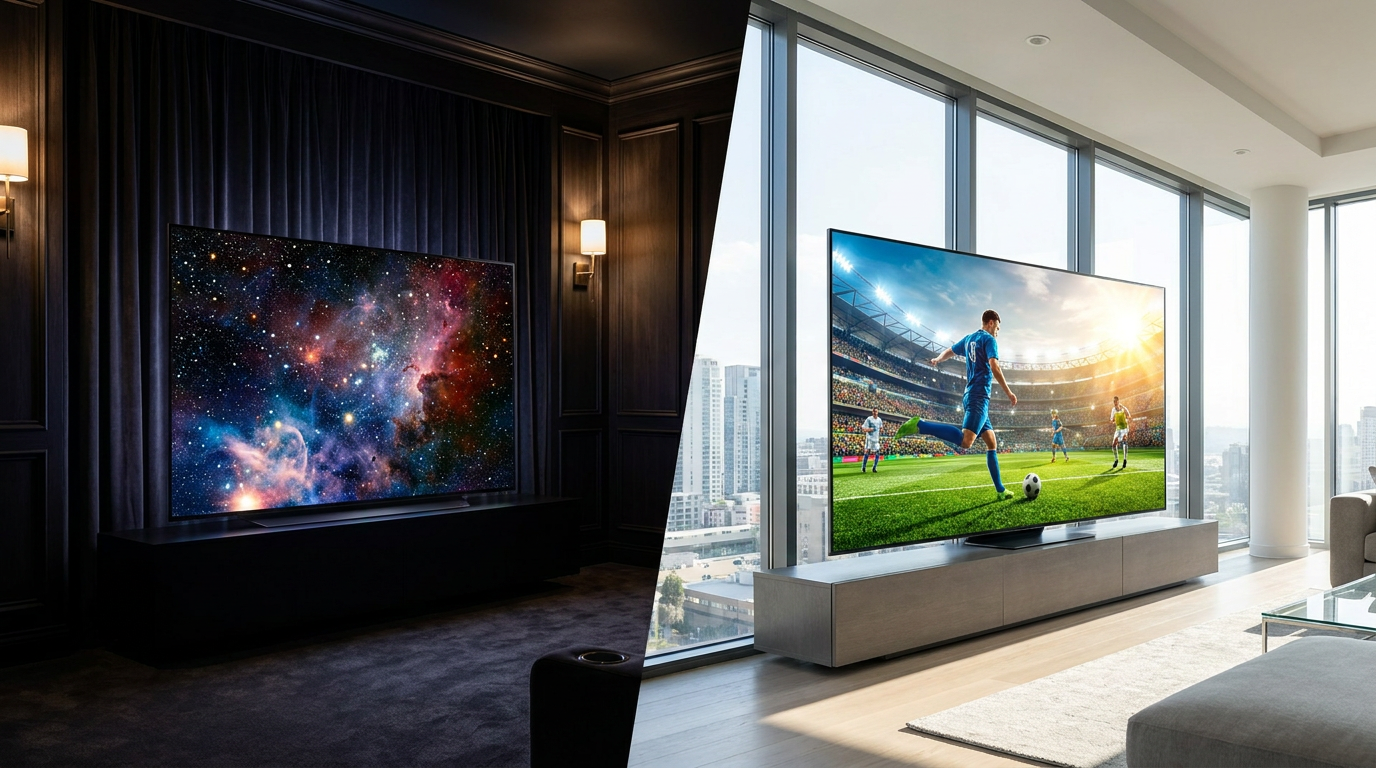
However, in the realm of contrast and black levels, OLED remains the gold standard. Because individual pixels turn off entirely, OLED achieves infinite contrast. A starfield in a sci-fi movie looks perfectly crisp, with brilliant white stars set against pitch-black space, creating a three-dimensional sense of depth that backlit TVs struggle to replicate.[1][4]
Despite having thousands of dimming zones, a Mini-LED TV cannot control light at the individual pixel level. This leads to a phenomenon known as "blooming" or haloing—a faint glow around bright objects on dark backgrounds. While 2026 algorithms have drastically reduced this effect, it is still noticeable when viewing white subtitles on a black letterbox bar in a dark room.[1][4]

Color volume and viewing angles offer another point of divergence. QD-OLEDs offer spectacular color saturation, maintaining vibrant reds and greens even at high brightness levels. OLEDs also boast near-perfect viewing angles, meaning the picture looks identical whether you are sitting dead center or off to the side in a wide seating arrangement.[3]
Color volume and viewing angles offer another point of divergence.
Conversely, many high-end Mini-LED TVs use VA (Vertical Alignment) LCD panels. While VA panels provide excellent native contrast for an LCD, their colors and black levels degrade when viewed from an angle. If you have a wide, U-shaped sectional couch, the people sitting on the far ends will see a slightly washed-out image compared to the person in the middle.[1][4]
For gamers, both technologies are spectacular companions for modern consoles and PCs. Flagship models from both camps offer 144Hz native refresh rates, Variable Refresh Rate (VRR) support, and Auto Low Latency Mode (ALLM), ensuring smooth, tear-free gameplay.[2][4]
Yet, OLED holds a slight edge for competitive gamers due to its near-instantaneous pixel response time—often measuring around 0.1 milliseconds. This eliminates motion blur behind fast-moving objects. Mini-LEDs are incredibly fast, but their VA panels can still exhibit minor smearing or ghosting in dark, fast-paced scenes.[1][4]
The size and value equation is where Mini-LED radically changes the math. In 2026, consumers can purchase an excellent 85-inch or even 98-inch Mini-LED TV for roughly the same price as a premium 65-inch OLED, democratizing massive, wall-filling home theater experiences.[2]

OLED faces a steep size ceiling. Manufacturing massive, defect-free sheets of organic material remains prohibitively expensive. While 77-inch OLED models have become more accessible, stepping up to 83-inch or 97-inch sizes incurs an exponential price premium, making Mini-LED the only practical choice for ultra-large formats on a normal budget.[1][2]
The elephant in the room for OLED has always been burn-in—where static images leave a permanent ghost on the screen. Thanks to pixel-shifting, advanced panel cooling, and better software management, burn-in is much rarer in 2026. However, the risk is not zero. Mini-LEDs are entirely immune to burn-in, offering total peace of mind for users who leave news channels or PC interfaces on all day.[1][2]
When evaluating OLED technology, the 'for' argument centers on absolute precision: perfect blacks, infinite contrast, and flawless viewing angles that preserve the image from any seat in the room. The 'against' argument focuses on lower sustained full-screen brightness and the steep premium cost for larger sizes. The evidence for this dynamic is clear in dark-room testing, where OLED's pixel-level control creates an unmatched sense of depth, but struggles to punch through heavy daytime glare.[1][6]
For Mini-LED, the 'for' column is dominated by explosive brightness, total immunity to burn-in, and the availability of massive screen sizes at accessible prices. The 'against' column highlights blooming around bright objects and narrower viewing angles inherent to VA panels. The evidence is visible in brightly lit living rooms, where Mini-LED easily overpowers daytime ambient light that would force an OLED's Automatic Brightness Limiter to aggressively dim the screen.[1][6]

Ultimately, OLED fits well when you have a dedicated home theater or a room where you can easily control the lighting. It is the definitive choice for cinematic purists, nighttime movie watchers, and gamers who prioritize motion clarity and perfect shadow detail. It does not fit well when the television is placed opposite a massive, uncovered window that floods the screen with afternoon sunlight.[3][6]
Conversely, Mini-LED fits well when your TV lives in a sun-drenched family room or an open-concept living space. It is the superior choice for daytime sports viewing, households that leave the news running all day, and anyone looking to maximize their screen size on a reasonable budget. It does not fit well when your primary goal is watching moody, dark cinema in a pitch-black room, where its minor blooming imperfections become visible.[2][6]
How we got here
2013
First commercial OLED TVs launch, establishing a new benchmark for perfect black levels.
2019
Mini-LED technology enters the consumer market, shrinking backlights to increase dimming zones.
2022
QD-OLED panels debut, combining quantum dots with OLED for unprecedented color volume.
2026
Tandem OLEDs and 2,000+ zone Mini-LEDs narrow the performance gap, offering extreme brightness and contrast.
Viewpoints in depth
Cinematic Purists' view
Deep dive into why infinite contrast matters more than peak nits in a dark room.
For home theater enthusiasts, the absence of light is just as important as the presence of it. Cinematic purists argue that OLED's ability to turn off individual pixels creates a level of micro-contrast that no backlit TV can match. In a pitch-black room, the blooming inherent to Mini-LEDs—even those with thousands of zones—breaks the immersion of dark, moody films. To this camp, the absolute precision of OLED is worth the trade-off of lower peak brightness.
Bright-Room Maximizers' view
Deep dive into how ambient light destroys perceived contrast, making sheer brightness the ultimate trump card.
This perspective points out that most people do not watch TV in pitch-black, light-controlled caves. In a typical living room with windows, ambient light washes out perfect blacks anyway. Therefore, the ability to push 2,500 nits of brightness to cut through daytime glare is far more valuable than infinite contrast. Furthermore, this camp champions Mini-LED for making massive 85-inch and 98-inch screens affordable, arguing that sheer size provides more cinematic impact than pixel-perfect black levels.
Hybrid Power Users' view
Deep dive into the anxiety of burn-in for PC users and gamers who leave static HUDs on screen for hours.
For users who connect their TVs to PCs or play the same video game for hundreds of hours, the persistent—albeit reduced—risk of OLED burn-in remains a dealbreaker. This camp values the peace of mind that comes with Mini-LED's immunity to permanent image retention. They prioritize high refresh rates, sustained brightness for productivity workflows, and the versatility to leave the display on all day without babysitting the panel.
What we don't know
- Whether manufacturing breakthroughs will eventually bring 97-inch OLED panels down to mainstream consumer prices.
- How quickly Micro-LED—a technology that combines the best of both—will become affordable enough to replace them.
Key terms
- OLED
- Organic Light-Emitting Diode, a display technology where each individual pixel generates its own light and can turn off completely.
- Mini-LED
- An LCD display that uses thousands of microscopic LEDs grouped into zones to backlight the screen, allowing for high brightness and localized dimming.
- Blooming
- A visual artifact where light bleeds from a bright object into surrounding dark areas, often seen as a halo effect on LED TVs.
- Local Dimming Zones
- Specific areas of a TV's backlight that can be dimmed or brightened independently to improve contrast.
- Nits
- A unit of measurement for luminance, used to describe how bright a television screen can get.
- Automatic Brightness Limiter (ABL)
- A safety feature in OLED TVs that automatically dims the screen when a bright image fills a large portion of the display to prevent overheating.
Frequently asked
Does OLED still suffer from burn-in in 2026?
Burn-in is much rarer today thanks to pixel-shifting, advanced cooling, and better panel management. However, the risk is not zero if you leave static elements on screen for thousands of hours.
Can a Mini-LED TV look as black as an OLED?
While 2026 Mini-LEDs with thousands of dimming zones produce incredibly deep blacks, they cannot achieve the perfect, pixel-level black of an OLED, resulting in minor haloing around bright objects.
Which is better for a bright room with windows?
Mini-LED is the superior choice for bright rooms. It can sustain much higher full-screen brightness to overpower daytime glare without dimming the image.
Why are large OLED TVs so much more expensive?
Manufacturing massive, defect-free sheets of organic light-emitting material is incredibly difficult and costly, causing prices to spike exponentially for sizes above 77 inches.
Sources
Source coverage
6 outlets
3 viewpoints surfaced






[1]RTINGSCinematic Purists
OLED vs Mini LED: Which Display Technology Is Better?
Read on RTINGS →[2]What Hi-Fi?Cinematic Purists
Best Mini LED TVs 2026: top models tested by our experts
Read on What Hi-Fi? →[3]Data Wire SolutionsBright-Room Maximizers
Best TVs for 2026: 10 OLED and Mini-LED Picks by Room, Brightness, and Install Reality
Read on Data Wire Solutions →[4]EcoPicksGoBright-Room Maximizers
LG G5 OLED vs LG QNED9M Mini LED Comparison (2026 Buyer's Guide)
Read on EcoPicksGo →[5]KTC PlayHybrid Power Users
Tandem OLED vs. Mini-LED: Choosing the Best HDR Panel in 2026
Read on KTC Play →[6]Factlen Editorial TeamHybrid Power Users
Synthesis by Factlen editorial team
Read on Factlen Editorial Team →
Every angle. Every day.
Get shopping stories with full source coverage and perspective breakdowns delivered to your inbox.