
The 'Library of Things' Movement is Changing How Neighborhoods Consume
Communities worldwide are saving money and reducing waste by borrowing tools, appliances, and gear instead of buying them.
By Factlen Editorial Team
- Community Organizers
- Focus on social cohesion, equitable access, and neighborhood resilience.
- Environmental Advocates
- Focus on the circular economy, reducing consumption, and lowering carbon emissions.
- Public Institutions
- Focus on expanding library services, managing budgets, and providing civic value.
- Everyday Consumers
- Focus on saving money, saving space, and practicality.
What's not represented
- · Hardware and retail store owners who may lose sales due to community borrowing.
- · Manufacturers of consumer goods facing potential shifts in demand.
Why this matters
The Library of Things movement offers a practical solution to the rising cost of living and the environmental toll of overconsumption. By shifting from individual ownership to community access, neighborhoods are saving thousands of dollars, reducing household clutter, and building local resilience.
Key points
- The Library of Things (LoT) movement allows communities to borrow rarely used items like tools, camping gear, and appliances.
- Over 2,000 formal LoTs now operate globally, saving members significant money on infrequent purchases.
- Sharing physical goods drastically reduces the carbon footprint associated with manufacturing and shipping new products.
- Traditional public libraries are increasingly adopting the model, lending out tech devices, park passes, and recreational equipment.
The average power drill is used for just 13 minutes over its entire lifespan. Yet, millions of households purchase their own, storing them in garages and closets where they gather dust for years. This paradox of modern consumption—buying expensive, resource-intensive items for single-use or rare occasions—has quietly birthed one of the most practical community movements of the decade. It is called the "Library of Things" (LoT), and it is fundamentally rethinking how neighborhoods access the tools of daily life.[7]
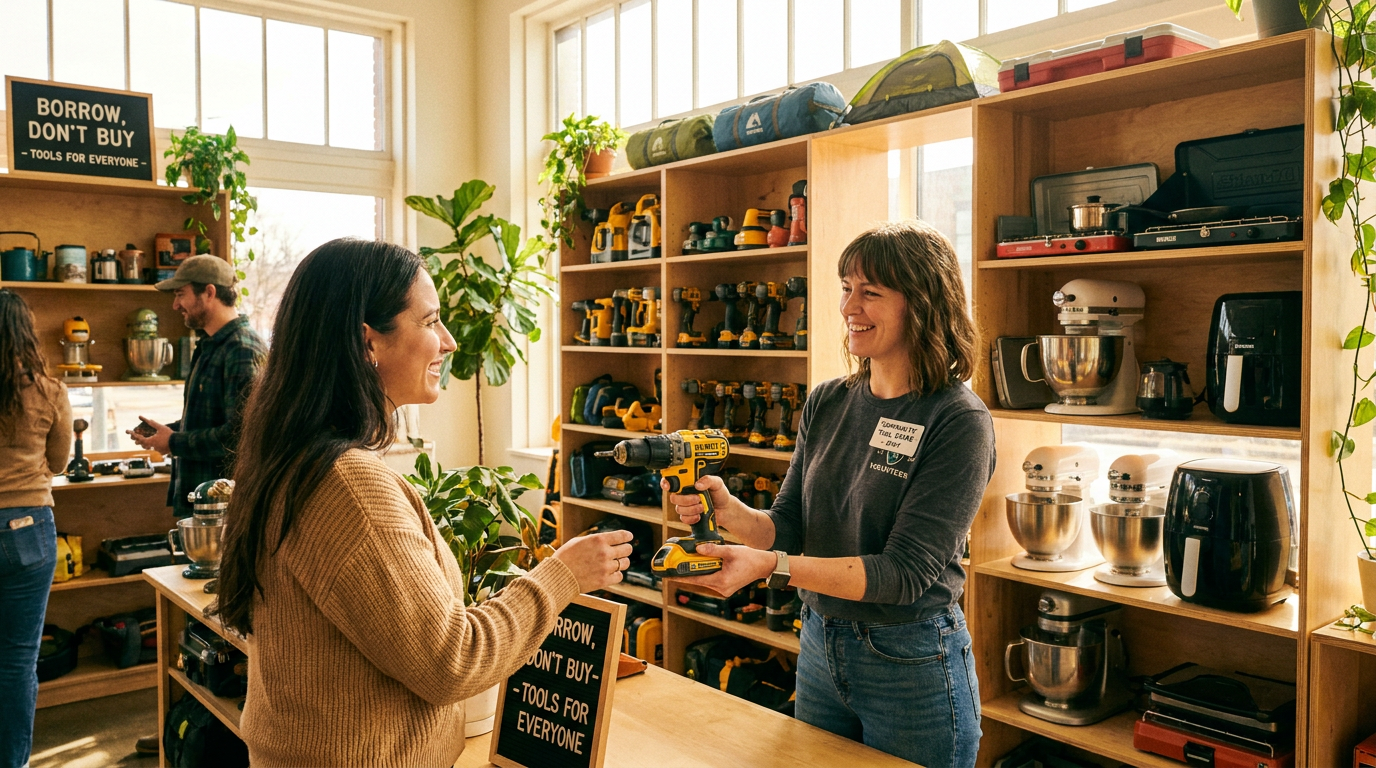
A Library of Things operates on the exact same premise as a traditional public library, but instead of checking out a hardcover novel, patrons borrow a pressure washer, a sewing machine, a camping tent, or a disco ball. The movement has grown from a handful of isolated neighborhood experiments into a robust global network. Today, there are roughly 2,000 formal LoTs operating worldwide, alongside countless informal community sharing hubs.[1][7]
The inventory of a mature Library of Things reads like a catalog of occasional necessities. Beyond the standard array of power drills and ladders, collections frequently feature specialized culinary equipment like dehydrators and stand mixers, recreational gear such as paddleboards and camping tents, and high-end electronics including projectors and thermal cameras. Some libraries even curate "experience kits," bundling a projector, a screen, and a popcorn maker for a neighborhood movie night, or offering a complete set of tools for a weekend gardening project.[1][6]
The mechanism behind these libraries is straightforward but highly organized. Most operate on an annual membership model—often tiered or sliding-scale based on income—which grants users access to an online inventory. Members reserve items digitally, pick them up during operating hours, use them for a set period, and return them. This logistical leap was made possible by specialized inventory software, such as the widely used myTurn platform, which allows small community groups to track assets, manage liability waivers, and automate return reminders just like a commercial rental company.[2][7]

The financial impact on everyday consumers is immediate and measurable. By shifting from isolated ownership to shared infrastructure, communities save staggering amounts of money. In 2025, a single pilot project run by the Charlton Kings Parish Council in the United Kingdom reported that its 482 borrowed items saved local residents £53,490 compared to the cost of buying those items new. For the cost of a single tool at a hardware store, a member gains year-round access to thousands of dollars worth of equipment.[3]
Beyond mere convenience, this model serves as a powerful tool for economic equity. Low-income households often face financial fragility when forced to make large, infrequent purchases—such as a carpet cleaner to secure a rental deposit return, or specialized tools for a home repair. Libraries of Things eliminate the need to take on high-interest debt for these necessities, effectively closing a hidden wealth gap in neighborhood infrastructure.[1][7]
Beyond mere convenience, this model serves as a powerful tool for economic equity.
The environmental argument for collaborative consumption is equally compelling. Consumer product manufacturing is one of the largest drivers of global greenhouse gas emissions, requiring vast resource extraction, energy-intensive production, and global shipping. According to research cited by the United Nations Resource Panel, reusing and sharing products rather than purchasing them new can reduce greenhouse gas emissions associated with those items by up to 99 percent.[2]
Local libraries are increasingly quantifying this climate impact to prove their value to municipal funders. The Charlton Kings project calculated that its 2025 circulation avoided 16.74 tonnes of carbon dioxide equivalent. Similarly, the Edinburgh Tool Library integrated carbon-tracking data directly into its management system, allowing members to see the exact emissions they saved by borrowing a jigsaw or a hedge trimmer instead of ordering a new one online.[3][5]

But the most unexpected benefit of the movement has been its impact on social cohesion. Founders of these spaces consistently report that while people come for the cheap tools, they stay for the community. Libraries of Things naturally evolve into neighborhood hubs where older, experienced residents teach younger generations how to use a power saw or repair a bicycle. This intergenerational knowledge transfer builds a type of community resilience that is difficult to manufacture through top-down city planning.[6]
Despite the overwhelming positives, running a Library of Things is not without operational friction. The most persistent challenge is maintenance. Tools break, blades dull, and electronics malfunction. Successful libraries must recruit dedicated volunteer "fixers" or budget for professional repairs to keep their inventory safe and functional. Furthermore, managing donations requires strict curation; many early libraries found themselves overwhelmed with well-meaning but useless donations, famously accumulating too many broken lawnmowers and outdated cables.[6][8]
Space is another premium. While a starter library can operate out of a shipping container or a church basement, scaling up requires accessible, climate-controlled real estate. To solve this, the movement is increasingly merging with established civic infrastructure. Traditional public libraries are rapidly expanding their own "Library of Things" collections, realizing that their mandate to provide free access to information naturally extends to providing free access to technology and tools.[1][8]

The 2025 annual report from the Guelph Public Library in Ontario perfectly illustrates this institutional shift. Alongside traditional book circulation, the library reported massive demand for its non-traditional items, with mobile Wi-Fi hotspots, Ontario Parks passes, binoculars, and disc golf sets topping the most-borrowed lists. By leveraging their existing cataloging systems and central locations, public libraries are mainstreaming the borrowing culture for millions of residents who might never seek out a standalone tool library.[4]
The future of the movement points toward even deeper integration into daily life. Urban developers are beginning to design "sharing spaces" directly into new apartment complexes, offering residents a built-in Library of Things as a premium amenity that offsets the shrinking square footage of modern units. Similarly, forward-thinking corporations are launching internal lending libraries as employee perks, reducing waste while encouraging staff to take up new hobbies.[2]
Ultimately, the Library of Things is more than just a clever life hack; it is a quiet rebellion against the assumption that every household must be a fully equipped, self-contained island. By pooling resources, neighborhoods are proving that access is far more valuable than ownership. In an era defined by economic pressure and climate anxiety, the simple act of borrowing a drill from a neighbor has become a profound statement of community resilience.[7][8]

How we got here
1943
What is widely considered the first tool library opens at the Grosse Pointe Public Library in Michigan.
2013
Software platforms like myTurn launch, providing the digital infrastructure needed to easily track and manage non-traditional library inventories.
2014
The term 'Library of Things' gains grassroots popularity in the UK and North America, sparking a wave of independent community lending centers.
2024
The Shareable network reports that roughly 2,000 formal Libraries of Things are operating globally.
2025
Major public library systems report record-breaking circulation numbers for non-traditional items like Wi-Fi hotspots and recreational gear.
Viewpoints in depth
Community Organizers
Focus on social cohesion and equitable access.
Organizers view the Library of Things primarily as a tool for social equity and neighborhood resilience. By removing the financial barrier to accessing equipment, these advocates argue that communities can close the wealth gap and empower low-income households to maintain their homes and pursue hobbies without taking on debt. Furthermore, they emphasize the 'bump factor'—the unplanned social interactions that occur when neighbors meet at the borrowing desk, which fosters trust, facilitates skill-sharing, and combats urban isolation.
Environmental Advocates
Focus on the circular economy and reducing consumption.
For sustainability experts, the movement is a critical lever for establishing a circular economy. They argue that the current model of hyper-individualized consumption is ecologically disastrous, driven by the over-manufacturing of rarely used goods. By maximizing the utilization rate of a single item—turning one drill into a resource for fifty families—they believe society can drastically reduce resource extraction, manufacturing emissions, and landfill waste, making collaborative consumption a highly effective climate intervention.
Public Institutions
Focus on expanding library services and providing civic value.
Traditional librarians and municipal leaders view the integration of physical objects as the natural evolution of their civic mandate. While books remain foundational, these institutions argue that their core mission is providing free access to information and resources. By lending out Wi-Fi hotspots, park passes, and tools, they are adapting to modern community needs, proving their continued relevance, and justifying municipal funding in an increasingly digital age.
What we don't know
- How standalone community libraries will secure long-term, sustainable funding as grant money fluctuates.
- Whether the model can successfully scale in highly rural areas where population density makes physical pickup locations less practical.
Key terms
- Library of Things (LoT)
- A collection of physical objects—ranging from tools to electronics—that are loaned out to community members, operating similarly to a traditional book library.
- Circular Economy
- An economic system aimed at eliminating waste and the continual use of resources by sharing, leasing, reusing, repairing, and recycling existing materials.
- Collaborative Consumption
- A model of economic exchange where individuals share access to products or services, rather than owning them individually.
- Carbon Dioxide Equivalent (CO2e)
- A standard unit for measuring carbon footprints, used by tool libraries to calculate the emissions saved when a community shares an item instead of buying new ones.
Frequently asked
What exactly is a Library of Things?
It is a community lending center where people can borrow rarely used physical items—like power tools, camping gear, and kitchen appliances—instead of buying them.
How much does it cost to join?
Many operate through traditional public libraries for free. Independent community libraries usually charge a small annual membership fee, often on a sliding scale based on income.
What happens if I break an item?
Most libraries expect normal wear and tear and have volunteers who repair items. Borrowers are typically only asked to replace an item if it was lost or destroyed through gross negligence.
How do these libraries get their inventory?
Inventories are usually built through community donations of gently used items, supplemented by grants or membership fees to purchase high-demand or specialized equipment.
Sources
Source coverage
8 outlets
4 viewpoints surfaced








[1]ShareableCommunity Organizers
Library of Things Toolkit (2.0)
Read on Shareable →[2]myTurnCommunity Organizers
Library of Things, Product Subscription & Asset Tracking
Read on myTurn →[3]Charlton Kings Parish CouncilPublic Institutions
Library of Things Impact Report 2025
Read on Charlton Kings Parish Council →[4]Guelph Public LibraryPublic Institutions
Digital circulation, technology use, and programs see growth in 2025 Guelph Public Library Annual Report
Read on Guelph Public Library →[5]Creative InformaticsEnvironmental Advocates
Edinburgh Tool Library Case Study
Read on Creative Informatics →[6]The GuardianEveryday Consumers
The library of things: could borrowing everything from drills to disco balls cut waste and save money?
Read on The Guardian →[7]Factlen Editorial Team
Synthesis by Factlen editorial team
Read on Factlen Editorial Team →[8]Lund University PublicationsEnvironmental Advocates
Libraries of Things: Exploring business model configurations and dominant archetypes
Read on Lund University Publications →
Every angle. Every day.
Get community stories with full source coverage and perspective breakdowns delivered to your inbox.