
How High-Tech Rotor Sails Are Bringing Wind Power Back to Global Shipping
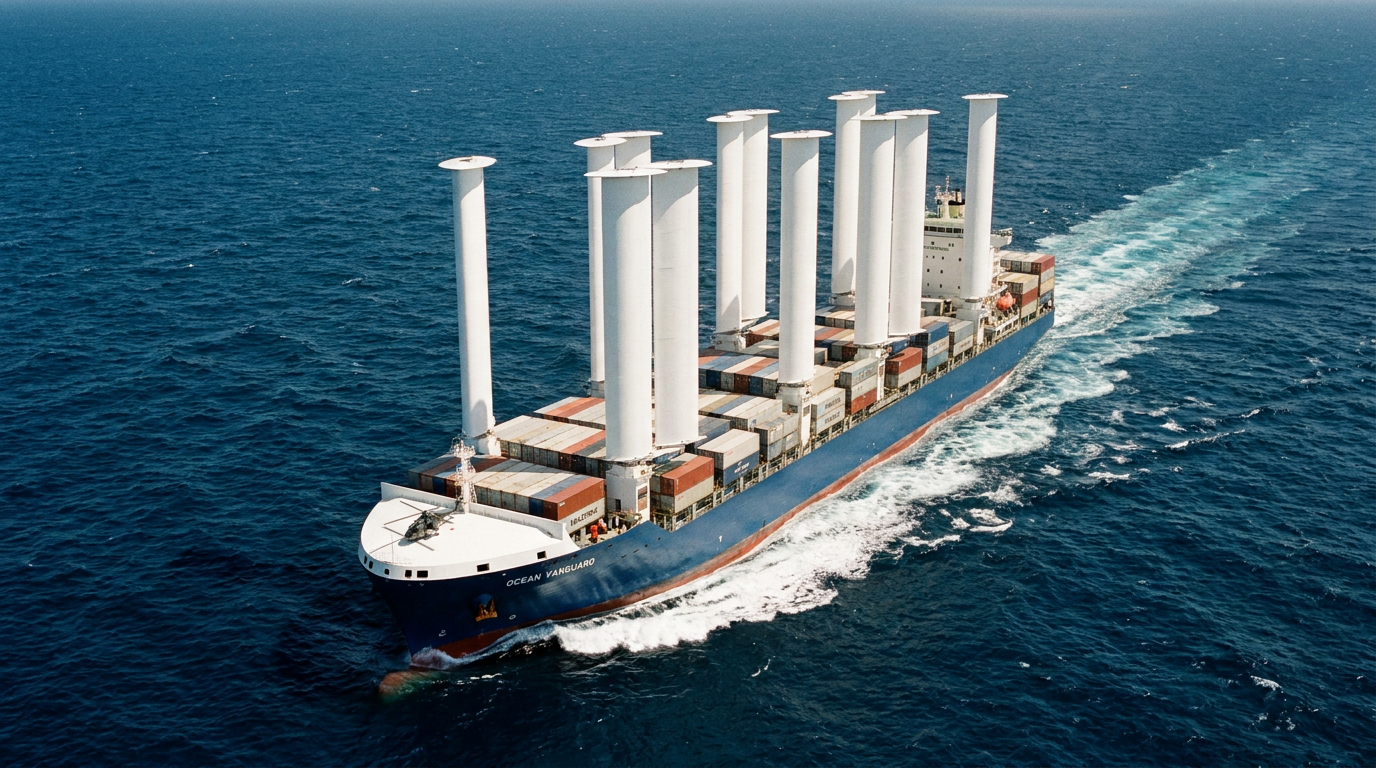
Faced with strict new emissions targets, the maritime industry is retrofitting cargo ships with towering, spinning cylinders and rigid wings to harness the wind. These modern wind-assisted propulsion systems are cutting fuel consumption by up to 30%.
By Factlen Editorial Team
- Ship Owners & Operators
- Focuses on the economic viability, fuel savings, and regulatory compliance of wind propulsion.
- Maritime Engineers
- Focuses on the aerodynamic efficiency, fluid dynamics, and integration of wind technologies.
- Environmental Advocates
- Focuses on immediate emissions reductions and the urgent transition away from fossil fuels.
What's not represented
- · Port Authorities managing air-draft limits for tall sails
- · Seafarers operating the new automated sail systems
Why this matters
Global shipping produces roughly one billion tons of carbon dioxide annually, making it one of the hardest sectors to decarbonize. By reviving wind power with cutting-edge aerodynamics, the industry can immediately slash emissions without waiting decades for zero-carbon fuels to scale.
Key points
- The maritime industry is retrofitting cargo ships with high-tech wind propulsion systems to cut emissions.
- Rotor sails use spinning cylinders and the Magnus effect to generate powerful forward thrust.
- These systems act as auxiliary power, allowing ships to throttle back main engines and save 5% to 30% on fuel.
- Wind tech offers an immediate emissions reduction while the industry waits for zero-carbon fuels to scale.
- Over 100 large-scale installations are active today, with projections of up to 10,000 by 2032.
For centuries, the silhouette of global trade was defined by canvas sails catching the ocean breeze. Today, the wind is making a dramatic return to the seas, but the modern iteration looks nothing like a galleon. Instead of rigging and cloth, today’s cargo ships are being retrofitted with towering, spinning metal cylinders and rigid, airplane-like wings.[1][6]
This high-tech renaissance of wind power is driven by a stark mathematical reality. The maritime shipping industry transports roughly 90% of the world’s traded goods, serving as the invisible backbone of the global economy. However, this massive logistical network burns highly polluting bunker fuels, accounting for approximately 3% of global greenhouse gas emissions—roughly one billion tons of carbon dioxide every year.[3]
Pressure to clean up the oceans is mounting from all sides. The International Maritime Organization (IMO) has set aggressive targets to reach net-zero emissions by 2050, introducing strict new efficiency metrics like the Carbon Intensity Indicator (CII) that grade vessels on their annual carbon output.[2][7]
While the industry is heavily investing in zero-carbon alternative fuels like green methanol, ammonia, and hydrogen, these technologies require entirely new infrastructure and will take decades to scale. Shipowners need immediate solutions to cut emissions today, which has sparked a boom in Wind-Assisted Ship Propulsion (WAPS).[1][7]
WAPS does not aim to replace a ship’s main engines. Instead, it supplements them, harnessing free aerodynamic energy to provide auxiliary thrust, allowing the captain to throttle back the primary motors without losing speed.[2][6]
The most visually striking of these technologies is the "rotor sail," also known as a Flettner rotor. These are vertical, mechanically driven cylinders mounted on the deck of a vessel. As the ship moves, internal electric motors spin the cylinders at high speeds.[2][5]
The magic of the rotor sail lies in a principle of fluid dynamics known as the Magnus effect. When wind blows across the spinning cylinder, the rotation accelerates the airflow on one side and slows it down on the other. This creates a pressure differential—low pressure on the accelerated side, high pressure on the slowed side—which generates a powerful perpendicular thrust that pushes the ship forward.[5]

The magic of the rotor sail lies in a principle of fluid dynamics known as the Magnus effect.
It is the exact same aerodynamic phenomenon that causes a struck soccer ball to curve in mid-air, or a tennis ball to dive when hit with topspin. Applied to a massive bulk carrier, the Magnus effect can generate up to ten times more lift than a traditional canvas sail of the exact same surface area.[5][6]
Rotor sails are not the only wind technology gaining traction. Engineers are also deploying "suction sails," which use internal fans and boundary-layer suction to generate thrust, and rigid "WindWings," which resemble the wings of a commercial airliner standing upright on the deck.[3][7]
The fuel savings from these systems are substantial. Depending on the vessel's size, the specific technology used, and the route sailed, wind-assisted propulsion can cut a ship's fuel consumption and associated emissions by 5% to 30%.[2][7]

For a massive cargo vessel burning dozens of tons of fuel a day, a 20% reduction translates to massive operational savings. As the cost of new, low-carbon alternative fuels is projected to be significantly higher than traditional heavy fuel oil, the economic payback period for installing wind systems is shrinking rapidly.[7]
Furthermore, the technology is highly adaptable. Rotor sails operate on a "plug-and-play" basis. They can be installed during routine port calls, and if a ship is sold or its route changes, the sails can be unbolted and transferred to another vessel—a flexibility that maritime economists refer to as "transferrable CAPEX."[2]
To maximize the benefit of these mechanical sails, shipping companies are pairing them with advanced artificial intelligence and weather-routing software. Just as ancient mariners charted their courses to catch the trade winds, modern algorithms analyze real-time meteorological data to map the windiest, most efficient routes across the oceans.[1][7]
The momentum behind WAPS is accelerating. What was viewed as a novelty just a few years ago is now becoming a commercial standard. By the end of 2025, the global fleet surpassed 100 large-scale wind installations, with major players like Maersk, Cargill, and Vale leading the charge.[6][8]

How we got here
1920s
German engineer Anton Flettner successfully tests the first rotor ship, the Buckau, crossing the Atlantic using the Magnus effect.
2018
Maersk installs rotor sails on the Pelican tanker, proving modern commercial viability with an 8.2% drop in fuel consumption.
August 2023
The Pyxis Ocean cargo ship completes its maiden voyage retrofitted with rigid WindWings, marking a major milestone for alternative sail designs.
2025
The global shipping fleet surpasses 100 large-scale wind-assisted propulsion installations.
2032 (Projected)
Industry forecasts suggest up to 10,000 commercial vessels will be equipped with modern wind propulsion technologies.
Viewpoints in depth
Ship Owners & Operators
Focuses on the economic viability, fuel savings, and regulatory compliance of wind propulsion.
For fleet operators, the transition to wind is driven as much by economics and regulation as it is by environmentalism. With the IMO enforcing strict Carbon Intensity Indicator (CII) ratings, ships that fail to improve their efficiency face operational restrictions or loss of asset value. Because zero-carbon fuels like green ammonia are currently expensive and lack global bunkering infrastructure, wind propulsion offers an immediate, reliable way to improve a ship's CII rating today. Furthermore, the modular nature of rotor sails—which can be uninstalled and moved to a new ship—makes them a low-risk, transferrable capital investment.
Maritime Engineers
Focuses on the aerodynamic efficiency, fluid dynamics, and integration of wind technologies.
Naval architects view modern wind propulsion as a triumph of fluid dynamics over brute force. By utilizing the Magnus effect or boundary-layer suction, these systems generate exponentially more thrust per square meter than traditional canvas sails. However, engineers face significant integration challenges. Retrofitting a bulk carrier requires ensuring the deck can handle the structural stress of towering cylinders, managing the aerodynamic wake so multiple sails do not interfere with each other, and designing folding mechanisms so ships can still clear low bridges and port cranes.
Environmental Advocates
Focuses on immediate emissions reductions and the urgent transition away from fossil fuels.
Climate advocates argue that the shipping industry, which emits roughly one billion tons of CO2 annually, cannot afford to wait decades for alternative fuels to scale. They champion wind propulsion because it delivers immediate, measurable reductions in fossil fuel consumption today. While acknowledging that a 30% reduction is not net-zero, environmental groups view wind as a permanent, necessary pillar of green shipping—one that will eventually be paired with green fuels to completely decarbonize the global supply chain.
What we don't know
- How quickly global ports will adapt their infrastructure to accommodate ships with towering, non-retractable sails.
- Whether the cost of zero-carbon alternative fuels will drop fast enough to compete with the ROI of wind-assisted systems.
- Which specific wind technology—rotor sails, suction wings, or rigid wings—will ultimately dominate the market.
Key terms
- Wind-Assisted Ship Propulsion (WAPS)
- A category of technologies, including rotor sails and rigid wings, that harness wind energy to supplement a vessel's main engines.
- Rotor Sail (Flettner Rotor)
- A towering, mechanically spinning cylinder mounted on a ship's deck that generates forward thrust using the Magnus effect.
- Magnus Effect
- An aerodynamic force generated when a spinning object moves through a fluid or gas, creating a pressure differential that results in lift or thrust.
- Carbon Intensity Indicator (CII)
- An international regulatory rating system that grades ships from A to E based on their annual greenhouse gas emissions.
- Transferrable CAPEX
- Capital expenditure on equipment, like modular rotor sails, that can be uninstalled and moved to a different vessel if the original ship is sold.
Frequently asked
Can rotor sails completely replace a ship's engine?
No. Wind-assisted propulsion systems are designed to provide auxiliary thrust, allowing the ship to reduce engine power and save fuel, but they cannot act as the sole power source.
How much fuel do these wind systems actually save?
Depending on the vessel size, technology, and wind conditions on the route, ships typically see fuel and emission reductions between 5% and 30%.
What happens if there is no wind?
Because the systems are auxiliary, the ship simply relies entirely on its primary engines when wind conditions are poor, ensuring no loss of speed or schedule reliability.
What is the Magnus effect?
It is an aerodynamic phenomenon where a spinning object drags air with it, creating a pressure difference that generates a perpendicular thrust force.
Sources
Source coverage
8 outlets
3 viewpoints surfaced








[1]ForbesEnvironmental Advocates
Green Shipping And Climate Change—Here Comes The Wind
Read on Forbes →[2]WärtsiläShip Owners & Operators
Rotor Sail technology
Read on Wärtsilä →[3]European CommissionEnvironmental Advocates
Shipping goes green by harnessing the cleanest energy of all – wind
Read on European Commission →[4]Earth.OrgEnvironmental Advocates
Navigating Towards Sustainability: Wind-Powered Cargo Ships and the Future of the Shipping Industry
Read on Earth.Org →[5]DeltaMaritime Engineers
Cargo ships are increasingly catching the wind in their (mechanical) sails
Read on Delta →[6]Riviera Maritime MediaShip Owners & Operators
Wind-assisted propulsion: return of the age of sail?
Read on Riviera Maritime Media →[7]Ship TechnologyShip Owners & Operators
The wind is in the rotor sails for shipping's decarbonisation goals
Read on Ship Technology →[8]Royal Institution of Naval ArchitectsMaritime Engineers
Wind Propulsion 2026
Read on Royal Institution of Naval Architects →
Every angle. Every day.
Get transportation stories with full source coverage and perspective breakdowns delivered to your inbox.