
How Cold Climate Heat Pumps Actually Work—and Why 2026 is Their Breakout Year
New advancements in variable-speed compressors and vapor injection have finally solved the heat pump's biggest flaw: freezing temperatures. Here is how the latest cold-climate models extract heat from sub-zero air to slash winter utility bills.
By Factlen Editorial Team
- Electrification Advocates
- Transitioning to all-electric heating is a critical climate imperative that is now technologically solved.
- HVAC Manufacturers
- Engineering innovations have turned the heat pump into a premium, year-round climate control solution.
- Homeowners & Contractors
- The technology is impressive, but upfront costs and extreme-weather anxiety still drive purchasing decisions.
What's not represented
- · Natural gas utility operators facing declining residential demand
Why this matters
Space heating is the largest energy expense for most households. The ability to efficiently heat homes with electricity in freezing climates removes the final technological barrier to decarbonizing residential heating, offering homeowners a way to bypass volatile fossil fuel prices.
Key points
- New cold-climate heat pumps can maintain 100 percent of their heating capacity in sub-zero temperatures.
- Variable-speed compressors and enhanced vapor injection allow the units to extract heat from freezing air without relying on inefficient electric strips.
- The Department of Energy's field tests confirmed a median efficiency ratio (COP) of 1.9 even when outdoor temperatures dropped near zero.
- The Inflation Reduction Act provides a $2,000 annual tax credit to help offset the higher upfront installation costs of qualifying systems.
For decades, conventional wisdom held that heat pumps were strictly for mild climates. Homeowners in the American South embraced them, while those in the Northeast and Midwest relied on gas furnaces, heating oil, or propane to survive the winter. The logic was simple: standard heat pumps lose 40 to 60 percent of their heating capacity when outdoor temperatures drop below freezing, forcing them to rely on highly inefficient electric resistance backup strips.[4][7]
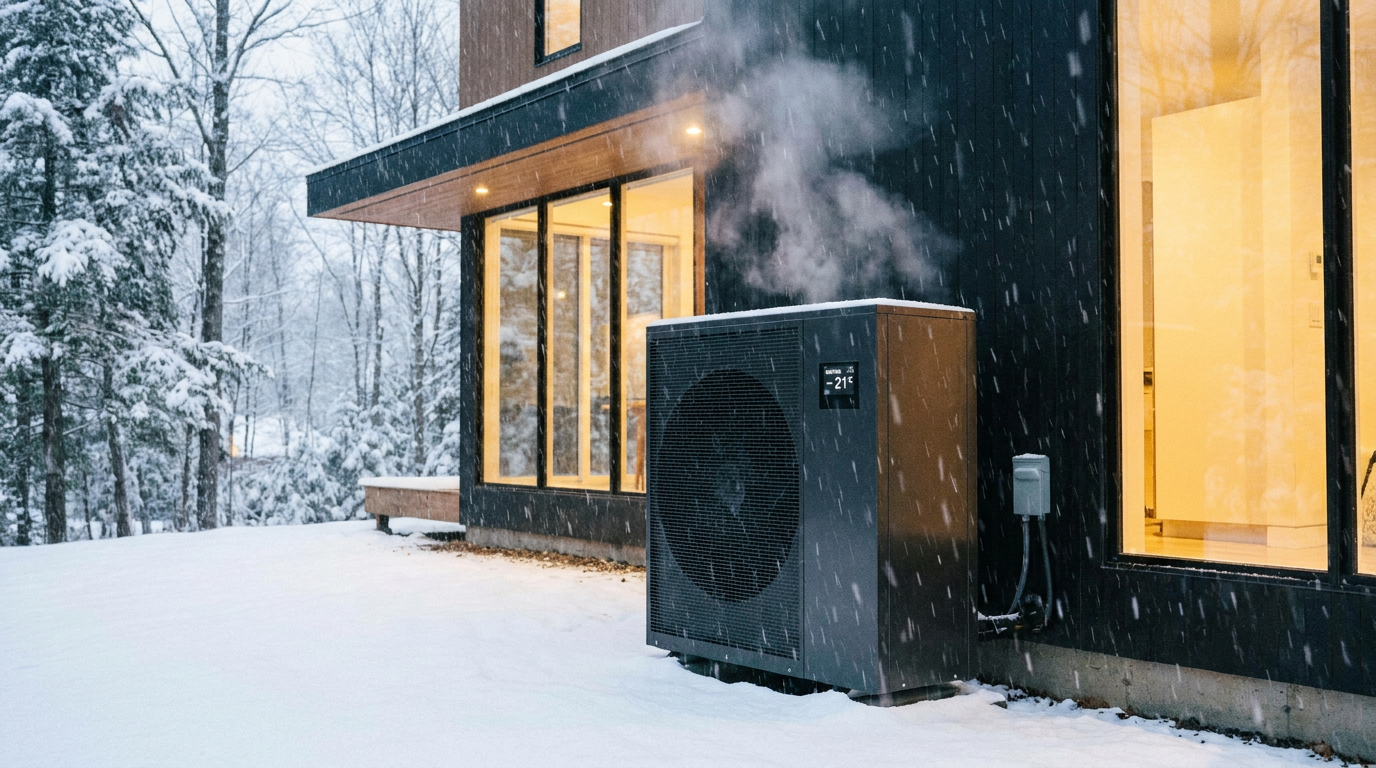
In 2026, that conventional wisdom is officially obsolete. A new generation of "Cold Climate Heat Pumps" (CCHPs) has entered the mainstream market, fundamentally altering the math of residential heating. Engineered to extract thermal energy from sub-zero air, these systems are proving that all-electric heating is not just viable in extreme climates, but often more efficient and cost-effective than combustion alternatives.[6][7]
The shift is largely the result of a coordinated push between the federal government and the HVAC industry. In 2021, the U.S. Department of Energy (DOE) launched the Cold Climate Heat Pump Technology Challenge, partnering with major manufacturers to develop and field-test prototypes capable of high performance in harsh winters.[1][2]
The field validation results, analyzed by the Pacific Northwest National Laboratory (PNNL), confirm the breakthrough. Across test sites in the U.S. and Canada, the prototype units maintained a median Coefficient of Performance (COP) of 1.9 even in the frigid 0 to 5°F temperature bin. In practical terms, this means the units produced nearly twice as much heat energy as the electrical energy they consumed, even when the air outside was near zero.[1]

Real-world trials underscore the financial impact. Trane Technologies, one of the first manufacturers to complete the DOE challenge, installed a prototype in a Boise, Idaho residence. Over two full winters, the system successfully heated the home by extracting heat from the air, relying on its backup electric heat strip only 10 percent of the time. The homeowner saw average energy bill savings of 15 to 20 percent.[2]
To understand how these systems achieve this, it helps to understand the basic mechanism of a heat pump. Unlike a furnace that burns fuel to create heat, a heat pump moves heat from one place to another. It uses a chemical refrigerant that circulates through a closed loop. As the liquid refrigerant passes through the outdoor coil, it absorbs ambient heat from the outside air, evaporating into a gas.[6][7]
Even air that feels freezing to human skin contains thermal energy. The refrigerant can absorb this heat because its boiling point is extremely low. Once the refrigerant becomes a gas, a compressor squeezes it, drastically increasing its pressure and temperature. This hot gas is then pumped indoors, where it releases its heat into the home's ductwork or wall units, condensing back into a liquid to repeat the cycle.[7]
Even air that feels freezing to human skin contains thermal energy.
The problem with older heat pumps was the compressor. Traditional compressors operate on a simple on/off switch—they run at 100 percent capacity until the thermostat is satisfied, then shut off. In extreme cold, the refrigerant pressure drops, and a single-speed compressor simply cannot pump enough volume to keep the house warm.[4][7]
The first major breakthrough in cold-climate models is the variable-speed inverter compressor. Instead of an on/off switch, an inverter acts like a car's gas pedal. It can ramp up to high speeds to capture more heat when temperatures plummet, or dial back to a low, continuous hum during milder weather. This provides precise temperature control while using significantly less electricity.[4][5]
The second, and perhaps most critical, innovation is Enhanced Vapor Injection (EVI). EVI acts as a turbocharger for the heat pump. A small amount of refrigerant is diverted, passed through a secondary expansion valve and heat exchanger, and then injected directly back into the compressor mid-cycle. This cools the compressor down, allowing it to run at higher speeds and pressures without overheating, which dramatically increases the system's heating capacity in sub-zero weather.[4][7]

These mechanical upgrades are paired with advanced software and new refrigerants. To meet 2025 and 2026 federal regulations aimed at reducing greenhouse gas emissions, manufacturers have transitioned to lower-Global Warming Potential (GWP) refrigerants like R-32 and R-454B. Meanwhile, electronic expansion valves use multiple sensors to precisely meter the flow of these refrigerants, optimizing performance minute by minute.[4][7]
The resulting specifications are striking. Carrier's Infinity Variable-Speed unit, for example, is engineered to operate reliably down to -23°F, maintaining 100 percent of its rated heating capacity at 0°F. Other leading brands like Lennox, Bosch, and Mitsubishi are fielding units with similar sub-zero capabilities.[1][2][3]
For consumers, identifying a true cold-climate model requires looking beyond standard efficiency ratings. The Northeast Energy Efficiency Partnerships (NEEP) maintains a widely referenced specification list. To qualify, a heat pump must demonstrate sustained performance at 5°F without relying on electric strip heat. This NEEP designation is now the benchmark required by most state and utility rebate programs in northern climates.[4]
The financial equation for homeowners has also shifted. While cold-climate heat pumps carry a higher upfront cost than traditional air conditioners or basic furnaces, the Inflation Reduction Act (IRA) provides a federal tax credit of 30 percent of the project cost, up to $2,000 annually. When combined with state rebates and the 30 to 50 percent reduction in monthly heating bills for homes switching from oil or propane, the return on investment often materializes within five to seven years.[5][6]

Despite the technological leaps, some HVAC professionals still recommend a "dual-fuel" approach for homes in the most extreme northern regions. This setup pairs a high-efficiency heat pump with a backup gas furnace. The system uses the heat pump for the vast majority of the winter, automatically switching to the furnace only during the most severe cold snaps, maximizing both efficiency and peace of mind.[3][5]
Ultimately, the maturation of cold-climate heat pumps marks a turning point in residential energy. By solving the freezing-temperature flaw, the HVAC industry has provided a viable, all-electric path forward for millions of homes, proving that decarbonization does not have to come at the expense of winter comfort.[6][7]
How we got here
2021
The U.S. Department of Energy launches the Cold Climate Heat Pump Technology Challenge to spur industry innovation.
2022-2024
Major HVAC manufacturers develop prototypes and begin field-testing them in occupied homes across the U.S. and Canada.
Jan 2025
The Pacific Northwest National Laboratory releases field validation results, proving the prototypes maintained high efficiency in sub-zero weather.
2026
Commercialized versions of the challenge prototypes hit the mainstream market, coinciding with new federal refrigerant regulations.
Viewpoints in depth
Electrification Advocates' view
Transitioning to all-electric heating is a critical climate imperative that is now technologically solved.
For environmental groups and policymakers, the maturation of cold-climate heat pumps removes the last major excuse for installing new fossil fuel infrastructure in homes. Because heat pumps move heat rather than generating it through combustion, they drastically reduce a home's carbon footprint over a 15-year lifespan. Advocates emphasize that as the electrical grid itself becomes greener, the emissions profile of a heat pump only improves, making it the linchpin of residential decarbonization.
HVAC Manufacturers' view
Engineering innovations have turned the heat pump into a premium, year-round climate control solution.
Manufacturers view the cold-climate heat pump as a triumph of mechanical engineering and software integration. By utilizing variable-speed inverter compressors and enhanced vapor injection, they have transformed a historically limited appliance into a highly precise machine. This allows them to market a single, premium unit that handles both summer cooling and harsh winter heating, streamlining production and capturing a larger share of the residential HVAC market.
Homeowners & Contractors' view
The technology is impressive, but upfront costs and extreme-weather anxiety still drive purchasing decisions.
While contractors acknowledge the impressive specifications of new units, they are the ones fielding calls when temperatures hit -20°F. Consequently, many still recommend "dual-fuel" systems—pairing a heat pump with a gas furnace—as an insurance policy for extreme northern climates. For homeowners, the decision often comes down to pure economics: balancing the higher initial installation cost against the $2,000 federal tax credit and the promise of lower monthly utility bills over the next decade.
What we don't know
- How the electrical grid in older neighborhoods will handle the increased winter load as entire blocks transition from gas furnaces to electric heat pumps.
- The long-term lifespan of variable-speed inverter compressors operating continuously in extreme sub-zero conditions over 15 to 20 years.
Key terms
- Cold Climate Heat Pump (CCHP)
- An advanced air-source heat pump specifically engineered to maintain high heating capacity and efficiency in sub-zero temperatures.
- Variable-Speed Inverter Compressor
- A compressor that can adjust its speed continuously to match the exact heating demand, rather than simply turning on and off.
- Enhanced Vapor Injection (EVI)
- A technology that injects a portion of refrigerant directly into the compressor mid-cycle, cooling it down and allowing it to pump more heat in extreme cold.
- Coefficient of Performance (COP)
- A ratio measuring a heat pump's efficiency, calculated by dividing the heat output by the electrical energy input.
- Dual-Fuel System
- An HVAC setup that combines an electric heat pump with a traditional gas or oil furnace for backup heating.
Frequently asked
Do heat pumps really work in freezing weather?
Yes. Modern cold-climate heat pumps use variable-speed compressors and vapor injection to extract heat from the air even at temperatures as low as -20°F.
What is a dual-fuel heating system?
A dual-fuel system pairs an electric heat pump with a backup gas furnace. The heat pump handles heating for most of the winter, and the furnace only kicks on during extreme cold snaps.
How much is the tax credit for a new heat pump?
Under the Inflation Reduction Act, qualifying high-efficiency heat pumps are eligible for a federal tax credit of 30 percent of the project cost, capped at $2,000 annually.
What is a good COP rating for a heat pump?
The Coefficient of Performance (COP) measures efficiency. A COP of 1.9 at 5°F means the unit produces nearly twice as much heat energy as the electrical energy it consumes.
Sources
Source coverage
7 outlets
3 viewpoints surfaced







[1]Pacific Northwest National LaboratoryElectrification Advocates
Performance Results from DOE Cold Climate Heat Pump Challenge Field Validation
Read on Pacific Northwest National Laboratory →[2]Trane TechnologiesHVAC Manufacturers
Trane Technologies Completes the U.S. Department of Energy's Residential Cold Climate Heat Pump Challenge
Read on Trane Technologies →[3]CarrierHVAC Manufacturers
Cold Climate Heat Pumps: Advanced Heating for Extreme Weather
Read on Carrier →[4]Heat Pump NetworkHomeowners & Contractors
What Makes a Heat Pump 'Cold Climate'
Read on Heat Pump Network →[5]HVAC Pro SalesHomeowners & Contractors
Performance in Extreme Climates: The Cold Climate Breakthrough
Read on HVAC Pro Sales →[6]The Switch Is OnElectrification Advocates
Cold-Climate Heat Pumps Work!
Read on The Switch Is On →[7]Factlen Editorial Team
Synthesis by Factlen editorial team
Read on Factlen Editorial Team →

Every angle. Every day.
Get home stories with full source coverage and perspective breakdowns delivered to your inbox.