
The End of the Tube-and-Wing: How Blended Body Aircraft Are Reshaping Aviation
Aerospace startup JetZero is backed by billions in new funding to build a radical 'blended wing' airliner that promises to cut fuel burn by 50 percent. With a full-scale demonstrator flying in 2027, the century-old shape of commercial flight is finally evolving.
By Factlen Editorial Team
- Aerospace Innovators
- Advocates argue that radical configuration changes are mandatory to meet 2050 climate goals.
- Military Strategists
- The U.S. Air Force values the BWB for its extended range, payload capacity, and logistical advantages.
- Aviation Skeptics
- Industry analysts emphasize the massive financial and regulatory risks of certifying a new airframe shape.
What's not represented
- · Commercial airline pilots
- · Airport infrastructure planners
Why this matters
Aviation accounts for a massive and growing share of global carbon emissions, and traditional aircraft designs have reached their physical limits. If successful, blended-wing technology will drastically lower the climate impact of flying while extending the range and capability of global supply chains.
Key points
- Aerospace startup JetZero is advancing a Blended Wing Body (BWB) aircraft designed to cut fuel consumption by 50 percent.
- The company recently secured $175 million in funding and announced a $4.7 billion manufacturing facility in North Carolina.
- NASA studies confirm that traditional 'tube-and-wing' aircraft cannot meet the industry's 2050 net-zero emissions targets.
- A full-scale demonstrator of JetZero's Z4 aircraft is scheduled to begin test flights in 2027.
- The U.S. Air Force is heavily backing the technology to develop longer-range, highly efficient refueling tankers.
For nearly seven decades, the silhouette of the commercial airliner has remained stubbornly unchanged. The "tube-and-wing" architecture—a cylindrical fuselage carrying passengers, with wings attached to generate lift—has been optimized to its absolute physical limits. From the early Boeing 707 to the modern Airbus A350, aerospace engineers have stretched, lightened, and refined this shape using advanced composite materials and massive high-bypass engines. Yet, despite billions of dollars in research and development, the fundamental geometry has always stayed the same, and the incremental efficiency gains extracted from this classic design are rapidly diminishing with each new generation of aircraft.
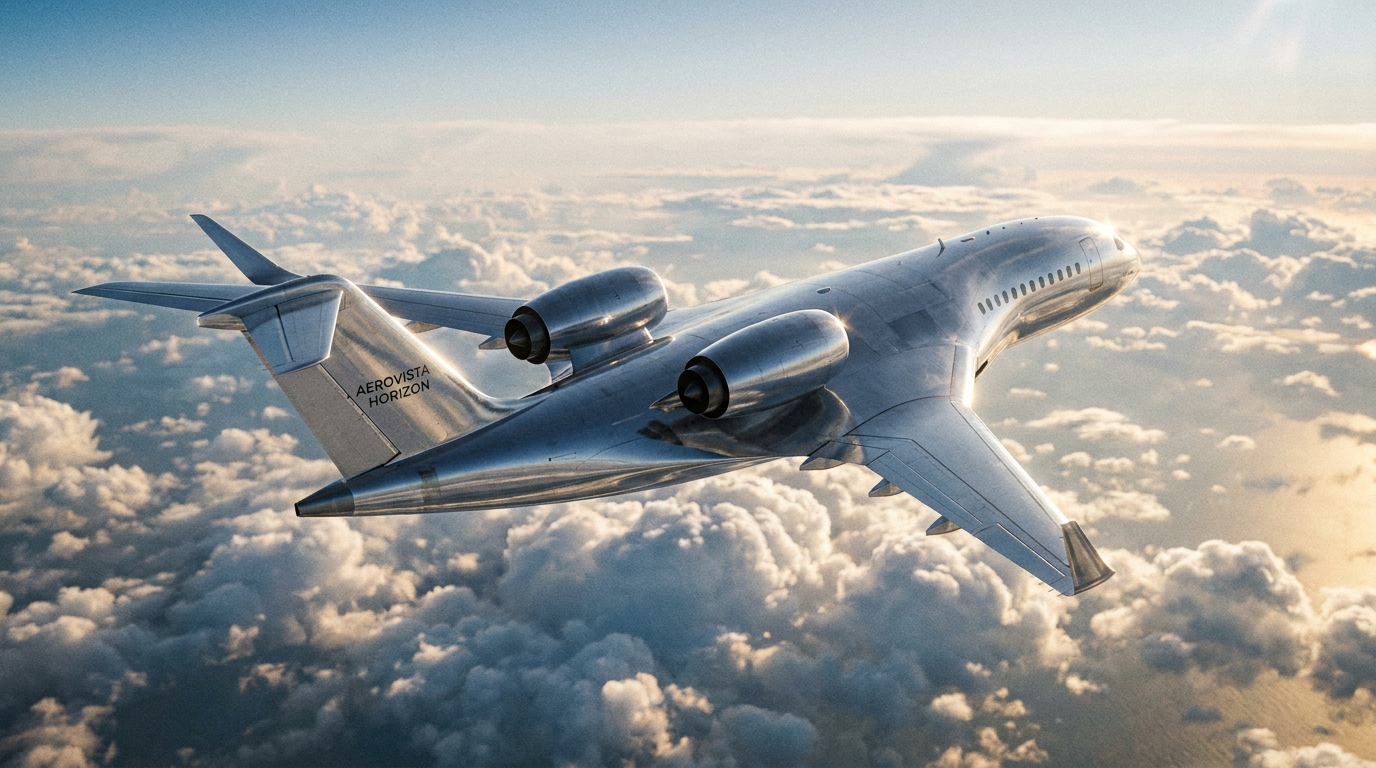
But the aviation industry is now confronting a mathematical wall. To meet ambitious 2050 net-zero emissions targets, incremental tweaks to existing airframes are no longer sufficient. Enter the Blended Wing Body (BWB), a radical redesign where the fuselage and wings merge into a single, continuous lifting surface. By eliminating the sharp angles and dead weight of a traditional fuselage, the BWB promises a generational leap in aerodynamic efficiency, fundamentally rewriting the rules of how commercial aircraft are built, powered, and flown across the globe.
In 2026, this long-theorized concept is rapidly moving from digital renders to physical reality. California-based aerospace startup JetZero recently secured $175 million in Series B financing to push its Z4 blended-wing demonstrator toward a full-scale test flight in 2027. Backed by a mix of airline, aerospace, and industrial investors, the fresh capital is allowing the company to shift from validating the aerodynamic concept in wind tunnels to executing the complex manufacturing required for a full-size, flight-ready aircraft.[1]
The financial momentum behind the project is staggering. In June 2026, JetZero confirmed a massive $4.7 billion investment to build its first manufacturing and final assembly facility in Greensboro, North Carolina. The greenfield factory, equipped with advanced artificial intelligence tools and digital production systems, is projected to create over 14,500 high-tech jobs and will eventually produce up to 20 aircraft per month once it reaches full capacity in the early 2030s. This massive capital injection signals that the industry is taking the blended wing concept seriously as a near-term commercial reality.[4]

The mechanism behind the BWB's efficiency is rooted in fundamental aerodynamics. In a traditional aircraft, the fuselage is essentially dead weight that produces drag, relying entirely on the wings to keep the plane aloft. In a blended-wing design, every surface of the aircraft generates lift. By seamlessly blending the wings into the wide body of the plane, the aircraft glides through the air with significantly less resistance, turning the entire vehicle into a highly optimized lifting platform.[6]
By eliminating the sharp aerodynamic junction between the fuselage and the wing, the BWB drastically reduces drag. JetZero claims this game-changing shape will deliver up to a 50 percent reduction in fuel burn and carbon emissions compared to today's conventional widebody jets. For an industry that operates on razor-thin margins and faces mounting pressure to decarbonize, cutting fuel consumption in half is the holy grail of aviation economics, offering a path to profitability that is decoupled from the volatile price swings of global oil markets.[1][4]
This isn't just startup optimism; the math is being validated by the world's top aerospace engineers. Recent studies conducted under NASA's Advanced Aircraft Concepts for Environmental Sustainability (AACES) 2050 program concluded that no heavily optimized tube-and-wing variant can reach the agency's far-term environmental targets. Configuration change, NASA found, is unavoidable, and the blended wing body is widely considered the most viable structural successor to the current paradigm, offering the necessary aerodynamic foundation for the next century of flight.[2]
This isn't just startup optimism; the math is being validated by the world's top aerospace engineers.
The U.S. military is also acting as a major catalyst for the BWB's development. The Air Force, which is the Department of Defense's largest consumer of fossil fuels, has committed $230 million to JetZero's prototype program. For military strategists, fuel efficiency translates directly to extended range, increased payload, and the ability to operate from shorter airfields in the vast Indo-Pacific theater, making the BWB an ideal candidate for future aerial refueling tankers and heavy cargo transports that need to operate independently for extended periods.[3]

However, the transition to a flying wing introduces a cascade of unprecedented engineering nightmares, particularly regarding propulsion. Conventional aircraft hang their engines below the wings, which serves as a neutral aerodynamic zone. On a BWB, where every surface generates lift, there is no aerodynamically neutral place to mount an engine. Placing the massive turbines disrupts the carefully calculated airflow that keeps the aircraft in the sky, requiring engineers to rethink decades of established propulsion science.[6]
JetZero's solution is to mount the engines on top of the rear fuselage. While the Z4 will utilize existing, proven Pratt & Whitney engines, integrating them into a surface that actively manages airflow and lift is a massive structural challenge. The airframe must be meticulously designed to ensure clean, uninterrupted airflow reaches the top-mounted engines at all angles of attack, a feat that requires highly advanced composite manufacturing and relentless computational fluid dynamics testing to ensure the engines do not stall during steep climbs or turbulent weather.[6]
Then there is the infrastructure problem. Historically, flying wing concepts were simply too wide to fit into standard airport gates, requiring specialized terminals. JetZero has specifically designed the 250-seat Z4 to fit within existing widebody gate footprints, aiming to avoid the multi-billion-dollar airport modifications that plagued the rollout of the massive Airbus A380. By keeping the wingspan manageable, the company hopes to seamlessly integrate the revolutionary aircraft into the daily operations of major global hubs.[1][2]
Despite these assurances, aviation skeptics remain cautious. Industry analysts have pointed out that certifying a fundamentally new aircraft shape with the Federal Aviation Administration (FAA) will take years and billions of dollars. The FAA has not yet published specific certification standards for a passenger BWB, meaning every data point from the upcoming 2027 ground and flight tests will be entirely novel for both the company and the regulators, potentially leading to unforeseen delays as the government figures out how to safely regulate a plane with no distinct fuselage.[5][6]

Critics argue that airlines are inherently risk-averse and might prefer to stick with proven tube-and-wing aircraft like the Boeing 787 or Airbus A350. Some analysts suggest that airlines would rather rely on incremental engine improvements and the gradual rollout of Sustainable Aviation Fuel (SAF) than risk capital on an unproven airframe that could face unforeseen maintenance or operational hurdles. For a legacy carrier, the logistical simplicity of operating a familiar fleet often outweighs the theoretical fuel savings of a radical new design.[5]
Yet, the pressure to decarbonize is forcing the industry's hand. As NASA's studies indicate, alternative fuels alone cannot bridge the emissions gap without a simultaneous leap in aerodynamic efficiency. The BWB offers a structural solution that complements, rather than competes with, new propulsion technologies, providing a highly efficient platform that could eventually be powered by liquid hydrogen or advanced SAF. Because the BWB has a massive internal volume, it is uniquely suited to store the bulky cryogenic tanks required for future hydrogen-powered flight.[2]
For passengers, the BWB will completely redefine the cabin experience. The ultra-wide interior resembles a spacious theater rather than a narrow tube. While fewer passengers will have traditional window seats, the design allows for massive aisles, faster boarding times, and a significantly more open cabin environment that eliminates the claustrophobia of modern economy class. Airlines will have an entirely new canvas for interior design, potentially introducing new classes of service, lounges, or communal spaces that are physically impossible in a standard jetliner.

As JetZero prepares to break ground on its North Carolina factory and finalize its demonstrator in California, the aviation world is watching closely. If the Z4 successfully takes to the skies in 2027 and meets its ambitious efficiency targets, it will mark the most significant transformation in commercial flight since the invention of the jet engine, proving that the future of aviation looks nothing like its past. The race to build the next generation of sustainable aircraft has officially begun, and the tube-and-wing era is finally drawing to a close.[4]
How we got here
2023
The U.S. Air Force awards JetZero a contract to develop a blended-wing body prototype for future tanker and cargo use.
March 2024
JetZero's subscale demonstrator, featuring a 23-foot wingspan, receives an experimental airworthiness certificate from the FAA.
January 2026
JetZero secures $175 million in Series B financing to accelerate the development of its full-scale Z4 demonstrator.
June 2026
JetZero announces a $4.7 billion manufacturing facility in North Carolina to mass-produce the Z4.
2027
The full-scale Z4 demonstrator is scheduled to make its first test flight.
Viewpoints in depth
Aerospace Innovators
Advocates argue that radical configuration changes are mandatory to meet 2050 climate goals.
For organizations like NASA and startups like JetZero, the math is uncompromising. Decades of optimization have pushed the traditional tube-and-wing design to its absolute aerodynamic limits. To achieve the aviation industry's net-zero emissions targets by 2050, incremental engine tweaks are insufficient. Innovators argue that the Blended Wing Body is the only structural leap capable of delivering the 30 to 50 percent efficiency gains required, serving as a necessary platform for future propulsion technologies like hydrogen or advanced sustainable aviation fuels.
Aviation Skeptics
Industry analysts emphasize the massive financial and regulatory risks of certifying a new airframe shape.
Skeptics do not doubt the aerodynamic math, but they question the commercial viability. Certifying a fundamentally new aircraft shape with the FAA is a multi-billion-dollar endeavor fraught with unknown regulatory hurdles, as current safety standards are written for traditional planes. Furthermore, critics argue that airlines are inherently risk-averse. Many may prefer to achieve 15 to 20 percent efficiency gains by putting next-generation engines on proven airframes like the Boeing 787, rather than gambling on an unproven design that could face unforeseen maintenance or infrastructure challenges at global airports.
Military Strategists
The U.S. Air Force values the BWB for its extended range, payload capacity, and logistical advantages.
For the Department of Defense, the BWB is less about carbon emissions and more about operational reach. The Air Force is the largest consumer of fossil fuels in the federal government, and fuel dependency is a critical logistical vulnerability in vast theaters like the Indo-Pacific. Military strategists view the BWB's efficiency as a tactical weapon: an aircraft that burns half the fuel can fly twice as far, loiter longer, and deliver heavier payloads to shorter, contested airfields without requiring constant mid-air refueling.
What we don't know
- How the FAA will adapt its certification standards for an aircraft with no distinct fuselage and top-mounted engines.
- Whether passengers will embrace an ultra-wide, theater-style cabin with significantly fewer window seats.
- How the complex composite structures of the blended wing will hold up to the daily wear-and-tear of high-frequency commercial airline operations.
Key terms
- Blended Wing Body (BWB)
- An aircraft configuration where the wings smoothly blend into the wide fuselage, allowing the entire airframe to generate lift.
- Tube-and-wing architecture
- The standard design of modern airplanes, featuring a cylindrical fuselage (the tube) that carries payload, attached to separate wings that provide lift.
- Type Certification
- The rigorous regulatory approval process by the FAA confirming that a new aircraft design meets all safety and airworthiness standards.
- Lift-to-drag ratio
- A key metric of aerodynamic efficiency, measuring how much lift an aircraft generates compared to the aerodynamic resistance (drag) it creates.
Frequently asked
What is a blended wing body (BWB) aircraft?
A BWB is an aircraft design where the fuselage and wings are merged into a single, continuous lifting surface, eliminating the traditional cylindrical body.
Why is the BWB more fuel-efficient?
Because the entire body of the aircraft generates lift, it drastically reduces aerodynamic drag, cutting fuel consumption by up to 50 percent compared to standard planes.
Will this new plane fit at standard airport gates?
Yes, JetZero designed its 250-seat Z4 aircraft to fit within existing widebody gate footprints to avoid requiring expensive airport modifications.
When will passengers be able to fly on a blended-wing aircraft?
While a full-scale demonstrator is scheduled to fly in 2027, commercial passenger flights are not expected until the early 2030s following rigorous FAA certification.
Sources
Source coverage
6 outlets
3 viewpoints surfaced






[1]FlightGlobalAerospace Innovators
JetZero secures $175m to push blended-wing demonstrator toward 2027 flight
Read on FlightGlobal →[2]Aviation WeekAerospace Innovators
Aviation's Next Transformation: NASA AACES Studies Point Toward 2050
Read on Aviation Week →[3]Air & Space Forces MagazineMilitary Strategists
Air Force Picks Startup to Build Blended-Wing Body Prototype
Read on Air & Space Forces Magazine →[4]The News & ObserverAerospace Innovators
JetZero Chooses North Carolina To Build Groundbreaking Blended Wing Aircraft
Read on The News & Observer →[5]Leeham News and AnalysisAviation Skeptics
Evaluating the Blended Wing Body: Certification and Infrastructure Hurdles
Read on Leeham News and Analysis →[6]Products UncoveredAviation Skeptics
How JetZero's MASSIVE 'Flying Wing' ENGINE Will Be Built
Read on Products Uncovered →

Every angle. Every day.
Get automotive stories with full source coverage and perspective breakdowns delivered to your inbox.