
Community Land Trusts Hit Historic Milestones as Neighborhoods Buy Back Local Real Estate
From New York to Texas, community-led nonprofits are successfully purchasing commercial and residential properties off the private market to guarantee permanent affordability.
By Factlen Editorial Team
- Community Organizers
- Advocates focused on preventing displacement and building generational wealth for marginalized neighborhoods.
- Municipal & Philanthropic Partners
- City officials and banks supporting CLTs as an efficient, long-term solution to the housing affordability crisis.
- Local Entrepreneurs
- Small business owners and cooperatives seeking protection from skyrocketing commercial rents.
What's not represented
- · Traditional private real estate developers
- · Market-rate landlords
Why this matters
As housing and commercial rent prices outpace wage growth across the country, the community land trust model offers a proven, scalable blueprint for residents to permanently protect their neighborhoods from speculative real estate displacement.
Key points
- The East New York Community Land Trust purchased a $2.3 million commercial building, the first private-market commercial acquisition by a NYC CLT.
- The building will become the East Brooklyn Liberation Center, offering affordable space for local businesses and nonprofits.
- In Texas, the Fort Worth Community Land Trust celebrated its first homeowner and launched a 200-home affordable development.
- CLTs decouple land ownership from building ownership, ensuring properties remain permanently affordable across multiple generations.
- The CLT movement has expanded rapidly, with NYC alone growing from two trusts to more than 20 over the last decade.
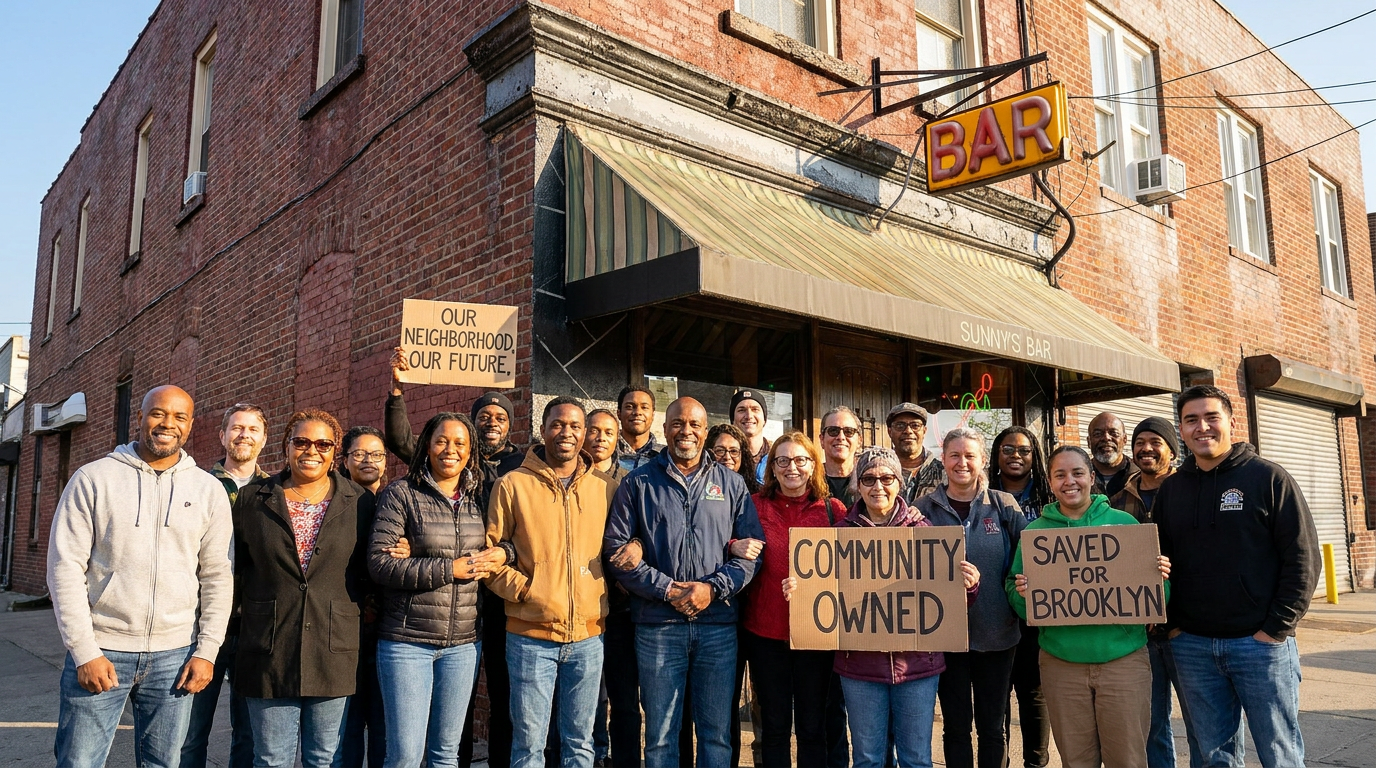
In June 2026, the East New York Community Land Trust (ENYCLT) reached a historic milestone, becoming the first organization of its kind in New York City history to purchase a commercial property directly off the private market. The $2.3 million acquisition of a vacant, two-story brick building in Brooklyn caps off a wave of recent community-led real estate victories across the country. For decades, local residents have watched as speculative real estate investment drove up property values, displacing the working-class families and small businesses that originally built the neighborhood. By successfully pooling resources to buy back their own block, the ENYCLT has demonstrated that neighborhoods can actively remove property from the speculative market and place it under permanent, democratic control.[1][3]
The ENYCLT plans to transform the 9,500-square-foot former manufacturing building into the "East Brooklyn Liberation Center." Once renovations are complete, the hub will provide deeply affordable office space for local businesses, worker cooperatives, and grassroots nonprofits, shielding them from the rising commercial rents that have displaced many neighborhood staples. Organizers view the purchase as a critical step in building community wealth and economic stability in an area that has faced successive waves of predatory lending, foreclosure, and aggressive rezoning. By acting as their own commercial landlord, the community ensures that the economic value generated within the building stays within the neighborhood, rather than being extracted by outside investors.[1]
The Brooklyn acquisition represents a major evolution for the city's broader community land trust movement. Over the past dozen years, the number of CLTs in New York City has multiplied dramatically, growing from just two organizations to more than 20 active trusts across the five boroughs. Together, these community-governed nonprofits now steward more than 1,200 units of permanently affordable housing, along with accessible green spaces, community gardens, and cultural hubs. This rapid expansion has been fueled by a highly organized coalition of housing advocates who view collective land ownership not merely as a housing policy, but as a fundamental matter of racial justice and neighborhood self-determination.[3]

At its core, the community land trust model works by decoupling the cost of the land from the cost of the structures built upon it. The nonprofit trust acquires and holds the land in perpetuity, effectively removing it from the volatile real estate market. Residents or businesses can then purchase or lease the buildings at restricted, affordable rates. If a homeowner eventually decides to sell, built-in resale formulas ensure the property remains affordable for the next buyer. This shared-equity approach allows the original owner to build personal wealth and recoup their investment without resetting the neighborhood's baseline prices to market rate, breaking the cycle of gentrification.[3][4]
At its core, the community land trust model works by decoupling the cost of the land from the cost of the structures built upon it.
This decommodified approach to real estate is gaining rapid traction far beyond the coastal cities. In May 2026, the Fort Worth Community Land Trust (FWCLT) in Texas celebrated its very first homeowner, a single mother who purchased a rehabilitated home in the city's Morningside neighborhood. Fort Worth's home prices have surged by more than 50 percent over the past five years, while the city's population has grown by 30 percent, outpacing the Texas average. This rapid growth has left thousands of working-class residents severely cost-burdened, prompting local leaders and housing advocates to embrace the land trust model as a permanent safeguard against displacement.[2][5]

To combat this escalating affordability crisis, the FWCLT recently launched the first phase of Carroll Park, an ambitious 15-acre development that will eventually feature 200 homes starting at $135,000. Backed by a $1.1 million philanthropic grant from JPMorgan Chase, the trust is also expanding its community developer program. This initiative provides technical assistance and city-acquired land to local builders who agree to construct permanently affordable homes. By partnering directly with municipal governments and major financial institutions, the Fort Worth trust is proving that the CLT model can operate at a significant scale, providing a viable alternative to traditional market-rate subdivision development.[2][4][5]

The momentum in New York and Texas mirrors similar community wealth-building efforts nationwide. In Oklahoma City, a community-owned grocery model called the Market at EastPoint recently celebrated its fifth anniversary. Launched by a local nonprofit after corporate supermarket chains abandoned the area, the market proves that resident-led enterprises can successfully provide fresh produce and local jobs in neighborhoods deemed unprofitable by traditional retailers. Across the country, communities are increasingly recognizing that relying on outside developers to solve local crises often accelerates displacement, prompting a surge in cooperative ownership models that prioritize resident needs over maximum profit extraction.[6]
Housing advocates argue that the community land trust model is rapidly transitioning from a niche, localized experiment into a mainstream economic strategy. In New York, organizers are currently advancing statewide legislation like the Community Opportunity to Purchase Act (COPA), which would give nonprofits the first right of refusal to buy neglected properties before they hit the open market. If passed, such policies could channel thousands of additional properties into community ownership in the coming years. By combining permanent land stewardship with relentless local organizing, neighborhoods facing gentrification are successfully rewriting the rules of local real estate—anchoring their communities in place for generations to come.[3]
How we got here
2014
New York City's CLT movement begins to gain traction with the launch of the East Harlem/El Barrio Community Land Trust.
2020
The East New York Community Land Trust is formed by local residents during the COVID-19 lockdown.
2023
The Fort Worth Community Land Trust is officially established to combat surging housing costs in North Texas.
May 2026
Fort Worth's CLT celebrates its first homeowner and receives a $1.1 million expansion grant from JPMorgan Chase.
June 2026
East New York CLT becomes the first in NYC history to purchase a commercial property off the private market.
Viewpoints in depth
Community Organizers
Advocates view land trusts as a vital tool for racial justice and neighborhood self-determination.
For local organizers, the speculative real estate market is fundamentally at odds with community stability. They argue that treating land as a commodity inevitably leads to the displacement of low-income residents and small businesses. By placing land into a community-governed trust, organizers believe neighborhoods can permanently insulate themselves from gentrification, build generational wealth for marginalized groups, and ensure that local development serves the people who actually live there.
Municipal Governments
City officials increasingly see land trusts as a scalable partner for solving the affordable housing crisis.
Faced with skyrocketing housing costs and limited public funds, municipal leaders are embracing CLTs as a highly efficient mechanism for preserving affordability. Because the trust retains the land, a single public subsidy or land grant pays dividends across multiple generations of homeowners, rather than disappearing after a single sale. Cities like Fort Worth and New York are now actively partnering with CLTs, transferring vacant city-owned lots to the trusts and providing capacity-building grants to accelerate their growth.
Traditional Real Estate Developers
Some private developers express caution about removing large swaths of land from the open market.
While generally supportive of affordable housing initiatives, some voices within the traditional real estate sector worry that aggressively expanding CLTs—especially through proposed 'opportunity to purchase' laws—could chill private investment. They argue that removing commercial and residential properties from the open market permanently restricts the tax base and limits the kind of high-density, market-rate development that cities also need to increase overall housing supply.
What we don't know
- Whether proposed legislation like the Community Opportunity to Purchase Act (COPA) will pass, which would give CLTs the first right of refusal on property sales.
- How effectively the CLT model can scale to meet the massive nationwide demand for affordable housing without significantly larger infusions of federal or state funding.
Key terms
- Community Land Trust (CLT)
- A community-governed nonprofit that acquires and holds land in perpetuity to ensure it is used for permanently affordable housing or local economic development.
- Speculative Real Estate
- The practice of buying property with the primary intention of reselling it later at a higher price, which often drives up neighborhood housing costs.
- Shared-Equity Housing
- A homeownership model where the buyer purchases the home at a below-market price and agrees to limit their return on investment when they sell, keeping the home affordable for the next buyer.
- Area Median Income (AMI)
- The midpoint of a region's income distribution, commonly used by housing programs to determine eligibility for affordable housing.
Frequently asked
How does a Community Land Trust make a home cheaper?
By separating the cost of the land from the cost of the house. The trust owns the land, so the buyer only pays for the physical structure, which significantly lowers the purchase price and down payment.
Can you sell a home built on a Community Land Trust?
Yes. Homeowners can sell their properties, but they must agree to a resale formula that caps the sale price. This allows them to build some equity while ensuring the home remains affordable for the next low-to-moderate-income buyer.
What is the East Brooklyn Liberation Center?
It is a planned community hub in a former manufacturing building purchased by the East New York CLT. It will provide deeply affordable office and retail space for local businesses, nonprofits, and worker cooperatives.
Sources
Source coverage
6 outlets
3 viewpoints surfaced






[1]Next CityCommunity Organizers
A Community Land Trust Is Purchasing Commercial Property in NYC for the First Time
Read on Next City →[2]Fort Worth Star-TelegramMunicipal & Philanthropic Partners
Fort Worth Community Land Trust expands affordable housing
Read on Fort Worth Star-Telegram →[3]Nonprofit QuarterlyCommunity Organizers
A Community Land Trust Movement Rises in New York City: Leadership Lessons
Read on Nonprofit Quarterly →[4]CandysDirt.comMunicipal & Philanthropic Partners
How Fort Worth's Community Land Trust Is Expanding Affordable Homeownership
Read on CandysDirt.com →[5]JPMorgan ChaseMunicipal & Philanthropic Partners
Fort Worth Community Land Trust celebrates first homeowner, expands access to affordable homeownership
Read on JPMorgan Chase →[6]Oklahoma City Free PressLocal Entrepreneurs
Market at EastPoint marks 5 years amid tough economy, Homeland plans
Read on Oklahoma City Free Press →

Every angle. Every day.
Get community stories with full source coverage and perspective breakdowns delivered to your inbox.