
NASA Unveils Artemis III Crew and Earth-Orbit Test Plan for Lunar Landers
NASA has named the four astronauts for the 2027 Artemis III mission, which will conduct critical Earth-orbit tests of commercial lunar landers to pave the way for a 2028 Moon landing.
By Factlen Editorial Team
- NASA Mission Planners
- Prioritizes rigorous testing and risk reduction in Earth orbit before committing to a deep-space lunar descent.
- Commercial Space Partners
- Focuses on rapid iteration, overcoming hardware anomalies, and fulfilling contract obligations to deliver operational landers.
- International Space Agencies
- Views the mission as a triumph of global cooperation and a critical step in establishing a sustainable, multi-national presence in space.
What's not represented
- · Lunar scientists awaiting surface samples
- · Budget watchdog organizations
Why this matters
By shifting Artemis III to a rigorous Earth-orbit test of multiple commercial landers, NASA is actively buying down the immense risks of deep-space exploration. This ensures that when humans finally return to the lunar surface in 2028, the vehicles carrying them will have been fully vetted in the vacuum of space.
Key points
- NASA has named Randy Bresnik, Luca Parmitano, Andre Douglas, and Frank Rubio as the crew for Artemis III.
- The 2027 mission will not land on the Moon, but will instead test lunar landers in low Earth orbit.
- Orion will dock with both Blue Origin's Blue Moon and SpaceX's Starship to test critical systems.
- The actual return of humans to the lunar surface is now slated for the Artemis IV mission in 2028.
- NASA and Blue Origin are working to ensure the New Glenn rocket is ready despite a recent launchpad explosion.
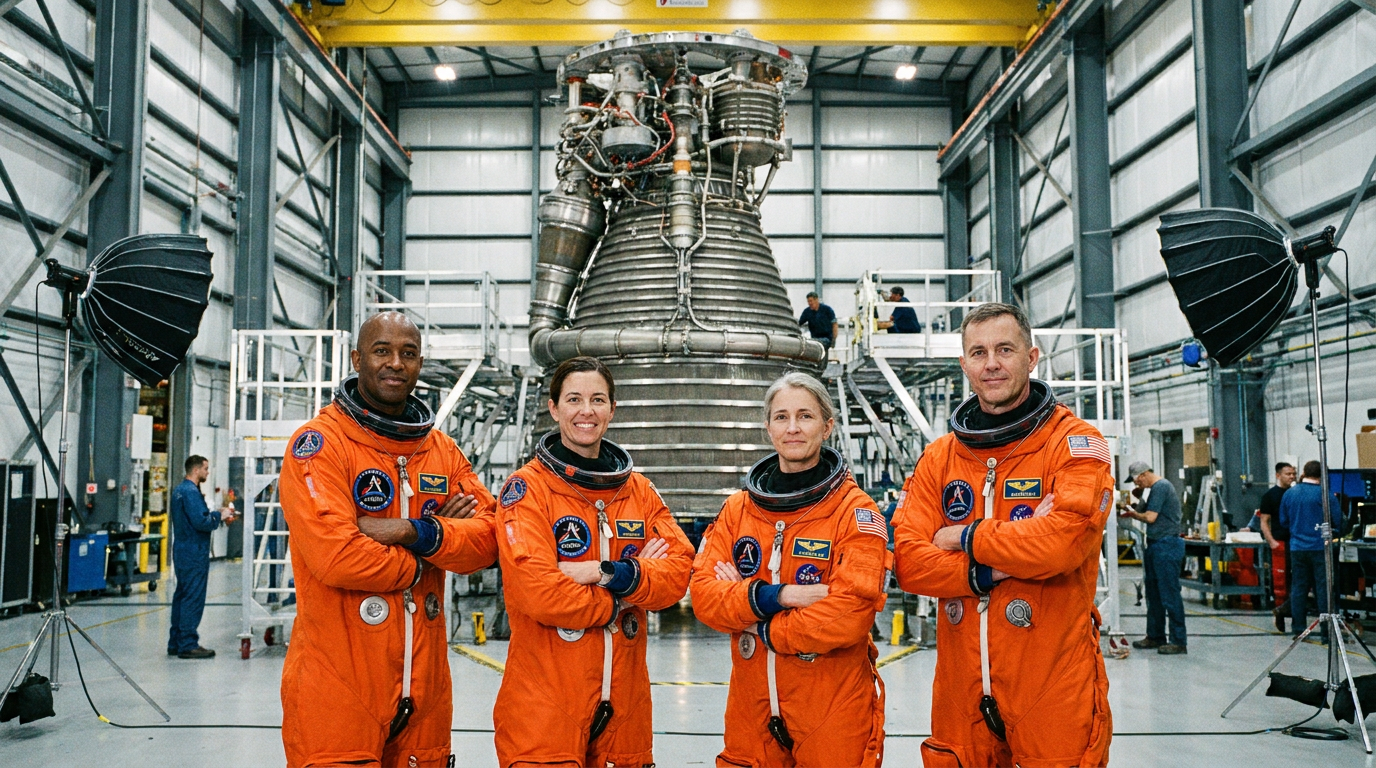
The architecture of humanity's return to the Moon has officially crystallized. On June 9, 2026, NASA unveiled the four astronauts who will crew the Artemis III mission, while simultaneously detailing a major shift in the mission's operational profile. Originally envisioned as the flight that would return boots to the lunar dust, Artemis III is now slated for 2027 as a highly complex, multi-launch demonstration in low Earth orbit.[1][3]
The crew represents a blend of veteran experience and new talent. NASA astronaut Randy Bresnik will command the mission, joined by European Space Agency (ESA) pilot Luca Parmitano, and NASA mission specialists Andre Douglas and Frank Rubio. For Douglas, an engineer who previously served as a backup for Artemis II, this will mark his first spaceflight. The international composition of the crew underscores the collaborative nature of the modern space race, contrasting sharply with the unilateral Apollo era.[1][3][6]
The primary claim driving NASA's updated mission profile is that testing critical hardware in Earth orbit first will significantly reduce the risk of a catastrophic failure during a lunar descent. Artemis III will serve as a proving ground for the Human Landing Systems (HLS) currently under development by two private aerospace giants: SpaceX and Blue Origin. By keeping the test in low Earth orbit, the crew maintains the ability to abort and return home within hours, rather than days.[1][4]
The mechanics of the Artemis III mission are unprecedented in their complexity, requiring what NASA describes as a "highly choreographed multi-launch campaign." The sequence begins with the launch of Blue Origin's Blue Moon lander test article atop a New Glenn rocket. This lander is designed to loiter in orbit for up to 90 days, awaiting the arrival of the human crew.[1][4]

Following the Blue Origin launch, the four astronauts will lift off from Kennedy Space Center aboard the Orion spacecraft, propelled by NASA's Space Launch System (SLS). Once in low Earth orbit, Orion will rendezvous and dock with the Blue Moon lander. The crew will spend approximately two days conducting integrated operations, testing life support systems, hatch mechanisms, and software interoperability.[1][6]
Following the Blue Origin launch, the four astronauts will lift off from Kennedy Space Center aboard the Orion spacecraft, propelled by NASA's Space Launch System (SLS).
The evidence-gathering does not stop there. After undocking from the Blue Origin vehicle, Orion will await the arrival of SpaceX's Starship HLS pathfinder. The crew will repeat the docking and checkout procedures with the massive Starship vehicle for roughly a day. This dual-testing approach ensures that NASA has multiple vetted options for the actual lunar landing, now scheduled for the Artemis IV mission in 2028.[1][2]

A key technical modification for Artemis III involves the SLS rocket itself. Unlike Artemis II, which utilized a traditional propulsive upper stage to push Orion toward the Moon, Artemis III will employ a non-propulsive "spacer." Because the mission remains in Earth orbit, Orion's European-built service module has sufficient thrust to handle orbital maneuvers, allowing engineers to test the spacecraft's standalone capabilities more rigorously.[6]
However, the timeline is not without transparent uncertainty. The most significant variable is the readiness of the commercial launch vehicles, particularly Blue Origin's New Glenn. On May 28, 2026, a New Glenn rocket suffered a catastrophic explosion during a static test fire at Cape Canaveral, severely damaging Launch Complex 36A. This anomaly immediately raised questions about Blue Origin's ability to meet the 2027 launch window.[2][3][5]
Despite the visible setback, evidence suggests a rapid recovery effort is underway. Blue Origin CEO Dave Limp publicly stated that the company will fly New Glenn before the end of the year, citing the company's motto, "Gradatim Ferociter" (Step by step, ferociously). NASA Administrator Jared Isaacman has pledged a "whole government response" to assist with the investigation and pad cleanup, reflecting the agency's deep reliance on the commercial provider.[5]
To mitigate this risk, NASA has built flexibility into the Artemis III architecture. Isaacman noted that the agency is "decoupling" the Blue Moon lander from the New Glenn rocket in its planning. If New Glenn faces extended delays, the lander could theoretically be reconfigured to launch on an alternative heavy-lift vehicle, such as a SpaceX Falcon Heavy, ensuring the 2027 test mission remains on track.[5]

SpaceX's Starship development also faces intense scrutiny. While the vehicle has made significant strides in its flight test program, demonstrating the complex in-space propellant transfer required for a lunar mission remains a formidable hurdle. Artemis III's Earth-orbit docking tests will provide critical data on Starship's life support and crew interfaces before it is trusted to carry humans to the lunar south pole.[2][4]
Ultimately, Artemis III represents a maturation of the Artemis program from isolated test flights to integrated, multi-system operations. By thoroughly vetting the commercial landers, new spacesuits, and orbital rendezvous procedures close to home, NASA is laying a robust, evidence-backed foundation. If successful, this 2027 mission will clear the final major technical hurdles, setting the stage for humanity's long-awaited return to the lunar surface in 2028.[1][4]
How we got here
November 2022
Artemis I successfully completes an uncrewed test flight around the Moon.
April 2026
Artemis II successfully flies four astronauts on a lunar flyby mission.
May 28, 2026
A Blue Origin New Glenn rocket explodes during a static test fire, damaging its launchpad.
June 9, 2026
NASA announces the Artemis III crew and details the Earth-orbit testing profile.
2027
Target launch window for the Artemis III Earth-orbit demonstration mission.
2028
Target launch window for Artemis IV, the first crewed lunar landing of the program.
Viewpoints in depth
NASA Mission Planners
Prioritizes rigorous testing and risk reduction in Earth orbit before committing to a deep-space lunar descent.
For NASA's leadership and engineering teams, the shift to an Earth-orbit test for Artemis III is a pragmatic move to buy down risk. The lunar descent is arguably the most dangerous phase of the Artemis architecture. By requiring SpaceX and Blue Origin to prove their vehicles can safely dock, transfer crew, and maintain life support in the relatively safe confines of low Earth orbit, NASA ensures that any catastrophic anomalies occur where astronauts can quickly abort to the Orion capsule and return home. This methodical approach prioritizes crew safety over arbitrary timeline goals.
Commercial Space Partners
Focuses on rapid iteration, overcoming hardware anomalies, and fulfilling contract obligations to deliver operational landers.
Companies like SpaceX and Blue Origin operate on a philosophy of rapid, iterative testing, where hardware failures are viewed as necessary data-gathering events rather than program-ending disasters. In the wake of the New Glenn launchpad explosion, Blue Origin's focus is on swift investigation, pad reconstruction, and returning to flight before the end of 2026. For these commercial partners, the Artemis III mission is a critical milestone to prove their heavy-lift and lunar landing technologies are viable, securing their position in the future multi-billion dollar cislunar economy.
International Space Agencies
Views the mission as a triumph of global cooperation and a critical step in establishing a sustainable, multi-national presence in space.
The inclusion of ESA astronaut Luca Parmitano on the Artemis III crew highlights the deeply integrated nature of the modern space program. International partners view Artemis not just as an American endeavor, but as a global coalition. ESA's contribution of the European Service Module for the Orion spacecraft is a critical piece of the mission's infrastructure. For these agencies, the methodical testing in Earth orbit ensures that the eventual lunar landings and the construction of the Lunar Gateway station will be built on a foundation of reliable, internationally vetted technology.
What we don't know
- Whether Blue Origin can rebuild its launchpad and successfully fly the New Glenn rocket in time for the 2027 window.
- How SpaceX's Starship will perform during complex in-space propellant transfer tests required before it can be used as a lunar lander.
- The exact duration of the Artemis III mission, which will be determined in real-time based on the success of the docking operations.
Key terms
- Human Landing System (HLS)
- The commercial spacecraft designed to ferry astronauts from lunar orbit down to the surface of the Moon and back.
- Low Earth Orbit (LEO)
- An orbit relatively close to Earth's surface, typically at an altitude of 2,000 km or less, where the Artemis III docking tests will occur.
- Space Launch System (SLS)
- NASA's super heavy-lift expendable launch vehicle, designed to carry the Orion spacecraft and its crew into space.
- Orion Spacecraft
- The NASA exploration vehicle that will carry the crew from Earth to orbit, sustain them during the mission, and return them safely.
Frequently asked
Will Artemis III land on the Moon?
No. NASA has updated the mission profile so that Artemis III will remain in low Earth orbit to test commercial lunar landers. The actual lunar landing is now scheduled for Artemis IV in 2028.
Who are the astronauts flying on Artemis III?
The crew consists of NASA astronauts Randy Bresnik (Commander), Andre Douglas, and Frank Rubio, alongside European Space Agency astronaut Luca Parmitano.
How will the mission test the lunar landers?
The Orion spacecraft will rendezvous and dock with both the Blue Origin Blue Moon lander and the SpaceX Starship lander in Earth orbit, allowing the crew to test life support, hatches, and software.
Did a rocket explosion delay the mission?
A Blue Origin New Glenn rocket exploded during a test in May 2026, but the company and NASA are working aggressively to recover, and the 2027 launch target for Artemis III remains in place.
Sources
Source coverage
6 outlets
3 viewpoints surfaced






[1]NASANASA Mission Planners
NASA Marches Toward Artemis III Mission in 2027, Names Crew Members
Read on NASA →[2]The New York TimesCommercial Space Partners
What NASA Needs to Stay on Track for the Moon
Read on The New York Times →[3]Al JazeeraInternational Space Agencies
NASA announces astronauts for Artemis III spaceflight, scheduled for 2027
Read on Al Jazeera →[4]Live ScienceNASA Mission Planners
NASA names crew for Artemis III moon mission
Read on Live Science →[5]The GuardianCommercial Space Partners
Blue Origin vows New Glenn flight this year after launchpad explosion
Read on The Guardian →[6]Sky at Night MagazineInternational Space Agencies
Artemis III crew revealed: who is flying on NASA's next Moon mission?
Read on Sky at Night Magazine →

Every angle. Every day.
Get science stories with full source coverage and perspective breakdowns delivered to your inbox.