
UK Expected to Weaken 2030 Electric Vehicle Sales Mandate
The UK government is poised to reduce its 2030 target for electric vehicle sales from 80% to 50% following intense pressure from the automotive industry and trade unions.
By Factlen Editorial Team
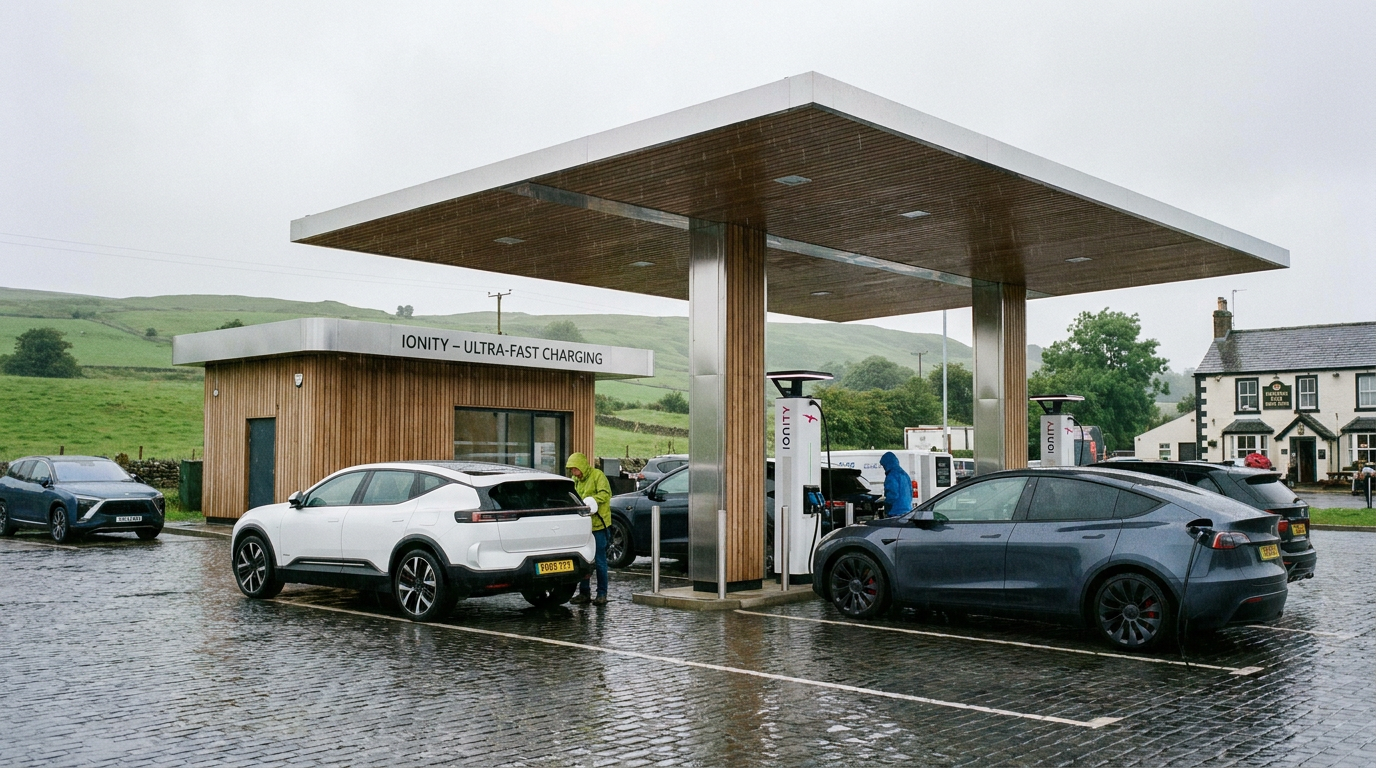
- Neutral Observers & Analysts
- Document the political friction and economic trade-offs of the policy shift.
- Automotive Industry & Unions
- Argue the mandate is unachievable, forces unsustainable discounting, and threatens manufacturing jobs.
- Infrastructure & Climate Advocates
- Argue the rollback destroys investor confidence, slows charger rollout, and jeopardizes net-zero goals.
What's not represented
- · Consumer advocacy groups
- · Used car dealerships
Why this matters
This policy shift directly impacts the types of cars available to UK consumers, the speed of the national charging network rollout, and the country's ability to meet its legally binding climate targets.
Key points
- The UK government is expected to reduce its 2030 EV sales target from 80% to 50%.
- The move follows intense lobbying from the automotive industry and trade unions over feared job losses.
- Carmakers currently face fines of up to £15,000 for every vehicle that misses the mandate quota.
- Infrastructure and climate groups warn the rollback will destroy investor confidence and harm net-zero goals.
The UK government is preparing to significantly weaken its flagship electric vehicle sales targets following intense pressure from automotive manufacturers and trade unions.[1][2]
Prime Minister Keir Starmer is expected to reduce the 2030 Zero Emission Vehicle (ZEV) mandate, dropping the requirement that 80% of new cars sold be fully electric to just 50%.[1][7]
The move represents a major victory for the automotive industry and the Unite union, but a substantial blow to Energy Secretary Ed Miliband and the UK's broader net-zero infrastructure sector.[1][3][4]
To understand the stakes of this policy rollback, it is necessary to examine the mechanics of the ZEV mandate, the economic evidence presented by the automotive sector, and the counter-claims from environmental and infrastructure groups.[7]
Introduced into law in early 2024, the ZEV mandate is a strict regulatory tool designed to force a transition away from internal combustion engines.[6]
It requires carmakers to ensure a rising percentage of their annual sales are zero-emission vehicles. In 2024, the target was 22%, rising to 28% in 2025, and 33% in 2026.[5][6]

Manufacturers who fail to meet these quotas face severe penalties. The statutory fine is set at £15,000 per non-compliant car, though unions estimate the effective cost after trading credits is closer to £11,000 to £12,000.[4][6]
Automotive leaders and unions argue that consumer demand is simply not keeping pace with the mandated targets, creating an unsustainable financial burden.[1][4]
Evidence for this claim is visible in recent sales data: in May 2026, battery electric vehicles accounted for 27.3% of new car registrations in the UK, falling short of the 33% required for the year.[1]
To avoid crippling fines, manufacturers claim they have been forced to offer massive discounts on EVs. Unite the Union warned that companies might simply halt UK sales entirely rather than absorb the penalties, threatening tens of thousands of manufacturing jobs.[1][4]

To avoid crippling fines, manufacturers claim they have been forced to offer massive discounts on EVs.
Business Secretary Peter Kyle reportedly backed these concerns, leading Starmer to overrule Miliband's insistence on maintaining the strict net-zero trajectory.[1]
Conversely, environmental organizations and the electric charging industry argue that softening the mandate is an act of economic self-harm that ignores the long-term benefits of the transition.[3][5]
ChargeUK, representing the charging infrastructure sector, stated that its members have invested billions based on the certainty of the ZEV mandate, warning that moving the goalposts destroys investor confidence.[3]
Transport & Environment, a clean transport campaign group, notes that the mandate is the single largest carbon-saving measure in the government's net-zero strategy.[5]
They argue that the policy already includes "flexibilities" until 2027—such as borrowing credits from future years or reducing CO2 in petrol cars—meaning the actual required EV sales are lower than the headline figures.[5]

By lowering the 2030 target to 50%, the government is effectively granting a stay of execution for hybrid vehicles.[1][7]
The 2030 ban on the sale of pure petrol and diesel cars remains in place, meaning the remaining 50% of sales would likely be plug-in hybrids.[1]
However, climate advocates have long warned that plug-in hybrids often run primarily on fossil fuels in real-world conditions, significantly driving up emissions compared to pure electrics.[1][5]
What remains uncertain is exactly how the revised trajectory will map out between 2026 and 2030, and whether the ultimate 2035 ban on all non-zero-emission vehicles will hold firm.[7]
How we got here
2019
The UK commits in law to net zero greenhouse gas emissions by 2050.
January 2024
The Zero Emission Vehicle (ZEV) Mandate officially comes into law.
May 2026
Battery electric vehicles account for 27.3% of new car registrations, missing the 33% target.
June 2026
Reports emerge that the government will reduce the 2030 EV target from 80% to 50%.
2035
The deadline for the complete phase-out of all new non-zero-emission vehicles.
Viewpoints in depth
Automotive Industry & Unions
Argue the mandate is unachievable, forces unsustainable discounting, and threatens manufacturing jobs.
Automotive leaders and trade unions like Unite argue that the ZEV mandate is fundamentally disconnected from the reality of consumer demand. They point to the fact that EV sales are lagging behind the government's aggressive trajectory, forcing manufacturers to heavily discount vehicles to avoid crippling fines of up to £15,000 per car. They warn that without a reduction in the 2030 target, companies will simply pull investment from the UK or halt sales entirely, leading to the decimation of the domestic automotive manufacturing sector and the loss of tens of thousands of jobs.
Infrastructure & Climate Advocates
Argue the rollback destroys investor confidence, slows charger rollout, and jeopardizes net-zero goals.
Environmental groups and the charging infrastructure sector view the rollback as an act of economic and environmental self-harm. Organizations like ChargeUK note that their members have invested billions of pounds into building a national charging network based on the certainty of the ZEV mandate. They argue that moving the goalposts now destroys investor confidence and will inevitably slow the rollout of public chargers. Furthermore, climate advocates warn that allowing a higher proportion of plug-in hybrids will significantly drive up real-world emissions, jeopardizing the UK's legally binding net-zero commitments.
Government Pragmatists
Argue a softer transition protects the economy while maintaining the long-term 2035 phase-out.
Within the government, figures like Prime Minister Keir Starmer and Business Secretary Peter Kyle appear to be prioritizing economic stability over strict adherence to interim climate targets. By softening the 2030 mandate to 50%, they aim to provide the automotive industry with a vital pressure release valve, allowing a larger proportion of hybrid vehicles to be sold in the medium term. This pragmatic approach seeks to protect manufacturing jobs and avoid passing the costs of the transition onto consumers, while still maintaining the ultimate 2035 ban on all new non-zero-emission vehicles.
What we don't know
- Exactly what the revised EV sales targets will be for the years between 2026 and 2030.
- Whether the ultimate 2035 ban on all new non-zero-emission vehicles will remain strictly enforced.
Key terms
- Zero Emission Vehicle (ZEV)
- A vehicle that produces no tailpipe exhaust emissions, such as a battery electric or hydrogen fuel cell car.
- ZEV Mandate
- A regulatory framework compelling automakers to ensure a specific percentage of their total sales are zero-emission vehicles.
- Plug-in Hybrid (PHEV)
- A vehicle with both a combustion engine and a battery that can be plugged in to charge, offering limited electric-only range.
- Carbon Credits
- Tradable certificates that represent the right to emit a certain amount of carbon or, in this case, sell a non-zero-emission vehicle under the mandate.
Frequently asked
What is the ZEV mandate?
The Zero Emission Vehicle mandate is a UK policy requiring carmakers to sell a rising percentage of fully electric vehicles each year.
Why is the government changing the target?
Manufacturers and unions warned that consumer demand is lagging behind the targets, risking massive fines and job losses in the automotive sector.
Are petrol and diesel cars still being banned?
Yes, the ban on the sale of new pure petrol and diesel cars by 2030 remains in place, but the new rules will allow more hybrid vehicles to be sold.
What happens if carmakers miss the target?
Under the original rules, manufacturers face statutory fines of up to £15,000 for every non-compliant vehicle sold, though they can trade credits to offset this.
Sources
Source coverage
7 outlets
3 viewpoints surfaced







[1]The GuardianNeutral Observers & Analysts
UK poised to water down 2030 EV sales targets after industry and union pressure
Read on The Guardian →[2]BBCNeutral Observers & Analysts
UK electric car sales target to be weakened
Read on BBC →[3]Birmingham LiveNeutral Observers & Analysts
Keir Starmer to water down EV policy in blow to energy secretary Ed Miliband
Read on Birmingham Live →[4]Unite the UnionAutomotive Industry & Unions
ZEV Mandate reforms huge win for car workers as government acts on Unite lobbying
Read on Unite the Union →[5]Transport & EnvironmentInfrastructure & Climate Advocates
Fact sheet: Zero Emissions Vehicles in the UK
Read on Transport & Environment →[6]EVA EnglandInfrastructure & Climate Advocates
ZEV Mandate
Read on EVA England →[7]Factlen Editorial TeamNeutral Observers & Analysts
Synthesis by Factlen editorial team
Read on Factlen Editorial Team →

Every angle. Every day.
Get science stories with full source coverage and perspective breakdowns delivered to your inbox.