
The Science Behind Red Light Therapy: How Photobiomodulation Actually Changes Your Skin
Red light therapy has exploded in popularity as a non-invasive anti-aging and acne treatment, but its efficacy relies on a biological process called photobiomodulation. By stimulating cellular energy production, consistent use can genuinely improve collagen density and reduce inflammation.
By Factlen Editorial Team
- Clinical Dermatology
- Focuses on the proven efficacy of high-powered, in-office treatments for specific medical and aesthetic conditions.
- Academic Researchers
- Prioritizes the cellular mechanisms, long-term safety data, and biological pathways activated by light therapy.
- Consumer Health Advocates
- Values the accessibility, non-invasive nature, and democratization of skincare technology through at-home devices.
What's not represented
- · Regulatory Bodies
- · Aesthetic Device Manufacturers
Why this matters
The skincare market is flooded with expensive gadgets making miraculous claims, making it difficult to separate marketing hype from medical reality. Understanding the actual cellular mechanics of light therapy empowers consumers to make evidence-based decisions about their skin health and set realistic expectations for at-home treatments.
Key points
- Red light therapy uses specific wavelengths to stimulate cellular energy production in the mitochondria.
- The therapy increases ATP production, giving cells more energy to repair damage and build collagen.
- Consistent use can reduce fine lines, calm inflammation, and accelerate wound healing.
- At-home devices are safe but significantly less powerful than clinical in-office treatments.
- Visible results from at-home masks require four to six months of dedicated, consistent use.
- Unlike tanning beds, LED therapy contains zero UV rays and does not damage the skin.
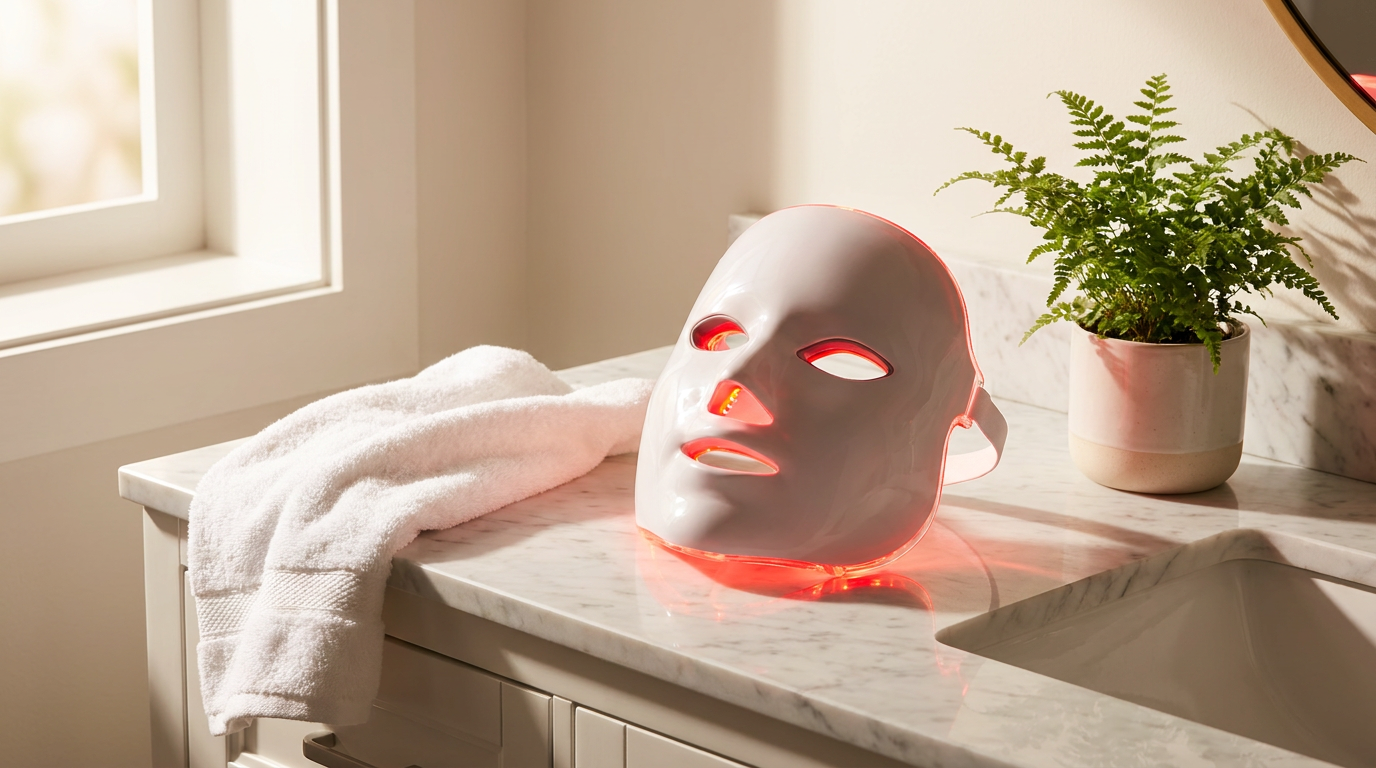
If you have scrolled through social media recently, you have likely seen the futuristic, glowing masks that look straight out of a science fiction movie. These devices, emitting bright red and blue hues, have become a ubiquitous staple in modern skincare routines, promising everything from banished breakouts to erased wrinkles. But beyond the striking aesthetic, the rise of light-emitting diode technology represents a significant shift in how we approach skin health.[7]
The core question for many consumers is whether this trend is merely an expensive fad or a treatment grounded in actual science. Dermatologists and medical researchers confirm that the underlying technology, clinically known as photobiomodulation, is supported by a robust and growing body of legitimate medical literature.[4]
The origins of this treatment are surprisingly cosmic. In the 1990s, NASA began studying the effects of light-emitting diodes to promote plant growth in space. Researchers soon discovered that the specific wavelengths of light also accelerated wound healing and tissue regeneration in astronauts, prompting the medical community to investigate its potential for human skin.[2]
To understand how shining a light on your face can physically change your skin, you have to look at the cellular level. Red and near-infrared light are capable of penetrating the outer layers of the skin without causing damage. Once inside, these light photons are absorbed by the mitochondria, which act as the microscopic powerhouses of our cells.[2][4]

Specifically, the light stimulates an enzyme called cytochrome c oxidase. This stimulation boosts the production of adenosine triphosphate, or ATP, which is the primary energy currency of the body. With an abundance of ATP, cells suddenly have the excess energy required to repair damage, regenerate tissue, and function at an optimal, youthful level.[5]
The most sought-after benefit of this cellular energy boost is anti-aging. As we age, our natural collagen production slows down, leading to structural weakness, fine lines, and sagging. Red light therapy directly activates fibroblasts, which are the specialized cells in the dermis responsible for synthesizing new collagen and elastin.[1][3]
Clinical studies have demonstrated that consistent exposure to these specific wavelengths can increase dermal thickness, smooth overall skin texture, and visibly reduce the appearance of fine lines. However, experts emphasize that this is a gradual biological process of rebuilding the skin's structural foundation from the inside out, not an instant cosmetic fix.[1][4]

However, experts emphasize that this is a gradual biological process of rebuilding the skin's structural foundation from the inside out, not an instant cosmetic fix.
Beyond anti-aging, photobiomodulation is highly effective at reducing systemic and localized inflammation. This makes it an incredibly valuable tool for managing chronic inflammatory skin conditions like rosacea, eczema, and psoriasis. By calming the inflammatory response, the light helps soothe redness and supports a compromised skin barrier.[2][3]
For acne sufferers, light therapy often employs a dual-wavelength approach. While blue light is utilized to target and destroy the specific bacteria on the skin's surface that cause breakouts, red light is applied afterward to soothe the resulting inflammation and accelerate the healing of active blemishes.[5][6]
Wound healing remains one of the primary medical applications of the technology. By enhancing microcirculation and delivering more oxygen and vital nutrients to damaged tissues, red light therapy helps fade acne scars, minimizes surgical scars, and speeds up recovery times after aggressive cosmetic procedures like chemical peels or laser resurfacing.[2][3]
Despite the proven benefits, dermatologists urge caution regarding consumer expectations, particularly with the booming market of at-home devices. The masks, wands, and panels sold for home use are significantly less powerful than the medical-grade LED arrays utilized in clinical settings.[1][6]

In-office treatments deliver a much higher intensity of light that penetrates deeper into the dermis, yielding faster and more pronounced clinical results. While at-home devices are generally considered safe and accessible, their lower power output means they require immense dedication to achieve visible structural changes.[1][3]
Consistency is the ultimate deciding factor for success. For at-home devices to be truly effective, users must commit to multiple sessions per week for a minimum of four to six months. It is a slow, cumulative process that demands patience and routine integration.[4][7]
The safety profile of the treatment is exceptionally strong. Unlike ultraviolet light, which damages cellular DNA and drastically increases the risk of skin cancer, red and near-infrared light do not contain any UV rays. The therapy is entirely non-invasive, painless, and carries minimal side effects, occasionally causing only temporary, mild redness.[2][4]
Ultimately, red light therapy is not a standalone miracle cure that will replace a comprehensive skincare routine. It works best as a complementary treatment alongside daily sun protection, proper hydration, and a healthy lifestyle. When used correctly and consistently, it serves as a powerful, science-backed tool to help the skin behave younger, heal faster, and maintain long-term resilience.[1][7]
How we got here
1960s
Light-emitting diode (LED) technology is first developed and introduced for commercial use.
1990s
NASA begins studying LED light therapy to promote plant growth and accelerate wound healing for astronauts in space.
Early 2000s
Dermatologists begin adopting clinical-grade LED panels for in-office anti-aging and acne treatments.
2020s
Advancements in consumer technology lead to a massive boom in the availability of at-home LED masks and wands.
Viewpoints in depth
Clinical Dermatology
Focuses on the proven efficacy of high-powered, in-office treatments for specific medical and aesthetic conditions.
Dermatologists emphasize that while the science of photobiomodulation is sound, the dosage matters immensely. Medical-grade LED panels deliver precise, high-intensity wavelengths capable of reaching the deeper dermis to treat severe acne, rosacea, and significant collagen loss. From this perspective, at-home devices are viewed as supplementary maintenance tools rather than primary treatments, and patients are encouraged to seek professional consultation to ensure their specific skin conditions are properly diagnosed and targeted.
Academic Researchers
Prioritizes the cellular mechanisms, long-term safety data, and biological pathways activated by light therapy.
For researchers, the fascination with red light therapy lies in its ability to fundamentally alter cellular behavior without causing physical trauma to the tissue. Unlike chemical peels or ablative lasers that rely on controlled damage to trigger a healing response, photobiomodulation directly upregulates ATP production via the mitochondria. This camp is focused on standardizing treatment protocols, determining the exact optimal wavelengths and exposure times, and expanding the therapy's applications beyond dermatology into systemic inflammation and wound healing.
Consumer Health Advocates
Values the accessibility, non-invasive nature, and democratization of skincare technology through at-home devices.
This perspective champions the shift of red light therapy from exclusive, expensive medical spas into the hands of everyday consumers. While acknowledging that at-home masks and wands are less powerful, advocates argue that the convenience allows for the high frequency of use required to see cumulative benefits. They view red light therapy as a foundational pillar of proactive wellness and aging gracefully, offering a safe, chemical-free alternative to more aggressive cosmetic interventions.
What we don't know
- The exact optimal 'dose' or exposure time required for specific skin conditions, which varies widely across different devices.
- The long-term effects of decades-long daily use of high-powered at-home LED devices.
- How effectively at-home devices perform on severe, cystic acne compared to clinical interventions.
Key terms
- Photobiomodulation
- The scientific term for using specific wavelengths of light to stimulate cellular function, reduce inflammation, and promote tissue healing.
- Mitochondria
- The microscopic 'powerhouses' of the cell that absorb light energy and convert it into usable cellular energy.
- Adenosine Triphosphate (ATP)
- The primary energy carrier in cells, which increases during red light therapy to fuel tissue repair and collagen production.
- Fibroblasts
- Specialized cells located in the dermis that are responsible for producing collagen and elastin, giving skin its structure and firmness.
- Near-Infrared Light
- Invisible light wavelengths (typically 810–850 nm) that penetrate deeper into the skin than visible red light to target deep tissue and inflammation.
Frequently asked
Does red light therapy contain UV rays?
No. Red and near-infrared light therapy uses specific, safe wavelengths that do not contain ultraviolet (UV) rays, meaning it cannot cause sunburn, DNA damage, or skin cancer.
Can I use red light therapy every day?
While it is generally safe for daily use, most dermatologists recommend three to five sessions per week. Cells need time to process the increased energy and carry out repair functions.
Does the treatment hurt?
No, the treatment is completely painless and non-invasive. Patients typically describe the sensation as feeling slightly warm and soothing on the skin.
How long until I see results?
Patience is required. While in-office treatments may yield faster results, at-home devices typically require four to six months of consistent use to show visible improvements in wrinkles and skin texture.
Sources
Source coverage
7 outlets
3 viewpoints surfaced







[1]American Academy of DermatologyClinical Dermatology
Red light therapy: Does it live up to the claims?
Read on American Academy of Dermatology →[2]Cleveland ClinicClinical Dermatology
Red Light Therapy: Benefits, Side Effects & Uses
Read on Cleveland Clinic →[3]Westlake DermatologyClinical Dermatology
The Skin Health Benefits of Red Light Therapy
Read on Westlake Dermatology →[4]Harvard Health PublishingAcademic Researchers
Is red light therapy all hype?
Read on Harvard Health Publishing →[5]Baylor College of MedicineAcademic Researchers
LED light therapy: How does it work on your skin?
Read on Baylor College of Medicine →[6]WebMDConsumer Health Advocates
LED Light Therapy: Uses, Benefits, and Risks
Read on WebMD →[7]Factlen Editorial TeamConsumer Health Advocates
Synthesis by Factlen editorial team
Read on Factlen Editorial Team →
Every angle. Every day.
Get lifestyle stories with full source coverage and perspective breakdowns delivered to your inbox.