
The Green-Collar Boom: How Vocational Training is Powering the Renewable Energy Transition
As AI disrupts traditional white-collar career paths, a surge in debt-free apprenticeships is preparing a new generation for high-demand roles in the renewable energy sector.
By Factlen Editorial Team
- Vocational Advocates
- Argue that apprenticeships offer debt-free, high-security paths to the middle class, especially as AI disrupts white-collar entry roles.
- Climate Policy Planners
- Focus on the urgent need to scale the green workforce to meet renewable energy deployment targets, viewing the skills gap as a critical bottleneck.
- Traditional Higher Ed Defenders
- Maintain that while trades are valuable, a four-year degree still provides long-term adaptability and higher lifetime earnings ceilings in a rapidly changing economy.
What's not represented
- · Fossil fuel workers facing industry phase-outs
- · High school guidance counselors navigating the changing landscape
Why this matters
As artificial intelligence shrinks the availability of entry-level office jobs, the renewable energy transition is creating millions of high-paying, debt-free career paths in the physical trades. Understanding this shift is crucial for young adults planning their futures and policymakers racing to meet global climate targets.
Key points
- Recent college graduate unemployment reached 5.7% in late 2025, outpacing the national average.
- Entry-level knowledge work postings have declined sharply due to AI and corporate offshoring.
- Global renewable energy employment hit 16.6 million in 2024, driven heavily by solar PV installation.
- State governments are investing millions in vocational training to close the green energy skills gap.
- Gen Z workers are increasingly choosing debt-free apprenticeships over traditional four-year degrees.
For nearly half a century, the four-year college degree was the undisputed ticket to economic security in the United States. But in 2026, the calculus is changing for a new generation of workers. As the stability of white-collar work comes into question, federal data suggests a historic inversion is underway in the labor market. The traditional path of accumulating student debt for an entry-level desk job is losing its luster, replaced by a surge of interest in the physical trades.[1]
The numbers paint a stark picture of the white-collar squeeze. By late 2025, the unemployment rate for recent college graduates hit 5.7%, nearly 1.5 percentage points above the overall national average. This gap represents the widest divergence in over a decade. Simultaneously, entry-level knowledge-work postings—the roles college graduates have historically walked into—have collapsed. Postings for entry-level software development and financial analysis roles have plummeted by 67% and 56% respectively since 2018.[2]
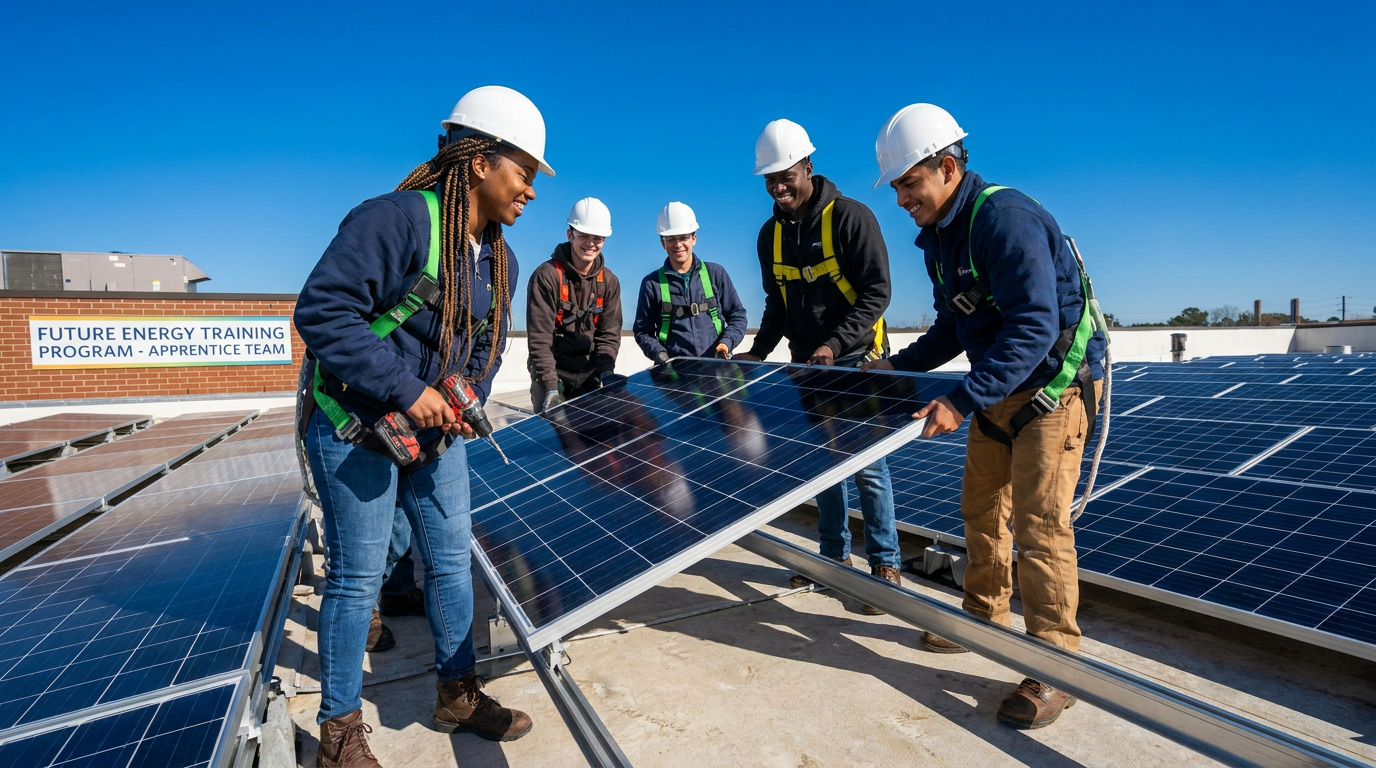
While generative AI and corporate offshoring have hollowed out the bottom rungs of the corporate ladder, a massive labor shortage has emerged in the physical world. The global race to decarbonize the economy has birthed the era of the "green-collar" worker. These are the professionals tasked with building, installing, and maintaining the infrastructure required for the renewable energy transition.[7]

The sheer scale of the green boom is unprecedented. In 2024, 16.6 million people held renewable energy jobs globally, with solar photovoltaic (PV) installation acting as the single largest employer at 7.3 million jobs. The International Labour Organization classifies these roles into three distinct layers: direct jobs like wind turbine technicians, indirect jobs in the manufacturing supply chain, and induced jobs supported by the local spending of green energy workers.[3]
To fill these millions of roles, the industry is bypassing the traditional university system and resurrecting an ancient model of workforce development: the apprenticeship. But these are not the apprenticeships of the 20th century. Today's programs are highly technical, focusing on grid modernization, battery storage diagnostics, and high-voltage electrical systems.[7]
The modern registered apprenticeship operates on an "earn-while-you-learn" model. Unlike college students who often exit school with crippling debt and no practical experience, apprentices are paid employees from day one. They split their time between rigorous classroom instruction and supervised, on-the-job training, often securing full-time employment with their training sponsor upon completion.[6]
State governments are recognizing that climate goals are impossible to meet without a massive expansion of this vocational pipeline. In April 2026, New York Governor Kathy Hochul announced a $50 million funding expansion specifically targeting clean energy workforce development. Administered by NYSERDA, the initiative funds career pathways, upskilling, and technical training in building electrification and smart grid technologies.[4]
State governments are recognizing that climate goals are impossible to meet without a massive expansion of this vocational pipeline.
Other states are adopting direct-to-worker subsidies to remove the financial friction of career transitions. The Nevada Clean Energy Fund recently launched a training voucher program that covers up to $15,000 per trainee. These funds can be applied to solar-related courses, union apprenticeships, and certifications, allowing job seekers to turn a short vocational course into a lucrative career without taking on tuition debt.[5]

This shift is being driven enthusiastically by Generation Z. Recent labor reports indicate that apprenticeship program enrollments grew by over 11% in 2024, while construction and skilled trades saw a 17% spike in applications from young adults. For a generation uniquely anxious about both climate change and economic instability, green-collar work offers a rare convergence of financial pragmatism and planetary impact.[6]
There is also a profound psychological appeal to the trades in the 2020s. Young workers are increasingly valuing predictable hours, tangible real-world results, and immunity from the screen fatigue that plagues modern office work. Furthermore, they recognize that while an artificial intelligence model can write code or draft a legal brief, it cannot climb a roof to install a solar array or splice a high-voltage cable.[1][6]
Despite the surge in vocational enrollment, the skills gap remains a critical bottleneck for the energy transition. Industry analysts warn that solar panels are currently being manufactured and shipped faster than qualified technicians can be trained to install them. Wind farms in remote regions frequently face commissioning delays not due to a lack of capital, but a severe shortage of maintenance engineers.[3]

To close this gap, the definition of vocational education is expanding to include rapid upskilling for mature workers. Transition pathways are being designed specifically for fossil fuel workers, allowing them to port their existing mechanical and electrical expertise into the renewable sector. This ensures that the green economy absorbs, rather than abandons, the legacy energy workforce.[7]
In this new educational paradigm, industry-recognized micro-credentials are functioning as the new bachelor's degrees. Certifications like the North American Board of Certified Energy Practitioners (NABCEP) for solar professionals, or the Global Wind Organisation (GWO) safety training, carry more weight with clean energy employers than a traditional four-year liberal arts diploma.[3]
The macroeconomic implications of this shift are profound. For the first time since the Bureau of Labor Statistics began tracking the data in the 1990s, the unemployment gap between workers with bachelor's degrees and those with occupational associate's degrees flipped in late 2025, giving trade workers a statistical edge.[1]

Ultimately, the rise of the green-collar worker represents a fundamental redefinition of what constitutes a "good job" in the 21st century. By aligning the urgent necessity of climate action with debt-free pathways to the middle class, vocational education is proving that the future of the economy will be built by skilled hands, not just algorithms.[7]
How we got here
2018–2025
Entry-level knowledge work postings decline by up to 67% as automation and AI reshape corporate hiring.
2024
Global renewable energy employment reaches 16.6 million, with solar PV accounting for nearly half of all green-collar roles.
Late 2025
The unemployment gap flips, with trade workers experiencing lower unemployment rates than recent college graduates for the first time in decades.
April 2026
New York State commits $50 million to clean energy workforce training, signaling a major policy shift toward state-funded green apprenticeships.
Viewpoints in depth
Vocational Advocates
Supporters of trade education argue that apprenticeships offer a superior, debt-free path to economic stability.
Vocational advocates point to the collapsing market for entry-level white-collar jobs as proof that the 'college-for-all' model is outdated. They argue that by pushing every student toward a four-year degree, society has saddled a generation with crippling debt while leaving critical infrastructure roles unfilled. In their view, the earn-while-you-learn apprenticeship model is the most pragmatic response to an AI-driven economy, offering young workers immediate income, zero tuition debt, and skills that cannot be easily automated or offshored.
Climate Policy Planners
Government and environmental strategists view the vocational pipeline as the primary bottleneck to achieving global climate targets.
For climate planners, the green-collar boom is less about individual career choices and more about existential infrastructure needs. They warn that ambitious state and federal decarbonization targets are mathematically impossible to hit without a massive, immediate expansion of the skilled trades workforce. This camp advocates for aggressive government intervention—such as New York's $50 million NYSERDA funding and Nevada's training vouchers—to subsidize training, remove financial barriers, and rapidly scale the number of qualified technicians capable of modernizing the grid.
Traditional Higher Ed Defenders
Proponents of the university system caution against abandoning four-year degrees entirely in favor of specialized trades.
While acknowledging the current labor shortage in the physical trades, defenders of traditional higher education argue that a four-year degree still provides unmatched long-term adaptability. They caution that highly specialized vocational training can leave workers vulnerable if specific green technologies become obsolete or if the physical toll of trade work shortens their careers. From this perspective, a liberal arts or broad STEM education teaches critical thinking and soft skills that allow workers to pivot across multiple industries over a 40-year career, ultimately leading to higher lifetime earnings.
What we don't know
- Whether the current surge in vocational enrollment will be enough to fully close the projected green energy skills gap by 2030.
- How long the statistical unemployment advantage for trade workers over recent college graduates will last as the economy continues to adapt to AI.
Key terms
- Green-Collar Worker
- A professional whose job directly contributes to reducing environmental harm or building clean energy infrastructure.
- Registered Apprenticeship
- A federally or state-recognized training program that combines paid on-the-job experience with structured classroom instruction.
- NYSERDA
- The New York State Energy Research and Development Authority, a public benefit corporation that funds and advances clean energy initiatives.
- NABCEP Certification
- The North American Board of Certified Energy Practitioners, a widely recognized professional credential for solar photovoltaic installers.
- Induced Jobs
- Employment created in local economies when direct and indirect industry workers spend their wages on community goods and services.
Frequently asked
What is a green-collar job?
A green-collar job is a role that directly contributes to environmental sustainability and decarbonization, such as a solar panel installer, wind turbine technician, or energy efficiency specialist.
Do I need a college degree to work in renewable energy?
No. Many of the fastest-growing roles in the clean energy sector rely on registered apprenticeships, vocational certificates, and on-the-job training rather than traditional four-year degrees.
Are apprentices paid during their training?
Yes. Registered apprenticeships operate on an 'earn-while-you-learn' model, meaning participants receive a paycheck from day one while splitting their time between the classroom and the job site.
Is AI a threat to green-collar jobs?
Currently, physical trades are highly insulated from AI disruption. While artificial intelligence can automate digital tasks, it cannot perform hands-on mechanical repairs or physical infrastructure installation.
Sources
Source coverage
7 outlets
3 viewpoints surfaced







[1]The Washington PostTraditional Higher Ed Defenders
Historically, U.S. workers with a bachelor's degree enjoyed better outcomes. That's shifting.
Read on The Washington Post →[2]zScale CapitalVocational Advocates
A degree used to be a safety net. The data says it isn't anymore.
Read on zScale Capital →[3]Green Fuel JournalClimate Policy Planners
What Are Renewable Energy Jobs? The Rise of the Green-Collar Worker
Read on Green Fuel Journal →[4]New York State GovernmentClimate Policy Planners
Governor Hochul Announces $50 Million for Clean Energy Workforce Development
Read on New York State Government →[5]Nevada Clean Energy FundClimate Policy Planners
Nevada Solar for All Training Voucher Program
Read on Nevada Clean Energy Fund →[6]The Blue Collar RecruiterVocational Advocates
Gen Z is leading a major shift away from traditional college degrees
Read on The Blue Collar Recruiter →[7]Factlen Editorial Team
Synthesis by Factlen editorial team
Read on Factlen Editorial Team →
Every angle. Every day.
Get education stories with full source coverage and perspective breakdowns delivered to your inbox.