
How Regenerative Tourism and Ancient Trails Are Revitalizing Rural Japan
As Japan grapples with overtourism in its major cities and severe depopulation in the countryside, a new travel model is emerging. Regenerative tourism aims to leave rural communities better off by turning visitors into active participants in ecological and cultural preservation.
By Factlen Editorial Team
- Rural Communities
- Focuses on economic survival, cultural preservation, and maintaining quality of life.
- Sustainable Tourism Operators
- Focuses on low-impact travel, ecological restoration, and authentic experiences.
- Academic Researchers
- Focuses on post-growth economic models, demographic challenges, and systemic shifts.
What's not represented
- · Urban Commuters
- · Mass-Market Hotel Developers
Why this matters
As global travel rebounds to record levels, the tension between overtourism and local quality of life has reached a breaking point. Japan's experiment with regenerative tourism offers a blueprint for how travelers can actively heal, rather than consume, the destinations they visit.
Key points
- Japan's tourism spending hit a record $35 billion in 2023, but the influx is heavily concentrated in major cities, causing overtourism.
- Rural Japanese communities are countering demographic decline by embracing regenerative tourism, which asks visitors to actively improve the destination.
- Initiatives along ancient routes like the Kumano Kodo and Nakasendo retain economic benefits locally by utilizing family-run inns and local guides.
- Programs like Nagano's 'Travelling Creature University' involve tourists directly in biodiversity monitoring and land regeneration.
- The model faces long-term challenges, including a severe shortage of young locals to maintain hospitality infrastructure and the threat of encroaching modernization.
The paradox of Japan's current tourism boom is written plainly in its economic data and crowded streets. In 2023, international visitors injected a record-breaking $35.05 billion into the national economy, and by April 2024, arrivals had already surged past the 10 million mark. Yet this massive influx is hyper-concentrated along the so-called "Golden Route"—the well-worn corridor linking Tokyo, Kyoto, and Osaka. These major urban centers are increasingly buckling under the weight of overtourism, which frustrates local residents, strains public infrastructure, and ultimately dilutes the authenticity of the visitor experience.[2]
Meanwhile, just a few hours away by bullet train, an entirely different crisis is unfolding across the Japanese countryside. Rural prefectures are facing severe demographic decline, driven by an aging population and the relentless migration of young people to urban centers. Historic villages are hollowing out, traditional agricultural industries are eroding, and centuries-old schools are closing their doors. For these remote communities, the challenge is not managing too many visitors, but rather finding a sustainable economic lifeline to prevent their towns from disappearing entirely.[3][4]
In response to this dual crisis, a paradigm shift is quietly taking root in Japan's rural prefectures: the rise of regenerative tourism. Moving beyond the traditional goal of sustainable travel—which primarily seeks to minimize the negative impacts of a trip—regenerative tourism asks a more ambitious question. It challenges visitors and operators to actively leave a destination better than they found it, transforming the act of travel into a tool for ecological restoration and cultural survival.[3][7]
The core mechanism of this movement relies on deliberately dispersing travelers away from saturated urban hubs and integrating them into the socio-ecological fabric of declining regions. Rather than treating tourists as passive consumers of a landscape, regenerative models invite them to become active participants. Visitors help fund local conservation efforts, sustain traditional agriculture, and preserve intangible cultural heritage through hands-on engagement and direct financial support to the community.[1][3]

Academic researchers studying Japan's transition into a "post-growth" economy note that this approach fundamentally challenges the extractive logic of the mass tourism industry. Instead of prioritizing high visitor volumes, rapid expansion, and multinational hotel developments, regenerative models focus on relational encounters. They prioritize long-term community resilience, ensuring that the local environment and social structures are strengthened, rather than depleted, by the presence of outsiders.[3]
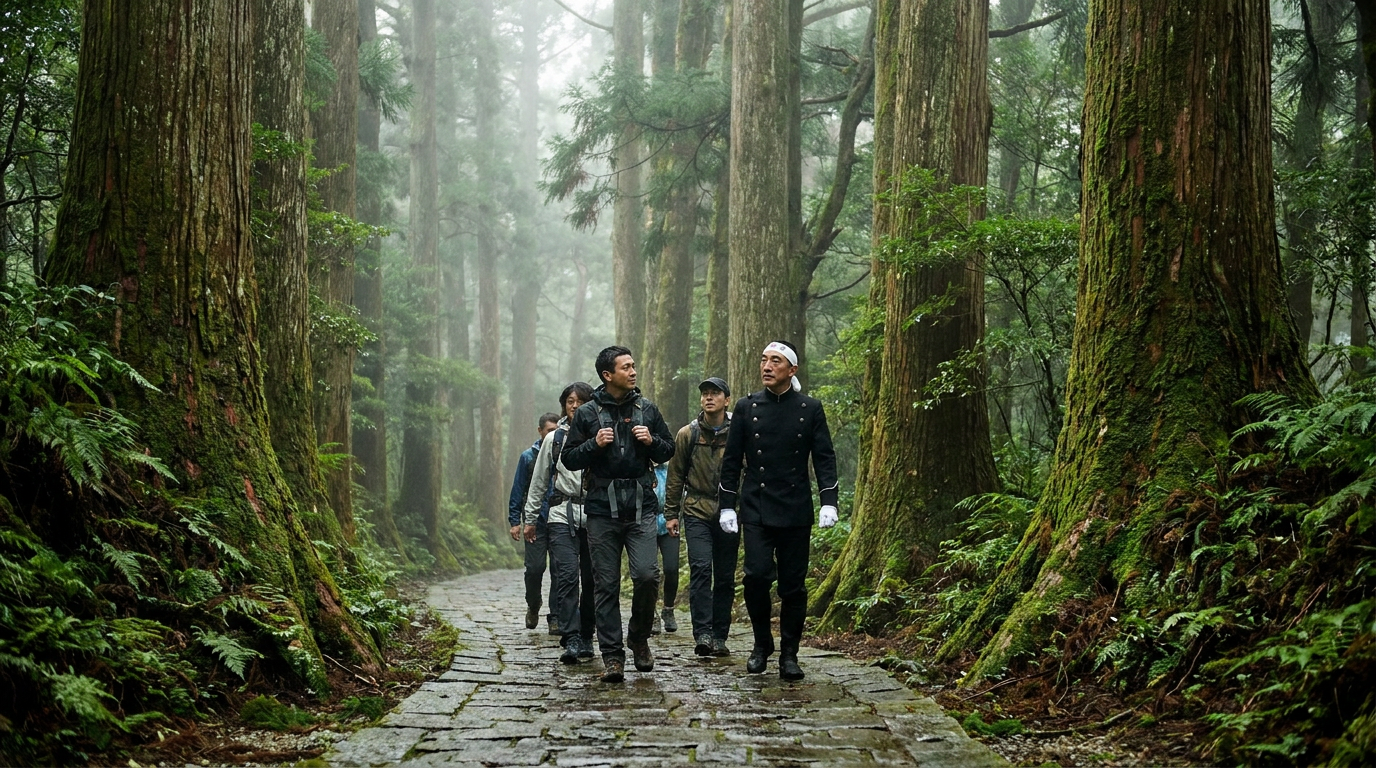
One of the most prominent and successful examples of this shift is the revitalization of the Kumano Kodo, a 1,000-year-old network of pilgrimage trails in Wakayama Prefecture. Recognized as a UNESCO World Heritage site, the trail winds through dense, cedar-covered mountains and connects remote, spiritually significant shrines. For decades, the villages along the route suffered from the same depopulation plaguing the rest of rural Japan.[5]
To reverse this trend, local organizations like the Tanabe City Kumano Tourism Bureau deliberately engineered a low-impact, high-value tourism model. Rather than courting large-scale hotel developers to accommodate busloads of tourists, the region relies on a network of small, family-run guesthouses known as minshuku. This intentional bottleneck in accommodation capacity ensures that the region cannot physically be overrun by mass tourism, naturally limiting visitor numbers to a sustainable level.[5]
This structural limitation guarantees that the economic benefits of tourism circulate directly and deeply within the local community. Visitors walking the Kumano Kodo eat locally grown food prepared by their hosts, bathe in community-maintained hot springs, and hire regional guides. This localized micro-economy has proven so effective that it has successfully reversed population decline in specific trailside towns, providing a viable livelihood that encourages younger generations to stay.[5]
This structural limitation guarantees that the economic benefits of tourism circulate directly and deeply within the local community.
A similar transformation is unfolding along the Nakasendo, the ancient inland mountain route that once connected Kyoto and Edo (modern-day Tokyo) during the 17th century. The trail passes through 69 historic post towns, many of which had fallen into deep obscurity and physical disrepair during Japan's rapid post-war economic boom, bypassed by modern highways and high-speed rail networks.[6]

Today, the Kiso Valley section of the Nakasendo is experiencing a vibrant renaissance driven by slow travel. Guided walking tours lead visitors through beautifully preserved towns like Tsumago and Magome, employing local artisans, woodcrafters, and historians along the way. By valuing and monetizing their traditional skills, the tourism economy provides these artisans with a sustainable income stream that justifies remaining in their ancestral villages.[6]
The regenerative impact of these initiatives extends beyond economics into direct environmental stewardship. In Nagano Prefecture's Ikusaka Village, a recently launched program called the "Travelling Creature University" exemplifies this hands-on approach. The award-winning initiative invites tourists to step off the sidelines and participate directly in land regeneration workshops, biodiversity monitoring, and ecosystem restoration.[1]
Operating under an innovative, decentralized community-led model, the Ikusaka project allows both local residents and visiting participants to democratically co-create the region's future. Visitors learn about traditional medicinal cuisine, help restore degraded natural landscapes, and forge deep emotional connections to the area. This relational approach encourages repeat visits and fosters a sense of shared ownership over the village's survival.[1]
The Japan National Tourism Organization (JNTO) has formally recognized the necessity of this shift away from volume-driven travel. In its recent strategic white papers, the agency emphasizes the urgent need to create sustainable tourism areas that protect residents' quality of life. The government is actively promoting initiatives that leverage digital transformation to distribute visitors more evenly across the archipelago, easing the burden on the Golden Route.[2]
This top-down endorsement is yielding measurable results. Currently, 24 Japanese cities and towns have been listed in the Green Destinations Top 100, a rigorous global standard for sustainable travel management. The national government provides targeted support and funding to local municipalities aiming to achieve this certification, signaling a broad institutional commitment to grassroots regenerative efforts.[2]

Despite these inspiring successes, the regenerative model faces significant structural hurdles. The most pressing is the sheer demographic reality of rural Japan. Even with an influx of high-value, respectful tourists, there is a critical shortage of young locals willing to take over family-run inns, guide long hikes, or maintain the labor-intensive agricultural terraces that visitors come to see.[3][4]
Furthermore, the delicate balance of slow travel is constantly threatened by the march of encroaching modernization. For example, the upcoming Chuo Shinkansen maglev train is slated to place quiet Nakasendo staging posts like Nakatsugawa within a mere 30-minute commute of Tokyo. Locals and operators worry that this hyper-connectivity could permanently alter the region's remote charm, transforming historic sanctuaries into suburban commuter towns.[6]
There is also the inherent tension of scaling a model that relies so heavily on intimacy and small numbers. Regenerative tourism is, by definition, resource-intensive to manage and difficult to expand. If a rural destination becomes too successful at marketing its "undiscovered" authenticity, it risks triggering the exact cycle of overtourism and extraction that it initially sought to avoid.[3][7]

Yet, for rural communities staring down the barrel of demographic extinction, the regenerative framework offers a highly compelling lifeline. It proves that the visitor economy does not have to be an extractive industry that commodifies local culture for mass consumption. Instead, it can be a collaborative partnership that breathes new life into forgotten spaces.[4][7]
By inviting travelers to share in the profound responsibility of preserving Japan's ancient landscapes and traditions, these rural enclaves are crafting a vital blueprint for the future of global travel. It is a hopeful, necessary model where the journey actively heals both the traveler and the destination, ensuring that the beauty of rural Japan endures for generations to come.[7]
How we got here
1600s
The Nakasendo Trail is established during the Edo period to connect Kyoto and Tokyo.
Late 20th Century
Japan's post-war economic boom and urbanization lead to severe depopulation in rural trailside villages.
2004
The Kumano Kodo pilgrimage routes are designated as a UNESCO World Heritage site, sparking initial conservation efforts.
2023
International travel spending in Japan hits a record $35 billion, exacerbating overtourism on the Golden Route and accelerating the push for rural dispersal.
April 2024
Visitor arrivals to Japan surpass 10 million in just four months, prompting the JNTO to heavily promote sustainable and regenerative travel models.
Viewpoints in depth
Rural Communities & Local Businesses
Focuses on economic survival, cultural preservation, and maintaining quality of life.
For the residents of Japan's aging rural villages, regenerative tourism is primarily a tool for survival. Facing the erosion of traditional industries and the closure of local schools, these communities view low-impact, high-value tourism as a way to create sustainable jobs that encourage young people to stay. They strongly advocate for community-led models, like family-run minshuku and local guiding, ensuring that the economic benefits do not leak out to multinational hotel chains.
Sustainable Tourism Operators
Focuses on low-impact travel, ecological restoration, and authentic experiences.
Tour operators specializing in regenerative travel argue that the traditional mass-tourism model is inherently extractive. They believe that visitors should be active participants in a destination's well-being, not just passive consumers. By organizing hands-on activities like biodiversity monitoring, trail maintenance, and farm-to-table dining, these operators aim to foster deep emotional connections between travelers and the landscape, proving that tourism can actively heal degraded ecosystems.
Academic & Policy Researchers
Focuses on post-growth economic models, demographic challenges, and systemic shifts.
Researchers studying Japan's 'post-growth' economy view regenerative tourism as a necessary paradigm shift, but they remain cautious about its scalability. While they praise the model's focus on relational encounters and community resilience, they point out that rural Japan's demographic collapse is a massive structural hurdle. Academics warn that without a sufficient younger workforce to maintain the hospitality and agricultural infrastructure, even the most well-intentioned regenerative projects may struggle to survive long-term.
What we don't know
- Whether the regenerative tourism model can scale sufficiently to offset the broader macroeconomic impacts of Japan's rural depopulation.
- How the upcoming Chuo Shinkansen maglev train will permanently alter the slow-travel atmosphere of the Kiso Valley once it connects the region to Tokyo in 30 minutes.
Key terms
- Regenerative Tourism
- A travel model focused on actively improving the ecological, social, and economic health of a destination, rather than just minimizing harm.
- Golden Route
- The heavily traveled tourist itinerary in Japan that typically includes Tokyo, Hakone, Kyoto, and Osaka.
- Overtourism
- A situation where the volume of visitors to a destination negatively impacts the local environment, infrastructure, and residents' quality of life.
- Minshuku
- Traditional, family-operated Japanese bed-and-breakfasts that offer visitors an intimate look at local life and cuisine.
- DMO (Destination Management Organization)
- A local or regional group responsible for coordinating tourism strategies, marketing, and community impact.
Frequently asked
What is the difference between sustainable and regenerative tourism?
Sustainable tourism aims to minimize negative impacts and maintain the status quo. Regenerative tourism goes a step further, aiming to actively improve and restore the ecological and social health of the destination.
What is the Nakasendo Trail?
The Nakasendo is an ancient 534-kilometer inland route that connected Kyoto and Tokyo during the Edo period. It is famous for its 69 historic post towns, many of which are now preserved for walking tours.
How does tourism help combat Japan's rural depopulation?
By creating local jobs and funding the preservation of cultural heritage, low-impact tourism provides a sustainable economic incentive for young people to stay in or return to rural villages.
Can regenerative tourism solve overtourism in cities like Kyoto?
While it helps by dispersing some visitors to lesser-known regions, regenerative tourism is inherently small-scale and cannot entirely offset the massive volume of tourists visiting Japan's Golden Route.
Sources
Source coverage
7 outlets
3 viewpoints surfaced







[1]ZenbirdSustainable Tourism Operators
Nagano village launches second phase of award-winning regenerative tourism
Read on Zenbird →[2]Japan National Tourism OrganizationAcademic Researchers
White Paper on Tourism in Japan, 2024
Read on Japan National Tourism Organization →[3]Hiroshima UniversityAcademic Researchers
Regenerative tourism for rural revitalization in post-growth Japan
Read on Hiroshima University →[4]ResearchGateAcademic Researchers
Regenerative Creative Tourism and Community Revitalization
Read on ResearchGate →[5]Japan Transport and Tourism Research InstituteRural Communities
Activity - JTTRI-AIRO
Read on Japan Transport and Tourism Research Institute →[6]The Winding TrailRural Communities
Mountains in the mist - The Winding Trail
Read on The Winding Trail →[7]Factlen Editorial Team
Synthesis by Factlen editorial team
Read on Factlen Editorial Team →

Every angle. Every day.
Get travel stories with full source coverage and perspective breakdowns delivered to your inbox.