
Why Hexagonal Rackets Are Rewriting the Physics of Table Tennis
A century after the round paddle became standard, hexagonal table tennis rackets are taking over the professional circuit by expanding the sweet spot and shifting the center of gravity.
By Factlen Editorial Team
- Equipment Innovators
- Argue that geometric optimization is the logical next step in a sport defined by millimeter margins.
- Market Analysts
- Focus on the commercial impact of high-performance gear driving a multi-billion dollar industry.
- Regulatory Bodies
- Focus on the strict material requirements that govern the sport, regardless of the racket's outer shape.
What's not represented
- · Recreational players who find the new shapes too expensive
- · Referees dealing with equipment inspections
Why this matters
For amateur and professional players alike, equipment geometry represents the biggest leap in table tennis technology since the introduction of sponge rubber in the 1950s, offering an immediate upgrade in power and consistency.
Key points
- Hexagonal table tennis rackets are replacing traditional round paddles at the elite level.
- The angular design increases the racket's sweet spot by up to 11 percent.
- Flat edges shift the center of gravity, providing more leverage for powerful topspin loops.
- The International Table Tennis Federation allows rackets of any shape, provided they are flat and rigid.
For over a century, the silhouette of a table tennis racket has remained largely unchanged. The familiar oval shape has been the undisputed standard, a design so ingrained in the sport's culture that it seemed immune to fundamental innovation.[4]
But step into any elite training facility or watch a top-tier international broadcast today, and you will notice a jarring geometric disruption. The smooth curves of the traditional paddle are increasingly being replaced by sharp, angular edges.[4]
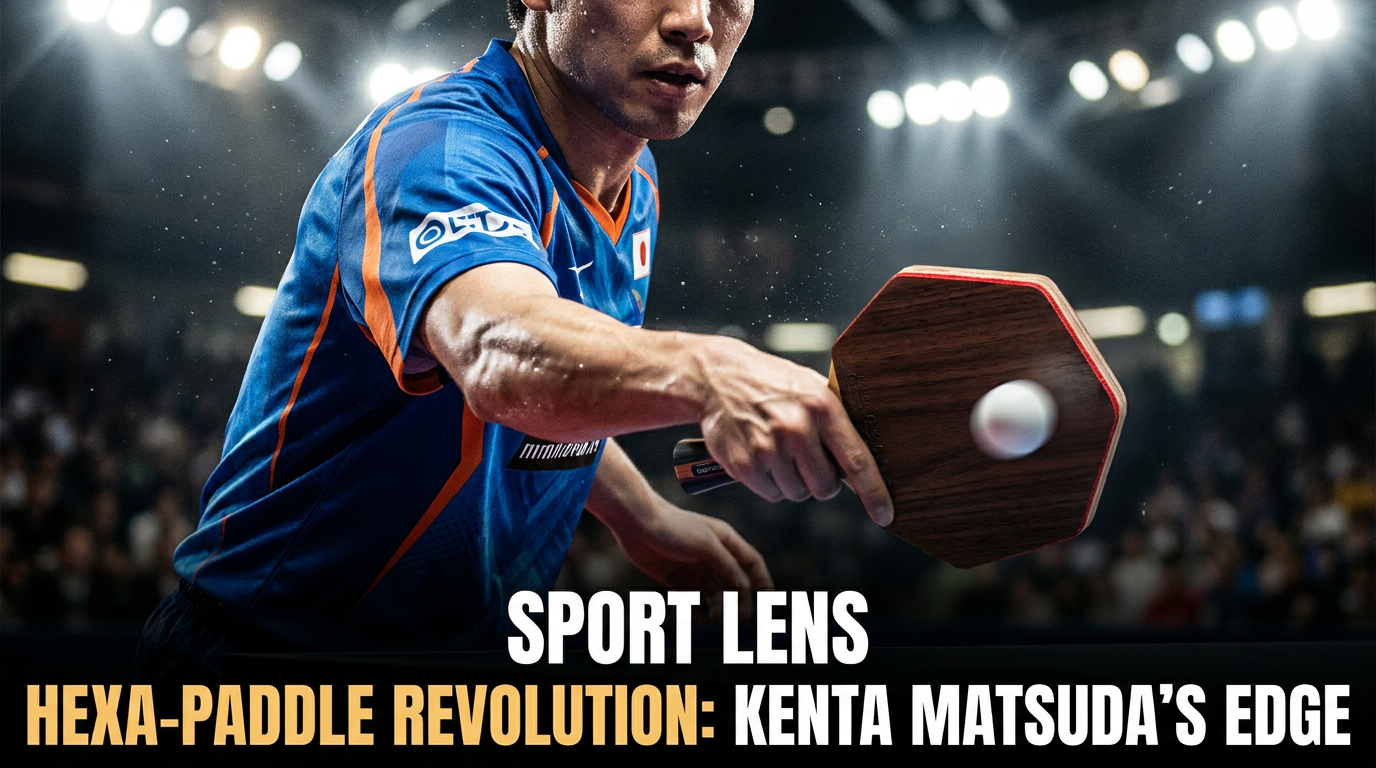
The hexagonal table tennis racket has arrived, and it is fundamentally rewriting the physics of the game. Popularized by Swedish star Truls Möregårdh, who wielded the distinctive Stiga Cybershape to global prominence, this angular design is much more than a visual gimmick.[1]
To understand why a six-sided paddle is taking over the sport, one must look at the concept of the "sweet spot." In table tennis, the sweet spot is the optimal area on the rubber surface that delivers maximum power, spin, and control upon impact.[4]
On a traditional round paddle, this optimal zone is concentrated in a relatively small circle near the center of the blade. If a player strikes the ball near the curved edges, the shot loses significant energy and accuracy, often resulting in an unforced error.[4]
The hexagonal design dramatically alters this geometry. By squaring off the top half of the racket, engineers have expanded the hitting surface exactly where players need it most during aggressive offensive strokes.[1]
For players using the standard "shakehand" grip, the hexagonal shape increases the optimal hitting area by roughly 11 percent. For those using the "penhold" grip, the increase is about 9 percent.[1]

This expansion means that off-center hits—which are inevitable during lightning-fast, high-stakes rallies—retain much more of their intended power and trajectory. The margin for error is effectively widened by the paddle's geometry.[1]
But the benefits extend beyond just a larger target area. The flat sides of the hexagon fundamentally shift the racket's center of gravity, altering the mechanics of the swing itself.[4]
The flat sides of the hexagon fundamentally shift the racket's center of gravity, altering the mechanics of the swing itself.
In a round paddle, the weight is distributed evenly along a continuous curve. In a hexagonal blade, the mass is pushed slightly further outward toward the tip, creating a "long feel" that gives players increased leverage and centrifugal force during aggressive topspin loops.[1]
Furthermore, the straight edges offer a unique tactical advantage during the short game. When returning a tight serve, players must often slide their paddle incredibly close to the table surface to execute a delicate "push" or a heavy "chop."[4]
The curved edge of a traditional paddle creates a natural pivot point that can make it difficult to get under a low-bouncing ball. The flat bottom edge of a hexagonal racket allows the player to align the blade parallel to the table, getting closer to the surface without scraping it.[1]

Despite its radical appearance, the hexagonal racket is perfectly legal in professional competition. The International Table Tennis Federation, the sport's global governing body, maintains surprisingly open regulations regarding equipment geometry.[2]
According to the official rules of table tennis, a racket "may be of any size, shape or weight but the blade shall be flat and rigid." As long as the paddle meets the material requirements, the outer silhouette is entirely up to the manufacturer.[2]
Those material rules dictate that at least 85 percent of the blade's thickness must be made of natural wood. The remaining 15 percent can incorporate synthetic fibers to enhance performance.[2]

To compensate for the larger surface area and shifted weight, modern hexagonal blades rely heavily on these advanced composite materials. Manufacturers typically use layers of carbon fiber sandwiched between the wood veneers to ensure the larger blade remains stiff and stable.[1]
The commercial impact of this geometric shift has been substantial. The global table tennis equipment market, valued at nearly $4.83 billion in 2025, is projected to surge to $7.85 billion by 2034.[3]

A significant driver of this growth is the demand for advanced, high-performance rackets that offer tangible technological advantages. As amateur players watch professionals succeed with hexagonal blades, the consumer market has eagerly embraced the trend.[3]
Will the round paddle eventually go extinct? Traditionalists argue that decades of muscle memory and the proven aerodynamics of the classic shape will keep it relevant for years to come, especially among recreational players.[4]
However, the rapid adoption of the hexagonal racket proves that even the most established sports have room for fundamental innovation. By simply rethinking the boundaries of the blade, engineers have given players a new edge in a game defined by millimeter margins.[4]
How we got here
1926
The International Table Tennis Federation (ITTF) is founded, establishing rules that allow rackets of any shape.
1950s
Sponge rubber is introduced, revolutionizing spin and speed, though the round blade shape remains the standard.
2021
Stiga introduces the Cybershape, bringing the first commercially successful hexagonal racket to the professional circuit.
2024
Truls Möregårdh wins Olympic silver using a hexagonal racket, cementing the design's elite status.
2026
Hexagonal and polygonal rackets become a major driver in the booming global table tennis equipment market.
Viewpoints in depth
Equipment Innovators
Argue that geometric optimization is the logical next step in a sport defined by millimeter margins.
Engineers and equipment designers view the hexagonal racket as a triumph of applied physics. By analyzing where elite players actually strike the ball during high-speed rallies, innovators realized that the traditional round shape was wasting valuable surface area. Expanding the top half of the blade while utilizing carbon fiber to maintain stiffness allows players to hit harder and more consistently without sacrificing maneuverability.
Regulatory Bodies
Focus on the strict material requirements that govern the sport, regardless of the racket's outer shape.
For the ITTF, the shape of the racket is less important than its composition. Regulators maintain that as long as the blade is flat, rigid, and composed of at least 85% natural wood, the integrity of the game is preserved. This open-ended rule regarding shape was designed decades ago to allow for personal customization, inadvertently paving the way for today's geometric revolution.
Market Analysts
Focus on the commercial impact of high-performance gear driving a multi-billion dollar industry.
Industry analysts see the hexagonal racket trend as a massive catalyst for the global equipment market. As recreational players seek to emulate the success of professionals, the demand for premium, technologically advanced rackets has surged. This shift is helping drive the table tennis equipment sector toward a projected $7.85 billion valuation by 2034, proving that innovation is highly profitable.
What we don't know
- Whether the hexagonal shape will completely replace the round paddle at the recreational level.
- How future iterations of polygonal rackets might further alter the sport's aerodynamics.
Key terms
- Sweet spot
- The optimal area on the racket face that delivers maximum power and control upon impact.
- Shakehand grip
- The most common way to hold a table tennis racket, resembling a traditional handshake.
- Penhold grip
- A grip style popular in Asia where the racket handle is held between the thumb and index finger, similar to holding a pen.
- Blade
- The rigid core of the table tennis racket, made primarily of wood and sometimes carbon fiber, excluding the rubber sheets.
Frequently asked
Are hexagonal table tennis rackets legal to use?
Yes. According to ITTF rules, a table tennis racket can be of any size, shape, or weight, provided the blade is flat and rigid.
Why do hexagonal rackets have a larger sweet spot?
By squaring off the top curves of a traditional paddle, the design expands the optimal hitting area exactly where players strike the ball during offensive loops.
Do hexagonal rackets feel heavier?
While the overall weight is similar to traditional rackets, the flat sides shift the center of gravity outward, creating a 'long feel' that provides more leverage during swings.
Sources
Source coverage
4 outlets
3 viewpoints surfaced




[1]STIGA SportsEquipment Innovators
Cybershape Carbon CWT Truls Möregårdh Table Tennis racket
Read on STIGA Sports →[2]International Table Tennis FederationRegulatory Bodies
ITTF Handbook: The Laws of Table Tennis
Read on International Table Tennis Federation →[3]Fortune Business InsightsMarket Analysts
Table Tennis Equipment Market Size, Share & Industry Analysis
Read on Fortune Business Insights →[4]Factlen Editorial TeamEquipment Innovators
Synthesis by Factlen editorial team
Read on Factlen Editorial Team →

More in sports
See all 10 stories →Standings
World Test Championship Standings: Australia Dominates as England's Lord's Triumph Shakes Up the Race
0 sources

Injury
Miguel Oliveira Completes Remarkable WorldSBK Return at Misano Following Shoulder Injury
0 sources

Sports Tech
How AI and Smart Gloves Are Fixing Boxing's Biggest Controversies
0 sources

Sports Science
How Biometric Data and Sports Science Are Extending MMA Careers
0 sources

Every angle. Every day.
Get sports stories with full source coverage and perspective breakdowns delivered to your inbox.