
The Science of Tangzhong: How a Simple Water Roux Transforms Home Baking
By pre-cooking a small portion of flour and water, bakers can trigger starch gelatinization to create exceptionally soft, long-lasting bread without commercial additives.
By Factlen Editorial Team
- Culinary Scientists
- Focus on the chemical mechanisms of starch gelatinization, hydration limits, and delayed retrogradation.
- Home Baking Educators
- Value the technique for its accessibility, reliable results, and ability to elevate standard home recipes.
- Factlen Editorial Team
- Synthesizes the scientific literature with practical baking applications to empower home cooks.
What's not represented
- · Gluten-free bakers
- · Industrial dough conditioner manufacturers
Why this matters
Understanding the chemistry of starch gelatinization allows home cooks to achieve bakery-level softness and shelf life without relying on ultra-processed dough conditioners or excessive amounts of butter.
Key points
- Pre-cooking a small portion of flour and water alters the starch structure, allowing dough to hold significantly more moisture.
- The trapped water creates internal steam during baking, resulting in a taller, fluffier loaf with a tender crumb.
- Gelatinized starches resist retrogradation, meaning the bread stays soft for days longer than standard recipes.
- The Tangzhong method uses a 1:5 flour-to-liquid ratio cooked on a stove, while Yudane uses a 1:1 ratio with boiling water.
- The technique can also be applied to whole wheat flours to soften the bran and improve the texture of brown bread.
For many home bakers, the joy of pulling a fresh loaf from the oven is often tempered by a frustrating reality: bread that is beautiful on day one frequently turns into a dense, crumbly brick by day two.[6]
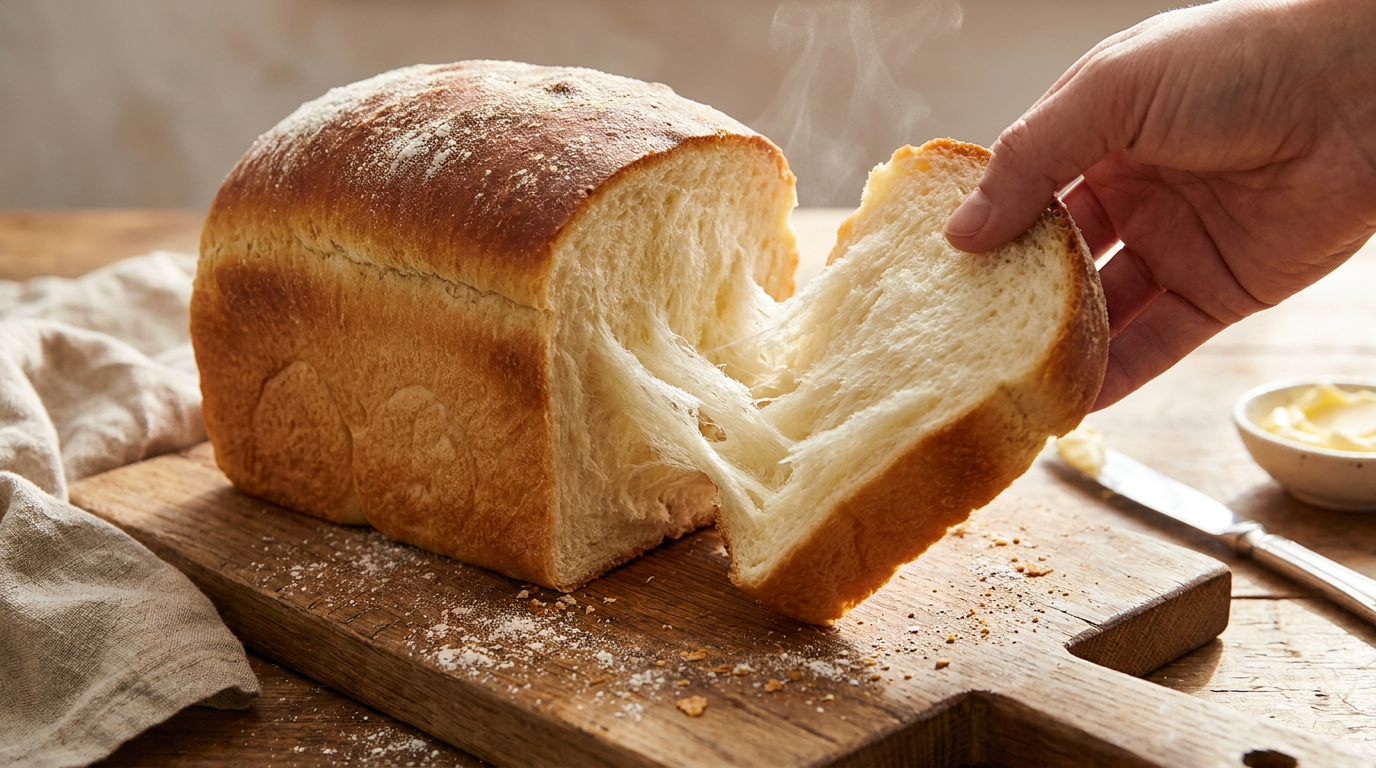
This rapid decline stands in stark contrast to the breads found in Asian bakeries, specifically the famous Japanese Hokkaido milk bread. These loaves boast a feathery, cloud-like crumb that practically melts in the mouth and miraculously retains its pillowy softness for nearly a week.[5]
The secret behind this enduring softness is not a chemical dough conditioner or an industrial preservative. Instead, it relies on a simple, highly effective technique of pre-cooking a small fraction of the recipe's flour and liquid into a thick paste before mixing the final dough.[6]
Known widely as the Tangzhong or Yudane method, this approach leverages a fundamental principle of food chemistry known as the pre-gelatinization of starches. By manipulating how wheat flour interacts with heat and water, bakers can fundamentally alter the structural limits of their bread.[1][2]
To understand the mechanics of this transformation, one must look at the microscopic structure of wheat flour. In their raw state, starch granules are tightly packed, crystalline, and relatively hydrophobic, meaning they can only absorb a limited amount of ambient-temperature water during a standard mixing process.[1]
However, when flour and water are heated together to approximately 65°C (150°F), a profound structural transformation occurs. The introduction of thermal energy breaks down the intermolecular bonds holding the starch molecules together.[2][3]
As these crystalline structures unravel, the starch granules swell and absorb massive amounts of the surrounding liquid. Eventually, they burst, leaching a starch called amylose into the water and creating a highly viscous, sticky gel that resembles papier-mâché paste.[1][3]

By incorporating this pre-cooked gel into a standard bread dough, bakers fundamentally alter the dough's hydration mechanics. The gelatinized starches act like microscopic sponges, locking water into a stable, heat-resistant matrix.[1][2]
This creates a unique paradox in the bread-making process. Typically, pushing a dough to higher hydration levels makes it unmanageably sticky and difficult to knead. But because the excess water in a Tangzhong is chemically trapped within the starch gel, the overall dough feels remarkably smooth, strong, and cohesive.[2]
Typically, pushing a dough to higher hydration levels makes it unmanageably sticky and difficult to knead.
During the baking process, this trapped moisture serves a critical structural purpose. As the internal temperature of the loaf rises, the locked-in water converts to steam, creating a powerful upward lift that results in a taller, lighter loaf with an incredibly tender crumb.[3]
The benefits of pre-gelatinization extend far beyond the initial bake. The primary cause of bread staling is not simple moisture evaporation, but rather a chemical process called retrogradation, where starch molecules slowly recrystallize and expel water as they cool and age.[1]
Because the starches in a Tangzhong or Yudane have been thoroughly pre-gelatinized, their crystalline structure is permanently dismantled. They strongly resist recrystallization, dramatically slowing the retrogradation process and keeping the bread soft for days longer than a standard loaf.[1][2]

While the terms are often used interchangeably in modern baking communities, there are two distinct variations of this technique: the Chinese Tangzhong and the Japanese Yudane.[2][5]
The Tangzhong method typically utilizes a 1:5 ratio of flour to liquid by weight. The mixture is whisked continuously in a saucepan over medium heat until it thickens into a pudding-like paste, which must then be cooled to room temperature before being incorporated into the main dough.[2][5]
The Yudane method, which is heavily favored by commercial bakeries for its scalability, uses a 1:1 ratio of flour to boiling water. Instead of cooking the mixture on a stove, the boiling water is simply poured directly over the flour, stirred into a thick paste, and left to rest—often overnight—to allow the starches to fully swell.[3][5]

Both methods yield remarkably similar results in the final bake. Culinary experiments have shown that Yudane can produce a slightly tighter, springier crumb with a higher rise, while Tangzhong often delivers maximum fluffiness. For home bakers, the choice usually comes down to workflow preference.[2][3]
Crucially, this technique is not limited to enriched white breads. Recent food science studies have demonstrated that applying the water roux method to whole wheat and brown flours significantly improves their baking performance and consumer appeal.[4]
Whole wheat doughs are notoriously dense because the sharp bran particles physically cut through developing gluten strands. Pre-gelatinizing a portion of the brown flour softens these harsh bran particles and increases the dough's overall elasticity, resulting in a lighter, more palatable whole grain loaf.[4]

Furthermore, because the pre-gelatinized starch provides such a reliable soft texture and extended shelf life, bakers can significantly reduce the amount of butter, eggs, or oil in their recipes. This allows for the creation of leaner, lower-fat breads that still mimic the luxurious mouthfeel of heavily enriched doughs.[3]
For home bakers, adopting the Tangzhong or Yudane method requires nothing more than a kitchen scale and a few extra minutes of preparation. Yet, this simple step bridges the gap between amateur loaves and professional-grade pastry, proving that the most powerful baking tools are often rooted in basic chemistry.[6]
How we got here
1800s
The Yudane method is believed to have originated in Japan as a way to create soft, rectangular milk bread loaves.
2001
A commercial patent for the Yudane method is filed in Japan, highlighting its value for large-scale bakery production.
2007
Taiwanese chef Yvonne Chen popularizes the stovetop Tangzhong variation across Asia with her influential book '65°C Bread Doctor'.
Viewpoints in depth
Commercial Bakery Manufacturers
Focus on the Yudane method for its scalability and cost-saving potential.
For large-scale bread manufacturers, the Yudane method is highly attractive because it requires less active labor than cooking a stovetop Tangzhong. Pouring boiling water from a tank over flour is easily automated. Beyond workflow, the pre-gelatinization process extends the shelf life of the bread naturally, allowing manufacturers to reduce their reliance on expensive fats like butter and chemical preservatives while still delivering a soft product to supermarket shelves.
Traditional European Bakers
Prioritize crust development and natural fermentation over extreme crumb softness.
Bakers trained in the traditional European style—focusing on crusty baguettes, sourdoughs, and lean rustic loaves—often view the water roux method as a specialty technique rather than a universal upgrade. European breads rely on a hard crust and a chewy, open crumb structure, whereas Tangzhong produces a tight, feathery, and crustless result. For these bakers, keeping quality is traditionally achieved through long, slow natural fermentation (sourdough) rather than starch pre-gelatinization.
Home Baking Enthusiasts
Embrace the technique for its accessibility and ability to elevate standard recipes.
For the home baker, the water roux method is a revelation. It allows amateurs to achieve bakery-level softness without needing professional dough conditioners or industrial mixers. Furthermore, because the technique relies entirely on water and flour, it has become incredibly popular in vegan baking communities, as it provides the rich, tender crumb usually associated with heavy egg and dairy enrichments, using only plant-based ingredients.
What we don't know
- The exact mathematical formula for calculating evaporation loss during the stovetop Tangzhong process, which varies widely by kitchen environment and stove type.
- Whether industrial-scale adoption of Yudane will eventually replace chemical dough conditioners entirely in mass-market supermarket breads.
Key terms
- Gelatinization
- The process where starch granules absorb liquid and swell when heated, eventually bursting to form a viscous gel.
- Retrogradation
- The recrystallization of starch molecules as bread cools and ages, which is the primary chemical cause of staling.
- Tangzhong
- A Chinese technique of cooking a 1:5 ratio of flour and liquid into a paste on a stovetop to improve bread texture.
- Yudane
- A Japanese technique of pouring boiling water over flour in a 1:1 ratio to pre-gelatinize starches without active cooking.
- Hydration
- The ratio of liquid to flour in a bread dough, usually expressed as a percentage of the total flour weight.
- Crumb
- The internal texture and structure of a baked loaf of bread, distinct from the exterior crust.
Frequently asked
Can I use milk instead of water for the roux?
Yes. Using milk instead of water adds fat and sugar to the dough, which further tenderizes the crumb and enhances the flavor of the final loaf.
How much of my recipe's flour should I use for Tangzhong?
Typically, bakers use between 5% and 10% of the total flour weight in the recipe to create the Tangzhong roux.
Can I prepare the roux in advance?
Yes. A cooked Tangzhong or Yudane can be stored in the refrigerator for up to three days, but it must be brought back to room temperature before mixing it into your dough.
Does this technique work for gluten-free baking?
While pre-gelatinizing gluten-free flours can help retain moisture, gluten-free baking lacks the specific starch-protein interactions of wheat, so the results vary and require different hydration ratios.
Sources
Source coverage
6 outlets
3 viewpoints surfaced






[1]BakerpediaCulinary Scientists
Tangzhong Method: Pre-gelatinizing starch for softer bread
Read on Bakerpedia →[2]The Perfect LoafHome Baking Educators
How to Make Tangzhong (and Yudane)
Read on The Perfect Loaf →[3]Institute of Culinary EducationCulinary Scientists
Tangzhong Method: A Revolutionary Baking Technique
Read on Institute of Culinary Education →[4]LWT – Food Science & TechnologyCulinary Scientists
The effect of the addition of gelatinized flour on dough rheology and quality of bread
Read on LWT – Food Science & Technology →[5]Asian InspirationsHome Baking Educators
Yudane vs Tangzhong: The Secret to Extra Fluffy Bread
Read on Asian Inspirations →[6]Factlen Editorial TeamFactlen Editorial Team
Synthesis by Factlen editorial team
Read on Factlen Editorial Team →
Every angle. Every day.
Get food drink stories with full source coverage and perspective breakdowns delivered to your inbox.