
The Rise of Local AI: How to Run Powerful Models on Your Everyday Laptop
Advancements in open-weight models and consumer hardware have made it possible to run powerful AI directly on personal laptops. By processing data locally, users gain complete privacy, zero subscription costs, and offline access to frontier-level intelligence.
By Factlen Editorial Team
- Open-Source Advocates
- Champions of decentralized AI who believe intelligence should be a public good.
- Privacy & Security Researchers
- Experts focused on data sovereignty and the risks of cloud-based data exfiltration.
- Enterprise IT Leaders
- Corporate strategists balancing AI capabilities with budget constraints and compliance.
What's not represented
- · Hardware Manufacturers
- · Cloud API Providers
Why this matters
For the past three years, using top-tier AI meant sending your private data, code, and documents to cloud servers owned by tech giants. Local AI flips that dynamic, putting the intelligence directly on your device so your data never leaves your possession.
Key points
- Running AI locally allows users to process data directly on their own devices, ensuring complete privacy and zero data exfiltration.
- Advancements in open-weight models like Llama 4 and Gemma 4 have brought frontier-level intelligence to smaller parameter sizes.
- A standard modern laptop with 16GB of RAM is now sufficient to run highly capable AI models.
- Tools like Ollama and LM Studio have removed technical barriers, allowing anyone to install a local AI in minutes.
- Local inference eliminates per-token API costs, making it free to generate unlimited text and code.
- The industry is shifting toward a hybrid model, using local AI for routine tasks and cloud AI for complex reasoning.
For the first few years of the generative AI boom, accessing state-of-the-art intelligence meant relying entirely on the cloud. Users typed prompts into web interfaces, and massive server farms owned by a handful of tech giants processed the requests. But in 2026, a quiet revolution has shifted the center of gravity back to the personal computer. Running Large Language Models (LLMs) locally—directly on a laptop or desktop—has transitioned from a niche hobby for machine learning engineers into a mainstream, accessible practice. Today, an estimated 55 percent of enterprise AI inference happens on-premises or on-device, driven by a desire for control and independence. This shift represents a fundamental democratization of artificial intelligence, placing frontier-level capabilities directly into the hands of everyday users without the need for an internet connection.[1][2]
The traditional cloud-based paradigm, while convenient, comes with inherent compromises. Every time a user asks a cloud AI to summarize a legal document, analyze a financial spreadsheet, or debug a proprietary codebase, that sensitive information is transmitted over the internet to a third-party server. For many professionals, enterprises, and privacy-conscious individuals, this data exfiltration is a non-starter. Furthermore, cloud APIs operate on a metered basis, charging users for every token generated or consumed. This creates a chilling effect on experimentation, as heavy usage can quickly lead to unpredictable and escalating monthly bills.[7][8]
Local AI solves these structural problems by severing the cord to the cloud. When an LLM runs locally, the model's weights and architecture are downloaded directly to the user's hard drive. All processing happens on the device's own CPU and GPU. The primary benefit is absolute data privacy: prompts, documents, and code never leave the machine, making it safe to process highly confidential information. Because the processing is handled by hardware the user already owns, there are zero subscription fees and no per-token costs, allowing for infinite, unmetered usage.[2][7]
This local revolution has been catalyzed by the rapid advancement of open-weight models. In 2026, the open-source community and major tech companies have released highly optimized models that punch far above their weight class. Meta's Llama 4, Google's Gemma 4, Alibaba's Qwen3, and even OpenAI's open-weight gpt-oss family have proven that you do not need a trillion-parameter behemoth to achieve excellent reasoning and coding capabilities. These models have been aggressively distilled and quantized—a mathematical process that reduces the precision of the model's weights to shrink its file size—allowing them to retain their intelligence while fitting into the memory constraints of consumer hardware.[3][8]

The hardware reality of 2026 has also caught up to the software. Previously, running a capable AI required a massive desktop workstation equipped with multiple expensive graphics cards. Today, a standard modern laptop with 16 gigabytes of RAM is entirely sufficient to run a highly capable 8-billion to 12-billion parameter model. For instance, Google's Gemma 4 12B model is specifically designed to fit within a 16GB memory footprint while delivering benchmark scores that rival much larger cloud models from just a year ago. For users with 32GB or 64GB of RAM, even more sophisticated reasoning models become accessible.[3][7]
Apple Silicon has emerged as a particularly potent weapon in the local AI landscape. The architecture of Apple's M-series chips—from the M1 through the latest M5—features unified memory. Unlike traditional PC architectures that separate system RAM from video RAM (VRAM), Apple's design allows the GPU to directly access the entire pool of system memory. This means a MacBook Pro with 64GB of unified memory can load massive AI models that would otherwise require thousands of dollars in dedicated discrete GPUs on a Windows machine. As a result, MacBooks have become the de facto standard for developers and researchers running heavy local inference.[2][8]
Apple has also played a massive role in normalizing the concept of local AI for the general public through Apple Intelligence. Integrated deeply into iOS and macOS, the cornerstone of Apple's AI strategy is "on-device processing." When a user asks their iPhone to summarize an email or find a specific photo, the operating system uses a local semantic index to process the request directly on the phone's silicon. This ensures that the AI is aware of the user's highly personal context—messages, calendar events, and locations—without ever collecting or transmitting that data to Apple's servers.[4]
Apple has also played a massive role in normalizing the concept of local AI for the general public through Apple Intelligence.
When a request is too complex for the iPhone or Mac to handle locally, Apple Intelligence utilizes a system called Private Cloud Compute. This architecture extends the device's privacy boundaries into the cloud. The servers process the data statelessly, meaning the information is used exclusively to fulfill the immediate request and is immediately erased from memory once the task is complete. Independent security researchers can cryptographically verify that no logs are kept and no data is stored, proving that the industry is moving toward a model where privacy is the default expectation, whether on-device or in the cloud.[4]

For users who want to run custom open-weight models, the software layer has become remarkably user-friendly. Just a few years ago, running a local LLM required navigating complex Python environments, compiling C++ code, and manually managing dependencies. Today, the friction has been entirely removed by a new generation of application wrappers that handle the heavy lifting behind the scenes. Anyone who knows how to download a standard desktop application can now have a private AI running on their machine in under five minutes.[5][7]
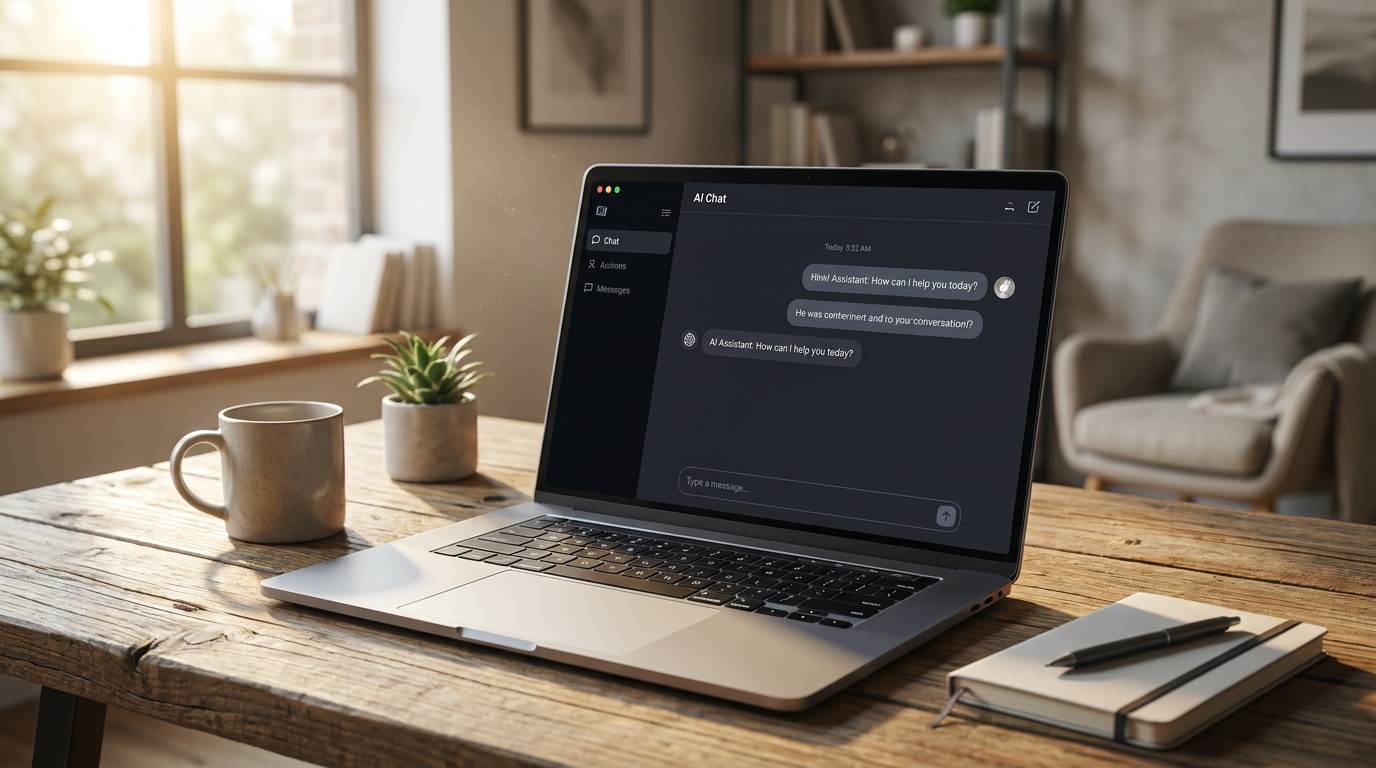
One of the most popular tools for everyday users is LM Studio. Often described as the "Spotify for LLMs," LM Studio provides a clean, intuitive graphical user interface for macOS, Windows, and Linux. Users can simply type the name of a model into a search bar, browse different quantization levels based on their available RAM, and click download. Once the model is saved to the drive, LM Studio provides a familiar chat interface that looks and feels exactly like ChatGPT, complete with performance metrics that show how fast the model is generating text.[2][5]
For developers and power users, Ollama has become the industry standard. Functioning similarly to Docker but built specifically for AI, Ollama allows users to download and run models using a single terminal command. Typing a command like "ollama run llama4" automatically fetches the model weights, configures the hardware acceleration, and drops the user into a chat prompt. More importantly, Ollama instantly spins up a local HTTP API, allowing developers to seamlessly integrate the local model into their own scripts, applications, and workflows without writing complex inference code.[5][8]

The financial implications of this local API capability are profound for software development. Cloud-based AI coding assistants charge per token, which can become prohibitively expensive when an agent needs to read through an entire codebase multiple times a day to understand context. By pointing coding tools and IDE extensions at a local Ollama instance, developers can generate thousands of lines of code and run endless automated tests for exactly zero dollars. The only cost is the electricity required to power the laptop.[6][7]
Beyond privacy and cost, local AI unlocks true offline capability. Because the model weights reside permanently on the local disk, the AI functions perfectly without an internet connection. This is a game-changer for professionals working on airplanes, researchers in remote field locations, or users dealing with intermittent network outages. A local LLM is always available, never suffers from server downtime, and never throttles the user due to high global traffic or rate limits.[2][6]
Specialized use cases are flourishing in this unconstrained environment. Developers are utilizing local models like Qwen3-Coder or DeepSeek to act as autonomous coding agents. Tools like OpenCode can be configured to use a local model to read a repository, edit files, and run unit tests entirely in the background. Because the code never leaves the laptop, enterprise developers can use these AI assistants on strictly confidential, proprietary codebases that would violate company policy if uploaded to a public cloud provider.[6][8]

Despite the rapid advancements, local AI is not poised to completely eradicate cloud models. Frontier models running on massive data centers still hold a distinct advantage in complex, multi-step reasoning, advanced mathematics, and sprawling agentic tasks. Instead, the industry is settling into a hybrid pattern. Users and applications route 80 percent of their daily tasks—summarization, drafting, code autocomplete, and basic queries—to fast, free, and private local models. Only when a task requires extreme reasoning capabilities is the query escalated to a paid cloud API.[2]
Ultimately, the rise of local LLMs represents a healthy rebalancing of power in the technology ecosystem. By proving that highly capable artificial intelligence can run efficiently on consumer hardware, the open-source community has ensured that AI will not be exclusively controlled by a few centralized gatekeepers. As laptops grow more powerful and models become more efficient, local AI guarantees that the future of computing remains personal, private, and firmly in the hands of the user.[1]
How we got here
Early 2023
The release of LLaMA by Meta sparks the open-source AI movement, leading developers to figure out how to run models on consumer hardware.
Late 2023
Tools like Ollama and LM Studio launch, removing the need for complex command-line setups and bringing local AI to everyday users.
Mid 2024
Apple announces Apple Intelligence, heavily emphasizing on-device processing and normalizing local AI for mainstream consumers.
2025-2026
A wave of highly optimized 8B to 12B parameter models, such as Llama 4 and Gemma 4, are released, offering cloud-level performance on standard laptops.
Viewpoints in depth
Open-Source Advocates
Champions of decentralized AI who believe intelligence should be a public good.
This camp views local AI as a necessary counterweight to the dominance of massive tech conglomerates. By running open-weight models on personal hardware, they argue that users can escape the censorship, rate limits, and subscription fees imposed by cloud providers. They point to the rapid proliferation of highly capable smaller models as proof that the future of AI development lies in community-driven, decentralized innovation rather than closed-door corporate server farms.
Privacy & Security Researchers
Experts focused on data sovereignty and the risks of cloud-based data exfiltration.
For security professionals, the primary appeal of local AI is absolute data sovereignty. They argue that sending proprietary code, financial documents, or personal health queries to a third-party cloud API is an unacceptable security risk, regardless of the provider's privacy policy. By keeping the model weights and the inference process entirely on the user's device, this camp emphasizes that local AI mathematically eliminates the possibility of network interception or unauthorized data retention.
Enterprise IT Leaders
Corporate strategists balancing AI capabilities with budget constraints and compliance.
Enterprise leaders approach local AI through the lens of cost predictability and regulatory compliance. While they acknowledge that cloud APIs offer superior reasoning for complex tasks, they highlight the unpredictable nature of per-token billing at scale. By routing routine tasks—like code autocomplete and internal document summarization—to local models, they argue that companies can drastically reduce their cloud expenditures while ensuring that highly regulated data never leaves the corporate firewall.
What we don't know
- How quickly local hardware advancements will plateau, and whether consumer laptops will eventually be able to run massive 70B+ parameter models without extreme quantization.
- Whether cloud providers will lower their API costs aggressively enough to undercut the financial incentive of running models locally.
- How the battery life of mobile devices and laptops will be impacted long-term by the heavy computational demands of continuous on-device AI processing.
Key terms
- Local Inference
- The process of running an artificial intelligence model directly on your own device's hardware rather than relying on a remote cloud server.
- Open-Weight Model
- An AI model where the underlying mathematical weights are made publicly available, allowing anyone to download and run the model on their own hardware.
- Quantization
- A mathematical compression technique that reduces the precision of an AI model's weights, significantly shrinking its file size so it can run on consumer laptops.
- Unified Memory
- A hardware architecture, prominently used in Apple Silicon, where the CPU and GPU share the same pool of RAM, allowing for highly efficient processing of large AI models.
- Parameters
- The internal variables or 'knowledge connections' an AI model learns during training; generally, more parameters mean a smarter model, but require more RAM to run.
Frequently asked
Do I need an internet connection to run a local LLM?
No. Once you have downloaded the model weights and the software (like Ollama or LM Studio), the AI runs entirely offline using your device's own processor and memory.
Can a local model replace ChatGPT or Claude?
For routine tasks like drafting emails, summarizing text, and basic coding, yes. However, for highly complex reasoning, advanced mathematics, or sprawling multi-step tasks, massive cloud models still hold a performance advantage.
What happens to my data when I use a local AI?
Your data never leaves your computer. Because the processing happens entirely on your local hardware, there is no data transmission to third-party servers, ensuring complete privacy.
Is it expensive to run AI locally?
The software and open-weight models are completely free, meaning there are zero subscription fees or per-token costs. The only requirement is owning a computer with sufficient RAM to run the models.
Sources
Source coverage
8 outlets
3 viewpoints surfaced








[1]Factlen Editorial TeamPrivacy & Security Researchers
Synthesis by Factlen editorial team
Read on Factlen Editorial Team →[2]TechsyOpen-Source Advocates
How to Run LLMs Locally: Hardware, Tools, and Models [2026]
Read on Techsy →[3]Hugging FaceOpen-Source Advocates
Quick Answer: Best Local LLMs in 2026
Read on Hugging Face →[4]ApplePrivacy & Security Researchers
Apple Intelligence and privacy on iPhone
Read on Apple →[5]CorsairEnterprise IT Leaders
What is Ollama? What is LM Studio?
Read on Corsair →[6]VibeHackersOpen-Source Advocates
Run Claude Code or OpenCode against a local model for $0/token
Read on VibeHackers →[7]DataCampEnterprise IT Leaders
Running large language models (LLMs) like Llama 3 locally
Read on DataCamp →[8]MediumEnterprise IT Leaders
In the fast-evolving world of Artificial Intelligence: Running LLMs Locally
Read on Medium →


Every angle. Every day.
Get ai stories with full source coverage and perspective breakdowns delivered to your inbox.