
How Agentic AI is Moving from Chatbots to Autonomous Digital Colleagues
AI agents have evolved beyond simple prompt-and-response interfaces into autonomous systems capable of executing complex, multi-step workflows. By 2026, open-source frameworks and new cost-optimization strategies are making 'functional autonomy' accessible to businesses of all sizes.
By Factlen Editorial Team
- Open-Source Developers
- Advocate for decentralized, self-hosted agent frameworks to ensure transparency and avoid vendor lock-in.
- Enterprise IT Leaders
- Focus on the governance, security, and cost-optimization required to deploy autonomous agents safely at scale.
- Solopreneurs & Small Businesses
- View agentic AI as a massive productivity lever that allows small teams to execute at the scale of large corporations.
- AI Safety Advocates
- Emphasize the critical need for human-in-the-loop safeguards to prevent autonomous systems from causing unintended harm.
What's not represented
- · Frontline administrative workers whose daily repetitive tasks are being automated.
- · Legal and compliance teams managing the liability of autonomous digital actions.
Why this matters
As AI shifts from generating text to taking action, professionals who learn to orchestrate these autonomous agents are reclaiming hours of their day. Understanding this shift is critical for anyone looking to remain competitive and scale their productivity in the modern digital economy.
Key points
- AI agents have evolved from simple chatbots into autonomous systems that can plan, use tools, and execute multi-step workflows.
- Open-source frameworks like LangGraph and CrewAI are democratizing access to complex, multi-agent orchestration.
- New Computer-Using Agent (CUA) models allow AI to interact directly with graphical user interfaces, bypassing the need for clean APIs.
- Organizations are managing the high compute costs of agents by adopting 'FinOps' strategies like the Plan-and-Execute pattern.
- To ensure safety, high-stakes agent workflows rely on 'supervised autonomy,' requiring human approval before executing irreversible actions.
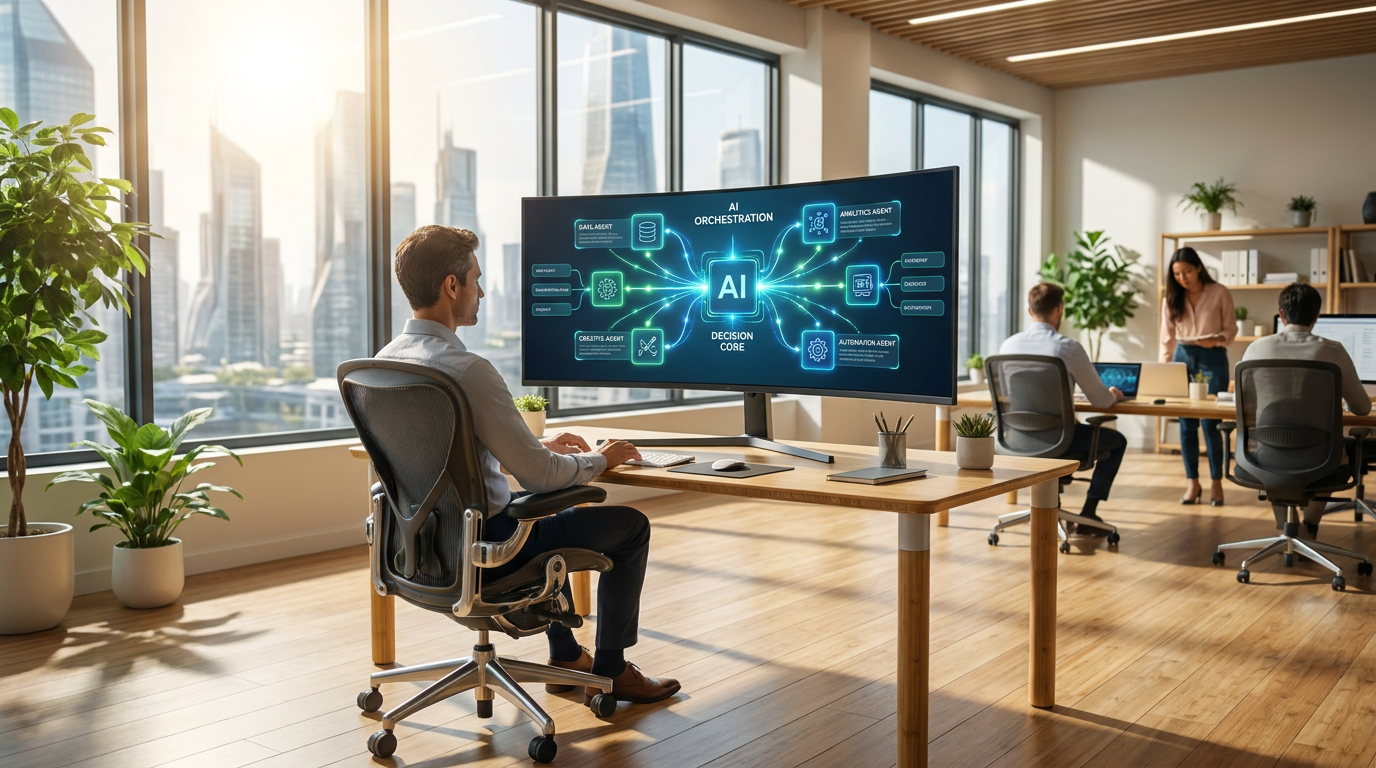
The era of chatting with artificial intelligence is quietly drawing to a close. Throughout 2026, the technology industry has decisively shifted its focus from conversational chatbots to a new paradigm known as "functional autonomy." For the past few years, users have been conditioned to operate in a prompt-and-response loop, asking an AI a question, waiting for a text output, and then manually applying that output to their work. Today, that manual bridge is being dismantled. We are no longer just prompting language models; we are orchestrating autonomous systems that can execute entire workflows from start to finish.[4][8]
This transformation is being driven by the rapid maturation of "Agentic AI." Unlike traditional generative AI, which sits idle until a human provides a specific instruction, AI agents are proactive, goal-oriented programs. They are designed to observe their digital environment, reason through complex problems, make independent decisions, and take concrete actions to achieve a high-level objective. Instead of asking an AI to write an email, a user can now instruct an agent to resolve a customer's billing issue, and the system will handle the investigation, the correspondence, and the database updates autonomously.[1]
The distinction between a tool and an agent is crucial for understanding this new wave of automation. If a standard AI tool is like a highly capable assistant that requires explicit, step-by-step supervision, an AI agent operates more like a trusted digital colleague. You provide the overarching goal—such as researching a prospective client and drafting a comprehensive briefing document—and the agent takes the initiative. It breaks the objective down into manageable steps, executes them across various applications, verifies its own work, and delivers the final result, freeing the human to focus on strategic oversight.[1][8]
Under the hood, the architecture of a modern AI agent relies on a sophisticated interplay of distinct functional layers. At the core sits a large language model (LLM), which provides the foundational reasoning, logic, and natural language understanding. However, the LLM is merely the engine. The true power of an agent lies in its orchestration framework—a surrounding layer of software that governs the agent's memory, manages its planning processes, and dictates how it interacts with the outside world to achieve its programmed objectives.[1]

Tool use is the defining characteristic that elevates these systems from text generators to digital actors. Through standardized protocols like the Model Context Protocol (MCP) and direct API integrations, AI agents can now seamlessly interact with the exact same software ecosystem that humans use every day. They are granted secure access to read proprietary databases, trigger webhooks, search the live internet for real-time information, manipulate local files, and push updates to customer relationship management platforms without requiring manual data entry.[3][5]
A particularly significant breakthrough in 2026 has been the widespread deployment of Computer-Using Agents (CUAs). Historically, automation required clean, well-documented APIs to function reliably. CUAs bypass this limitation entirely by processing raw pixel data from screen captures to identify graphical interface elements. This visual processing capability allows an agent to navigate any website or legacy software application by virtually "clicking" buttons, scrolling through pages, and typing text, effectively bridging the gap between cutting-edge AI and older, rigid digital infrastructure.[4]
The open-source software community has served as the primary engine accelerating this agentic transformation. Frameworks like LangGraph have democratized the creation of complex, stateful AI workflows, moving development out of proprietary walled gardens. LangGraph enables software engineers to build highly resilient agents that can loop through tasks, branch their logic based on new information, and pause at specific checkpoints without losing their contextual memory, making it possible to automate processes that require sustained attention over long periods.[2][3]
The open-source software community has served as the primary engine accelerating this agentic transformation.
Other open-source platforms, such as CrewAI, have pioneered a fundamentally different approach centered on multi-agent collaboration. Rather than building one massive, generalized agent, users can design a "crew" of specialized, narrow agents. Each agent is assigned a specific persona, a defined goal, and a unique set of tools. A research agent might scour the web for financial data and hand its findings off to an analysis agent, who synthesizes the numbers and passes the insights to a writing agent—effectively simulating an entire digital department working in parallel.[2][3]

In the modern workplace, these autonomous systems are already reclaiming hours of human time by taking over high-friction administrative chores. One of the most popular and immediate applications is autonomous email delegation. Moving far beyond simple spam filters, modern agents can read incoming messages, categorize them by urgency, draft highly contextual replies based on company knowledge bases, and autonomously update calendar schedules. For many professionals, these systems successfully archive or resolve the vast majority of non-essential correspondence before a human ever opens their inbox.[4]
The field of software development has also experienced a massive influx of agentic automation, fundamentally altering how code is written and maintained. Open-source tools like OpenHands provide AI agents with a secure, sandboxed environment where they can safely edit codebases, run terminal commands, and inspect the results of their actions. These coding agents operate much like a junior developer: they read a bug report, write the necessary code, run automated tests, fix the inevitable errors that arise, and submit a polished pull request for human review.[7]
However, running autonomous agents at scale introduces a significant new challenge for organizations: computational cost. Because agents must make dozens or even thousands of individual calls to a large language model as they reason through multi-step problems and correct their own mistakes, the economics of automation have quickly become a primary engineering concern. Without careful management, the API costs of running a fleet of autonomous agents can easily outpace the financial benefits of the automation itself.[5]
To solve this economic hurdle, the industry has rapidly adopted a discipline known as "FinOps for Agents." The dominant strategy to emerge in 2026 is the Plan-and-Execute pattern. In this architecture, a highly capable, expensive "frontier" model is used only briefly to create the overarching strategy and break the task into smaller, discrete steps. Then, smaller, significantly cheaper, and faster models are deployed to execute those individual steps. This hybrid approach maintains high quality while reducing operational costs by up to 90%.[5]

Despite the rapid technical progress and clear economic incentives, the transition to agentic AI is not without friction. The single biggest hurdle for enterprise adoption remains the issue of trust and reliability. When an AI is merely generating text for a blog post, a hallucination or logical error is a minor annoyance. But when an AI is autonomously executing actions—such as sending emails to clients, modifying production databases, or authorizing financial transactions—a hallucination can result in catastrophic business consequences.[6]
To mitigate these operational risks, organizations are increasingly deploying a model of "supervised autonomy." In high-stakes scenarios, agents are explicitly designed with mandatory human-in-the-loop checkpoints. The agent performs 95% of the heavy lifting—gathering the necessary data, preparing the action, and staging the workflow—but it automatically pauses to require a human's cryptographic approval before executing the final, irreversible step. This ensures that humans retain ultimate accountability while still benefiting from the speed of AI automation.[5][6]

The long-term impact of agentic AI represents a fundamental restructuring of human work and organizational design. As autonomous agents take over repetitive execution, data gathering, and low-stakes decision-making, the human role is rapidly shifting upward. Industry analysts note that the traditional career pyramid is flattening into a diamond shape, placing a massive new premium on uniquely human skills such as critical thinking, complex problem-solving, empathy, and strategic orchestration.[6]
We are entering an era where software is increasingly judged not by the static data it stores, but by the dynamic work it performs on our behalf. By mastering the orchestration of these digital colleagues, individuals and small businesses are achieving a scale of productivity and operational efficiency that was previously reserved for large corporations. The future of work is not about competing with artificial intelligence, but about learning to effectively manage and direct a fleet of autonomous agents.[4][8]
How we got here
Late 2022
Generative AI chatbots introduce mainstream prompt-and-response capabilities to the public.
Early 2024
Early autonomous experiments demonstrate the potential for multi-step reasoning, though they remain brittle.
Mid 2025
Open-source frameworks like LangGraph and CrewAI stabilize, making reliable agent orchestration accessible to developers.
Early 2026
Computer-Using Agents (CUAs) and FinOps cost-optimization patterns move agentic AI from experimental to production-ready.
Viewpoints in depth
Open-Source Developers
Advocating for decentralized, self-hosted agent frameworks to ensure transparency and avoid vendor lock-in.
For the developer community, the rise of agentic AI must not be controlled by a few massive tech conglomerates. They argue that frameworks like LangGraph, CrewAI, and OpenHands are essential for maintaining a transparent and competitive ecosystem. By building open-source tools, developers ensure that businesses can self-host their autonomous agents, inspect the underlying orchestration logic, and swap out language models at will, preventing costly vendor lock-in and ensuring data privacy.
Enterprise IT Leaders
Focusing on the governance, security, and cost-optimization required to deploy autonomous agents safely at scale.
Enterprise leaders approach agentic AI with cautious optimism, heavily prioritizing risk management over rapid deployment. Their primary concerns revolve around 'FinOps for Agents'—managing the spiraling API costs of multi-step reasoning—and establishing robust governance frameworks. They advocate for strict 'supervised autonomy,' where agents are sandboxed and require cryptographic human approval before executing any action that alters a database, spends money, or communicates externally.
Solopreneurs & Small Businesses
Viewing agentic AI as a massive productivity lever that allows small teams to execute at the scale of large corporations.
For independent professionals and small business owners, agentic AI is a transformative equalizer. They are less concerned with enterprise-grade governance and more focused on immediate 'functional autonomy.' By deploying multi-agent crews to handle lead qualification, customer support, and administrative research, these users are effectively spinning up digital departments for a fraction of the cost of human labor, allowing them to compete with much larger organizations.
What we don't know
- How legal liability will be assigned when an autonomous agent makes a costly error or violates compliance regulations.
- Whether the massive energy and compute demands of running millions of multi-step agents can be sustained by current grid infrastructure.
- How quickly traditional software vendors will adapt to a world where their user interfaces are navigated by AI models rather than humans.
Key terms
- Agentic AI
- Artificial intelligence systems designed to act autonomously, setting goals, planning steps, and using tools to complete tasks without constant human input.
- Computer-Using Agent (CUA)
- An AI model trained to interact directly with graphical user interfaces by processing screen pixels and simulating mouse clicks and keystrokes.
- Multi-Agent Orchestration
- The practice of coordinating several specialized AI agents—each with a distinct role—to collaborate on a complex workflow.
- Plan-and-Execute Pattern
- A cost-saving architecture where a highly capable AI model creates a strategy, and smaller, cheaper models execute the individual steps.
- Human-in-the-Loop (HITL)
- A safety mechanism where an autonomous system pauses to require human review and approval before executing a high-stakes action.
Frequently asked
What is the difference between an AI agent and a chatbot?
A chatbot waits for a user prompt and generates text in response. An AI agent is goal-oriented and autonomous; it can plan steps, use external tools, and execute actions to complete a task without continuous human supervision.
Can AI agents control my computer or software?
Yes. Through direct API integrations and new Computer-Using Agent (CUA) models that process screen pixels, modern agents can navigate software, click buttons, and type text just like a human user.
Are AI agents expensive to run?
They can be, as they make multiple calls to language models to reason through tasks. However, developers are reducing costs by up to 90% using the 'Plan-and-Execute' pattern, which uses a large model for strategy and cheaper models for execution.
Will AI agents replace human jobs?
While agents are automating repetitive execution and administrative tasks, experts predict they will shift human roles toward strategic orchestration, critical thinking, and problem-solving rather than replacing the workforce entirely.
Sources
Source coverage
8 outlets
4 viewpoints surfaced







[1]GammaSolopreneurs & Small Businesses
7 AI Agents That Actually Help You Automate Your Workflows in 2026
Read on Gamma →[2]AY AutomateOpen-Source Developers
8 best open-source AI agent frameworks on GitHub in 2026
Read on AY Automate →[3]LangChainOpen-Source Developers
The best AI agent frameworks in 2026
Read on LangChain →[4]Karan PowarSolopreneurs & Small Businesses
Automating daily tasks with AI agents: The 2026 Tactical Roadmap
Read on Karan Powar →[5]Machine Learning MasteryEnterprise IT Leaders
7 Agentic AI Trends to Watch in 2026
Read on Machine Learning Mastery →[6]Google Cloud BlogEnterprise IT Leaders
5 insights to build your agentic AI advantage in 2026
Read on Google Cloud Blog →[7]OSSphereOpen-Source Developers
Best Open Source AI Agent Frameworks in 2026
Read on OSSphere →[8]Factlen Editorial TeamAI Safety Advocates
Synthesis by Factlen editorial team
Read on Factlen Editorial Team →

More in ai
See all 5 stories →


Every angle. Every day.
Get ai stories with full source coverage and perspective breakdowns delivered to your inbox.