
Tour de France 2026 Injury Report: Carapaz Returns as Van Aert and Tarling Face Setbacks
As the Tour de France approaches, the professional peloton is navigating a wave of critical injuries and returns, highlighted by Richard Carapaz's comeback and Wout van Aert's concerning elbow infection.
By Factlen Editorial Team
- Team Management & Medical Staff
- Prioritizes long-term health and Tour de France readiness over immediate stage race results, opting to withdraw riders at the first sign of severe trouble.
- The Riders
- Balances the deep frustration of sudden setbacks with the determination to complete grueling rehabilitation blocks and return to elite form.
- Neutral Analysts
- Evaluates how these roster gaps and returning stars will alter the tactical landscape and general classification battles of the upcoming Tour de France.
What's not represented
- · Race Organizers
- · Equipment Manufacturers
Why this matters
The final preparation races in June are critical for Tour de France contenders. These late-stage injuries and recoveries will directly alter team strategies, general classification battles, and stage-win dynamics in July.
Key points
- Richard Carapaz returns to racing at the Tour de Suisse after missing the Giro d'Italia due to surgery.
- Wout van Aert's Tour de France status is in doubt after an elbow wound became infected during a preparation race.
- Ineos Grenadiers' Josh Tarling broke his collarbone in a high-speed crash, likely ruling out his Tour debut.
- Decathlon CMA CGM pulled 19-year-old Paul Seixas from racing as a precaution after a 70 kph crash.
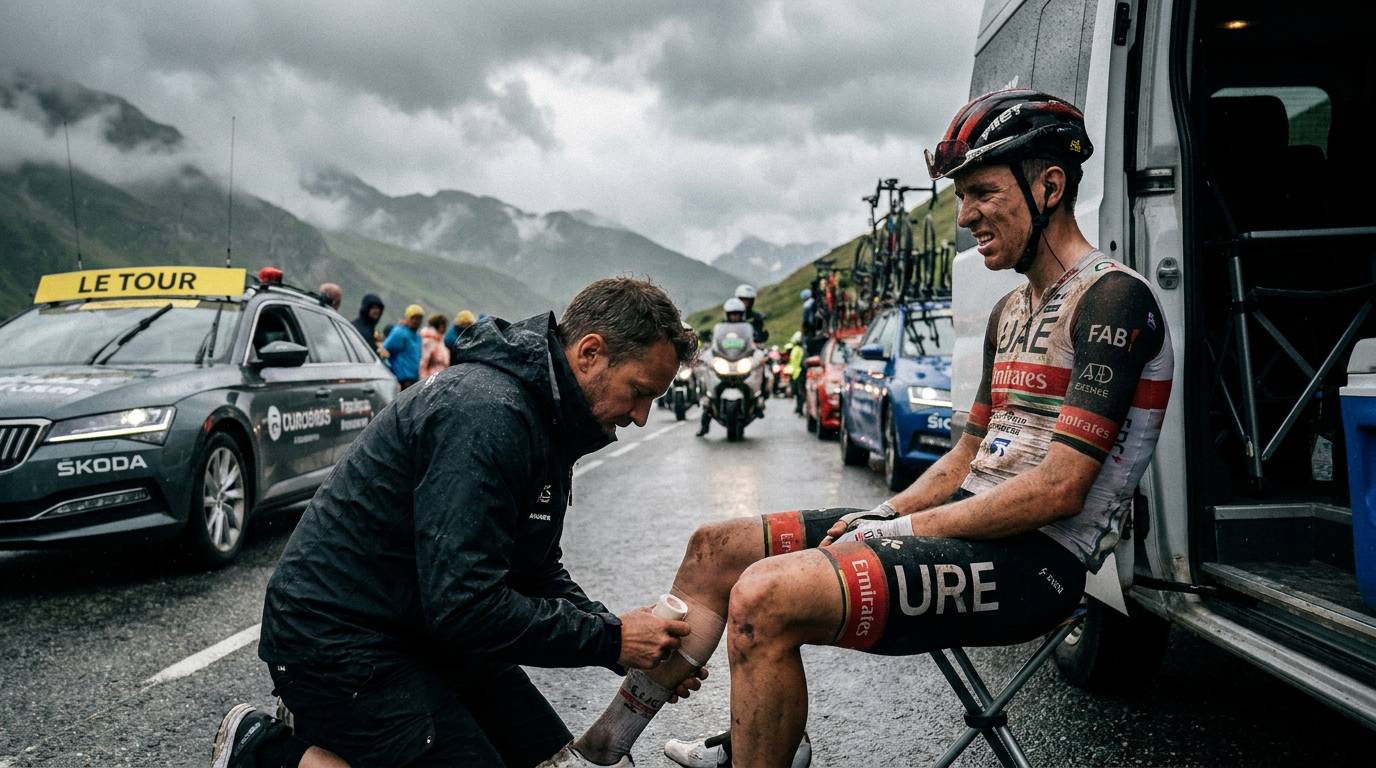
The countdown to the 2026 Tour de France has entered its most critical—and perilous—phase, with the peloton navigating the traditional June preparation races under immense pressure. As riders push their bodies to the absolute limit to secure their spots on the starting line in Barcelona, team doctors and sports directors are working overtime to manage a sudden, disruptive spike in high-profile injuries. While some general classification contenders are finally finding their rhythm and recovering from early-season setbacks, others are facing agonizing, last-minute medical emergencies that threaten to completely derail their July ambitions. The contrast between successful rehabilitations and sudden crashes highlights the razor-thin margins of professional cycling, where a single slick corner or lingering infection can alter a team's entire summer strategy.[1][3]
The most uplifting news of the preparation window comes from the EF Education-EasyPost camp, where Olympic champion Richard Carapaz is finally making his long-awaited return to the professional peloton. The Ecuadorian star was forced to completely abandon his spring campaign and miss the Giro d'Italia after undergoing surgery in April to remove a perineal cyst. The operation required a delicate and frustratingly slow rehabilitation process, keeping him off the bike during crucial training blocks. However, after months of quiet recovery at home, Carapaz has been cleared to race, bringing a massive morale boost to his squad as they finalize their Tour de France roster.[1]
Carapaz is officially back in action, using the GP Gippingen and the grueling stages of the Tour de Suisse to rigorously test his legs against WorldTour competition. "Right now, I feel good on the bike," Carapaz stated through his team, noting that his extended time at home allowed him to build a stable, uninterrupted training rhythm without the constant travel of the racing circuit. His return to the mountains of Switzerland serves as the ultimate proving ground; if his power numbers and recovery metrics hold up over the multi-day stage race, he will head to the Tour de France as a formidable wild card in the high mountains.[1]

However, the optimistic mood surrounding Carapaz is markedly absent at Visma | Lease a Bike, which is currently grappling with a mounting medical crisis that threatens their Tour dominance. Wout van Aert, the versatile Belgian superstar, had just claimed his first road victory since Paris-Roubaix by winning a chaotic sprint on stage 5 of the Tour Auvergne-Rhône-Alpes. The victory seemed to signal a triumphant return to form, but the celebration was incredibly short-lived. The very next morning, team management announced that Van Aert was forced to abandon the race entirely, citing severe, escalating pain in his elbow.[4][6]
Van Aert had been quietly nursing a deep elbow wound sustained in a high-speed training crash on June 1. While the initial damage appeared manageable—allowing him to start the preparation race with visible strapping on his arm and knee—team director Maarten Wynants revealed that the wound suddenly worsened overnight and completely stopped healing. Visma's medical staff attempted to aggressively reduce the swelling with ice and compression therapies, but the treatments failed to bring enough improvement for the Belgian to safely grip the handlebars and continue racing.[4]
Van Aert had been quietly nursing a deep elbow wound sustained in a high-speed training crash on June 1.
Subsequent medical examinations at a hospital in Belgium confirmed the team's worst fears: the elbow wound had become severely infected. According to inside reports and team management, the irritation was drastically aggravated by Van Aert's aerodynamic position on the time-trial bars during the race's team time trial. The intense pressure placed directly on the forearms and elbows in the aggressive aero tuck forced bacteria deeper into the unhealed tissue, triggering a severe inflammatory response that required immediate medical intervention and a total cessation of physical exertion.[2]
This infection has forced Van Aert into a total stoppage of all training activities, throwing his carefully calibrated summer schedule into complete disarray. The mandatory rest period casts serious doubt on his ability to participate in the team's upcoming, highly crucial high-altitude training camp in Tignes. More alarmingly, it puts his actual start at the Tour de France in jeopardy. Without the necessary altitude adaptations and final endurance blocks, Van Aert may not possess the deep fitness required to survive three weeks of relentless racing, leaving Visma's leadership with a massive tactical void.[2][6]

Visma | Lease a Bike's roster woes unfortunately do not end with Van Aert's infected elbow. The powerhouse squad was already reeling from the devastating loss of Christophe Laporte, another vital engine for their flat and rolling stage strategies. Laporte has officially shifted his focus away from the Tour de France entirely in order to fully recover from a severe quadriceps tear, which he sustained in a separate, brutal training crash earlier in the spring. These compounding medical absences have decimated the team's depth, leaving the squad with a shocking four active riders by the final stage of the Auvergne-Rhône-Alpes race.[3][6]
Elsewhere in the peloton, the Ineos Grenadiers suffered a heartbreaking blow when their time-trial prodigy, Josh Tarling, crashed heavily on a treacherous mountain descent. The young British rider, who had impressively infiltrated the day's major breakaway on the opening mountain stage of the Tour Auvergne-Rhône-Alpes, lost control with just under 100 kilometers remaining. Television cameras captured Tarling sitting on the tarmac, visibly in agony and clutching his left arm against his chest—a classic, undeniable indicator of a broken collarbone in professional cycling.[3]
Medical scans at a local hospital quickly confirmed the collarbone fracture, requiring Tarling to undergo immediate surgery to stabilize the bone with plates and screws. The severe injury effectively rules the young powerhouse out of what would have been a highly anticipated Tour de France debut. His absence strips the Ineos Grenadiers of a crucial, massive engine for the flat transitional stages and removes one of the absolute top favorites for the Tour's individual time trials, forcing the British squad to completely rethink their roster composition.[3]

Meanwhile, the Decathlon CMA CGM squad faced a terrifying scare with their 19-year-old French prodigy, Paul Seixas. While navigating a highly technical and steep descent, Seixas lost control of his bike at a blistering 70 kilometers per hour. The teenager slid for up to 30 meters across the unforgiving tarmac, suffering severe abrasions across his hands, arms, and legs. Remarkably, his teammates helped him remount and chase the peloton for 60 kilometers, allowing him to finish the stage just over a minute behind the leaders in a stunning display of grit.[5]
Despite Seixas's bravery, team manager Julien Jurdie ultimately made the executive decision to pull the battered teenager from the race the following morning. Acknowledging that the soreness and stiffness had set in overnight, the team prioritized caution over immediate results. The withdrawal was a strictly preventative measure, designed to protect the young rider's long-term physical condition and ensure he can fully heal ahead of his highly anticipated Tour de France debut next month. In a sport defined by suffering, the decision highlighted a modern, health-first approach to rider management.[5]
How we got here
April 2026
Richard Carapaz undergoes surgery for a perineal cyst, forcing him to miss the Giro d'Italia.
June 1, 2026
Wout van Aert suffers an elbow injury in a training crash.
June 12, 2026
Josh Tarling breaks his collarbone on a mountain descent at the Tour Auvergne-Rhône-Alpes.
June 13, 2026
Visma | Lease a Bike confirms Van Aert's elbow wound has become infected, forcing him to abandon racing.
Viewpoints in depth
Team Management & Medical Staff
Prioritizing long-term health and Tour de France readiness over immediate stage race results.
For team directors and medical staff, June preparation races are a delicate balancing act between building race fitness and avoiding catastrophic injury. When Paul Seixas crashed at 70 kph, Decathlon CMA CGM management immediately recognized that pushing the teenager through the final stage wasn't worth the risk to his Tour de France debut. Similarly, Visma | Lease a Bike's decision to pull Wout van Aert and send him back to Belgium for hospital tests underscores a modern, cautious approach where long-term recovery metrics dictate the calendar, rather than sheer rider willpower.
The Riders
Balancing the deep frustration of sudden setbacks with the determination to complete grueling rehabilitation blocks.
For the athletes, the psychological toll of a June injury is often as agonizing as the physical pain. Riders spend months at altitude camps meticulously building their form, only to have a single slick corner—like the one that broke Josh Tarling's collarbone—erase their summer goals. Conversely, the relief of successfully completing rehabilitation is immense. Richard Carapaz's return to the Tour de Suisse highlights the quiet, unglamorous work done behind the scenes, as he noted the benefit of staying home to build a stable rhythm away from the chaotic racing circuit.
Neutral Analysts
Evaluating how these roster gaps and returning stars will alter the tactical landscape of the upcoming Tour de France.
Cycling analysts are closely watching how this wave of injuries reshapes the tactical board for July. Visma | Lease a Bike's depleted roster—missing Christophe Laporte and potentially Wout van Aert—severely weakens their ability to control flat stages and protect their general classification leaders against a powerhouse UAE Team Emirates squad. Meanwhile, the return of a healthy Richard Carapaz introduces a dangerous wild card into the high mountains, as EF Education-EasyPost gains a proven Grand Tour winner who can disrupt the established hierarchy.
What we don't know
- Whether Wout van Aert's infection will clear in time for him to attend Visma's crucial high-altitude training camp in Tignes.
- If Josh Tarling has any mathematical chance of recovering from his collarbone surgery before the Tour de France begins.
- How Richard Carapaz's power numbers will hold up over a grueling three-week Grand Tour after missing the spring season.
Key terms
- General Classification (GC)
- The overall standings in a multi-day stage race, determined by the cumulative time taken by each rider to complete all stages.
- Peloton
- The main group or pack of riders in a road bicycle race, who ride closely together to save energy by drafting.
- Time-trial bars
- Aerodynamic extensions attached to the handlebars that allow a rider to rest their forearms and tuck into a streamlined, wind-cheating position.
Frequently asked
Why did Wout van Aert abandon his preparation race?
Van Aert abandoned the Tour Auvergne-Rhône-Alpes because an elbow wound from a previous training crash became severely infected, aggravated by his position on the time-trial bike.
Will Josh Tarling race in the 2026 Tour de France?
It is highly unlikely. Tarling broke his collarbone in a crash during the Tour Auvergne-Rhône-Alpes, requiring immediate surgery that puts his Tour debut in severe doubt.
When is Richard Carapaz returning to racing?
Carapaz is returning at the GP Gippingen and the Tour de Suisse in June, following a successful recovery from perineal cyst surgery in April.
Sources
Source coverage
6 outlets
3 viewpoints surfaced






[1]IDL Pro CyclingThe Riders
A few days before the Tour de Suisse gets underway, Sunday's GP Gippingen offers several notable comebacks
Read on IDL Pro Cycling →[2]CyclingUpToDateNeutral Analysts
"They believe the irritation was exacerbated by being in the time-trial bar" - Van Aert infection cause identified ahead of Tour de France
Read on CyclingUpToDate →[3]CyclingnewsThe Riders
Tour de France in doubt for Josh Tarling as he undergoes speedy surgery following Tour Auvergne-Rhône-Alpes crash
Read on Cyclingnews →[4]Domestique CyclingTeam Management & Medical Staff
'The wound is not healing' - Van Aert faces Tour de France concern after Dauphiné exit
Read on Domestique Cycling →[5]SuperSportTeam Management & Medical Staff
Seixas out of Auvergne Tour due to crash injuries
Read on SuperSport →[6]QuotidianoNeutral Analysts
Is Van Aert's 2026 Tour de France at risk? Infection in the wound requires stoppage
Read on Quotidiano →
More in sports
See all 9 stories →Women's Soccer
NWSL Cements Global Footprint With Record 138 International Call-Ups and Prime-Time Championship Return
0 sources
Standings
Global Table Tennis Standings Tighten as Young Stars Challenge Chinese Dominance Ahead of US Smash
0 sources
Injury
Global Field Hockey Sees Wave of Star Returns Ahead of Crucial Pro League Leg
0 sources

Standings
Belgium Men and Netherlands Women Tighten Grip on FIH Pro League Titles as Olympic Qualification Looms
0 sources
Every angle. Every day.
Get sports stories with full source coverage and perspective breakdowns delivered to your inbox.