
How Environmental DNA is Revolutionizing Wildlife Conservation
Scientists are using microscopic genetic traces left in water, soil, and air to track elusive species without ever seeing them. This breakthrough technology, known as eDNA, is transforming how we measure and protect global biodiversity.
By Factlen Editorial Team
- Conservation Biologists
- Field researchers focused on non-invasive species discovery and ecosystem monitoring.
- Technology Developers
- Engineers and marine technologists focused on scaling and automating data collection.
- Environmental Regulators
- Policymakers focused on data standardization, false positives, and legal frameworks.
What's not represented
- · Indigenous communities managing local ecosystems
- · Commercial fisheries impacted by eDNA monitoring
Why this matters
Understanding exactly which species live in an ecosystem is the first step to protecting them. By making biodiversity monitoring cheaper, faster, and non-invasive, eDNA empowers communities and governments to make better conservation decisions before habitats are lost.
Key points
- Environmental DNA (eDNA) allows scientists to identify wildlife by sequencing genetic material shed into water, soil, or air.
- The technology is highly effective at detecting rare, elusive, or endangered species without disturbing their habitats.
- Recent breakthroughs include autonomous underwater samplers and synthetic DNA tracers that model how genetic material moves in currents.
- While eDNA accurately confirms species presence, determining exact population sizes remains a significant scientific challenge.
For centuries, tracking wildlife meant trudging through dense forests, setting up remote camera traps, or capturing animals in nets to tag them. It is a notoriously slow, expensive, and inherently invasive process that often stresses the very creatures researchers are trying to protect. But a remarkable breakthrough in genetic technology is allowing scientists to catalog entire ecosystems without ever laying eyes on a single animal. This non-invasive approach is fundamentally transforming the field of conservation biology, offering a faster and more comprehensive way to measure the health of the natural world.[3]
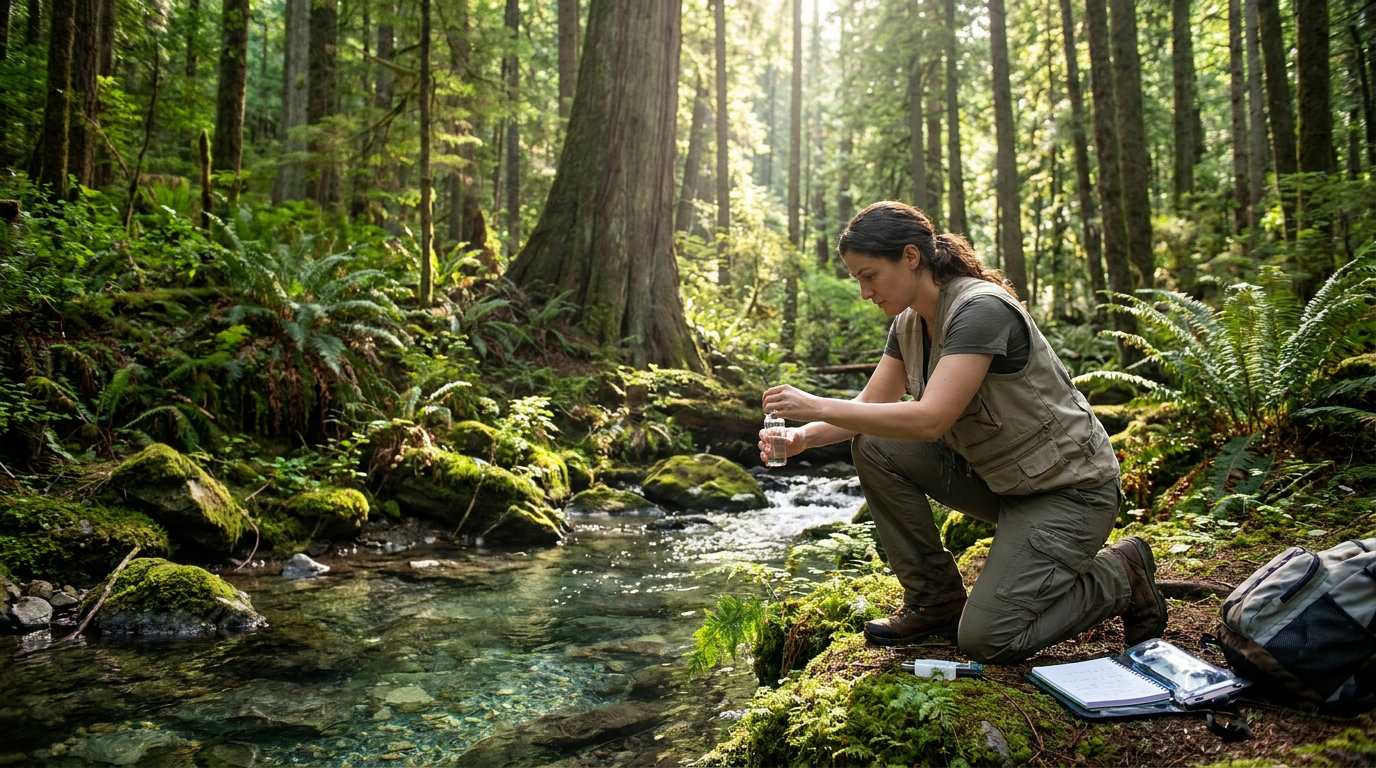
The technique relies on a concept known as environmental DNA, or eDNA. Just as humans leave behind hair, skin cells, and microscopic traces wherever they go, wildlife constantly shed genetic breadcrumbs into their surroundings. A fish swimming through a river leaves behind scales and mucus; a jaguar walking through a forest sheds fur; a blooming plant drops pollen into the soil. These microscopic leftovers carry enough genetic information for scientists to detect exactly what species are present in a given habitat.[1]
The collection process is surprisingly straightforward, even if the underlying science is highly complex. By scooping up a single liter of river water, gathering a handful of soil, or even running a specialized filter to capture airborne dust, researchers can extract these scattered genetic fragments. They then take the samples back to a sterile laboratory, sequence the isolated DNA using advanced molecular tools, and compare the results against vast global reference databases to reveal a hidden, highly accurate census of the local habitat.[1][7]
"eDNA is basically 'CSI: Nature Edition,'" notes Conservation International, highlighting how a single water sample can provide a surprisingly rich snapshot of a broader watershed. Because water naturally mixes and moves, it gathers genetic material from across the entire ecosystem. This unique property allows researchers to detect rare, secretive, or endangered species that live in places far too remote, dangerous, or dense for human surveyors to easily reach on foot, revolutionizing how we map biodiversity. It fundamentally changes the scale at which conservation can operate.[1]
The mechanism behind this genetic detective work relies on two primary analytical approaches. The first is targeted sampling, where scientists look specifically for the genetic signature of one particular animal. This method is frequently deployed when conservationists are trying to locate a highly endangered species to protect its habitat, or conversely, when they are trying to detect the early arrival of an invasive species before it can establish a foothold and damage the local ecosystem.[7]

The second, arguably more revolutionary approach is known as metabarcoding. In a metabarcoding study, the goal is not to find a single needle in the haystack, but to identify all the different species that contributed DNA to the sample simultaneously. This provides an unparalleled level of biodiversity detail, capturing nearly the whole tree of life—from microscopic bacteria and fungi to massive marine mammals—in a single, comprehensive test.[7][8]
The real-world evidence of eDNA's efficacy is mounting rapidly, with striking results consistently emerging from the field. In a recent scientific expedition to the Alto Mayo Protected Forest in northern Peru, researchers decided to bypass traditional visual surveys, which would have taken months of grueling jungle trekking. Instead, they collected simple water samples from the local rivers and streams, letting the environmental DNA do the heavy lifting while minimizing their physical footprint in the delicate ecosystem. The results were nothing short of extraordinary.[1]
The genetic detective work paid off spectacularly for the research team. The laboratory analysis of the water samples revealed the distinct genetic signatures of 261 different vertebrate species living in the watershed. Many of these animals were incredibly rare or notoriously elusive, making them almost impossible to spot by human eyes or traditional camera traps. The success of the Alto Mayo expedition proved that eDNA could map biodiversity at a fraction of the traditional cost and time.[1]
Beyond manual collection by field researchers, the technology is now scaling up rapidly through advanced robotics and automation. Engineers and marine biologists are collaborating to deploy autonomous eDNA samplers attached to sophisticated underwater vehicles, removing the need for human divers or cumbersome ship-based collection methods. This leap in automation is particularly crucial for monitoring the vast, largely unexplored expanses of the open ocean, where traditional sampling is prohibitively expensive. By automating the process, scientists can gather continuous, high-resolution data over massive geographic areas.[6]
Beyond manual collection by field researchers, the technology is now scaling up rapidly through advanced robotics and automation.
In recent breakthrough field trials conducted off the coast of Portugal, an autonomous underwater vehicle successfully filtered seawater at depths of up to 75 meters. This seamless integration allows for large-scale, standardized, and entirely non-invasive monitoring of marine ecosystems. The collected samples capture genetic data across multiple trophic levels, providing a comprehensive view of ocean health from foundational phytoplankton all the way up to apex predators like cetaceans.[6]

However, despite its immense promise and rapid adoption, the science of environmental DNA is not without its uncertainties and practical limitations. One of the most significant challenges, particularly in dynamic aquatic environments like fast-flowing rivers and turbulent oceans, is understanding exactly where the detected DNA originally came from and how long it has been floating in the water column before being captured by a scientist's vial. Without this context, interpreting the ecological significance of a positive detection can be incredibly difficult for wildlife managers.[2]
DNA is a biological molecule that naturally degrades over time when exposed to the elements. Factors like ultraviolet sunlight, fluctuating temperatures, and microbial activity actively break down the genetic material, meaning its presence in the environment is strictly temporary. Furthermore, strong river currents or powerful ocean waves can transport genetic material miles away from the actual organism, severely complicating efforts to pinpoint a species' exact physical location or core habitat. This spatial ambiguity is a major hurdle for localized conservation planning.[2][7]
To address this hydrodynamic challenge, researchers at Cornell University recently developed an innovative synthetic DNA tracer encapsulated in a safe, biodegradable polymer. By releasing this synthetic tracer into a lake and meticulously tracking its movement over 33 hours, the engineering team created a sophisticated new computational model. This model helps aquatic ecologists predict where a sampled particle of eDNA likely originated, greatly improving the spatial accuracy of the data and helping managers locate the actual source populations. It represents a massive leap forward in eDNA reliability.[2]
Another major limitation of current eDNA technology is the difficulty of precise quantification. While environmental DNA is exceptionally good at answering qualitative questions like "Is this specific species here?" and "What is the full range of species present in this lake?", it currently struggles to accurately answer the vital quantitative question: "Exactly how many of them are there?" For wildlife managers setting hunting quotas or tracking population recoveries, absolute numbers are essential. Relying solely on eDNA for population counts is currently impossible.[4]
Converting the relative abundance of genetic material found in a water sample into an absolute population count is notoriously difficult. This is because different species shed DNA at vastly different rates, and their genome sizes vary wildly. A massive, slow-moving fish might actually shed less detectable DNA into the water than a much smaller, highly active amphibian, which can easily skew the perceived population data if the results are not carefully calibrated against known biological baselines. Scientists are working on algorithms to correct these shedding disparities.[4]

False positives and false negatives also remain a persistent risk in eDNA analysis. Accidental contamination during field sampling or laboratory processing can falsely suggest a species is present when it is not, potentially triggering unnecessary conservation interventions. Conversely, incomplete genetic reference databases can result in false negatives, where the DNA of an actual inhabitant is successfully sequenced but cannot be identified because its genetic barcode has not yet been cataloged by the scientific community. Building comprehensive reference libraries is an urgent priority.[3][5]
Because of these inherent uncertainties, leading conservation organizations like the International Union for Conservation of Nature (IUCN) heavily emphasize that eDNA should not entirely replace traditional fieldwork. Instead, it is most powerful when used as a complementary tool, working alongside acoustic sensors, camera traps, and traditional visual surveys to build a bulletproof, multi-layered understanding of an ecosystem. Every sensor has a unique niche, and eDNA is just one piece of the puzzle. Combining these methods yields the highest confidence in biodiversity assessments.[1][3]
To maximize the technology's reliability, the IUCN and other global scientific bodies are currently working to create unified best practices for eDNA collection, extraction, and analysis. They are also funding massive international initiatives to expand open-source DNA reference libraries, ensuring that these powerful detection methods are applied consistently across borders. Standardizing these protocols is essential so that the resulting genetic data can accurately and legally inform international wildlife management policies. Without standardization, comparing data between different research teams remains a challenge.[3]
As the cost of genetic sequencing continues to drop and bioinformatics software becomes increasingly sophisticated, environmental DNA is poised to become the undisputed gold standard for environmental impact assessments. It offers a scalable, biologically grounded alternative to traditional monitoring, allowing governments, NGOs, and corporations to track their ecological footprint with unprecedented precision. The technology is rapidly moving from experimental academic research into mainstream commercial and regulatory applications. This transition marks a new era of corporate environmental accountability.[5][8]
By making the invisible visible, environmental DNA is giving humanity a clearer, more comprehensive understanding of the natural world than ever before. It empowers local communities, researchers, and policymakers to protect fragile ecosystems, track the success of restoration efforts, and safeguard global biodiversity before it quietly slips away. As we face unprecedented ecological challenges, eDNA provides the critical data needed to make informed, effective conservation decisions. It is a beacon of hope in the fight to preserve the planet's intricate web of life.[3][8]
How we got here
2008
The first scientific manuscript demonstrating the use of eDNA for biomonitoring is published.
2012
Researchers begin applying eDNA techniques to detect marine mammals in open ocean environments.
April 2025
Conservation International uses eDNA to detect 261 vertebrate species in Peru's Alto Mayo Protected Forest.
July 2025
BioProtect successfully deploys an autonomous eDNA sampler on an underwater vehicle at 75-meter depths.
January 2026
Cornell University develops a synthetic DNA tracer to model how genetic material moves through water currents.
Viewpoints in depth
Conservation Biologists
Field researchers focused on non-invasive species discovery and ecosystem monitoring.
For conservation biologists, eDNA is a revolutionary tool that eliminates the need to trap, dart, or stress wildlife. They emphasize its ability to detect cryptic or endangered species that traditional visual surveys miss, arguing that a single water sample can provide a more comprehensive biodiversity baseline than weeks of manual camera-trapping.
Technology Developers
Engineers and marine technologists focused on scaling and automating data collection.
This camp views manual eDNA collection as just the first step. They are focused on integrating autonomous samplers into underwater vehicles and drones to standardize collection across vast, inaccessible areas. Their goal is to build real-time, global biodiversity monitoring networks that operate with minimal human intervention.
Environmental Regulators
Policymakers focused on data standardization, false positives, and legal frameworks.
Regulators and policy experts approach eDNA with cautious optimism. While they recognize its cost-effectiveness, they stress the need for rigorous quality control. They point out that false positives—such as detecting DNA that drifted miles downriver—could trigger costly and unnecessary legal protections or management interventions if the data isn't properly contextualized.
What we don't know
- How to accurately translate the concentration of eDNA in a sample into an absolute population count for a given species.
- The exact rate at which different species shed DNA, which varies wildly based on size, behavior, and environment.
- How far specific genetic fragments have traveled in strong ocean currents or river systems before being collected.
Key terms
- Environmental DNA (eDNA)
- Genetic material shed by organisms into their surroundings, such as water, soil, or air, which can be collected and sequenced to identify species.
- Metabarcoding
- A sequencing technique that identifies multiple species simultaneously from a single environmental sample by comparing the DNA to a reference database.
- False Positive
- In eDNA testing, when a sample incorrectly indicates the presence of a species, often due to contamination or DNA drifting from another location.
- Trophic Level
- The position an organism occupies in a food web, ranging from primary producers like phytoplankton to apex predators.
Frequently asked
Does eDNA harm the animals being studied?
No. eDNA is completely non-invasive. Scientists only collect water, soil, or air samples, meaning the animals are never captured, handled, or disturbed.
Can eDNA tell us exactly how many animals are in an area?
Not yet. While it is excellent at confirming which species are present, converting the amount of DNA into an exact population count remains highly uncertain due to varying shedding rates.
How long does DNA last in the environment?
It depends on the conditions. In water, DNA typically degrades within a few days to weeks due to UV light, temperature, and microbial activity, whereas it can last much longer in soil.
Sources
Source coverage
8 outlets
3 viewpoints surfaced






[1]Conservation InternationalConservation Biologists
What on Earth is 'eDNA'?
Read on Conservation International →[2]Cornell ChronicleTechnology Developers
Environmental DNA breakthrough will aid conservation efforts
Read on Cornell Chronicle →[3]IUCNConservation Biologists
Environmental DNA - resource
Read on IUCN →[4]Royal SocietyEnvironmental Regulators
Environmental DNA: a policy explainer
Read on Royal Society →[5]PubMed CentralEnvironmental Regulators
Environmental DNA (eDNA) Technology in Biodiversity and Ecosystem Health Research: Advances and Prospects
Read on PubMed Central →[6]BioProtectTechnology Developers
Breakthrough Field Trials Advance Autonomous eDNA BioSampler
Read on BioProtect →[7]Bentzen LabConservation Biologists
Environmental DNA explained
Read on Bentzen Lab →[8]Factlen Editorial Team
Synthesis by Factlen editorial team
Read on Factlen Editorial Team →
Every angle. Every day.
Get environment stories with full source coverage and perspective breakdowns delivered to your inbox.