
The Rise of Local AI: How Small Language Models Are Replacing Cloud Chatbots
Millions of users are downloading 'Small Language Models' to run private, offline AI chatbots directly on their laptops and phones. This shift is democratizing AI, eliminating subscription fees, and ensuring total data privacy.
By Factlen Editorial Team
- Enterprise IT & Developers
- Value local models for their ability to eliminate recurring cloud API costs and provide predictable, offline reliability.
- Privacy Advocates
- Argue that local AI is essential for data sovereignty and protecting sensitive information from corporate logging.
- Open-Source Community
- Focus on the democratization of AI, emphasizing that users should own and control the models they rely on.
- Cloud AI Providers
- Maintain that while local models are useful for basic tasks, frontier cloud models remain necessary for complex reasoning and massive context processing.
What's not represented
- · Hardware manufacturers benefiting from the push for more on-device RAM
- · Regulators monitoring the safety of uncensored, open-weights models
Why this matters
Running AI locally means your sensitive data never leaves your device, you can work entirely offline, and you no longer have to pay monthly subscription fees for basic AI assistance. It transforms AI from a rented cloud service into a private tool you actually own.
Key points
- Small Language Models (SLMs) allow users to run capable AI chatbots directly on their laptops and phones.
- Local AI ensures absolute data privacy, as prompts and documents never leave the user's device.
- Running models locally eliminates the recurring subscription and API fees associated with cloud AI.
- Techniques like quantization compress models by 75% while retaining 95% of their reasoning capabilities.
- Consumer-friendly software like LM Studio and Ollama have made installing local AI as easy as downloading a web browser.
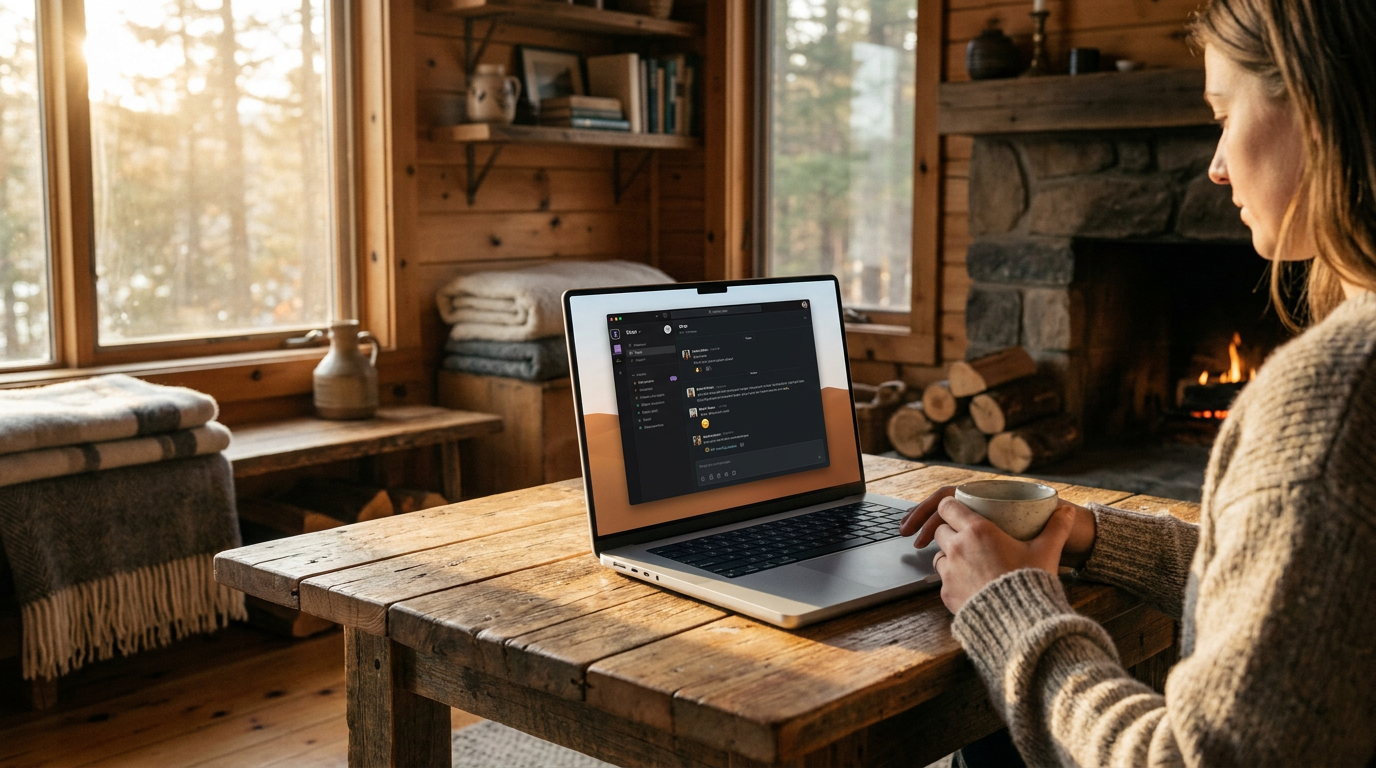
For the past three years, the artificial intelligence revolution has lived almost exclusively in the cloud. Using a capable chatbot meant sending your personal questions, proprietary code, and sensitive documents to server farms owned by tech giants. But in 2026, a quiet rebellion has reached critical mass: the rise of local AI. Millions of users are now downloading "Small Language Models" (SLMs) directly to their laptops and phones, severing the cord to the cloud entirely. This shift is transforming AI from a rented service into a locally owned utility, much like a word processor or a calculator.[1][3]
The catalyst for this transition is a dramatic improvement in model efficiency. While frontier cloud models like GPT-4 operate with over a trillion parameters—the internal "knobs and dials" that dictate how the AI processes language—open-source researchers have discovered how to pack startling intelligence into a fraction of that size. Today's leading SLMs, such as Microsoft's Phi-4 Mini and Meta's Llama 3.2, operate in the 3-to-8 billion parameter range. Despite being hundreds of times smaller than their cloud counterparts, these compact models can handle the vast majority of everyday tasks, from drafting emails to debugging code, with near-instantaneous speed.[4][5]
Shrinking an AI model to fit on a consumer laptop requires a mathematical technique known as quantization. In simple terms, quantization compresses the precision of the model's weights. If a standard neural network stores its parameters as highly precise 16-bit numbers, quantization rounds them down to 4-bit or 8-bit formats. While this sounds like it would severely degrade the AI's intelligence, researchers have found that modern quantization techniques preserve upwards of 95% of the model's reasoning capabilities while slashing its memory footprint by 75%. This compression is the magic trick that makes local inference possible.[4][7]

The hardware landscape has evolved perfectly to meet these compressed models. A few years ago, running a capable AI required a massive, power-hungry desktop graphics card. Today, standard consumer hardware is more than sufficient. Apple's Silicon chips (the M-series) have proven particularly adept at local AI due to their "unified memory" architecture, which allows the CPU and GPU to share the same pool of RAM without bottlenecking. Meanwhile, standard Windows laptops with 8GB to 16GB of RAM and integrated neural processing units (NPUs) can comfortably run 4-billion-parameter models at reading speed.[2][6]
For many users, the primary appeal of local AI is absolute data sovereignty. When you type a prompt into a cloud-based chatbot, that data leaves your device, travels to a corporate server, and is often logged or used for future training. Local LLMs flip this paradigm. Because the model weights live entirely on your hard drive, the inference happens locally. You can feed the AI confidential legal contracts, unreleased source code, or deeply personal journal entries without a single byte of data ever crossing the internet. For enterprise IT departments and privacy-conscious individuals, this zero-trust architecture is a game-changer.[1][3]
For many users, the primary appeal of local AI is absolute data sovereignty.
Beyond privacy, the economics of local AI are driving massive adoption among developers and small businesses. Relying on cloud APIs for high-volume tasks—like summarizing thousands of documents or powering an automated customer service agent—can quickly rack up thousands of dollars in monthly inference bills. Local models eliminate this variable cost entirely. Once the hardware is purchased, generating a million tokens costs exactly the same as generating zero: nothing but the electricity required to run the laptop. This cost arbitrage is allowing startups to build AI-heavy applications that would have been financially ruinous just two years ago.[5][6]

The utility of an AI assistant plummets when it requires a persistent broadband connection. Local models restore the reliability of traditional software. Because they require zero internet connectivity after the initial download, these chatbots work flawlessly on airplanes, in remote field locations, or during network outages. Field engineers can query technical manuals in areas without cell service, and travelers can translate documents or draft reports while entirely off the grid. This offline capability transforms the AI from a web service into a truly personal, always-available tool.[2][7]
Until recently, running a local model required navigating complex command-line interfaces and managing Python dependencies—a barrier that kept the technology confined to hardcore developers. In 2026, the software layer has been entirely consumerized. Desktop applications like LM Studio and Ollama operate like standard app stores for AI. Users simply download the software, click a button to install a model like Gemma 3 or Qwen 2.5, and are immediately presented with a familiar, polished chat interface. The setup process now takes less than five minutes and requires zero coding knowledge.[3][7]

Despite the rapid advancements, local SLMs are not a complete replacement for frontier cloud models. The laws of compute still apply: a 4-billion-parameter model running on a laptop cannot match the deep reasoning, obscure factual recall, or massive context windows of a trillion-parameter cloud behemoth. When tasked with highly complex logic puzzles, advanced mathematics, or synthesizing hundreds of pages of text simultaneously, local models will hallucinate or lose the thread much faster than their cloud counterparts. The industry consensus is that local models are for "everyday drafting," while the cloud remains necessary for "heavy lifting."[2][5]
The trajectory of local AI points toward even smaller, more ubiquitous deployments. Mobile and edge LLMs are currently the fastest-growing segment of the market, with models being optimized to run directly on smartphones and IoT devices without draining the battery. As neural processing units become standard in every consumer electronic device, the default state of AI will be local-first. Cloud models will likely become specialized escalation endpoints—consulted only when the on-device AI encounters a problem too complex to solve on its own.[1][2]

The democratization of AI inference represents a fundamental shift in the balance of power within the tech industry. By moving the intelligence from centralized server farms to the devices sitting on our desks and in our pockets, local LLMs are ensuring that the benefits of artificial intelligence are not exclusively controlled by a handful of massive corporations. It is a return to the ethos of the personal computing revolution: powerful, private, and entirely under the user's control.[8]
Viewpoints in depth
Privacy Advocates
Argue that local AI is essential for data sovereignty and protecting sensitive information from corporate logging.
For privacy advocates, the shift to local AI is a necessary correction to the cloud-first era. They argue that sending proprietary code, legal documents, or personal health queries to centralized corporate servers poses an unacceptable security risk. By running models locally, users achieve a 'zero-trust' environment where data never traverses the internet, making it immune to cloud breaches, corporate logging, or unauthorized training data scraping.
Enterprise IT & Developers
Value local models for their ability to eliminate recurring cloud API costs and provide predictable, offline reliability.
Developers and IT departments view local AI primarily through the lens of economics and reliability. Relying on cloud APIs for high-volume automated tasks can result in unpredictable and exorbitant monthly bills. Local inference converts this variable cost into a fixed hardware investment. Furthermore, local models guarantee uptime, ensuring that internal tools and customer-facing applications don't break when a cloud provider experiences an outage or when a device loses internet connectivity.
Open-Source Community
Focus on the democratization of AI, emphasizing that users should own and control the models they rely on.
The open-source community sees local AI as a philosophical victory against the monopolization of intelligence by a few massive tech companies. They champion the idea that AI should be a fundamental utility, freely available and modifiable by anyone. By distributing the models directly to users, the community ensures that developers can fine-tune the AI for specific niche tasks without being restricted by the safety filters or commercial terms of service imposed by cloud providers.
Cloud AI Providers
Maintain that while local models are useful for basic tasks, frontier cloud models remain necessary for complex reasoning and massive context processing.
Companies operating massive cloud models acknowledge the utility of local AI for simple, everyday tasks but emphasize the hard limits of consumer hardware. They point out that Small Language Models lack the parameter count necessary for deep, multi-step logical reasoning, advanced coding architecture, or processing hundreds of pages of context simultaneously. In their view, local AI will serve as a lightweight frontend, while the cloud will remain the indispensable engine for true frontier intelligence.
What we don't know
- Whether hardware manufacturers will aggressively increase base RAM in consumer laptops to accommodate larger local models.
- How cloud AI providers will adjust their pricing models to compete with the zero-marginal-cost of local inference.
- The extent to which highly compressed models can overcome their tendency to hallucinate on complex logical tasks.
Key terms
- Small Language Model (SLM)
- An AI model designed with fewer parameters (typically under 10 billion) so it can run efficiently on consumer hardware like laptops and phones.
- Quantization
- A mathematical compression technique that reduces the memory footprint of an AI model by lowering the precision of its internal numbers, allowing it to fit on standard devices.
- Inference
- The process of an AI model actively generating a response to a prompt, which requires computational power.
- Unified Memory
- A hardware architecture (common in Apple Silicon) where the CPU and GPU share the same pool of RAM, making it highly efficient for running AI models.
- Parameter
- The internal numerical values or "weights" within a neural network that the model uses to understand and generate language.
Frequently asked
Do I need a powerful computer to run local AI?
No. While massive cloud models require supercomputers, modern Small Language Models (SLMs) can run comfortably on standard laptops with 8GB to 16GB of RAM.
Is local AI as smart as ChatGPT?
For everyday tasks like drafting emails, summarizing text, and basic coding, local models are highly competitive. However, for highly complex reasoning or obscure trivia, massive cloud models still hold an advantage.
Does local AI need an internet connection?
Only for the initial download of the software and the model weights. Once installed, the AI runs entirely offline, making it perfect for travel or secure environments.
Are local AI models free to use?
Yes. Most Small Language Models are open-weights and free to download. Because the processing happens on your own hardware, there are no per-message or subscription fees.
Sources
Source coverage
8 outlets
4 viewpoints surfaced







[1]Prompt QuorumPrivacy Advocates
Power Local LLM — Build a Private AI Stack That Replaces Your SaaS Bills
Read on Prompt Quorum →[2]AI MagicxCloud AI Providers
On-device AI in 2026: A practical guide to running AI models locally
Read on AI Magicx →[3]IPRoyalPrivacy Advocates
What Is a Local LLM and Why Use One?
Read on IPRoyal →[4]Machine Learning MasteryOpen-Source Community
Top 7 Small Language Models You Can Run on a Laptop
Read on Machine Learning Mastery →[5]Local AI MasterEnterprise IT & Developers
Top SLMs in 2026: Why SLMs Matter
Read on Local AI Master →[6]First AI MoversEnterprise IT & Developers
Small Models, Big Impact: Top Local LLMs You Can Run on a Laptop in 2026
Read on First AI Movers →[7]MediumOpen-Source Community
Running LLMs Offline in 2026
Read on Medium →[8]Factlen Editorial Team
Synthesis by Factlen editorial team
Read on Factlen Editorial Team →

Every angle. Every day.
Get ai stories with full source coverage and perspective breakdowns delivered to your inbox.